Doctoring Your Taxes and Finding the Right Amount of Medical Expenses to Deduct
How to Determine the Amount of Medical Expenses for Tax Deduction 2023 and 2026
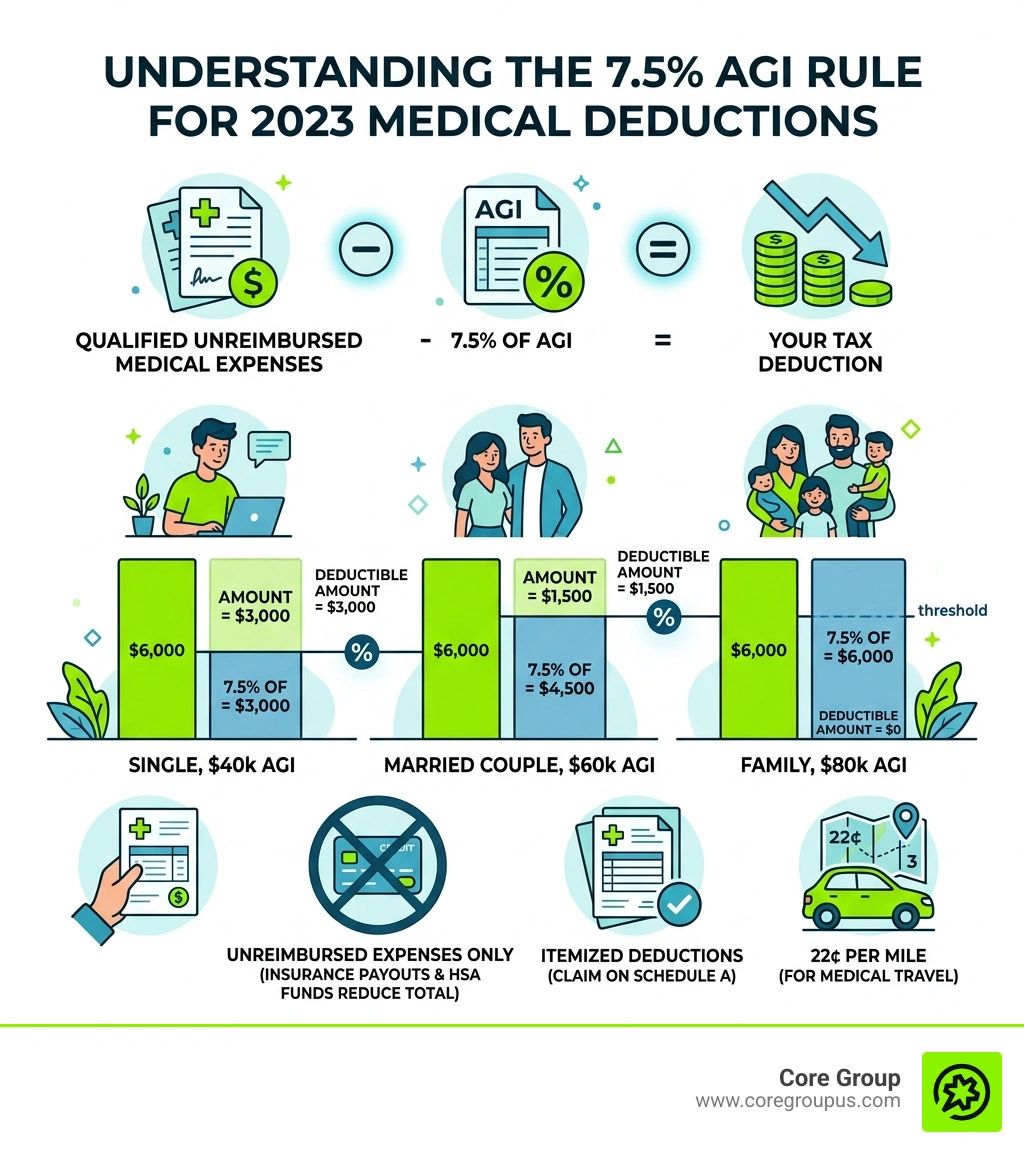
The amount of medical expenses for tax deduction 2023 follows one core rule where you can only deduct unreimbursed medical costs that exceed 7.5% of your Adjusted Gross Income (AGI).
Here is a quick breakdown so you can see where you stand right away.
| Your AGI | 7.5% Threshold | If You Spent $6,000 Out-of-Pocket | Your Deductible Amount |
|---|---|---|---|
| $40,000 | $3,000 | $6,000 | $3,000 |
| $50,000 | $3,750 | $6,000 | $2,250 |
| $60,000 | $4,500 | $6,000 | $1,500 |
| $80,000 | $6,000 | $6,000 | $0 |
A few other key facts for the current tax season.
- You must itemize deductions on Schedule A to claim this
- Only unreimbursed expenses count because insurance payouts and HSA funds reduce your total
- The standard mileage rate for medical travel is 22 cents per mile
- A dependent generally qualifies if their gross income was under the IRS limit for that year
Medical costs have a way of piling up quietly throughout the year. A surgery here, a specialist visit there, and a few hundred dollars in prescriptions. For creative entrepreneurs especially, these costs often go untracked until tax season hits and the stress spikes.
The good news is that with the right records and a clear understanding of the rules, these expenses can meaningfully reduce your tax bill.
This guide walks you through exactly how to calculate your deductible amount, which expenses qualify, and what documentation you need to back it all up.
Understanding the Amount of Medical Expenses for Tax Deduction 2023 and 2026
Navigating tax laws often feels like trying to read a map in a dark room. However, once you understand the 7.5 percent threshold, the lights start to flicker on. For the 2026 tax year, the IRS allows you to deduct the portion of your qualified medical and dental expenses that exceeds 7.5 percent of your Adjusted Gross Income (AGI). This same rule applied when calculating the amount of medical expenses for tax deduction 2023.
Your AGI is a critical number. You can find it on Line 11 of your Form 1040. This number represents your total income minus specific adjustments like student loan interest or certain retirement contributions. The IRS uses this as the baseline to determine how much of a financial hit you are expected to absorb before tax relief kicks in.
To claim these costs, you cannot use the standard deduction. Instead, you must use Official IRS Schedule A Form to itemize your deductions. This means your total itemized deductions, including medical costs, mortgage interest, and state taxes, should be higher than the standard deduction amount for your filing status to make this strategy worthwhile.
Calculating the Amount of Medical Expenses for Tax Deduction 2023 and 2026
Calculating your potential savings is a straightforward three step process. First, you determine your AGI. Second, you multiply that AGI by 0.075 to find your floor or threshold. Third, you subtract that threshold from your total unreimbursed medical costs.
For example, if your AGI was $60,000, your threshold is $4,500. If you had $10,000 in total out of pocket medical bills, you can deduct $5,500 on your taxes.
| AGI Amount | 7.5% Floor | Total Expenses | Deductible Amount |
|---|---|---|---|
| $30,000 | $2,250 | $5,000 | $2,750 |
| $70,000 | $5,250 | $5,000 | $0 |
| $100,000 | $7,500 | $12,000 | $4,500 |
It is important to remember that you only count unreimbursed costs. If your insurance company eventually paid you back for a procedure, or if you used a Health Savings Account (HSA) to pay the bill, those amounts do not count toward your total.
Qualifying Individuals and Eligible Medical Costs
You are not limited to just your own medical bills. The IRS allows you to include expenses paid for your spouse and your dependents. For the current tax year, a person generally qualifies as your dependent if you provided more than half of their support and their gross income was below the designated threshold.
There are a few nuances to keep in mind. You can include expenses for a child of divorced parents even if the other parent claims the child as a dependent. Also, if you live in one of the community property states listed in our service areas, like Arizona, California, Idaho, Louisiana, Nevada, New Mexico, Texas, Washington, or Wisconsin, special rules may apply to how you split expenses if you and your spouse file separate returns.
In cases where multiple siblings support an elderly parent, a multiple support agreement might allow one person to claim the medical expenses even if no single person provides more than half of the support. For a deep dive into these specific definitions, we recommend reviewing IRS Publication 502 Medical and Dental Expenses.

Common Deductible and Non-Deductible Expenses
The list of what you can actually deduct is surprisingly long, but it has very specific boundaries. The IRS defines medical care expenses as payments for the diagnosis, cure, mitigation, treatment, or prevention of disease.
Qualified expenses include
- Prescription drugs and insulin
- Hospital stays and clinic visits
- Dental treatments including X-rays and cleanings
- Vision care such as eye exams, contact lenses, and even LASIK surgery
- Guide dogs or other service animals for individuals with disabilities
- Long term care services and qualified insurance premiums
- Psychiatric and psychological care
- Acupuncture and chiropractic services
However, the IRS is quite firm on what does not qualify. You generally cannot deduct expenses that are merely beneficial to general health. This means your daily multivitamins, gym memberships, and that relaxing spa retreat are not deductible. Cosmetic surgery is also excluded unless it is necessary to improve a deformity arising from a congenital abnormality, personal injury, or a disfiguring disease.

Transportation and Home Improvements for Medical Care
Many taxpayers forget that getting to the doctor is just as much a medical expense as the visit itself. For the current tax year, the standard medical mileage rate is 22 cents per mile. You can also include parking fees and tolls paid during these trips. If you prefer to use actual expenses like gas and oil instead of the mileage rate, you must keep meticulous records.
Capital expenses for home improvements can also qualify if their primary purpose is medical care. If you install a ramp, widen doorways, or lower cabinets to accommodate a disability, these costs are usually fully deductible. However, if you install something that increases the value of your home, such as an elevator, you can only deduct the portion of the cost that exceeds the increase in your property value. If the elevator costs $10,000 but adds $4,000 to your home value, your medical deduction is $6,000.
Filing Requirements and Necessary Documentation
To claim the amount of medical expenses for tax deduction 2023 or current years, you must be prepared to show your work. While you do not need to mail your receipts to the IRS with your return, you absolutely must have them on hand in case of an audit.
We suggest keeping an organized folder, either physical or digital, containing
- Itemized bills from hospitals and doctors
- Receipts for prescriptions and medical equipment
- Canceled checks or credit card statements showing the payment date
- A mileage log for medical trips including dates and destinations
The timing of your payment matters. The IRS considers an expense paid when you hand over the check, mail the envelope, or charge it to your credit card. If you charged a medical bill in December but did not pay the credit card company until January, it still counts as an expense for the year the charge occurred.
If you realize you missed out on significant deductions after you already filed, do not panic. You generally have three years from the date you filed your original return to file Form 1040-X to amend your return and claim the refund you deserve.
Managing the Amount of Medical Expenses for Tax Deduction 2023 with Reimbursements
One of the biggest mistakes taxpayers make is double dipping. You cannot deduct any expense for which you were reimbursed. This includes payments from your insurance company, settlements from a personal injury claim, or reimbursements from your employer.
If you have a Health Savings Account (HSA) or a Flexible Spending Account (FSA), the funds you use from those accounts are already tax free. Therefore, you cannot include expenses paid with HSA or FSA funds in your itemized medical deductions. You can only deduct the unreimbursed balance that you paid with your own after tax dollars.
Frequently Asked Questions about Medical Tax Deductions
Can I deduct medical expenses for a deceased spouse?
Yes, the IRS provides specific rules for decedents. You can include medical expenses you paid for a spouse or dependent who died during the year. Furthermore, if the estate pays medical expenses within one year of the date of death, those expenses can be treated as if the deceased person paid them at the time the services were provided. This allows the executor to claim the expenses on the decedent's final income tax return or an amended return.
Do I need to itemize to claim medical costs?
Yes, medical expenses are an itemized deduction. For many creative entrepreneurs, the standard deduction is quite high, so you only see a tax benefit if your total itemized deductions exceed that standard amount. If your mortgage interest, state taxes, and medical expenses do not beat those numbers, you are better off taking the standard deduction.
What is the medical mileage rate for 2023 and 2026?
The rate for 2023 and 2026 is 22 cents per mile. This rate covers the cost of operating your car for medical purposes. In addition to the mileage rate, you can deduct out of pocket costs for parking and tolls. It is vital to keep a log that records the date, the medical purpose of the trip, and the number of miles driven to ensure your deduction stands up to scrutiny.
Conclusion
Managing the amount of medical expenses for tax deduction 2023 and current years is about more than just numbers. It is about protecting your financial health so you can focus on your creative work. At Core Group, we understand that creative entrepreneurs have enough on their plates without worrying about complex IRS thresholds and mileage logs.
Our no-fluff, profit-first playbook is designed to give you peace of mind and save you time. We handle the bookkeeping and tax complexities so you can stay in your creative flow, all backed by our MacBook Pro guarantee. If you are ready to take the stress out of tax season and ensure you are maximizing every possible deduction, explore our resources for Tax planning for creative entrepreneurs. Let us help you keep more of what you earn so you can continue to build the business of your dreams.