The Ultimate Guide to Niche Bookkeeping Success
Introduction

Bookkeeping for agencies is the systematic process of recording, organizing, and managing financial transactions to ensure accurate financial reporting, informed decision-making, and long-term business stability.
Key aspects of agency bookkeeping include:
- System Selection: Choosing between cash vs. accrual accounting and single-entry vs. double-entry bookkeeping based on agency size and complexity
- Essential Practices: Accurate record-keeping, timely invoicing, expense tracking, and project-based cost management
- Financial Monitoring: Tracking KPIs like Monthly Recurring Revenue (MRR), gross margin, client profitability, and labor efficiency
- Technology Integration: Using cloud-based accounting software to automate tasks, track expenses in real-time, and generate critical reports
- Professional Support: Knowing when to hire a bookkeeper, specialized accounting firm, fractional CFO, or in-house controller based on revenue milestones
Many agency owners believe their biggest risk is a lack of sales. The reality is starkly different. Research shows that the primary reasons agencies fail are poor financial planning and inadequate cash flow management—not a shortage of clients.
When you're brilliant at creating campaigns, producing films, or building brands, the numbers side of business can feel overwhelming. You became an entrepreneur to pursue your creative passion, not to spend nights buried in spreadsheets wondering where your profit went.
But here's the truth: your financial system is either your launchpad or your ceiling. Without accurate bookkeeping, you're flying blind. You can't confidently hire that talented designer, expand into new markets, or finally pay yourself what you're worth. You're stuck reacting to crises instead of building the agency you envisioned.
The good news? Mastering bookkeeping doesn't mean abandoning your creative work. It means building the financial foundation that lets you focus on what you do best while making smart, data-driven decisions that fuel growth.
This guide walks you through everything you need to know—from choosing the right bookkeeping system to tracking the metrics that actually matter, from overcoming common agency challenges to knowing exactly when to bring in professional help.
Why Your Agency's Success Hinges on Smart Bookkeeping

At Core Group, we understand that for creative agencies, the numbers often feel like a necessary evil. However, robust bookkeeping for agencies isn't just about compliance; it's about empowerment. It’s the backbone of your agency, providing the financial clarity needed to make informed decisions and transform stress into strategy.
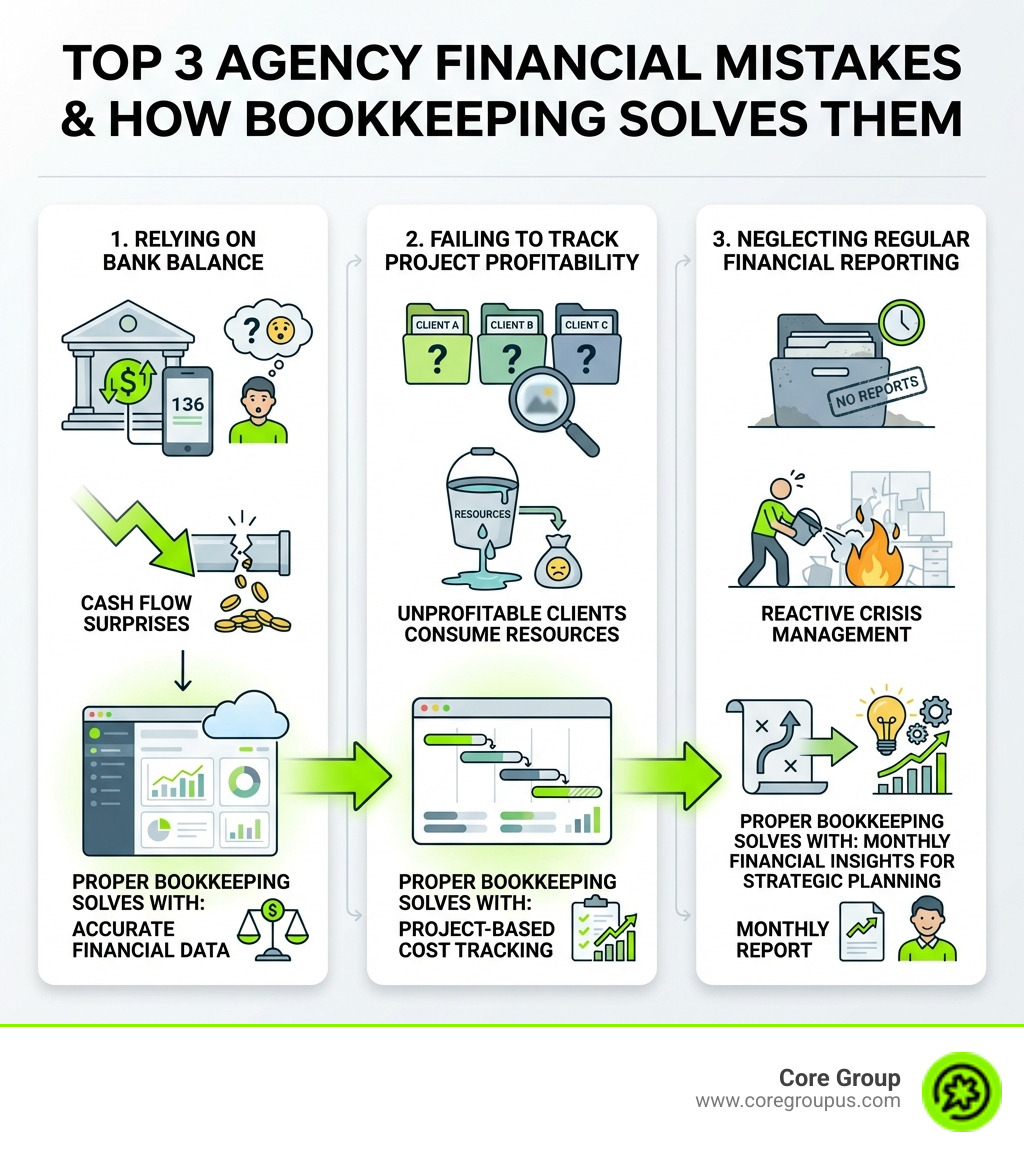
Without a clear financial picture, you're operating on intuition—a risky business strategy. Accurate bookkeeping provides profound insights into your agency's financial health, helping identify areas for improvement, avoid costly mistakes, and track profit margins effectively. A major benefit is eliminating tax time stress. When your books are maintained throughout the year, tax season becomes a smooth process, not a frantic scramble.
Beyond compliance, effective bookkeeping is crucial for project profitability. Knowing the true cost and revenue of each project is vital to avoid underpricing services or taking on unprofitable work. This insight also ensures you, the agency owner, can pay yourself a livable wage, a common challenge for creative entrepreneurs. As we often discuss on The Profitable Creative Podcast, your financial well-being is linked to your agency's long-term success. Strong financial management brings peace of mind, freeing you to focus on creative work and client results.
Building a Foundation for Growth
Every successful agency is built on a solid financial foundation of planning, budgeting, and forecasting. Understanding where your money comes from and where it goes allows for proactive resource management and future growth. Robust bookkeeping helps identify cost-cutting opportunities without hindering growth and highlights profitable service lines to boost income. This strategic insight is invaluable for balancing artistic vision with financial acumen, a journey we explore in From Real Estate to Creative Agency.
From Stress to Strategy
With sound bookkeeping, you can stop reacting to financial surprises and start proactively shaping your agency's future. Financial data, when properly analyzed, becomes a powerful strategic tool for optimizing performance, from staffing to service offerings. This shift from stress to strategy fosters agency stability and empowers confident growth. As we discuss in The Founders Evolution: Why Your Business Cannot Grow Beyond You, leveraging your financial data is key to open uping your agency's full potential.
Setting Up Your Financial Foundation: Systems and Technology

The journey to effective bookkeeping for agencies begins with choosing the right systems and technology. While DIY spreadsheets seem cost-effective, they are often error-prone and provide a limited view of your finances. We advocate for moving to robust accounting software that forms the core of your agency's financial tech stack, a crucial step towards organized and efficient Accounting. An integrated tech stack allows your accounting software to work seamlessly with other tools like project management and CRM systems, minimizing manual data entry and providing a holistic view of your agency’s performance.
Choosing Your Bookkeeping System
Before selecting software, understand the fundamental bookkeeping systems:
- Cash Basis Accounting: Records revenue when cash is received and expenses when paid. It's simpler and clearly shows your cash on hand, making it suitable for smaller agencies.
- Accrual Basis Accounting: Records revenue when earned and expenses when incurred, regardless of cash movement. It provides a more accurate long-term picture of profitability and is preferred for growing agencies needing a sophisticated financial view.
| Feature | Cash Basis Accounting | Accrual Basis Accounting |
|---|---|---|
| Revenue Timing | Recorded when cash is received | Recorded when earned (service delivered) |
| Expense Timing | Recorded when cash is paid | Recorded when incurred (bill received) |
| Complexity | Simpler, easier for small businesses | More complex, requires tracking receivables/payables |
| Financial View | Shows actual cash on hand | Provides a more accurate picture of long-term profitability |
| Tax Implications | May delay tax on revenue until payment received | May require tax payment on revenue not yet collected |
| Suitability | Small agencies, simple transactions, focus on cash | Growing agencies, complex projects, better for analysis |
Beyond cash vs. accrual, consider:
- Single-Entry Bookkeeping: A basic method, like a checkbook register, that shows cash flow but lacks comprehensive insight.
- Double-Entry Bookkeeping: Every transaction affects at least two accounts (a debit and a credit). This system provides a self-checking mechanism to detect errors and offers a complete financial picture essential for accurate reporting.
For most growing agencies, we recommend adopting accrual basis and double-entry bookkeeping for accurate and comparable financial reporting.
The Role of Technology in Bookkeeping for Agencies
Modern bookkeeping for agencies relies on cloud-based accounting software. These tools offer immense benefits:
- Automation: Automate invoicing, billing, and payroll, reducing manual data entry and saving time.
- Real-time Tracking: Integrate bank accounts and credit cards to automatically categorize transactions for an up-to-the-minute view of expenses.
- Secure Data: Reputable cloud platforms offer robust security for your sensitive financial data.
- Simplified Invoicing and Payroll: Generate professional invoices, set up automated payment reminders, and manage payroll efficiently. Proper payroll management is critical to avoid severe IRS penalties.
- Integration: Many platforms integrate with project management tools and CRM systems, creating a seamless flow of data, which is valuable for agencies dealing with complexities like those in digital marketing, as discussed in Navigating the Digital Marketing Landscape with Enleaf.
Platforms like Xero, QuickBooks, and FreshBooks are popular choices, each offering features suitable for different agency sizes and needs.
Essential Practices for Effective Bookkeeping for Agencies
Beyond systems and software, consistent practices drive effective bookkeeping for agencies, ensuring your financial data is accurate, insightful, and actionable.
1. Accurate Record-Keeping: This is the bedrock of good bookkeeping. Every transaction must be recorded carefully. We recommend digitalizing all receipts and categorizing transactions correctly from the outset to prevent headaches later.
2. Maintain a Well-Structured Chart of Accounts: Your chart of accounts lists all accounts in your general ledger. A well-defined chart customized for an agency's needs (e.g., distinct revenue and expense categories) is crucial for accurate reporting.
3. Invoicing Best Practices: Agencies deal with retainers, project billing, and varied payment terms. Implement systems for sending invoices quickly and accurately. Automated reminders for overdue payments can significantly improve cash flow.
4. Expense Management: Track all agency expenses diligently, including operational costs, client-related expenses, and overhead. Cloud-based tools can automate expense tracking by syncing with bank accounts.
5. Project Costing: Understanding the profitability of individual projects is paramount. This involves accurately tracking team members' time and direct project expenses to inform future pricing and client prioritization.
Overcoming Common Bookkeeping for Agencies Challenges
Agencies face unique financial challenges:
- Unpredictable Working Capital: Fluctuating project scopes and client payment delays can lead to cash flow shortages, even when an agency is profitable on paper.
- Complex Revenue Streams: Accurately categorizing diverse income from retainers, project fees, and commissions is vital.
- Retainers vs. Projects: Managing the financial implications of different billing models requires careful tracking to ensure resource efficiency and profitability.
- Time Tracking for Profitability: Without accurate time tracking, it's impossible to know the true cost of delivering services, leading to underpricing.
- Payroll and Tax Compliance: Navigating payroll taxes and state-specific regulations can be complex. Mishandling them can lead to severe penalties, so working with specialized bookkeeping services is often a wise choice.
Key Metrics and Reports to Monitor
Go beyond basic cash flow by tracking key performance indicators (KPIs) and financial reports for strategic decision-making.
Essential Agency KPIs:
- Monthly Recurring Revenue (MRR): Tracks predictable income from retainer clients, offering a stable baseline for forecasting.
- Gross Margin: Measures the profitability of your services after deducting direct costs.
- Client Profitability: Tracking profitability per client helps identify high-value relationships and those draining resources, which is key for improving Client Retention Is Your Real Competitive Advantage.
- Labor Efficiency: Assesses how effectively your team's time is used and billed.
- Aged Receivables: Shows how long invoices have been outstanding, helping to improve collection efforts.
Key Financial Reports:
- Profit and Loss (P&L) Statement: Summarizes revenues, costs, and expenses over a period to reveal your net profit or loss.
- Balance Sheet: A snapshot of your agency's assets, liabilities, and owner's equity at a specific point in time.
- Cash Flow Forecast: Projects the movement of cash in and out of your business, vital for managing liquidity and planning.
- Bank Reconciliation Report: Regularly comparing your bank statements to your accounting software helps spot inconsistencies and ensures accuracy. Learn more about the importance of regular balance sheet reviews.
Monitoring these reports monthly allows for proactive adjustments and keeps your agency on a path to growth. For more insights, explore The Planner Blog.
Scaling Your Agency: When to Hire a Financial Pro
As your agency grows, the complexities of bookkeeping for agencies multiply. A manageable DIY task can quickly become a bottleneck, consuming time better spent on clients and strategy.
DIY Limitations
The biggest limitation of DIY bookkeeping is often the owner's lack of time and accounting expertise. Mistakes can lead to inaccurate reports, missed deductions, and even tax penalties. Moreover, time spent on bookkeeping is time not spent on revenue-generating activities.
Signs You Need Help
Consider professional financial support if you're experiencing:
- Overwhelm: You're consistently behind on your books or dread the task.
- Lack of Clarity: You don't understand your financial reports or profitability.
- Missed Opportunities: You're unsure if you can afford to hire or expand due to a lack of accurate forecasting.
- Tax Stress: Tax season is a nightmare, indicating disorganized bookkeeping.
- Growth Pains: The volume of transactions is becoming too much to handle.
Vetting Professionals
When seeking financial help, it's crucial to find professionals who understand the unique landscape of Marketing Agencies. A generalist might handle basic transactions, but a niche specialist brings invaluable industry-specific knowledge. They understand project-based billing, client profitability, and the nuances of agency revenue, which is what truly makes a difference.
Levels of Financial Support
The type of financial professional you need often depends on your agency's size and revenue:
- Freelance Bookkeeper: Ideal for smaller agencies. They handle daily transactions, categorization, and reconciliations, offering a cost-effective way to get organized.
- Specialized Accounting Firm: As your agency grows, a firm specializing in agencies offers more comprehensive services, including bookkeeping, payroll, tax preparation, and advisory. This is often the recommended solution for agencies doing under $1 million in annual revenue.
- Fractional CFO: For agencies exceeding 7-figures in revenue, a fractional CFO provides high-level financial strategy—like cash flow analysis and business modeling—without the cost of a full-time executive.
- In-house Controller: Typically beneficial for larger agencies (over $10 million in annual revenue). This role manages all accounting operations and internal reporting. For most agencies under this threshold, the cost is likely overkill.
Outsourcing these functions to a specialized firm can improve efficiency and reduce costs, allowing agency owners to modernize their accounting, save money, and make smarter business decisions.
Frequently Asked Questions about Agency Bookkeeping
We hear a lot of questions from agency owners about their financials. Here are some of the most common ones:
What's the difference between a bookkeeper and an accountant?
Think of it this way: a bookkeeper records your daily financial activities, while an accountant interprets those records for strategic planning.
- Bookkeeper focus: Their primary role is to record daily transactions, manage payables and receivables, and reconcile accounts to ensure data is accurate and up-to-date.
- Accountant focus: An accountant analyzes the bookkeeper's data. They prepare financial statements, handle tax returns, provide strategic financial advice, and help with forecasting to inform business decisions.
Essentially, a bookkeeper handles the "how" of recording, while an accountant handles the "why" and "what next" of financial strategy.
Can I use a general bookkeeper for my marketing agency?
While a general bookkeeper can handle basic tasks, we strongly recommend a specialist in bookkeeping for agencies. An agency-focused professional understands your unique financial structures, such as project-based billing, retainers, and complex revenue recognition. They know which KPIs are critical (like client profitability) and can provide more valuable, proactive insights. This strategic advantage helps you move beyond mere compliance to using your financial data to drive growth.
How much does bookkeeping for an agency typically cost?
The cost of bookkeeping for agencies varies based on transaction volume, service complexity, and the type of provider.
- Freelance Bookkeeper: Might charge a few hundred dollars per month for basic services in a small agency.
- Specialized Accounting Firm: Can range from several hundred to a few thousand dollars per month, offering comprehensive services like payroll, advisory, and detailed reporting.
- In-house Staff: A full-time salary with benefits, typically justifiable only for larger agencies with higher revenue.
It's important to view bookkeeping as an investment, not just an expense. The right financial partner saves you money through efficiency, tax optimization, and preventing costly mistakes, ultimately boosting your agency's profitability.
Conclusion: From Overwhelmed Creative to Profitable Agency Owner
The journey from a passionate artist to a thriving agency owner is exhilarating, but it often comes with the unexpected challenge of managing the numbers. As we've explored, bookkeeping for agencies isn't just an administrative chore; it's a strategic imperative that directly impacts your agency's survival, stability, and growth.
We've covered why robust financial management provides clarity, informs decisions, and eliminates tax-time stress, allowing you to pay yourself a livable wage and ensure every project is profitable. We've digd into setting up your financial foundation, from choosing between cash and accrual accounting to leveraging cloud-based software for automation and real-time insights. We also discussed essential practices like accurate record-keeping, smart invoicing, and meticulous project costing, all while navigating the unique challenges agencies face. Finally, we outlined when and how to scale your financial support, from freelance bookkeepers to specialized firms and fractional CFOs.
The power of financial clarity cannot be overstated. It transforms you from an overwhelmed creative, reacting to financial surprises, into a confident agency leader, making data-driven decisions that fuel sustainable growth. At Core Group, we believe in empowering creative entrepreneurs with a "no-fluff, profit-first playbook" that guarantees peace of mind and saves you time, allowing you to focus on your business. We're here to be your financial co-pilot, ensuring your creative genius is matched by financial strength.
To learn more and access valuable tools that can help your agency thrive, explore our comprehensive Resources. Let's build a profitable future, together.