The Creative's Guide to Stress-Free Bookkeeping
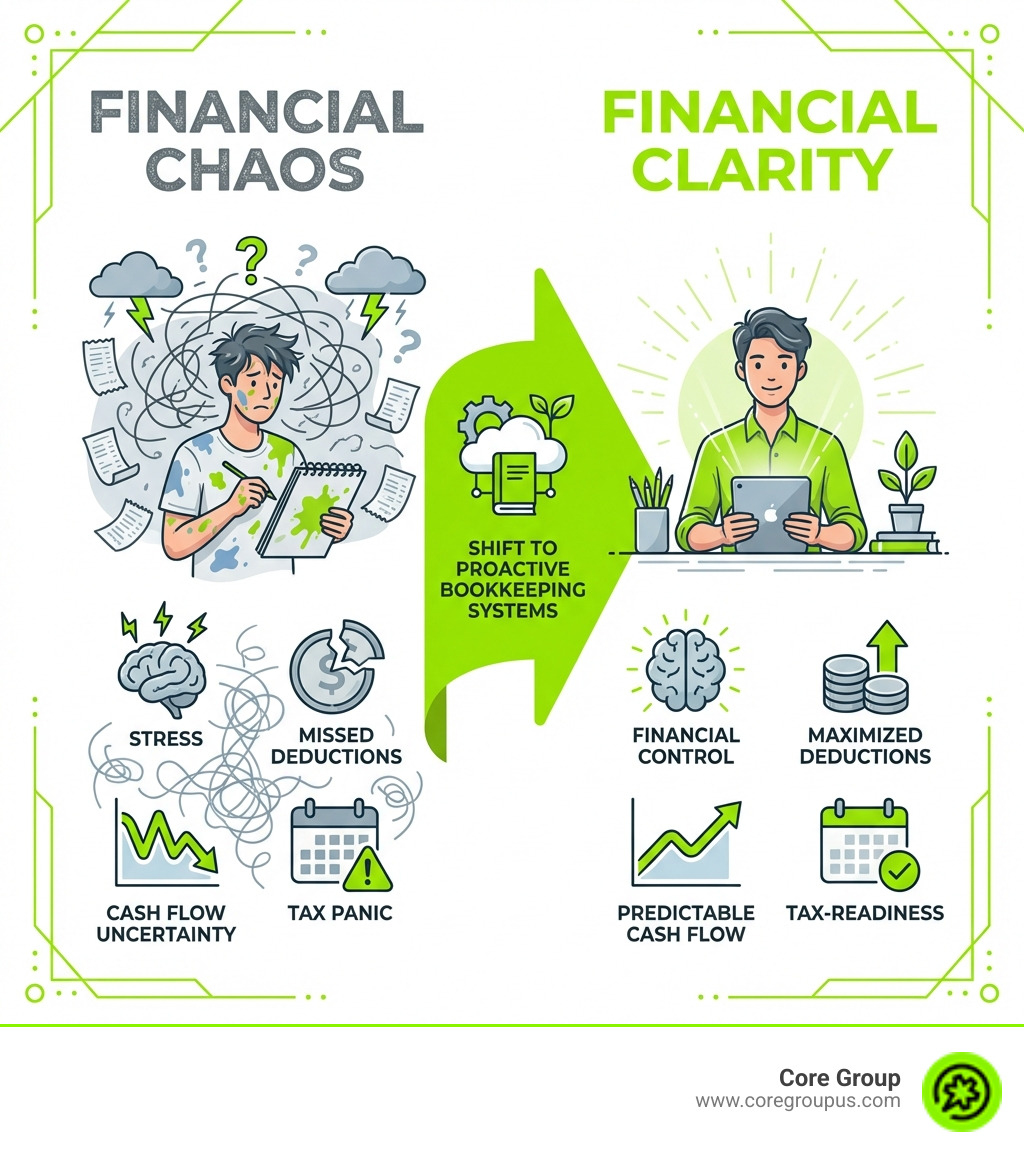
From Creative Chaos to Financial Clarity

Bookkeeping for creatives doesn't have to be overwhelming. Here's what you need to manage your creative finances effectively:
Quick Start Guide:
- Separate your finances - Open a dedicated business bank account and credit card
- Track everything - Record all income and expenses, no matter how small
- Plan for taxes - Set aside 25-35% of each payment for quarterly tax obligations
- Invoice promptly - Send clear invoices with payment terms and follow up consistently
- Review monthly - Spend 30-60 minutes each week organizing your financial records
- Get help when needed - Consider professional support when revenue exceeds $75,000 annually
"We get it, spending time on your business finances is probably the last thing you want to be doing," acknowledges one bookkeeping expert for creatives. And they're right.
You didn't become a content creator, photographer, videographer, graphic designer, or creative entrepreneur to stare at spreadsheets. You got into this business to create, to tell stories, to design beautiful things.
But here's the reality: your creative business faces unique financial challenges that standard advice doesn't address. Irregular income streams mean some months are feast, others are famine. Multiple revenue sources—from client projects to digital products to affiliate income—create a tracking nightmare. Variable expenses make budgeting feel impossible.
The result? Many creatives have books that are months or even years behind. They can't answer basic questions like "How much did I make last quarter?" or "Which clients are actually profitable?" Tax season becomes a panic-inducing scramble. And worst of all, poor financial records can prevent you from qualifying for loans, securing investors, or simply understanding if your business is truly sustainable.
Good bookkeeping isn't just about compliance or avoiding IRS problems. It's about gaining control, reducing stress, and building a creative business that supports your life. When your finances are organized, your mind can relax. You can focus on doing amazing work instead of worrying about money.
This guide will show you exactly how to set up a bookkeeping system that works for your creative brain, not against it. Whether you're a marketing agency owner or an influencer managing brand deals, you'll learn the essential practices that bring clarity to your finances and peace of mind to your business.
The Foundations: Setting Up Your Financial System
Bookkeeping, at its core, is the systematic recording of your business's financial transactions—your income and expenses. It's the backbone of any successful venture, and for creatives, it's the key to turning passion into sustainable profit. Why is it so important? Because it helps us gain control, make informed decisions, and be ready for tax time without the usual panic. Organizing your creative business's finances helps you feel more in control, allowing your mind to relax so you can focus on doing amazing work.
Many creative business owners find bookkeeping exhausting, preferring to focus on marketing, client interactions, and networking. But good bookkeeping practices are essential for building a sustainable creative business, not just for compliance.

Essential Bookkeeping for Creatives: Where to Start?
The single most crucial step in setting up your financial system is to separate your business and personal finances. This isn't just a best practice; it's a non-negotiable first step for creative professionals to simplify taxes, protect assets, and maintain clarity.
Open a dedicated business checking account and, if possible, a business credit card. Use these exclusively for business transactions. This separation makes tracking income and expenses infinitely easier, simplifies budgeting, and provides better audit protection. Failing to keep proper financial records, especially by mixing funds, can result in significant penalties and fines.
Once your finances are separated, you need a system to track everything. The best bookkeeping system is the one that you actually use and consistently keep up-to-date. Options include:
- Spreadsheet systems: For those just starting or with lower transaction volumes, a well-organized spreadsheet (like the ones from The Creative Ledger by Core Group) can be a cost-effective solution.
- Cloud accounting software: We recommend The Creative Ledger by Core Group, designed to streamline your financial management. It helps you track profit, revenue, and business expenses efficiently.
- Paper ledgers: While less common today, a simple paper notebook and your trusty calculator can still work if you prefer a tangible approach.
Regardless of the method, the goal is to record all financial transactions (income and expenses) on a regular basis.
Understanding Profitability with Project-Based Accounting
Creative work often involves project-based engagements, which presents a unique opportunity: project-based accounting. Implementing a project-based tracking system helps creatives understand profitability per project and client. This is crucial for identifying which types of projects are most profitable, assessing client value, and improving future pricing strategies.
When we talk about profitability, we're looking at your Profit & Loss (P&L) statements. For designers and other project-based creatives, we structure your P&L statements with revenue at the very top, direct costs in the middle, and other expenses at the bottom. This creates a logical flow: Money in → money out → money that’s left. This approach, often aligned with principles like those found in Profit First for Creatives, ensures you have a firm grasp on where your money is coming from and where it's going.
By categorizing revenue streams one-by-one—such as 1:1 services (packages or retainers), digital products, coaching income, and affiliate income—you gain crucial insights. You can't know your business's overall expenses, profit, or financial success without recording things diligently. Analyzing financial records helps us identify potential issues and irregularities before they become major problems.
Managing Cash Flow: Invoicing and Payments
Effective cash flow management is vital for creatives, especially given irregular income streams. The key here is mastering the art of invoicing and payment terms.
- Promptness: Send invoices immediately upon project milestones or completion. The faster you invoice, the faster you get paid.
- Clarity: Your invoices should be clear, itemized, and include all necessary details such as project scope, services rendered, and payment due dates.
- Deposits: For larger projects, consider requiring a 25-50% deposit upfront. This secures the client's commitment and provides immediate cash flow.
- Automated Reminders: Use your accounting software to send automated payment reminders for outstanding invoices. Clients are busy, and a gentle nudge often does the trick.
- Following Up on Accounts Receivable: Don't be shy about following up on unpaid invoices. Consistent and polite communication is crucial. Effective invoicing, including promptness, clarity, and deposits, is crucial for cash flow management for creatives.
This proactive approach ensures a steady flow of funds, allowing you to focus on your creative work rather than chasing payments. Learning from experts like Francis Flair, as discussed in The Profitable Creative: Client Retention is Your Real Competitive Advantage, can also help you build stronger client relationships that lead to timely payments.
The Creative's Guide to Taxes: Deductions and Payments
"Being your own boss has its perks—flexibility, creative control, and the freedom to work in pajama pants if you feel like it. But as any freelancer will tell you, managing your own business means you don’t just get to make the art... you also have to track the income, file the taxes, and figure out which receipts to keep."
This quote perfectly captures the reality for creatives. Taxes can be intimidating, but with proper bookkeeping, they become manageable. Good bookkeeping practices are essential not just for compliance but for stress-free tax times.

Common Tax Deductions You Can't Afford to Miss
One of the most rewarding aspects of diligent bookkeeping is realizing the power of tax deductions. Creative professionals often miss valuable deductions by not tracking small expenses. We can save you thousands by ensuring you don't leave money on the table.
Here's a list of common deductions creative freelancers and business owners can claim:
- Home Office Deduction: If you use a portion of your home exclusively and regularly for business, you can deduct a percentage of your rent, utilities, insurance, and other home-related expenses. Learn more about the nuances in Tax Implications When You Sell Your House With a Home Office.
- Equipment & Technology: Your computer, tablet, phone, camera, lighting equipment, musical instruments, or any other tools essential for your craft are deductible.
- Software & Subscriptions: Creative software (Adobe Creative Suite, Procreate, Final Cut Pro), web hosting, domain fees, online store platforms, project management tools—all deductible.
- Office Supplies: Pens, paper, props, backdrops, specific materials for your art or design projects.
- Business Travel: Mileage for client meetings, travel to workshops, conferences, or photo shoots. Remember to track your mileage!
- Professional Development: Courses, workshops, books, and coaching related to improving your business or creative skills.
- Business Meals: Meals with clients or business partners (50% deductible).
- Contracted Help: Payments to other freelancers, virtual assistants, editors, or collaborators.
- Insurance: Business liability insurance, professional indemnity insurance.
- Marketing & Advertising: Website costs, online ads, business cards, portfolio printing.
- Section 105 Plan: For sole proprietors, this can be a powerful way to deduct medical expenses. Read more in Section 105 Plan for Sole Proprietors Filing Schedule C.
The IRS expects business expenses to be "ordinary and necessary" for your specific line of work. Keep digital copies of all receipts and add notes to explain business-related charges.
Self-Employment Tax and Quarterly Estimated Payments
As a creative professional, you're likely self-employed, which means you're responsible for paying self-employment tax. This isn't just income tax; it covers both the employer and employee portions of Social Security and Medicare, currently at 15.3% on your net earnings.
If we expect to owe more than $1,000 in taxes for the year, we must make quarterly estimated tax payments. This helps us avoid penalties at tax time. A general rule of thumb for freelancers is to save about 25-35% of each payment for your annual tax bill.
The due dates for these payments are:
- April 15 (for January 1 to March 31 income)
- June 15 (for April 1 to May 31 income)
- September 15 (for June 1 to August 31 income)
- January 15 of the next year (for September 1 to December 31 income)
Planning for irregular income through income smoothing, emergency funds, and tax savings is vital for creative professionals. We help you estimate your yearly income, subtract estimated deductions, and project your tax liability so you can make these payments on time and stress-free. For more detailed information, consult the IRS guide on Self-Employment Tax.
Advanced Tax Strategies: LLC vs. S-Corp
As your creative business grows, we might start discussing different business structures beyond a sole proprietorship. Most creatives begin as an LLC, which allows for owner's draws. However, if your profits grow significantly, we might explore forming an S-Corp.
An S-Corp allows you to pay yourself a reasonable salary, and the remaining profits can be distributed to you, potentially saving you on self-employment taxes. This decision is complex and depends on your specific income and expenses. It's crucial to consult with a tax professional to run the calculations and determine if an S-Corp will actually save you money. We've explored this in depth in Should Creative Entrepreneurs Become an S-Corp? and The Essential Guide to S-Corporations. The goal is always to optimize your tax strategy for maximum savings.
Smart Systems and Pro Support for Creatives
Creative professionals often tell us they didn't get into their field to spend hours sorting receipts. We understand. The good news is that smart systems and professional support can save you significant time, reduce errors, and free you up to focus on your craft.
Automating Your Bookkeeping Process
Automating bookkeeping tasks through technology can save creative professionals significant time and effort. Modern accounting software and apps are designed to streamline much of the tedious work.
Consider integrating these automation tools into your workflow:
- Bank Feed Integration: Connect your business bank accounts and credit cards directly to your accounting software. This automatically imports transactions, saving you from manual data entry.
- Receipt Scanning Apps: Use apps that allow you to snap a photo of a receipt, categorize it, and attach it to the corresponding transaction in your accounting software. This ensures you never miss a deduction.
- Automated Invoicing: Set up recurring invoices for retainers or use templates to quickly generate and send new invoices. Many systems also offer automated payment reminders.
- Rule-Based Categorization: Your accounting software can learn to categorize transactions based on vendors or keywords, further reducing manual effort.
Our solution, The Creative Ledger, is designed to simplify these processes, offering a cloud-based system that makes financial management intuitive for creatives.
Building Consistent Financial Habits
Even with automation, consistency is key. Consistent bookkeeping habits, such as a weekly money date and monthly reviews, are essential for financial success. We encourage our clients to adopt these simple, yet powerful, habits:
- Weekly Money Date (30-60 minutes): Set aside a specific time each week to log new transactions, categorize expenses, organize receipts, and follow up on any outstanding invoices. This small, regular effort prevents tasks from piling up.
- Monthly Financial Reviews: At the end of each month, take a moment to review your Profit & Loss statement and balance sheet. Understand where your money came from and where it went. This helps you identify trends, assess profitability, and make adjustments.
- Quarterly Planning: Before each quarterly tax deadline, review your financial position, project your income and expenses for the next quarter, and prepare for your estimated tax payments.
- Annual Assessment: At year-end, close your books, prepare for tax filing, and set financial goals for the upcoming year.
These consistent habits lead to financial epiphanies, as discussed in From Intimidated to Empowered: A Creative's Guide to Financial Epiphanies.
When to Hire a Professional Bookkeeper or Accountant
While we empower you with the tools and knowledge to manage your finances, there comes a point when professional help is not just beneficial, but essential. Professional bookkeeping help is recommended for creatives generating over $75,000 annually or spending more than 5 hours per week on financial management.
Consider bringing in an expert when:
- Your revenue exceeds $75,000 annually: Your financial complexity likely warrants professional oversight to ensure accuracy and optimize tax strategy.
- You're spending 5+ hours a week on bookkeeping: Your time is better spent creating and growing your business. Outsourcing frees up this valuable time.
- You have complex tax situations: This could include multiple income streams, cross-state operations, or plans for significant investments.
- You're hiring employees: Managing payroll and contractor payments accurately and compliantly requires specialized knowledge. We offer comprehensive Payroll services to handle this for you.
- You simply want peace of mind: If numbers make you anxious, or you constantly worry about missing something, a professional can alleviate that stress.
An experienced bookkeeper or accountant can not only keep your books clean but also act as a trusted business advisor, helping you interpret your financial data to make strategic decisions. We offer comprehensive Accounting services custom to creatives.
Frequently Asked Questions about Bookkeeping for Creatives
How can I manage my finances with an irregular income?
Irregular income is a reality for many creatives, and it's one of the unique financial challenges faced by creative professionals. Here’s how we manage it:
- Income Smoothing: Create an "income reserve" account. When you have a good month, put a portion of the surplus into this account. During slower months, draw from it to maintain a consistent personal income. Planning for irregular income through income smoothing, emergency funds, and tax savings is vital.
- Emergency Fund: Build a separate emergency fund covering 3-6 months of your business operating expenses. This acts as a buffer during lean periods.
- Tax Savings: Set aside 25-35% of each payment you receive specifically for estimated taxes. This prevents a huge tax bill from derailing your finances.
What are the best bookkeeping software options for a creative business?
The "best" software depends on your specific needs, but we advise you to focus on features that support your creative business model, rather than just brand names. Look for:
- Cloud-based access: Essential for working from anywhere.
- Invoicing capabilities: To create and send professional invoices easily.
- Expense tracking: With categorization and receipt attachment features.
- Project tracking: To monitor profitability per project.
- Mileage tracking: Crucial for creatives who travel for work.
- Scalability: A system that can grow with your business.
At Core Group, we've developed The Creative Ledger by Core Group precisely for these needs, offering a comprehensive and intuitive solution custom for creative entrepreneurs.
What are the most common bookkeeping mistakes for creatives to avoid?
Many creatives fall into similar financial traps. Here are the common bookkeeping mistakes creative professionals should avoid:
- Commingling Funds: Mixing business and personal finances. This is the cardinal sin of small business bookkeeping, complicating taxes and legal protection. Separate personal and business finances is a non-negotiable first step.
- Waiting Until Tax Season: Trying to sort out a year's worth of transactions in a few frantic weeks is a recipe for stress, missed deductions, and potential errors. Consistent, regular effort is key.
- Ignoring Accounts Receivable: Not following up on unpaid invoices. This directly impacts your cash flow.
- Not Tracking Small Expenses: Creative professionals often miss valuable deductions by not tracking small expenses like coffee meetings or parking fees. Every dollar counts!
- Forgetting to Back Up Data: Whether digital or physical, always have a backup of your financial records.
Conclusion: Turn Your Passion into a Profitable Business
You started your creative business because you have a passion, a unique talent to share with the world. We believe that passion shouldn't be stifled by financial anxiety. By embracing smart bookkeeping for creatives, you gain invaluable financial control, reduce stress, and empower your business to grow sustainably.
With clear financial insights, you're not just creating art; you're building a thriving enterprise. You'll be able to make informed decisions, price your services confidently, and approach tax season with a calm smile, knowing every penny is accounted for.
At Core Group, we offer a "no-fluff, profit-first playbook" that guarantees peace of mind and saves you precious time, allowing you to focus on what you do best: create. We understand the unique needs of creative entrepreneurs, and we're here to be your trusted financial partner.
Ready to transform your financial chaos into clarity? Let's chat about how we can help. Book a Call with us today to discuss your Tax Planning strategy and open up the full potential of your creative business.