Digital Nomad's Guide to Bookkeeping: Keep Your Books as Mobile as You Are
Why Bookkeeping for Solopreneurs is Your Key to Creative Freedom

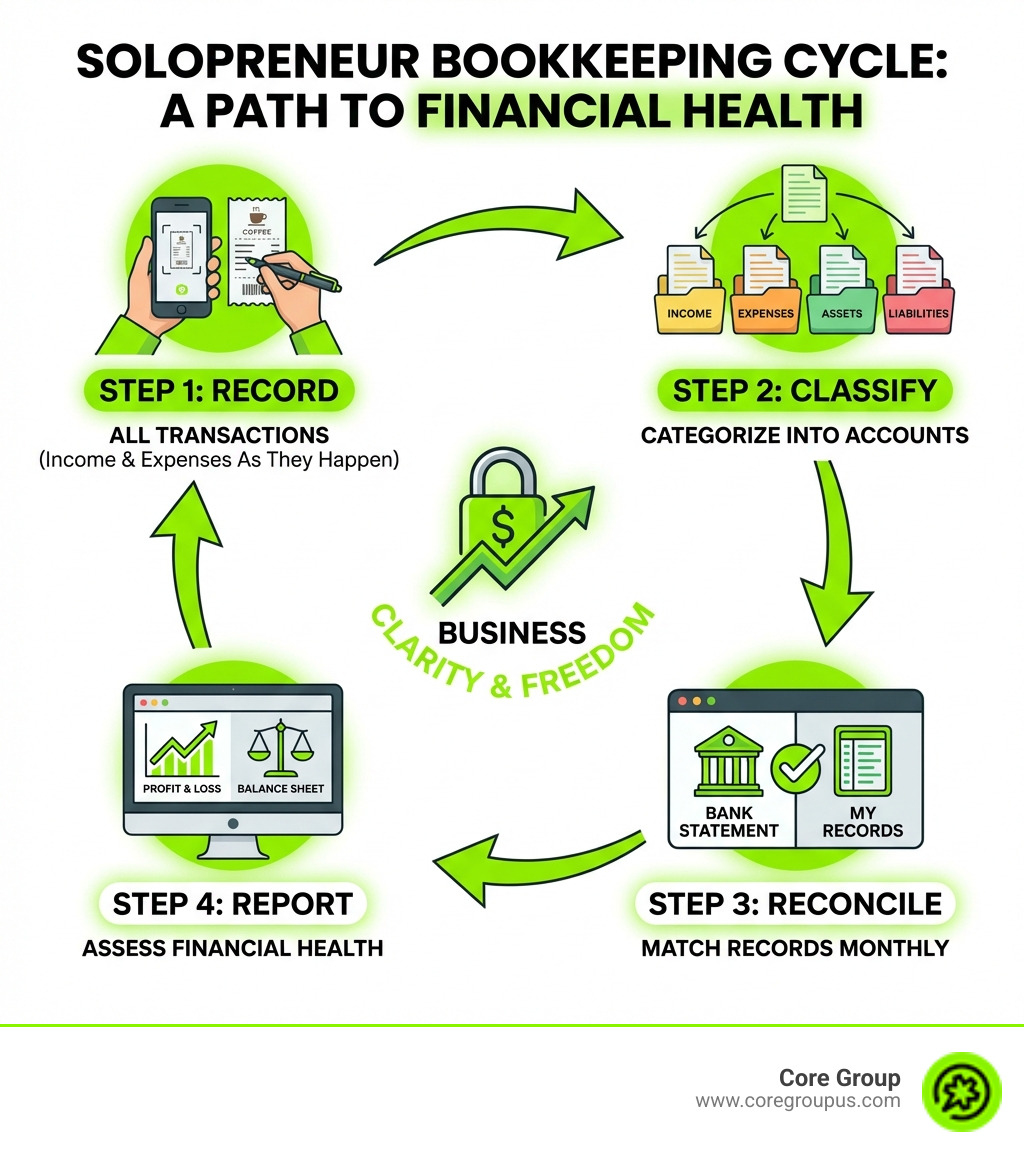
Bookkeeping for solopreneurs is the systematic process of recording, organizing, and maintaining all financial transactions for your solo business. At its core, it involves tracking every dollar that comes in and goes out, categorizing expenses, reconciling bank accounts, and generating financial reports that show your business's health.
Essential bookkeeping tasks for solopreneurs include:
- Separating personal and business finances - Open dedicated business bank accounts and credit cards
- Recording all transactions - Track every invoice, payment, receipt, and expense as they happen
- Organizing financial documents - Maintain digital or physical files of receipts, invoices, and bank statements
- Reconciling accounts - Match your records to bank statements monthly to catch errors
- Generating financial reports - Create profit & loss statements and balance sheets to understand your financial position
- Preparing for taxes - Set aside funds for quarterly payments and track deductible expenses year-round
As a creative entrepreneur, you excel at your craft. You can direct a scene, edit a masterpiece, or craft compelling narratives. But when tax season arrives or you need to understand your cash flow, the financial side of your business can feel overwhelming.
You're not alone. Research shows that solopreneurs often juggle countless roles—from marketing and customer service to product creation and financial management. Many describe bookkeeping as dull and repetitive, yet overlooking it creates chaos: missed deductions, surprise tax bills, and worst of all, no clear picture of whether your business is actually profitable.
The good news? Organized bookkeeping isn't just about compliance—it's your passport to business freedom. When you track your numbers consistently, you gain clarity on cash flow, make informed decisions about growth, and most importantly, reclaim time and mental energy to focus on your creative passion.
The challenge is real: managing finances while living a mobile lifestyle or running between projects. But with the right systems, bookkeeping becomes less of a burden and more of a tool that supports your freedom rather than constraining it.
Why Bookkeeping is Your Business's Passport to Freedom
For many solopreneurs, especially creative ones, the idea of bookkeeping for solopreneurs can feel like a chore, a necessary evil that pulls us away from our true passion. We get it. You started your business to create, innovate, and serve, not to spend hours poring over spreadsheets. However, understanding the "what" and "why" behind consistent and organized bookkeeping transforms it from a burden into a powerful ally for your business's growth and your personal peace of mind.
At its core, bookkeeping is about providing vital monetary insight. It allows us to track every dollar coming in and going out, understand our cash availability, and gauge our profitability. These accurate records show us how our company is truly doing, enabling intelligent choices that drive our ventures forward. Without this clarity, we're essentially flying blind, unable to make informed decisions about pricing, investments, or even when to take a much-deserved break.
Think of it this way: bookkeeping exists to make our lives easier, not more difficult. It creates a clear paper trail for tax filings, making that dreaded season less stressful. Consistent records help us with budgeting, allowing us to allocate resources wisely and plan for future projects. Most importantly, it gives us a clear understanding of the financial health of our business. This isn't just about avoiding problems; it's about identifying opportunities. Are we spending too much in one area? Is a particular service line more profitable than we thought? Bookkeeping answers these questions.
Meticulous bookkeeping lays the foundation for a thriving solo business. Precise monetary records, kept distinct from personal funds, plus streamlined processes, provide a transparent view of our fiscal well-being. This isn't just a compliance task; it's a tool for growth. It empowers us, moving us from feeling intimidated by numbers to becoming truly empowered in our financial journey. Want to dive deeper into this change? Check out our guide on From Intimidated to Empowered: A Creative's Guide to Financial Epiphanies.
The average taxpayer spends 13 hours preparing their own tax return. Imagine reclaiming some of that time by having organized books all year round! This foundational work leads to immense peace of mind, allowing us to focus on what we do best: creating and growing our businesses.
Essential Bookkeeping for Solopreneurs: From Setup to Daily Tasks
Getting your bookkeeping system set up correctly from the start is half the battle. Think of it as building a sturdy foundation for your financial house. Even if you're a digital nomad constantly on the move, these principles apply, ensuring your financial records are as mobile and accessible as you are.

Separate Your Worlds: Business vs. Personal Finances
This is perhaps the single most crucial piece of advice for any solopreneur: keep your business and personal finances completely separate. We cannot stress this enough. Mixing them up is a common mistake that can lead to a messy tangle of issues, making tracking profits tricky, complicating tax filing, and potentially even risking legal protections.
Our recommendation is simple: open a distinct bank account and credit card solely for business expenses. Deposit all business revenue into this dedicated business bank account. This clear separation provides a precise picture of your business's financial position, simplifies your bookkeeping efforts, and makes tax season significantly easier. When funds mingle, financial reports become inaccurate, making it hard to know if your business is truly profitable. Plus, in the event of an audit, having distinct accounts makes demonstrating business legitimacy far simpler.
While it might be tempting to use a personal credit card for a quick business expense, resisting this urge will save you countless headaches down the line. A dedicated business account improves your professionalism and helps maintain the legal separation between you and your business, especially if you operate as an LLC or corporation. Understanding the nuances of business versus personal financial structures, including debt, can be complex. For a deeper dive, explore What is the Difference Between Short-Term and Long-Term Debt?.
Create Your Financial Map: The Chart of Accounts
Once your finances are separated, the next step in effective bookkeeping for solopreneurs is to create a Chart of Accounts. But what exactly is it? Simply put, a Chart of Accounts is a structured list of all the financial accounts used by your business. It's your financial map, organized logically into categories like Assets, Liabilities, Equity, Income, and Expenses.
- Assets: What your business owns (e.g., cash, bank accounts, equipment, accounts receivable – money owed to you).
- Liabilities: What your business owes (e.g., loans, credit card debt, accounts payable – money you owe others).
- Equity: The owner's stake in the business (e.g., owner's contributions, owner's draws, retained earnings). For solopreneurs, your Owner's Withdrawal or Draw is typically an equity account, not a liability or asset.
- Income Categories: All the ways your business earns money (e.g., service revenue, product sales, consulting fees).
- Expense Categories: All the ways your business spends money (e.g., office supplies, software subscriptions, marketing, travel, professional fees).
A well-defined Chart of Accounts provides a big-picture perspective of your various business accounts, helping you set goals and priorities. It's crucial for generating accurate financial reports and understanding where your money is truly going. For creative entrepreneurs, customizing this chart to reflect your specific revenue streams and unique expenses (like specific software, creative tools, or workshop fees) ensures that your financial reporting is custom and meaningful. This map is a fundamental component of The Creative Ledger.
Best Practices for Tracking Income and Expenses
Effective tracking of income and expenses is the heartbeat of good bookkeeping for solopreneurs. It’s not just about compliance; it’s about having your finger on the pulse of your business.

Here are our best practices:
- Record Every Transaction Promptly: We advocate for documenting every transaction as it happens, or at least on a daily or weekly basis. This includes all cash inflows and outflows, accounts receivable (money clients owe you), accounts payable (money you owe vendors), and any transfers between accounts. Delayed record-keeping is a common mistake that leads to gaps in financial records and endless headaches later.
- Digital Receipt Management: Gone are the days of the shoebox full of crumpled receipts. We recommend using digital tools to scan and store receipts for efficiency. Many mobile apps allow you to photograph receipts, automatically extract key information, and categorize them. Ensure each receipt is legible and includes essential details like the amount, date, and purpose of the expense. This makes auditing easier and provides crucial documentation for tax purposes.
- Consistent Categorization: Use your Chart of Accounts to categorize expenses properly and consistently. This ensures that your financial reports accurately reflect your spending patterns and helps you identify deductible expenses come tax time. For example, all software subscriptions should fall under the same expense category.
- Invoicing Systems: For income, implement a robust invoicing system. Send invoices with clear due dates and set up late payment reminders. This helps manage accounts receivable and ensures you get paid on time. Many accounting software solutions integrate invoicing capabilities, allowing you to create professional-looking invoices and track their status.
- Payment Processing: Connect your invoicing system or accounting software with your payment processors (like Stripe or PayPal) to automatically track payments received. This streamlines income tracking and reconciliation.
By adopting these practices, you maintain a consistent and accurate log of business activities, giving you a clear understanding of your cash flow and making your bookkeeping for solopreneurs process much smoother.
Key Financial Documents Every Solopreneur Must Maintain
Beyond individual transactions, certain financial documents provide a holistic view of your business's health. We consider these indispensable for any solopreneur:
- Profit & Loss (P&L) Statement (or Income Statement): This document summarizes your revenues, costs, and expenses over a specific period (e.g., a month, quarter, or year). It shows whether your business is making a profit or a loss. Regularly reviewing your P&L helps you understand if you are spending too much to earn a profit and allows you to rethink operations.
- Balance Sheet: This provides a snapshot of your business's financial position at a specific point in time. It lists your assets (what you own), liabilities (what you owe), and owner's equity (your stake in the business). The balance sheet helps you understand your company's financial performance and guides future transactions.
- Cash Flow Statement: This report tracks the cash coming into and going out of your business. It’s crucial for understanding your liquidity and ensuring you have enough cash on hand to cover operating expenses.
- Bank and Credit Card Statements: These are your primary source documents for verifying and reconciling your recorded transactions. We recommend reviewing them monthly, comparing them with your internal records to catch any discrepancies or errors.
- Invoices and Receipts: Keep every invoice you send to clients and every receipt for business expenses. These are the backbone of your financial records, providing proof of transactions and supporting your deductions during tax season. Digital storage is ideal here.
- Mileage Logs: If you use your vehicle for business travel, maintaining a detailed mileage log is essential. This log should include dates, destinations, purposes of trips, and odometer readings. Self-employed individuals can often write off mileage on their taxes, so creating these logs is in your best interest.
- Inventory Records: If your business involves selling physical products, accurate inventory logs are vital. The IRS considers stock an asset, and in some U.S. states, you may even have to pay taxes on inventory. Keeping these records helps with tax preparation and provides insights into which items sell quickly.
Maintaining these documents diligently is crucial not just for tax filing but for making informed business decisions and protecting yourself in case of an audit.
Leveling Up: Taxes, Software, and Professional Help
Once you have the fundamentals of bookkeeping for solopreneurs down, you can start leveraging your financial data for strategic planning, efficiency, and growth. This is where we move beyond basic record-keeping to proactive management.
A Proactive Approach to Taxes and Deductions
Tax season can be a source of anxiety for many solopreneurs, but with proactive bookkeeping, it becomes much more manageable. As a self-employed individual, you're responsible for both the employer and employee portions of Social Security and Medicare taxes, known as self-employment tax, in addition to federal and state income taxes. This is why setting aside money for taxes throughout the year is critical. We recommend putting aside at least 20-30% of your income for these obligations.
The good news is that many business expenses are deductible, significantly reducing your taxable income. This is where meticulous record-keeping truly pays off. Key deductions for solopreneurs often include:
- Home Office Deduction: If you use a dedicated space in your home exclusively and regularly for business, you can deduct a portion of your rent, utilities, internet, and other home-related expenses.
- Business Vehicle Costs: Mileage, maintenance, insurance, and other costs associated with using your vehicle for business can be deducted. Keep those mileage logs!
- Supplies and Equipment: Office supplies, software subscriptions, creative tools, and larger equipment purchases.
- Professional Fees: Costs for legal, accounting, and professional development services.
- Marketing and Advertising: Expenses related to promoting your business.
- Retirement Plan Contributions: Contributing to qualified retirement accounts like a Solo 401(k) or SEP IRA can reduce your taxable income while building your nest egg.
To maximize these deductions, track everything and categorize expenses properly year-round. Don't wait until April 14th to sort through a year's worth of receipts! Consulting experts or using tax projection calculators can help you estimate your quarterly tax payments accurately. For comprehensive guidance on preparing for tax season and optimizing your financial strategy, our Tax Planning resources are invaluable. Also, exploring business structures like an S-Corp might offer additional tax advantages for some creative entrepreneurs; learn more about this in Should Creative Entrepreneurs Become an S-Corp?.
The Power of Automation: Choosing the Right Tools
Manual bookkeeping often feels like trying to steer with a paper map when you have a GPS in your pocket. For bookkeeping for solopreneurs, leveraging accounting software is a game-changer. It streamlines processes, saves time, and significantly reduces the potential for errors.
The benefits of using digital bookkeeping tools are immense:
- Time Savings: Automating tasks like expense tracking, transaction categorization, and report generation frees up precious hours that you can reinvest in your creative work or personal life. We often hear that manually entering transactions gets old fast!
- Accuracy: Software minimizes human error, ensuring your financial data is precise and reliable. It performs calculations automatically and helps reconcile accounts with greater accuracy.
- Real-time Insights: With bank accounts linked, you get an up-to-date view of your financial standing, allowing for informed decision-making based on current data, not outdated figures.
- Simplified Tax Preparation: Many tools are designed to simplify tax season by organizing deductions, generating necessary reports, and sometimes even integrating directly with tax filing solutions.
When choosing accounting software, we recommend looking for key features:
- Bank Sync: The ability to connect your business bank accounts and credit cards to automatically import transactions.
- Invoicing: Professional, customizable invoicing capabilities that allow you to send, track, and manage client payments.
- Expense Tracking: Easy ways to capture and categorize expenses, ideally with receipt scanning features.
- Reporting: The ability to generate essential financial reports like P&L statements, balance sheets, and cash flow statements.
- Automation: Features that automate categorization, reconciliation, and recurring transactions.
- Tax Preparation Support: Tools that help track deductible expenses and prepare tax summaries.
- Mobile Access: A user-friendly mobile app for managing finances on the go.
While we won't recommend specific third-party software here, many options exist with varying features and price points. The best tool for you will prioritize simplicity, ease of use, and automation, allowing you to manage your finances without feeling like it's a part-time job.
When to Outsource Your Bookkeeping for Solopreneurs
As your solo business grows, so does the complexity of your finances. What started as a simple spreadsheet might evolve into a maze of transactions, payroll considerations, and more intricate tax situations. This is when many solopreneurs find themselves asking: "When should I consider outsourcing my bookkeeping for solopreneurs?"
There's no single right answer, but here are clear indicators that it might be time to bring in professional help:
- Time Constraints: If you're spending more time on bookkeeping than on revenue-generating activities or simply feeling overwhelmed, outsourcing can free up valuable hours. As a solopreneur, your time holds immense value.
- Increasing Complexity: Your business might be growing, you're handling more diverse transactions, or perhaps your business structure has changed (e.g., from sole proprietor to S-Corp). When the financial waters get murky, a professional bookkeeper can steer them with ease.
- Desire for Strategic Advice: A good bookkeeper or accountant does more than just record numbers; they can offer insights into your financial health, help identify cost-saving opportunities, and assist with financial planning.
- Reducing Tax Season Stress: Professionals dedicate their careers to understanding tax laws. With their help, your deductions can be maximized, and you can avoid costly errors. This means less stress and potentially more money in your pocket.
- Focusing on Your Creative Work: Outsourcing allows you to lean into your strengths and passion. If bookkeeping isn't your zone of genius, offloading it to an expert means you can dedicate your energy to the creative endeavors that truly drive your business. As we often say, your business cannot grow beyond you if you're stuck in the weeds of admin. Explore this concept further in The Founder's Evolution: Why Your Business Cannot Grow Beyond You.
While the cost of professional bookkeeping services can range, the value often outweighs the expense. It's an investment in accuracy, compliance, and your own mental bandwidth. We've seen businesses pay anywhere from a few hundred to a couple thousand dollars per month, depending on the volume and complexity of their transactions. The key is to consider it an investment that fuels your growth, rather than just another expense.
Frequently Asked Questions about Solopreneur Bookkeeping
We hear a lot of questions from solopreneurs navigating their financial responsibilities. Here are some of the most common ones we encounter, along with our expert answers.
What are the most common bookkeeping mistakes solopreneurs should avoid?
We’ve seen it all, and these are the pitfalls we most frequently advise solopreneurs to steer clear of:
- Mixing Personal and Business Finances: This is mistake number one. As we discussed, jumbling funds makes financial reports inaccurate, complicates tax filing, and can even risk legal protections. Dedicated business accounts are a must-have.
- Inconsistent Record-Keeping: Delayed record-keeping, inadequate documentation, or simply not tracking every transaction leads to missing data, forgotten expenses, and a chaotic mess come tax time.
- Not Reconciling Accounts: Failing to regularly compare your internal records with your bank and credit card statements means you might miss errors, fraudulent activity, or unrecorded transactions. This lack of reconciliation can lead to significant discrepancies.
- Missing Out on Deductions: Without diligent tracking and proper categorization, it's easy to overlook deductible expenses. This means you could be paying more in taxes than necessary.
- Waiting Until Tax Time to Organize: This is a classic. Trying to sort a year's worth of financial data in a few weeks is incredibly stressful, prone to errors, and often leads to missed opportunities. Bookkeeping should be an ongoing process, not an annual sprint.
How often should a solopreneur do their bookkeeping?
The ideal frequency for bookkeeping for solopreneurs depends on the volume of your transactions. However, consistency is key. We recommend one of the following approaches:
- Daily: If you have a high volume of transactions, making quick entries each day keeps you on top of everything. This might involve reviewing new transactions, categorizing them, and scanning receipts.
- Weekly: For most solopreneurs, a dedicated weekly session (say, 1-2 hours) is highly effective. This allows you to review the past week's activity, reconcile new transactions, send invoices, and chase any overdue payments.
- Monthly: At a minimum, you should be reviewing your books and reconciling your bank statements once a month. This ensures accuracy, helps you keep an eye on cash flow, and prevents tasks from piling up.
The important thing is to find a system that works for you and stick to it. A few hours a month can keep your books balanced and your financial picture clear. The cost of falling behind is far greater than the time invested in consistent, organized efforts.
What's the difference between bookkeeping and accounting?
While often used interchangeably, bookkeeping and accounting are distinct, albeit related, functions:
- Bookkeeping: This is the foundational process of recording, organizing, and maintaining all financial transactions. Think of it as the meticulous data entry and organization. Bookkeepers take every bill, sale, and payment and write it all down neatly, ensuring all cash inflows and outflows are captured. They establish a clear record of your daily financial activities.
- Accounting: This goes beyond mere recording. Accounting involves interpreting, analyzing, and summarizing the financial data collected by bookkeeping. Accountants use these records to generate comprehensive financial reports, provide strategic financial advice, evaluate business performance, and prepare tax filings. They offer in-depth insights to help you make informed business decisions.
Bookkeeping is the "what" and "how" of financial record-keeping, while accounting is the "why" and "what next" of financial analysis and strategy. Both are crucial for a thriving solo business. For more insights into strategic financial thinking, tune into The Profitable Creative Podcast.
Conclusion: From Financial Admin to Financial Empowerment
We've covered a lot of ground, but the core message remains simple: bookkeeping for solopreneurs isn't just about ticking boxes or avoiding penalties. It's about empowering you, the creative entrepreneur, to take control of your financial destiny.
By embracing organized bookkeeping, separating your finances, leveraging smart tools, and knowing when to seek professional support, you gain unparalleled clarity. You transform from someone intimidated by numbers to an individual who understands their cash flow, tracks profitability, maximizes deductions, and makes confident, informed decisions about their business's future.
This consistent, meticulous approach gives you control over your cash flow, boosts your profits, and sets your business on a path to steady growth. It's the "no-fluff, profit-first playbook" that guarantees peace of mind and saves you time, allowing you to focus on your creative passion and the work you love.
At Core Group, we believe that financial clarity is the ultimate creative freedom. We're here to help you steer these waters, providing the expertise and support you need to ensure your books are as mobile and thriving as your business.
Ready to transform your financial admin into true financial empowerment? Get expert help with your accounting.