Your Guide to Bookkeeping for YouTubers
Why Your Creative Success Depends on Financial Clarity

Bookkeeping for YouTubers is the systematic tracking of your channel's income and expenses to maintain financial clarity, maximize tax deductions, and ensure legal compliance.
Essential Bookkeeping Basics for YouTubers:
- Separate your finances - Open a dedicated business bank account.
- Track all income sources - AdSense, sponsorships, merchandise, memberships, affiliate commissions.
- Document every expense - Equipment, software, internet, travel, marketing, professional services.
- Set aside 25-30% for taxes.
- Keep digital records of all receipts and financial documents.
- Reconcile monthly to catch errors and stay audit-ready.
You started your YouTube channel to create, not to be an accountant. But as soon as money flows in from AdSense, brand deals, or merchandise, you're not just a creator—you're running a business.
Many YouTubers don't realize this until tax season hits. With over 40,000 creators earning from content in 2025, many are leaving money on the table or facing penalties by treating their finances like an afterthought.
The good news is that bookkeeping doesn't have to be overwhelming. When done right, it becomes a secret weapon for growth. It helps you understand which videos make money, what expenses you can write off, and how much to set aside so the IRS (or CRA) doesn't catch you off guard.
Great content builds your audience—but great bookkeeping protects your business.
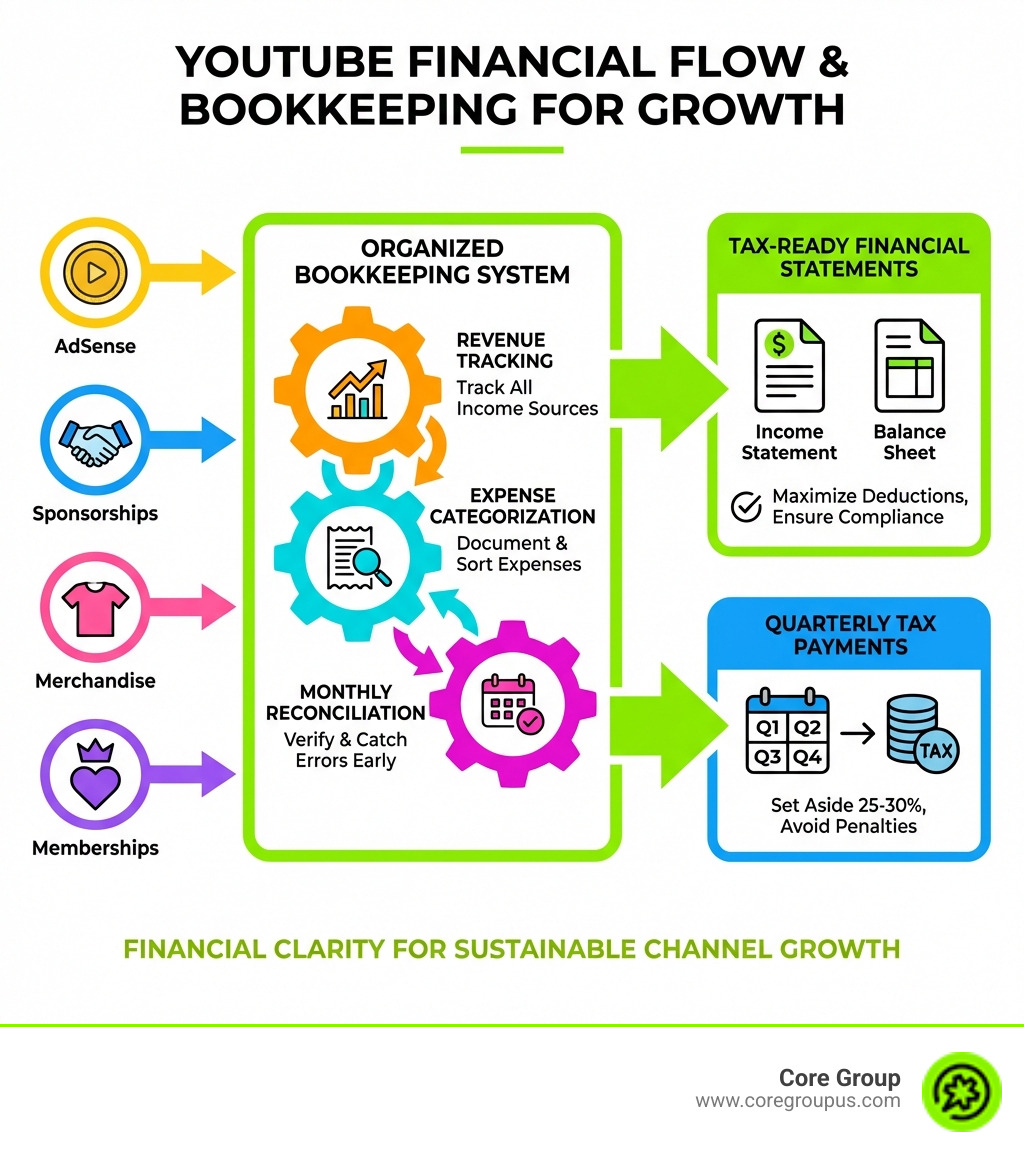
Why Bookkeeping is Your Secret Weapon for Growth
Think of bookkeeping as your channel's co-pilot for smarter financial decisions. Without treating your content like a business, you're likely overpaying in taxes and risking penalties. We believe bookkeeping for YouTubers is essential for compliance and true business growth.
Here's why financial clarity is your secret weapon:
- Informed Decision-Making: Accurate records of income and expenses reveal your channel's financial health. This data helps you decide on content strategy, investments, and collaborations. Should you buy that new lens? Are your software subscriptions paying off? Clean books provide the answers.
- Tracking Profitability: Bookkeeping distinguishes between gross income and net profit. Knowing your profit margins helps identify which content, sponsorships, or merchandise is most lucrative, enabling "calculated scaling" for a profitable business.
- Budgeting for Big Projects: Want to launch a new series or hire an editor? Detailed financial records allow for realistic budgets, ensuring your creative ideas don't break the bank.
- Understanding Financial Reports: Reports like Profit & Loss (P&L) and Cash Flow statements are vital. A P&L shows your channel's profitability, while a cash flow statement tracks how cash is generated and used. Understanding these helps in planning tax payments and controlling spending.
- Peace of Mind: Great bookkeeping frees you from financial chaos. It helps maximize deductions, avoid IRS penalties, and even qualify for loans. This peace of mind lets you focus on creating engaging content.
Bookkeeping is simply tracking your financial transactions. When done right, it reduces stress and protects your business, allowing you to focus on your passion.
Tracking Your Multi-Platform Income & Expenses

Today's creators juggle multiple income streams, which can become a headache without proper financial management. For agencies and startups managing creators, the challenge is capturing income from disparate sources and categorizing expenses to optimize profitability.
Centralizing income tracking with automation is key. Software that integrates with major platforms can automatically import payments, invoices, and transaction data from payment processors, ad dashboards, and e-commerce platforms. This streamlines data input, prevents errors, and provides clear insights into your revenue streams.
Primary YouTuber Income Sources
Understanding and tracking each income source is crucial for accurate bookkeeping for YouTubers. Here are the primary sources:
- AdSense Revenue: Paid by Google for ads on your videos. We track this via your AdSense dashboard or monthly payouts.
- Brand Sponsorships: Direct deals with brands for product placements or integrated content. We track these using invoices and contract details.
- Affiliate Marketing: Commissions earned from audience purchases through your unique links. We record payouts from affiliate programs as they arrive.
- Merchandise Sales: Income from branded products. We integrate with e-commerce platforms like Shopify to track sales data.
- Channel Memberships & Patreon: Recurring fees from viewers for exclusive content. We track these monthly after platform fees.
- Super Chat & Super Thanks: Direct donations from viewers during live streams or on videos, tracked through YouTube payout reports.
- Digital Products: Sales of e-books, presets, or online courses, tracked through your hosting platform.
All income, including cash and gifted products (at fair market value), is taxable. We ensure every dollar is accounted for.
Common Deductible Expenses for YouTubers
Treating your channel as a business allows you to claim tax deductions, which reduce your taxable income. Here are common deductible expenses we help clients claim:
- Video Equipment: Cameras, lenses, tripods, lighting, microphones, and drones. Larger purchases are typically depreciated over time.
- Editing Software & Tools: Subscriptions for video editing, graphic design, music licensing, stock footage, and analytics platforms.
- Home Office Expenses: A portion of your rent/mortgage, utilities, and insurance if you have a dedicated and exclusive workspace.
- Internet & Phone Bills: The business-use portion of these services is deductible.
- Travel for Content: Costs for travel related to collaborations, filming, or industry events, including flights and accommodation.
- Marketing & Advertising: Expenses for promoting your channel, like social media ads or Google AdWords campaigns.
- Professional Services: Fees for lawyers, accountants, bookkeepers, editors, or virtual assistants.
- Props and Wardrobe: Items purchased specifically for use in your videos.
- Training & Education: Courses or workshops to improve your video production or business skills.
We track these expenses with creator-specific tax deductions in mind to lower your tax bill.
A Practical Guide to Bookkeeping for YouTubers
Treating your YouTube channel like a business requires a consistent and reliable financial system. Spending 15-30 minutes on bookkeeping weekly or monthly is far easier than facing a mountain of receipts at year-end. Our Free Creative Guide can help you get started.
Setting Up Your System
The foundation of effective bookkeeping for YouTubers is separating personal and business finances.

- Separate Business Bank Account: This is the most important step. Mixing personal and channel money creates chaos at tax time. A dedicated business account clarifies your financial picture and simplifies tracking. Link it to your YouTube AdSense for seamless payments.
- Choosing a Method: You can use simple spreadsheets or robust bookkeeping software.
- Spreadsheets: Good for beginners but become unwieldy and error-prone as your channel grows.
- Bookkeeping Software: Solutions like QuickBooks Online, Xero, or Wave streamline tracking with automation and reporting features.
- Setting Up Income & Expense Categories: Define clear categories for income (AdSense, Sponsorships) and expenses (Equipment, Software) to ensure consistency and simplify reporting.
- Digital Record-Keeping: Ditch paper receipts. Digitize every receipt and invoice immediately using scanning apps and cloud storage. The IRS and CRA require proof for every deduction, and digital copies are acceptable.
Best Practices in Bookkeeping for YouTubers
Once your system is set up, adopt these best practices:
- Schedule Monthly Money Check-ins: Dedicate 15-30 minutes each month to review finances, categorize transactions, and track income.
- Reconcile Accounts Regularly: Monthly reconciliation of bank and credit card accounts ensures accuracy and keeps your financials audit-ready.
- Keep Detailed Financial Records: Maintain all income statements, invoices, receipts, and contracts. The IRS requires proof for every deduction.
- Set Aside Money for Taxes: As a self-employed creator, you must pay estimated taxes. Set aside 25-30% of your income to avoid a large tax bill.
- Automate Where Possible: Use bookkeeping software to automate recurring payments, categorize expenses, and import transactions to save time.
- Review Financial Reports: Regularly review your Profit & Loss and Cash Flow statements to understand profitability and manage spending.
Common Bookkeeping Mistakes YouTubers Make
Avoid these common mistakes that lead to missed deductions, stress, and penalties:
- Mixing Personal and Business Finances: This complicates tax preparation and makes tracking a nightmare.
- Only Tracking AdSense: Forgetting other income from sponsorships, affiliates, or merch leads to an incomplete financial picture.
- Not Saving Receipts/Invoices: No receipt means no proof of the expense, and you lose the deduction.
- Forgetting Write-Offs: Many creators miss out on deductible expenses like internet bills or home office space, leading to overpaying taxes.
- Waiting Until Tax Season: Sorting a year's worth of transactions at the last minute causes stress and errors.
- Ignoring Unpaid Invoices: Failing to follow up on overdue payments hurts your cash flow.
Poor financial management leads to mismatched books, missed deductions, and year-end frustration. For growing creators, DIY methods introduce risk and costly errors.
Navigating Taxes: From AdSense to Tax Forms
Once you start earning money from any source—AdSense, brand deals, merch—you're running a business, and your earnings are taxable income. All revenue streams, including ad revenue, Super Chat, memberships, and sponsorships, must be declared.
For U.S.-based creators, the IRS considers you self-employed. This means you owe both regular income tax and self-employment taxes (Social Security and Medicare). You'll likely need to pay estimated taxes quarterly. Keeping detailed financial records is essential for filing accurate returns and avoiding IRS penalties. We recommend setting aside funds for these payments, and the IRS offers resources on Estimated Tax Payments and Deadlines.
Tax Obligations for Canadian YouTubers
The Canada Revenue Agency (CRA) views YouTubers as self-employed, so you must report all earnings as business income. This includes AdSense, sponsorships, and gifted products.
Here's a breakdown of your tax obligations:
- Income Tax: You pay self-employment income tax. Combined federal and provincial taxes can be 20–30% on an income of $50,000. The first $15,705 (for 2025) is tax-free due to the basic personal amount but must still be reported.
- GST/HST Registration: If your income exceeds $30,000 annually, you must register for, collect, and remit GST/HST. Learn more about GST/HST for businesses.
- CPP Contributions: As self-employed, you pay both employee and employer portions of CPP contributions, totaling 12.2% on net income between $3,500 and $79,400 (for 2025).
- Filing Deadlines: Your tax return is due by June 15th, but any taxes owed must be paid by April 30th to avoid penalties.
- Claiming Deductions: Lower your taxes by deducting business expenses on Form T2125. This calculates your net business income, which is then transferred to your T1 General return. See the CRA’s deductions guide for more details.
- Avoiding Penalties: Report all income, keep records for six years, and use the Voluntary Disclosures Program (VDP) to correct errors without severe penalties. We recommend setting aside 25-30% of your income for taxes and 12.2% for CPP.
DIY vs. Pro: When to Level Up Your Financial Game
You got into YouTube to create, not crunch numbers. While DIY bookkeeping may work initially, as your channel scales, manual spreadsheets introduce risk and costly errors. Managing content, editing, and audience engagement is enough work without the added stress of complex finances.
This is where expertise helps. We work with Content Creators across the country, providing the financial clarity they need. Our "no-fluff, profit-first playbook" saves time and provides peace of mind.
Using Bookkeeping Solutions
The right bookkeeping software can be a game-changer, offering several benefits:
- Automation: Software automates repetitive tasks like importing transactions from banks and payment platforms (YouTube, Patreon, Shopify), saving hours and preventing errors.
- Real-time Financial Dashboards: Get an at-a-glance view of your channel's financial health to make informed strategic decisions.
- Integration: The best solutions integrate with your income platforms, tracking all revenue streams in one place.
- Scalability: Software can scale with your business, handling increased transaction volumes and complexity.
Working with a Professional Bookkeeper or Firm
While software is a powerful tool, expert guidance is invaluable. Here’s how a firm like ours makes a difference:
- Expertise in the Creator Economy: We specialize in the unique financial landscape of YouTubers, from ad revenue nuances to the specific tax laws that apply to you.
- Maximizing Tax Deductions: Our expertise ensures you claim all legitimate tax deductions, and we advise on strategies to minimize your tax liability.
- Strategic Financial Advice: We go beyond tracking numbers to offer strategic advice. As your CFO consultant, we help you analyze reports, manage cash flow, and make informed decisions about growth.
- Cost-Effective Expertise: Hiring a full-time accountant can cost upwards of $57,000 annually. Our services provide a dedicated bookkeeper and accountant at a fraction of that cost. We work with clients across Alabama, Alaska, Arizona, Arkansas, California, Colorado, Connecticut, Delaware, Florida, Georgia, Hawaii, Idaho, Illinois, Indiana, Iowa, Kansas, Kentucky, Louisiana, Maine, Maryland, Massachusetts, Michigan, Minnesota, Mississippi, Missouri, Montana, Nebraska, Nevada, New Hampshire, New Jersey, New Mexico, New York, North Carolina, North Dakota, Ohio, Oklahoma, Oregon, Pennsylvania, Rhode Island, South Carolina, South Dakota, Tennessee, Texas, Utah, Vermont, Virginia, Washington, West Virginia, Wisconsin, and Wyoming.
- Managing Complex Finances: We simplify multi-platform income by centralizing data and ensuring everything is tax-ready, preventing mismatched books. Our Bookkeeping Services Dallas page outlines our approach.
By partnering with us, you gain access to a team that treats your business as if it were our own, providing the financial backbone you need to flourish.
Frequently Asked Questions about Bookkeeping for YouTubers
We often get asked similar questions by content creators navigating their finances. Here are some of the most common:
How much should a YouTuber set aside for taxes?
A general rule of thumb for self-employed individuals in the U.S. is to set aside around 25-30% of your net income for federal and state income taxes, plus self-employment taxes (Social Security and Medicare). In Canada, we advise setting aside 25-30% for income taxes and an additional 12.2% for CPP contributions. However, this can vary significantly based on your total income, deductions, and the specific tax laws in your state or province. For the most accurate estimate, we highly recommend consulting with a tax professional who understands the creator economy. They can help you calculate your estimated quarterly tax payments precisely.
Can I deduct equipment I also use personally?
Yes, you generally can, but you can only deduct the business-use portion of the expense. For example, if you use a camera 80% of the time for filming your YouTube videos and 20% for personal family photos, you can only deduct 80% of the camera's cost and any related expenses (like repairs or insurance). It’s crucial to keep a detailed log or reasonable estimate of your business versus personal use to justify the deduction if ever questioned by the IRS or CRA.
What's the single most important first step for a new YouTuber's finances?
Without a doubt, the single most important first step for any new YouTuber (or any self-employed individual) is to open a separate bank account for your YouTube business. This simple action creates a clear distinction between your personal and business finances, which is the absolute foundation for clean bookkeeping. It makes tracking income and expenses infinitely easier, simplifies reconciliation, and drastically reduces headaches during tax season. This separation is also vital for liability protection if you ever decide to incorporate your business.
Conclusion: Focus on Creating, Not Crunching Numbers
Content creators and influencers aren’t just building brands—they’re building businesses. And like any successful business, yours needs a solid financial foundation.
Great content builds your audience—but great bookkeeping protects your business.
We know that bookkeeping for YouTubers can seem daunting, but it doesn't have to be. By understanding your income streams, tracking your expenses, separating personal and business finances, and adopting consistent practices, you can transform your financial management from a source of stress into a powerful tool for growth.
Key takeaways:
- You are running a business, and financial clarity is paramount.
- Track all income and expenses carefully across all platforms.
- Leverage technology and consider professional help as you scale.
- Understand your tax obligations and plan for them proactively.
Don't let the complexities of finance distract you from your passion. Take control of your finances today, and empower your creative journey. Our "no-fluff, profit-first playbook" is designed specifically for creative entrepreneurs like you, guaranteeing peace of mind and saving you time, so you can focus on creating.
Ready to gain financial clarity and protect your YouTube business? Lets Chat about your financial strategy and how we can help your Content Creators thrive.