4 Steps to a Bulletproof Business Financial Plan
Why Business Financial Planning is Your Creative Business's Foundation

Business financial planning is the strategic process of mapping out your company's financial future—projecting revenues, planning expenses, managing cash flow, and aligning resources with your business goals. For creative entrepreneurs juggling production schedules, client deliverables, and team management, a solid financial plan transforms financial chaos into clarity.
Quick Answer: What Business Financial Planning Includes
- Financial Statements - Income statement, balance sheet, and cash flow statement that track your money
- Revenue Forecasting - Projecting future sales based on historical data and market trends
- Expense Planning - Identifying and budgeting for all fixed and variable costs
- Cash Flow Management - Ensuring you have money when you need it
- Risk Planning - Building contingencies for unexpected challenges
- Funding Strategy - Determining capital needs and financing sources
Here's the reality: companies with professional financial plans secure funding 40% faster and at 15-20% better valuations than those without. More importantly, they avoid the $50K-$500K cost of a cash crisis—those emergency financing fees, rushed asset sales, and disrupted operations that can sink a creative business.
Think of your financial plan as your business's north star. It's not a spreadsheet to file away—it's your strategic roadmap that turns creative vision into profitable reality. It answers the critical questions: How will we make money? What do we need to achieve our goals? Can we afford this next hire or equipment purchase?
The best part? You don't need an MBA to create one. You just need the right framework and the willingness to face your numbers honestly.
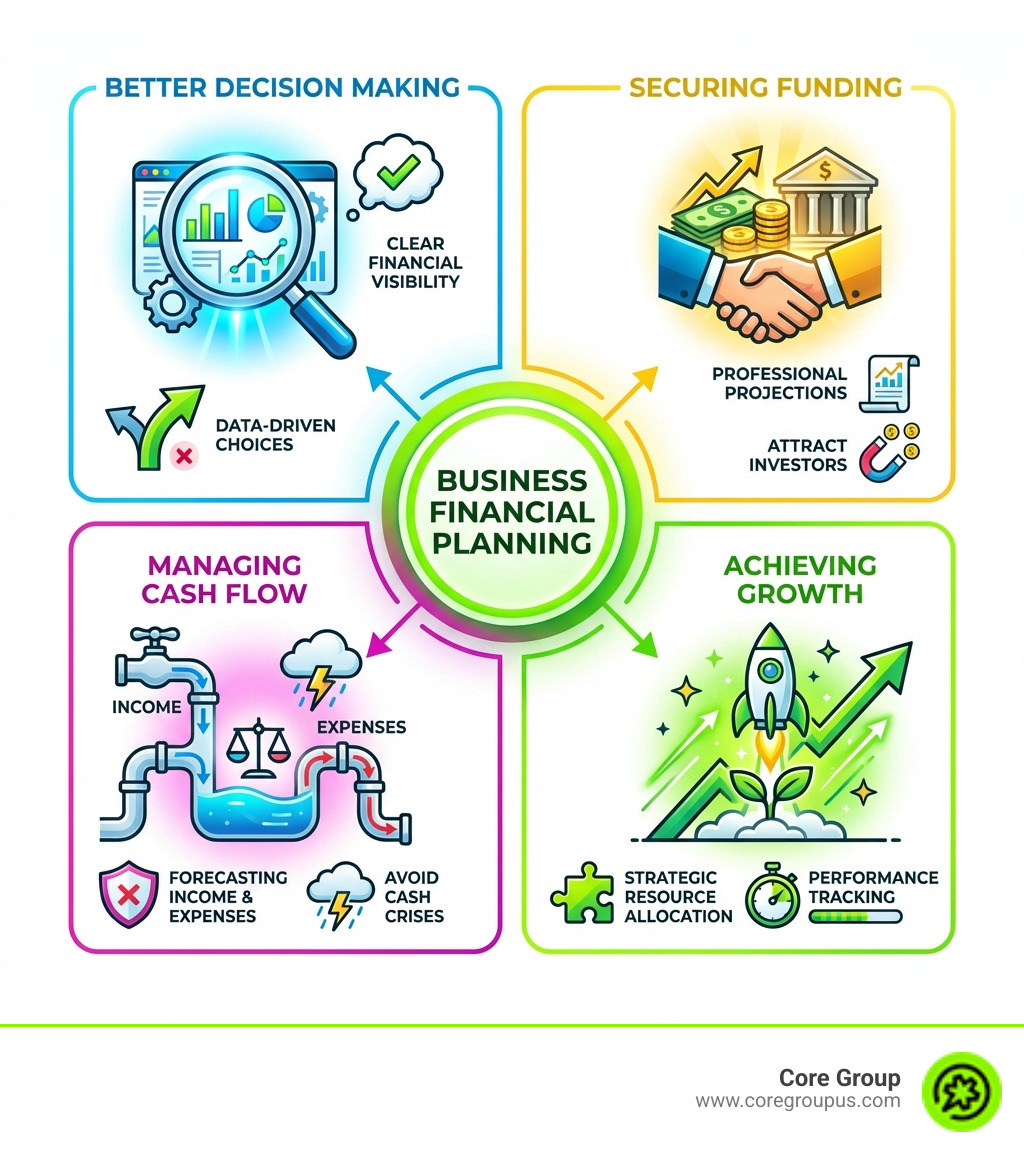
What is Business Financial Planning and Why is it Your Creative Compass?
At its heart, business financial planning translates your grand business goals into a numerical story. It’s the process of looking ahead, estimating your income, anticipating your expenses, and making sure you have enough cash to keep the lights on and grow. For us creative entrepreneurs, this isn't about stifling our artistic spirit; it's about providing the clarity and control we need to flourish.
A well-crafted financial plan aligns your creative strategy with your available resources. It helps us understand the financial impact of our decisions, whether we're investing in new equipment, hiring a new team member, or launching a new product line. Without this roadmap, we're navigating in the dark, risking wasted budget on low-ROI activities and missing out on over $200K+ in lost revenue annually from an inability to seize time-sensitive opportunities.
When we commit to financial planning, we gain confidence and empower ourselves to make informed choices. It's how we move From Intimidated to Empowered: A Creative's Guide to Financial Epiphanies, changing our relationship with our business's money.
The Financial Plan vs. The Business Plan
While often discussed together, it's crucial to understand the distinction:
- The Business Plan is the "what" and "why" of your enterprise. It outlines your company's mission, vision, products or services, market analysis, marketing strategy, and management team. It describes the overall direction and purpose of your business. If you're looking for a guide to writing your comprehensive business plan, you can find valuable resources on Writing a business plan.
- The Financial Plan is the "how much" and "when." It's the numerical expression of your business plan, detailing the monetary aspects of your strategy. It quantifies the costs, revenues, and cash flows required to achieve your business goals.
These are interconnected but distinct documents. Your financial plan is a core part of your broader business plan, providing the hard numbers that demonstrate viability and potential. The business plan sets the stage, and the financial plan proves the concept is financially sound.
The Undeniable Benefits for Your Business
Embracing business financial planning offers a multitude of advantages that go beyond just balancing the books:
- Informed Decision-Making: A financial plan provides the data for timely, informed decisions, showing the potential impact of choices on revenue, expenses, and cash flow.
- Proactive Risk Management: Planning for contingencies reduces financial surprises by 60-70%. This means building emergency funds or lines of credit to cushion against unexpected downturns.
- Optimized Resource Allocation: Financial planning ensures budgets support strategic goals. It helps identify low-ROI activities and reallocate funds to initiatives that drive growth.
- Attracting Investors: A well-structured financial plan helps secure funding faster and at better valuations. It demonstrates financial stewardship and a clear path to profitability.
- Increased Company Value: Clear financial documentation increases company value, helping businesses sell 25-40% faster and for 10-20% higher valuations. This strategic approach helps build a business that can grow beyond its founders, as explored in The Founders' Evolution: Why Your Business Cannot Grow Beyond You.
The Anatomy of a Winning Financial Plan
A comprehensive financial plan is built on a foundation of key documents and forecasts that work together to give us a 360-degree view of our business's financial health. It's like having an X-ray of our company, revealing its strengths and areas for improvement.

The Three Core Financial Statements
These three statements are the bedrock of any financial plan, providing an objective record of our business's past performance and current standing. Historical data from these statements serves as a crucial baseline for our future projections.
- Income Statement (Profit & Loss or P&L): This statement summarizes your company’s revenues, costs, and expenses over a period (e.g., a quarter or year). It reveals your profit margins and overall profitability, including elements like cost of goods sold and operating expenses.
- Balance Sheet: This snapshot of your company’s financial position reports assets (what you own), liabilities (what you owe), and equity. Following the formula Assets = Liabilities + Shareholder Equity, it assesses financial stability and health.
- Cash Flow Statement: This statement tracks the actual movement of cash into and out of your business. It's vital because profit doesn't always equal cash; a profitable business can fail if payments are delayed. It helps you manage liquidity and assess your ability to pay obligations.
Essential Components of a Business Financial Planning Document
Beyond the core statements, a robust business financial planning document includes forward-looking elements:
- Sales Forecasts: We base these forecasts on historical sales data, market research, and seasonal trends. Realistic sales forecasts are critical, as most projections tend to be 30-50% too high.
- Expense Projections: This involves forecasting all anticipated fixed and variable costs (like rent and materials). Accurate expense projections help us budget effectively and avoid financial surprises.
- Personnel Plan: For many creative businesses, people are our biggest asset and expense. This plan forecasts salaries, benefits, and other personnel-related expenses. It helps align hiring with revenue projections.
- Assets and Liabilities: While the Balance Sheet shows our current assets and liabilities, the financial plan also projects future changes. Assets are resources we own that can provide future economic benefits (e.g., cash, inventory, property, equipment). Liabilities are our financial obligations (e.g., loans, accounts payable, debt). Understanding these helps us assess our financial position, liquidity, and overall health.
Key Financial Analyses to Include
To truly understand our financial narrative, we integrate specific analyses:
- Break-Even Analysis: This determines the point where our total revenues equal our total costs, meaning we're neither making a profit nor incurring a loss. It's invaluable for setting sales volume and revenue goals, informing pricing strategies, budgeting, and cost management. Its key components include fixed costs, variable costs, and sales price per unit.
- Profitability Analysis: Beyond the P&L, this digs deeper into what drives our profits. It can involve analyzing profitability by product, service, client, or project. This helps us identify our most lucrative offerings and allocate resources accordingly.
- Contribution Margin: This metric tells us how much revenue is available to cover fixed costs after variable costs are paid. It's the amount of sales revenue a company has, less its variable costs, to put toward paying its fixed costs. A healthy contribution margin is essential for covering overhead and generating profit.
- Scenario Modeling (Best, Base, Worst-Case): This involves creating financial projections for various potential futures. A "base case" is our most likely scenario, an "optimistic" or "best case" scenario assumes favorable conditions, and a "pessimistic" or "worst case" scenario prepares us for challenges. Typically, we might model these as +/- 10% variations of key financial drivers. This helps us plan for contingencies and build resilience.
The 7-Step Blueprint to Your Business Financial Planning
Building our financial plan is a methodical process. By following these steps, we can create a robust financial roadmap that guides our creative enterprise to sustainable success.

Step 1: Define Your Strategic Goals (SMART)
Every great journey begins with a clear destination. For us, that means setting SMART goals: Specific, Measurable, Achievable, Relevant, and Time-bound. Are we aiming to launch a new product? Expand into a new market? Increase our profit margin by 15% in the next year? Our financial targets must align directly with our broader business vision. This initial step is about asking critical questions like: Do we need to expand? Do we need more equipment? Do we need to hire more staff? What resources do we need? Clearly defining these goals is the foundation upon which the rest of our financial plan will be built, much like how we first approach Developing your business idea.
Step 2: Gather Your Financial Data
To accurately project our future, we must understand our past and present. This step involves collecting comprehensive data:
- Historical financial statements: Our past income statements, balance sheets, and cash flow statements provide crucial insights into trends and performance.
- Sales data: Detailed records of past sales, broken down by product, service, or customer, help us identify patterns.
- Operational costs: A thorough understanding of all our fixed and variable expenses is paramount.
- Market research: Data about our target market, industry trends, and competitor analysis helps us make informed assumptions for our forecasts. For example, understanding demographic data can help us better understand our potential customers and their needs.
Data quality is key here—it needs to be accurate, complete, current, and relevant.
Step 3: Develop Financial Projections
With our goals defined and data gathered, we can now forecast our financial future. This is where we translate our strategic aspirations into numbers:
- Forecast revenue and expenses: Using our sales data and market insights, we project our future income. Simultaneously, we anticipate all our expenses, including costs for major projects identified in our strategic plan. We recommend creating monthly projections for the next 12 months, and quarterly or annually for the next 3-5 years.
- Create projected financial statements: We then build pro-forma (projected) income statements, balance sheets, and cash flow statements. These are our best guesses for what these statements will look like in the future, based on our assumptions. Remember to consider best, base, and worst-case scenarios to understand the range of possibilities.
Templates can be incredibly helpful during this stage. You can find examples in a Business plan template.
Step 4: Plan for Contingencies and Risks
No business journey is without its bumps. Identifying potential financial risks and having a plan to mitigate them is crucial. This is about asking: "What would we do if our finances suddenly deteriorated?"
- Identify potential financial risks: These could include market downturns, loss of a major client, unexpected expenses, or supply chain disruptions.
- Cost of cash crisis: As we've seen, the average cost of a cash crisis can range from $50K-$500K. Proactive planning can help us avoid these exorbitant emergency financing fees.
- Create a contingency fund: Establish emergency sources of money, such as a dedicated cash reserve equal to 3-6 months of operating expenses, or a readily available line of credit.
- Consult with a Core Group advisor about risk management strategies: Our team can help you assess specific risks unique to your creative business and build robust mitigation plans.
Step 5: Outline Your Funding Strategy
Most creative businesses will need external capital at some point, whether for initial startup, growth, or unexpected challenges. Our financial plan helps us determine our capital needs and how we'll acquire it.
- Determine capital needs: Based on our projections, we'll know how much money we need and when. This includes distinguishing between short-term working capital needs and long-term investment requirements.
- Equity vs. Debt financing: We'll evaluate the pros and cons of different funding sources. Equity financing involves selling a stake in our company, while debt financing involves borrowing money that must be repaid with interest. Understanding What is the Difference Between Short-Term and Long-Term Debt? is crucial here.
- Attracting investors: A well-articulated funding strategy, backed by solid financial projections, is essential for attracting potential investors or securing loans from financial institutions. They want to see a clear path to repayment or return on investment.
Step 6: Create a Monitoring and Review Process
A financial plan isn't a static document; it's a living guide. Consistent monitoring ensures we stay on track and can adapt as circumstances change.
- Establish Key Performance Indicators (KPIs): These are the critical metrics we'll track regularly to gauge our financial health. Examples include gross profit margin, net profit margin, customer acquisition cost, and monthly recurring revenue.
- Set a review schedule (monthly, quarterly): We recommend reviewing our actual financial results against our projections monthly for granular insights, and conducting a more comprehensive review quarterly. Annually, we'll update the entire plan.
- Variance analysis: This involves investigating significant deviations between our actual results and our planned projections (e.g., if revenue is 15% below forecast). Understanding why these variances occurred helps us make necessary adjustments.
Step 7: Consolidate Your Plan
Finally, we compile all the sections of our business financial planning into one cohesive document. This includes our strategic goals, financial statements, projections, risk assessments, and funding strategy. We'll also write a compelling executive summary—a high-level overview for leaders and potential investors that highlights our mission, objectives, top-line projections, and critical assumptions. This comprehensive document is our financial story, ready to guide us and impress stakeholders. When you're ready to discuss your plan or need assistance, remember you can always Book a Call with our experts.
Monitoring, Measuring, and Mastering Your Financial Health
A financial plan is a living document. Consistent monitoring and adaptation are crucial for navigating the unpredictable journey of entrepreneurship. We wouldn't set sail without a compass and then ignore it; similarly, we shouldn't create a financial plan and then forget about it.
Key Financial Metrics and Ratios to Track
Financial ratios provide clear indications of our financial standing and help us evaluate our business's health. They are powerful tools for understanding our liquidity, profitability, debt levels, and operational efficiency.
| Ratio Category | Ratio Name | Formula (Example) | What it Measures | Ideal Value (General) |
|---|---|---|---|---|
| Liquidity | Current Ratio | Current Assets / Current Liabilities | Ability to meet short-term obligations | > 2:1 |
| Quick Ratio | (Current Assets - Inventory) / Current Liabilities | Ability to meet short-term obligations without inventory | > 1:1 | |
| Profitability | Gross Profit Margin | (Revenue - COGS) / Revenue | Profitability after direct costs of goods/services | Varies by industry |
| Net Profit Margin | Net Income / Revenue | Overall profitability after all expenses | Varies by industry | |
| Debt | Debt-to-Equity | Total Debt / Shareholder Equity | Proportion of debt financing relative to equity | < 1:1 (Generally safe) |
| Debt-to-Asset | Total Debt / Total Assets | Proportion of assets financed by debt | < 0.5:1 | |
| Efficiency | Inventory Turnover | COGS / Average Inventory | How quickly inventory is sold and replaced | Varies by industry |
| Accounts Receivable Turnover | Net Credit Sales / Average Accounts Receivable | How efficiently credit is extended and collected | Higher is better |
- Liquidity Ratios: Ratios like the Current and Quick Ratio measure your ability to meet short-term obligations. A current ratio above 2:1 and a quick ratio above 1:1 are ideal, while values below 1 are a red flag.
- Profitability Ratios: These measure your business's ability to generate profit relative to revenue or assets. Gross and Net Profit Margins are essential for understanding your core earning power.
- Debt Ratios: Ratios like Debt-to-Equity show the extent to which your business relies on debt. A ratio below 1 is generally considered safe, while anything above 2 can indicate higher risk.
- Efficiency Ratios: These evaluate how effectively your business uses its assets and manages liabilities. Inventory Turnover, for instance, shows how efficiently you're managing stock.
The Role of Technology and Professional Help
Managing the complexities of business financial planning can be significantly streamlined with the right tools and expertise.
- Financial planning software: While spreadsheets are a good starting point, they can quickly become overwhelming as our business grows, especially when collaborating or needing advanced analytics. Cloud-based budgeting software offers customizable budgets, robust tracking, powerful analytics, and automation features, providing greater precision and efficiency.
- Accounting software benefits: Modern accounting software helps us maintain well-kept, accurate, and accessible financial records. This forms the basis for sound financial decisions, improves our credibility with investors, helps us fulfill tax obligations, and makes our lives much easier.
- When to hire an accountant or financial advisor: Even with excellent software, the nuances of financial strategy, tax planning, and risk management can be complex. An accountant can help with accurate record-keeping, tax preparation, and understanding financial statements. A financial advisor, particularly one specializing in small businesses, can provide strategic guidance on projections, funding, and long-term growth. Our team at Core Group provides the accounting and financial expertise creative entrepreneurs need to thrive. For more insights and guidance, don't forget to check out The Planner Blog.
Best Practices for Monitoring Performance
Effective monitoring isn't just about looking at numbers; it's about active engagement with our financial story.
- Regularly compare actuals to projections: This is the core of financial monitoring. Monthly, we should review our actual income and expenses against what we projected. This helps us spot problems early—companies with strong operational planning often spot issues 6-8 weeks earlier than those without.
- Conduct variance analysis: When there's a significant difference (e.g., more than 10%) between our actuals and projections, we need to investigate why. Was revenue lower than expected? Were expenses higher? Understanding the root cause is crucial for corrective action.
- Adjust the plan as needed: Our financial plan should be flexible. If market conditions change, a new opportunity arises, or our projections prove inaccurate, we must be prepared to adjust our plan. Don't adhere too rigidly to a plan when circumstances demand a pivot.
- Use rolling forecasts: Instead of just sticking to an annual budget, consider rolling forecasts. This means continually updating our projections for the next 12 months, adding a new month as each one passes. This keeps our financial outlook fresh and relevant.
Frequently Asked Questions about Business Financial Planning
How often should I review and update my financial plan?
We recommend a multi-tiered approach:
- Annually at a minimum: Conduct a comprehensive review and update of your entire financial plan, including long-term projections. This aligns with annual business strategy sessions.
- Quarterly for a detailed review: Dive deeper into your financial statements, compare actuals to projections, and adjust your forecasts for the upcoming quarters.
- Monthly check-ins on key metrics: Monitor your KPIs and cash flow statements monthly to catch any deviations early.
- Update after major business events or market shifts: If you launch a new product, secure a significant client, experience a sudden market downturn, or make a major investment, your financial plan needs immediate updating to reflect these new realities.
Financial plans are living documents; they should evolve with your business and the market.
How does a financial plan differ for a startup versus an established business?
The core principles of business financial planning remain the same, but the emphasis shifts:
- Startups: For new ventures, the focus is heavily on cash runway, burn rate, and securing initial funding. Projections are often based on market research and assumptions, with less historical data. The primary goal is to prove viability, manage initial capital, and reach profitability. For creative entrepreneurs, understanding entity types like Should Creative Entrepreneurs Become an S-Corp? can be crucial early on.
- Established Businesses: These businesses have historical data to draw from, making projections more accurate. The focus shifts to optimizing cash flow, maximizing profitability, return on investment, and strategic growth initiatives. They plan for expansion, new investments, and potentially exit strategies.
A 5-year plan for a pre-revenue startup might be mostly fiction, but for a mature business, it's a solid roadmap.
What are the most common mistakes to avoid when creating a financial plan?
Even the most well-intentioned entrepreneurs can stumble. Here are some pitfalls to steer clear of:
- Overly optimistic revenue projections: It's easy to get excited about potential sales, but unrealistic forecasts can lead to poor decision-making and cash flow problems. Always ground your revenue estimates in solid market research and realistic growth rates.
- Underestimating expenses: Many entrepreneurs forget to account for every little cost, from software subscriptions to professional fees. Be thorough, and always build in a buffer for unexpected costs.
- Forgetting to plan for taxes: Taxes are a significant expense that can catch businesses off guard if not properly accounted for in the financial plan. Integrating tax planning from the outset is crucial.
- Ignoring cash flow: A business can be profitable on paper but still fail due to lack of cash. Always prioritize cash flow projections to ensure you have the liquidity to meet your obligations.
- Creating the plan and never looking at it again: A financial plan is not a one-and-done task. It needs continuous monitoring, review, and adjustment to remain relevant and effective.
Conclusion: Empower Your Creative Vision with Financial Clarity
Crafting a business financial planning document is not about restricting your creativity—it's about empowering it. By building a clear, strategic financial roadmap, you gain the confidence and control to make bold decisions, seize opportunities, and build a sustainable, profitable business. We believe that with financial clarity, creative entrepreneurs can truly flourish, focusing their energy on what they do best: bringing their unique visions to life.
The team at Core Group specializes in this "profit-first" approach, helping creative entrepreneurs across Alabama, Alaska, Arizona, Arkansas, California, Colorado, Connecticut, Delaware, Florida, Georgia, Hawaii, Idaho, Illinois, Indiana, Iowa, Kansas, Kentucky, Louisiana, Maine, Maryland, Massachusetts, Michigan, Minnesota, Mississippi, Missouri, Montana, Nebraska, Nevada, New Hampshire, New Jersey, New Mexico, New York, North Carolina, North Dakota, Ohio, Oklahoma, Oregon, Pennsylvania, Rhode Island, South Carolina, South Dakota, Tennessee, Texas, Utah, Vermont, Virginia, Washington, West Virginia, Wisconsin, and Wyoming transform financial data into a powerful tool for growth and peace of mind. Our no-fluff, profit-first playbook saves you time and guarantees peace of mind, allowing you to focus on your business.
Ready to take the next step in securing your financial future? Explore our Tax Planning resources to get started.