How to Claim Your Business Phone Deduction
Why Your Business Phone Could Be Your Next Big Tax Win

Your smartphone is a powerful tool for your creative business, but it's also a valuable tax deduction. Many entrepreneurs overlook the ability to write off their phone, service plan, and related expenses, potentially missing out on hundreds or thousands of dollars in savings.
Quick Answer: Can You Deduct Your Business Phone?
- Self-Employed/Freelancers: Yes, deduct the business-use percentage of your phone expenses on Schedule C
- Business Owners (LLC, S-Corp): Yes, through business expenses or reimbursement plans
- W-2 Employees: Generally no (since 2018), except for specific professions like Armed Forces reservists
- Mixed Personal/Business Use: Deduct only the business percentage (e.g., 60% business use = 60% deduction)
- 100% Business Phone: Deduct the full cost if used exclusively for business
The IRS allows you to deduct ordinary and necessary business expenses, and your phone certainly qualifies. However, the rules for claiming this deduction can be complex, depending on your business structure and how you use your phone. This guide will simplify the process, explaining who can claim the deduction, what expenses are eligible, how to calculate the correct amount, and the documentation you need to stay compliant. We'll help you maximize your savings without running afoul of the IRS.
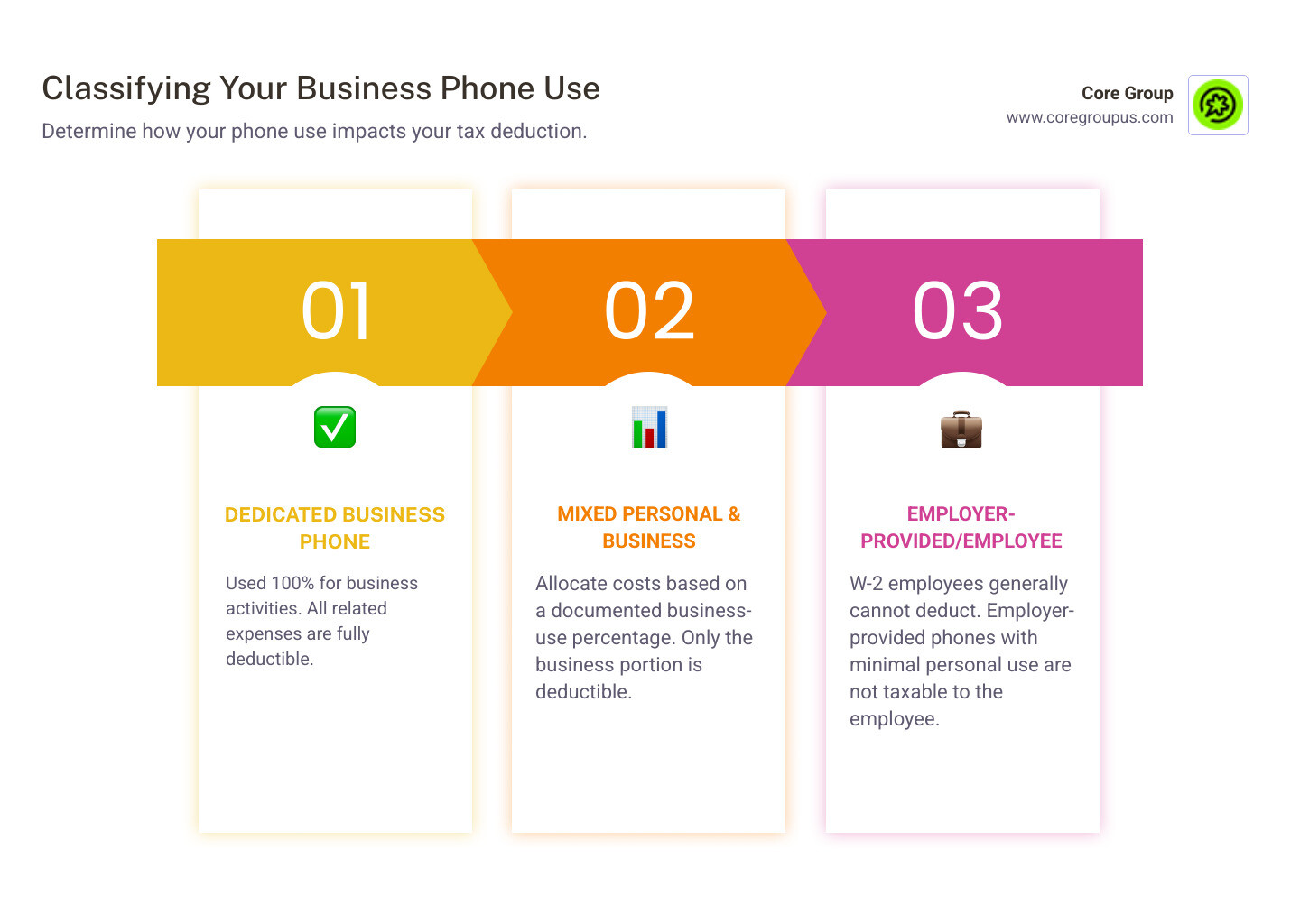
Who Can Write Off a Business Phone?

The ability to claim a business phone deduction depends on your employment status. The IRS requires that any claimed expense be "ordinary and necessary" for your business, a principle from Section 162 of the Internal Revenue Code that applies to all business deductions. Understanding these rules is key to effective Tax Planning.
Self-Employed, Freelancers, and Business Owners
If you're a sole proprietor, independent contractor, or single-member LLC, you can deduct the business-use portion of your phone expenses on Schedule C (Form 1040). This includes the phone itself, your service plan, and data. The key is to accurately track and document your business usage. For example, if 70% of your phone use is for business, you can deduct 70% of your phone-related costs. For partnerships and multi-member LLCs, these expenses are typically deducted at the business level.
S-Corp Owners and Shareholder-Employees
For S-Corporations, the business can deduct the cost of providing cell phones to employees, including shareholder-employees. If you use a personal phone for work, the S-Corp should reimburse you under an accountable plan. This requires you to substantiate the business use and return any excess reimbursement. This reimbursement is tax-free to you and deductible for the S-Corp. Importantly, since 2018, shareholder-employees cannot deduct unreimbursed business expenses on their personal tax returns, making a formal reimbursement policy essential. Learn more in The Essential Guide to S Corporations.
W-2 Employees: The Post-2018 Rules
Due to the Tax Cuts and Jobs Act (TCJA), most W-2 employees can no longer deduct unreimbursed business expenses, including cell phone use. The miscellaneous itemized deduction for these costs was eliminated starting in 2018. The only way for an employee to get a tax benefit for business use of a personal phone is through an employer reimbursement plan. A few exceptions exist for specific professions like Armed Forces reservists. For more details, see IRS Publication 529.
What Phone Expenses Are Actually Deductible?
The business phone deduction covers more than just your monthly bill. Any expense that is "ordinary and necessary" for using your phone for business can be included. This includes the purchase price of the phone itself, monthly service plans, data usage, business-specific apps, accessories like chargers and cases, repairs, insurance, and even international roaming charges for business travel.
The Phone Itself: Purchase Price and Depreciation
The cost of a new smartphone for your business is generally deductible. If it's used 100% for business, you can deduct the full price. For mixed-use phones, you must prorate the cost based on your business-use percentage.
You have two main options for deducting the cost:
- Section 179 Deduction: This allows you to deduct the full purchase price in the year you buy it, which can significantly lower your taxable income.
- MACRS Depreciation: Alternatively, you can depreciate the cost over its useful life, which the IRS generally considers to be 7 years for a cell phone.
For a mixed-use phone, if it's used 60% for business, you can deduct 60% of its cost, either upfront with Section 179 or over time through depreciation.
Service Plans, Bundled Bills, and Second Lines
Your monthly phone bill is a key deductible expense. This includes service fees, data charges, business-related app subscriptions, and long-distance calls.
If you have a bundled bill (e.g., phone, internet, and TV), you must separate the cost of the phone service. If your bill isn't itemized, you can use a reasonable method to allocate the costs, such as dividing the total by the number of services.
A crucial point is the "first landline" rule: The IRS does not allow you to deduct the cost of the first landline into your home, even if you have a home office. However, if you have a second phone line (landline or cell) used exclusively for business, its entire cost is 100% deductible. This is a great strategy for separating business and personal use and maximizing your deduction. For more details, see IRS Publication 535 Business Expenses.
Beyond the Phone: Smartwatches, Hotspots, and Other Tech
Other devices can also qualify as a business expense if they are essential for your work. This includes:
- Smartwatches: If used for business notifications, client communication, or other work-related tasks.
- Mobile hotspots: If you need reliable internet on the go for business purposes.
- Tablets with cellular: If used as a portable workstation for client presentations or work-related tasks.
For all these devices, the business necessity test applies. You must be able to prove the device is an ordinary and necessary expense for your business to claim the deduction.
Calculating Your Business Phone Deduction: Rules for Every Scenario
When it comes to calculating your business phone deduction, the approach varies depending on how you use your phone. The IRS isn't asking you to be a detective, but they do want a reasonable and consistent method.
| Scenario | Deductibility | Calculation Method | Documentation Needed |
|---|---|---|---|
| 1. 100% Business Use | 100% Deductible | Deduct the full cost of the phone and 100% of the monthly service bills. This is the simplest method but requires strict separation. | Phone bills and purchase receipts. Be prepared to prove the phone is used exclusively for business. |
| 2. Mixed Personal & Business Use | Partially Deductible | Calculate your business-use percentage. Apply this percentage to your phone's cost and monthly bills. (e.g., 70% business use = 70% deduction). | Detailed records are crucial. Keep a log for a representative period (e.g., one month per quarter) tracking business vs. personal use, or use a tracking app. Keep all bills and receipts. |
| 3. Employer-Provided Phone (Company-Owned) | Not a personal deduction. The cost is a business expense for the employer. | The employer deducts the full cost. Incidental personal use is generally considered a non-taxable "de minimis" fringe benefit for the employee. | The employer maintains all purchase and service records. A clear company policy on personal use is recommended. |
| 4. Employee-Owned Phone with Reimbursement (Accountable Plan) | Not a personal deduction. Reimbursement is tax-free to the employee. | The employee submits expense reports for business use. The employer reimburses this amount and deducts it as a business expense. | The employee must provide the employer with detailed records (e.g., phone bills, usage logs) to substantiate the expenses. |
| 5. Employee-Owned Phone, No Reimbursement | Not Deductible (for most W-2 employees) | N/A. The Tax Cuts and Jobs Act (TCJA) eliminated the deduction for unreimbursed employee expenses for most taxpayers (2018-2025). | No tax documentation needed, but tracking usage can help you negotiate a reimbursement policy with your employer. |
Why Your Business Phone Could Be Your Next Big Tax Win
Business phone deduction allows you to write off the cost of your smartphone, service plan, and related expenses if you use it for work—potentially saving you hundreds or thousands of dollars each year.
Quick Answer: Can You Deduct Your Business Phone?
- Self-Employed/Freelancers: Yes, deduct the business-use percentage of your phone expenses on Schedule C
- Business Owners (LLC, S-Corp): Yes, through business expenses or reimbursement plans
- W-2 Employees: Generally no (since 2018), except for specific professions like Armed Forces reservists
- Mixed Personal/Business Use: Deduct only the business percentage (e.g., 60% business use = 60% deduction)
- 100% Business Phone: Deduct the full cost if used exclusively for business
Your smartphone isn't just how you communicate with clients, manage projects, or promote your creative work on Instagram. It's also a legitimate business expense that many creative entrepreneurs overlook when tax season rolls around.
Here's the thing: the IRS allows you to deduct ordinary and necessary business expenses, and for most modern businesses, a phone falls squarely into that category. Whether you're a photographer coordinating shoots, a filmmaker managing production schedules, or a media professional juggling multiple client calls, your phone is as essential to your business as your camera or editing software.
But claiming this deduction isn't as simple as writing off your entire phone bill. The rules vary depending on whether you're self-employed, an S-Corp owner, or a W-2 employee. You'll need to calculate your business-use percentage, maintain proper documentation, and understand what the IRS considers "ordinary and necessary."
The good news? Once you understand the rules, claiming your business phone deduction becomes straightforward. And the savings can be significant—especially if you're paying for a premium data plan, business apps, or multiple devices.
This guide will walk you through exactly who can claim a business phone deduction, what expenses qualify, how to calculate your deduction accurately, and what documentation you need to keep the IRS happy. We'll also cover common mistakes that could trigger an audit and show you how to maximize your savings without crossing any lines.
Who Can Write Off a Business Phone?
The ability to claim a business phone deduction hinges primarily on your employment status and how your business is structured. The IRS wants to ensure that any expense claimed is "ordinary and necessary" for your trade or business, meaning it's common and helpful in your industry. This core principle, outlined in Section 162 of the Internal Revenue Code, is our guiding star for all business expense deductions, including your phone.
Navigating these rules can feel like deciphering ancient hieroglyphs, but don't worry, we're here to help you understand the landscape for different business types and individuals. Effective Tax Planning means understanding these distinctions.
Self-Employed, Freelancers, and Business Owners
If you're a sole proprietor, an independent contractor, or run a single-member LLC (taxed as a sole proprietorship), you're generally in the best position to claim a business phone deduction. As a self-employed individual, you report your income and expenses on Schedule C (Form 1040), where you can deduct all ordinary and necessary business expenses.
Eligibility requirements are quite clear: if you use your phone for business, you can deduct the business portion of its cost. This includes calls, texts, data, and even the phone itself. The challenge, and where many get tripped up, is proving business use. The IRS expects you to have records that substantiate your claims. For instance, if you spend 70% of your phone time on client calls, emails, and business-related research, you can deduct 70% of your phone bill.
The impact of your business structure (Sole Proprietorship, LLC, Partnership) on these deductions is relatively straightforward for smaller entities. Sole proprietors and single-member LLCs (taxed as sole proprietors) will claim these deductions directly on Schedule C. For partnerships and multi-member LLCs (taxed as partnerships), the business expenses are typically deducted at the entity level, reducing the partnership's taxable income which then flows through to the individual partners. The key is always the "ordinary and necessary" rule—is the phone essential for generating income for the business? Almost always, the answer is a resounding "yes" in today's digital world.
S-Corp Owners and Shareholder-Employees
For S-Corporations, the rules shift slightly. As a shareholder-employee, you typically work for the S-Corp and receive a salary, but you also own a part of the company. The S-Corp can deduct the cost of providing cell phones to its employees (including you, the shareholder-employee) as a business expense.
The crucial part here is the concept of accountable plans and reimbursement policies. If you use your personal phone for business, the S-Corp should reimburse you for the business portion of the expense under an accountable plan. This means you must:
- Incur the expense while performing services for the business.
- Adequately account for the expense (provide receipts, business purpose).
- Return any excess reimbursement within a reasonable time.
If these conditions are met, the reimbursement is not considered taxable income to you, and the S-Corp still gets the deduction.
However, a significant change post-2018 is that shareholder-employees are prohibited from deducting unreimbursed business expenses on their personal returns. This means if your S-Corp doesn't reimburse you for business phone use, you can't deduct it yourself. This makes having a robust reimbursement policy or providing company phones even more critical for S-Corps. Understanding these nuances is vital for The Essential Guide to S Corporations.
W-2 Employees: The Post-2018 Rules
This is where things get a bit less exciting for many. Prior to 2018, if you were a W-2 employee and had unreimbursed business expenses (like using your personal cell phone for work), you could deduct them as an itemized deduction on Schedule A, provided they exceeded 2% of your adjusted gross income.
However, the Tax Cuts and Jobs Act (TCJA), which took effect in 2018, eliminated these unreimbursed employee expenses for most taxpayers. This means that for tax years beginning in 2018 and later, if you're a W-2 employee and your employer doesn't reimburse you for your business phone use, you generally cannot deduct it on your personal tax return.
There are a few exceptions for specific professions, such as Armed Forces reservists, qualified performing artists, and fee-basis government officials, but for the vast majority of W-2 employees, this deduction is no longer available. If you're an employee and frequently use your personal phone for work, we recommend discussing a reimbursement policy with your employer. For more details on what might still be deductible, you can refer to IRS Publication 529.
What Phone Expenses Are Actually Deductible?
When we talk about a business phone deduction, we're not just talking about your monthly service plan. A surprisingly wide array of related expenses can be deductible, provided they meet the "ordinary and necessary" criteria and you use them for business. Think of everything that enables your phone to function as a business tool, and you're probably on the right track.
This includes the phone purchase cost itself, your monthly service plans (data, calls, texts), data usage (especially if you have overage charges due to business), business-specific apps or subscriptions (project management, photo editing, scheduling software), essential accessories like cases, chargers, or headsets, repairs to keep your device functional, phone insurance, and even international roaming charges if you're doing business abroad.
The Phone Itself: Purchase Price and Depreciation
Buying a new smartphone for your business can be a significant investment, but the good news is that its cost is generally deductible. If you use the phone 100% for business, you can deduct the full cost. If it's used for both business and personal purposes, you'll need to prorate the deduction based on its business-use percentage.
You have a few options for how to deduct the cost of the phone:
- Deducting the full cost in the year of purchase: This is often possible under Section 179 of the IRS tax code, which allows businesses to deduct the full purchase price of qualifying equipment (including cell phones) in the year it's placed in service, up to certain limits. This is a great way to reduce your taxable income immediately.
- MACRS depreciation: If you don't elect Section 179 or if the phone doesn't qualify, you can depreciate the cost over its useful life. Cell phones are generally classified as 7-year property for depreciation purposes. This means you'd deduct a portion of the cost each year over seven years.
- Pro-rating for mixed-use: Regardless of whether you use Section 179 or MACRS depreciation, if the phone is used for both business and personal purposes, you can only deduct the business-use percentage of the cost. So, if your $1,000 phone is used 60% for business, you can deduct $600 (either all at once with Section 179 or over its depreciable life).
The key is always to prove the business necessity and the percentage of business use.
Service Plans, Bundled Bills, and Second Lines
Your monthly phone bill is likely one of the most consistent phone-related expenses. Here’s a breakdown of deductible service costs:
- Monthly service fees for calls, texts, and data plans.
- Long-distance charges for business calls.
- Overage fees or increased plan costs due to business data usage.
- Business apps and subscriptions linked to your phone use.
- International roaming charges incurred for business travel or communication.
What about those pesky bundled bills that include phone, internet, and cable? It's a common scenario, especially for home-based businesses. While the cable and internet portions might have their own deductions, you can still prorate the phone portion. If your provider doesn't give you an itemized breakdown, a reasonable method is to divide the total bundled bill by the number of services (e.g., three for phone, internet, cable), and then further divide the phone portion by the number of lines. This helps you estimate the cost attributable to your deductible business phone line.
Now, for a critical rule: the "first landline" rule. The IRS clearly states that the cost of basic local telephone service (including any taxes) for the first telephone line you have in your home is generally not deductible, even if you have an office in your home. This rule dates back to 1988, when Congress decided that a basic home phone line is inherently personal. For more on this, check out IRS Publication 535 Business Expenses.
However, there's a silver lining: if you have a second phone line (landline or cell) that you use 100% for business, then its entire cost is deductible. This can be a smart strategy for creative entrepreneurs who want to keep their business and personal communications completely separate and maximize their deduction.
Beyond the Phone: Smartwatches, Hotspots, and Other Tech
In our increasingly connected world, mobile technology extends far beyond just smartphones. Many of these cutting-edge devices can also qualify for a business phone deduction if they serve a legitimate business purpose.
- Deducting smartwatches: If a smartwatch is essential for your business operations—say, a surgeon monitoring patient data, a fitness trainer tracking client progress, or a field technician receiving alerts—then its cost and related cellular plan can be deductible.
- Mobile hotspots: These are often crucial for maintaining connectivity on the go. If you rely on a mobile hotspot for internet access during client meetings, travel, or remote work, its purchase and service plan are deductible.
- Tablets with cellular: A tablet with a cellular connection can function as a portable workstation. If you use it for presentations, design work, note-taking during meetings, or managing business apps while away from your primary office, its cost and data plan are deductible.
- Other cutting-edge technologies: This can extend to augmented reality (AR) devices used for design visualization, smart glasses for remote collaboration, or real-time translation devices for international business.
The key for all these technologies is the business necessity test. Can you demonstrate that the device is "ordinary and necessary" for your specific trade or business? If so, and you maintain good records of its business use, you're likely in a good position to claim the deduction.
Calculating Your Business Phone Deduction: Rules for Every Scenario
When it comes to calculating your business phone deduction, the approach varies depending on how you use your phone. The IRS isn't asking you to be a detective, but they do want a reasonable and consistent method.
| Scenario | Deductibility