Claiming Gambling Losses: Standard Deduction vs Itemizing
What You Need to Know Before Filing Gambling Losses
Can you claim gambling losses on your taxes? Yes, but only under specific conditions.
Here is the quick answer.
- You must report all gambling winnings as taxable income first
- You can only deduct losses up to the amount of your winnings and not a dollar more
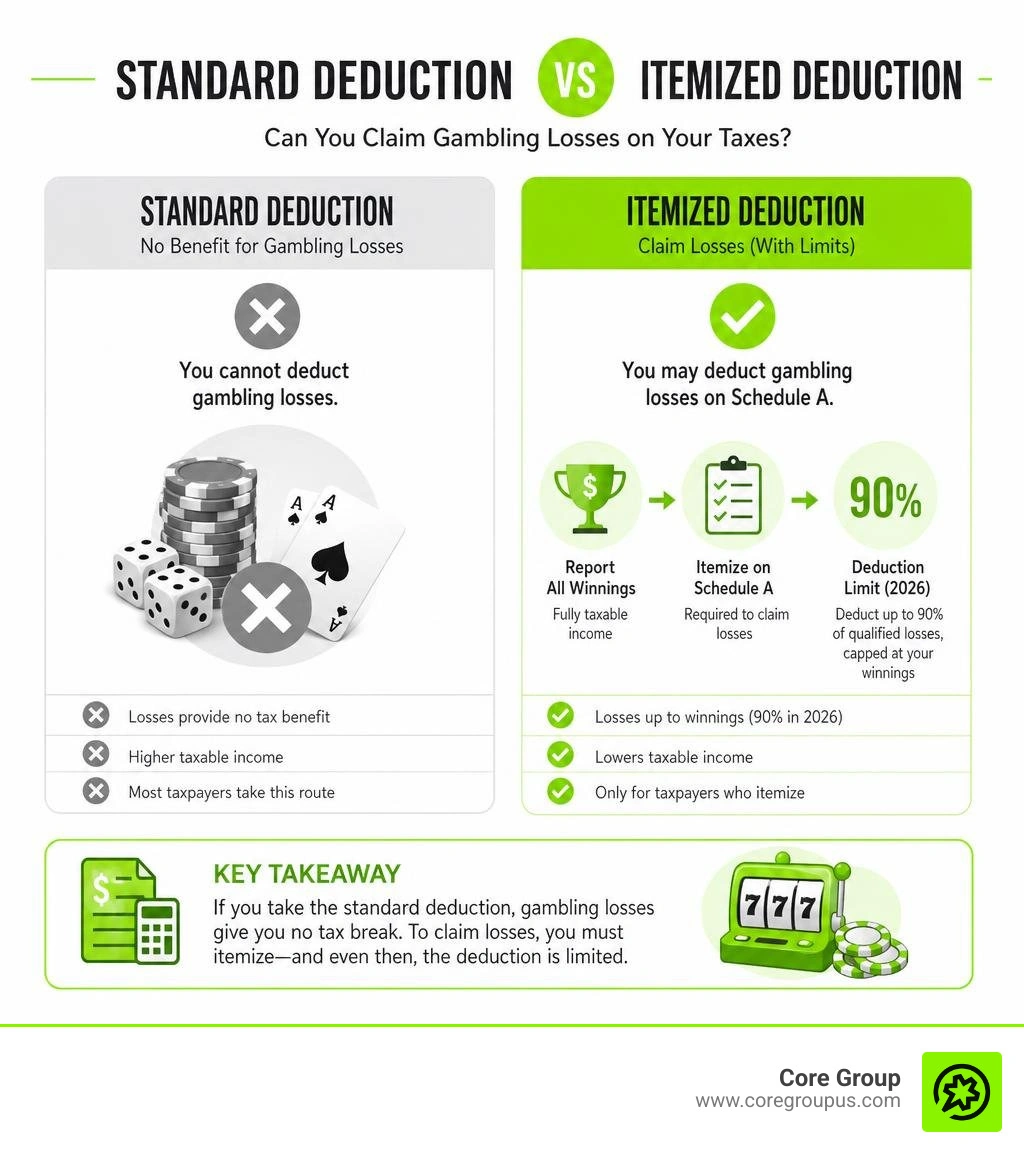
- You must itemize deductions on Schedule A because the standard deduction gives you nothing here
- Starting in tax year 2026, a new law limits your deduction to 90% of your qualified losses (capped at your winnings)
- You need detailed records to back up every loss you claim
If you take the standard deduction like most Americans, you cannot write off gambling losses at all. Only about 14% of taxpayers are expected to itemize in 2026, which means the majority of gamblers get no deduction, even if they lost thousands.
And with the One Big Beautiful Bill Act signed into law on July 4, 2025, even those who do itemize now face a new 10% haircut on their deductions. A gambler with $10,000 in winnings and $10,000 in losses can now only deduct $9,000, leaving $1,000 in taxable income on a bet they broke even on.
For creative entrepreneurs juggling irregular income streams, these rules can quietly create a tax bill you never saw coming. Understanding them before you file makes a real difference.
Can you claim gambling losses on your taxes under IRS rules
When we look at the official tax code, the IRS is very clear about how it views your time at the blackjack table or your sports betting app. According to Topic no. 419, Gambling income and losses | Internal Revenue Service , all gambling winnings are fully taxable. This is not just limited to cash. The IRS requires you to report the fair market value of any non-cash prizes you win, such as cars, vacations, or electronics.
For the average recreational player, the tax rules are strict. You cannot simply subtract your losses from your wins and report the difference. Instead, you must report every single dollar of your winnings as gross income. If you want to use your losses to offset those winnings, you have to claim them separately as an itemized deduction.
This creates a major challenge for casual gamblers who do not keep close track of their play. In the eyes of the government, every winning spin of a slot machine or successful sports bet is taxable income, while your losing bets are only deductible under very specific, highly regulated conditions.
The ninety percent limit under the One Big Beautiful Bill
The rules of the game changed significantly when the One Big Beautiful Bill Act was signed into law. Starting in tax year 2026, this legislation introduced a major restriction on gambling loss deductions. You can read the full details of this change on the 2026 Gambling Loss Deduction How To Claim The New 90% Limit | Super Lawyers page.
Under this new law, your deduction for gambling losses is limited to ninety percent of your qualified losses. Because your qualified losses are already capped at the amount of your reported winnings, this change creates what tax professionals call phantom income.

For example, if you win 10,000 dollars on sports betting throughout 2026 but lose 12,000 dollars, your qualified losses are capped at your winnings of 10,000 dollars. Under the new ninety percent limit, you can only deduct 9,000 dollars on your Schedule A. This means you will owe income tax on 1,000 dollars of phantom income, despite the fact that you actually lost 2,000 dollars overall. This new law makes meticulous record keeping more critical than ever before.
What records do you need so can you claim gambling losses on your taxes
If you plan to claim any losses on your tax return, you must be prepared to back up your claims with solid proof. The IRS will not take your word for it. To find out more about the general financial impact of these rules, you can review the guide on How Gambling Losses Affect Your Finances and Taxes .
To satisfy an auditor, you should maintain a contemporaneous diary or log of your activity. This log should include the following details for every session.
- The date and type of your specific wager or activity
- The name and address of the gambling establishment
- The names of other people present with you at the time
- The exact amounts you won or lost
Alongside your diary, you need to preserve physical and digital evidence. This includes wagering tickets, canceled checks, bank statements, and credit card receipts. If you bet online or use casino loyalty cards, you should regularly download your player activity statements. These statements are excellent supporting documents, but the IRS still expects you to keep your own daily log to verify the accuracy of those statements.
The standard deduction versus itemizing for gambling write offs
Choosing between the standard deduction and itemizing is the single biggest factor in determining whether you can deduct your losses.
| Tax Rule Category | Standard Deduction | Itemized Deduction (Schedule A) |
|---|---|---|
| Deduction Eligibility | No gambling loss deduction allowed | Losses deductible up to winnings limit |
| 2026 Deduction Limit | Fixed standard amount based on filing status | Ninety percent of qualified losses |
| Record Keeping Required | Minimal records needed | Detailed diary and receipts required |
| Typical Taxpayer Usage | Used by roughly eighty-six percent of filers | Used by roughly fourteen percent of filers |
Because the standard deduction is so high, the vast majority of taxpayers choose it because it simplifies their filing. However, making this choice completely locks you out of writing off your losses.
How can you claim gambling losses on your taxes if you take the standard deduction
The short answer is that you cannot. If you claim the standard deduction on your tax return, your deduction for gambling losses is exactly zero.
This creates a painful tax trap for many recreational players. If you win a 5,000 dollar jackpot on a slot machine, that 5,000 dollars is added directly to your taxable gross income. Even if you put all 5,000 dollars back into the machines and lost it the very same night, you cannot write off those losses if you take the standard deduction. You will pay income tax on the full 5,000 dollars of winnings, and your losses will go completely unused.
For more details on how these choices affect your tax liabilities, you can read the comprehensive guide on Can You Claim Gambling Losses on Your Taxes? - TurboTax - Intuit .
Why itemizing on Schedule A is required for casual gamblers
To claim your losses, you must bypass the standard deduction and itemize on Schedule A. When you do this, your losses are listed under the other itemized deductions section of the form.
We explain this process in detail in our article on Are Gambling Losses Itemized Deductions. Itemizing only makes financial sense if your total itemized deductions, including mortgage interest, state taxes, charitable donations, and gambling losses, add up to more than your standard deduction.
For casual gamblers, this is a high bar to clear. If your other deductions are low, you might have to choose between a higher standard deduction or itemizing just to write off your losses, which sometimes results in a smaller overall tax benefit.
How to report your wins and losses on your tax return
Filing your taxes with gambling activity requires careful attention to detail. You must report your total winnings and your deductible losses in two completely different places on your return.

Understanding Form W2G and Schedule 1 reporting
Whenever you have a significant win, the payer may issue a Form W-2G to both you and the IRS. The thresholds that trigger this form vary depending on the game.
- 1,200 dollars or more in winnings from slot machines or bingo
- 1,500 dollars or more in winnings from keno
- 5,000 dollars or more in net winnings from a poker tournament
- 600 dollars or more in winnings if the payout is at least 300 times the amount of your wager
Even if you do not receive a Form W-2G, you are still legally required to report every dollar of your winnings. You will report your total winnings on Schedule 1 of Form 1040 under the other income category. Additionally, if you did not provide a correct taxpayer identification number at the time of your win, the casino may apply a backup withholding tax of twenty-four percent, which you must report on your main tax return to claim credit for the taxes already paid.
State tax implications and rules that vary by location
While federal tax rules are uniform, state tax rules vary wildly. If you live in Illinois or North Carolina, you face a particularly tough environment because these states completely ban the deduction of gambling losses on state income tax returns. This means you will pay state income tax on all your winnings, even if you itemize and deduct your losses on your federal return.
Other states have their own unique legal precedents. In Alabama, the state tax tribunal recently ruled on the deductibility of personal property gambling losses, which you can read about in the Alabama Tax Tribunal Rules on Deductibility of Personal Property ... report.
If you are playing in California, you should review the rules outlined in Are Casino Winnings Taxed in California? to understand how local casinos handle state tax reporting.
For those located in Colorado, the guide on Win or Lose The Scoop on Gambling Taxes for Colorado Springs ... offers helpful local insights.
If you live in Connecticut, you must follow the official guidelines in IP 201127 Connecticut Income Tax Treatment of Gambling Winnings ... to make sure you remain in full compliance.
Special rules for nonresident aliens and professional gamblers
Nonresident aliens filing taxes in the United States must use Form 1040-NR. Under general IRS rules, nonresident aliens cannot deduct gambling losses at all, meaning they are taxed on their gross winnings. However, there is a major exception for Canadian residents, who are permitted to deduct their losses up to the amount of their winnings under the United States and Canada tax treaty.
For professional gamblers, the rules are entirely different. Professionals treat their gambling as a business, reporting their income and expenses on Schedule C. This allows them to deduct ordinary and necessary business expenses, such as travel and lodging, which casual gamblers cannot do. However, professional gamblers must still navigate the permanent expansion of what constitutes a gambling loss, meaning their business deductions are often subject to the same strict limitations as wagering losses.
Frequently Asked Questions about gambling tax rules
Tax rules surrounding wagering can be confusing. Here are some of the most common questions we receive from taxpayers looking to stay compliant.
Can you net your wins and losses throughout the year
No, you cannot simply net everything out at the end of the year. The IRS requires you to calculate your gains and losses on a session-by-session basis.
According to the IRS legal memorandum AM 2008-011 , slot machine players must calculate their gains and losses at the time they redeem their tokens or cash out of a session. If you start with 100 dollars and walk away with 300 dollars, you have a 200 dollar wagering gain for that session. If you go back later that day and lose your entire buy-in, that is a separate session resulting in a loss.
We dive deeper into this topic in our blog post Gambling Losses Should Just Offset My Gambling Winnings Right. You cannot aggregate your entire year of play into a single net figure on your tax forms.
What are the common mistakes that trigger an IRS audit
One of the quickest ways to trigger an IRS audit is netting your wins and losses on your tax return instead of reporting them separately. If the IRS receives a Form W-2G showing 5,000 dollars in winnings, and you fail to list that 5,000 dollars as income on Schedule 1, their automated systems will quickly flag your return for underreporting.
Another common mistake is claiming loss deductions without any supporting receipts or logs. If you get audited and cannot produce a contemporaneous diary of your play, the IRS will disallow your deductions entirely, leaving you with a hefty tax bill, interest, and potential penalties.
Can you carry forward excess gambling losses to future years
No, there is no carryforward provision for gambling losses. Your losses can only be used to offset winnings in the exact same tax year. If you have 5,000 dollars in winnings and 10,000 dollars in losses in 2026, you can only claim a deduction up to the limit of your winnings (and subject to the ninety percent cap). The remaining 5,000 dollars in losses is lost forever and cannot be used to reduce your taxes in 2027 or any other future year.
Conclusion
Managing your taxes when you have gambling activity requires careful planning, strict record keeping, and a clear understanding of the tax code. Navigating the shift from the standard deduction to itemizing on Schedule A is complex, and the new ninety percent limit under the One Big Beautiful Bill Act makes the math even trickier. To explore more about how these deductions work, read our detailed guide on IRS Gambling Deductions.
At Core Group, we provide expert financial management, bookkeeping, and tax services specifically tailored for creative entrepreneurs. We know that you want to focus on growing your business rather than drowning in tax forms. That is why we built our no-fluff, profit-first playbook to guarantee you absolute peace of mind and save you valuable time. We are so confident in our ability to streamline your financial life that we back our services with our signature MacBook Pro guarantee. Let us handle the complex tax rules so you can focus on doing what you do best.