Reach Your Business Potential with A Consultant's Guide to Financial Mastery
Why Financial Management Matters for Your Creative Business

Consultant financial management helps businesses optimize their finances through expert guidance on planning, budgeting, and strategic decision-making. Whether you're struggling with bookkeeping or planning for growth, a financial management consultant provides the expertise to strengthen your business's financial foundation.
What Financial Management Consultants Do:
- Strategic Planning & Analysis - Develop financial roadmaps aligned with your business goals.
- Cash Flow Optimization - Ensure you have money when you need it.
- Risk Management & Compliance - Steer regulations and protect your business.
- Performance Improvement - Identify opportunities to boost profitability.
- Technology Integration - Leverage tools for better financial visibility.
The reality is, your business's success hinges on meeting financial targets, regardless of your creative talent. Many entrepreneurs face challenges with economic uncertainty and complex financial processes. For creative professionals, these challenges can feel even more daunting when your passion is your craft, not spreadsheets.
The good news? The financial advisory segment is a massive $67 billion global industry, with consultants ready to help you steer these complexities. They bring proven strategies and advanced tools to transform financial management from a source of stress into a driver of growth.
Research shows that 79% of boards are implementing digital technologies to improve their finance and accounting processes. Meanwhile, optimizing processes and standardizing technology can reduce operating costs by more than 30%. These aren't just numbers—they represent real opportunities to free up resources and focus on what you do best.
Whether you're overwhelmed by bookkeeping, worried about cash flow, or planning your next growth phase, understanding how consultant financial management works is your first step toward financial clarity and peace of mind.
Why Effective Financial Management is Your Business's Bedrock

For any business, especially a creative one, sound financial management is the bedrock of success. It's what turns your artistic vision into a sustainable, thriving enterprise. Without a solid financial foundation, even the most brilliant ideas can falter.
Effective financial management means making smart decisions with your money. This includes strategic planning, cost control, cash flow management, and understanding how to increase shareholder value. It empowers your business to grow sustainably, seize new opportunities, and weather economic storms.
By optimizing processes and standardizing technology, businesses can reduce operating costs by over 30%. This frees up capital for your creative projects and marketing. It's about achieving a "financial epiphany"—changing intimidation into empowerment, as we discuss in From Intimidated to Empowered: A Creative's Guide to Financial Epiphanies.
The Core Components of Financial Health
So, what exactly is "financial management"? It's a system with several interconnected components that provide a clear picture of your business's financial standing and future.
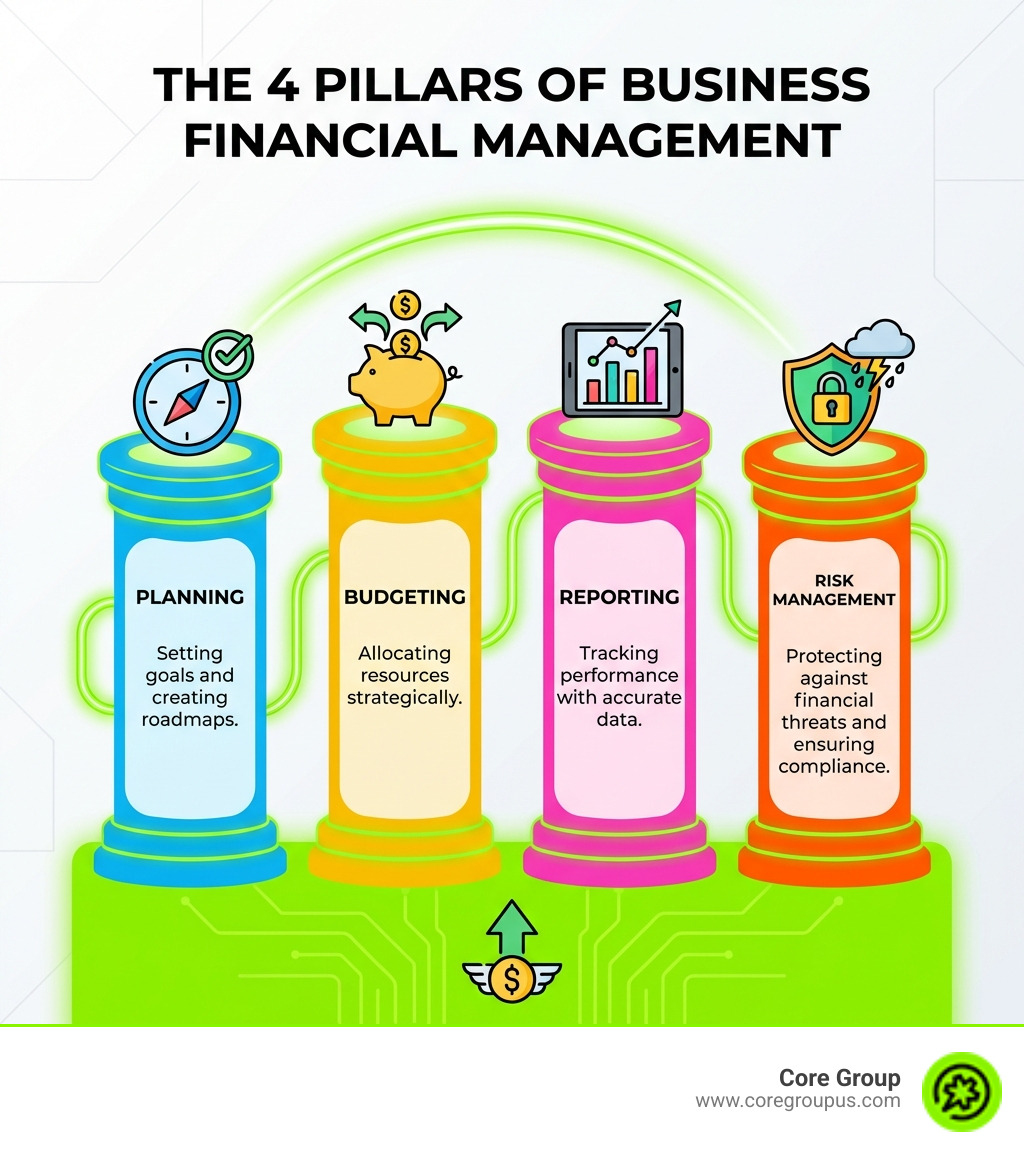
- Planning: Set financial goals and create a roadmap to achieve them. This involves breaking down your vision into achievable financial milestones.
- Budgeting: Allocate resources strategically to ensure spending aligns with your income and priorities. A well-crafted budget acts as a financial GPS.
- Forecasting: Predict future financial performance based on historical data and market trends to anticipate needs and make proactive adjustments.
- Reporting: Track and present financial information through reports like profit & loss statements and balance sheets. These provide a snapshot of your business's financial health.
- Controls: Implement policies and procedures to safeguard assets, ensure reporting accuracy, and prevent fraud. These are your internal checks and balances.
- Decision-Making: Use clear financial data and insights to make strategic choices about investments, pricing, and expansion that propel your business forward.
Understanding and mastering these components can be a journey, but it's one that leads to profound clarity, as explored in The Journey to Financial Epiphany.
How Strong Finances Fuel Success and Growth
When these core financial components are managed effectively, the benefits cascade throughout your business:
- Improved Profitability: By watching income and expenses, identifying cost-saving opportunities, and optimizing pricing, we can directly impact your bottom line.
- Seizing Opportunities: Strong cash flow and financial reserves mean you're ready to act when opportunities arise, whether it's investing in new equipment or expanding your team.
- Avoiding Liquidity Issues: Effective cash flow management prevents the dreaded "running out of money" scenario, ensuring you can cover operational expenses and manage obligations.
- Attracting Investors: A well-managed financial history and clear projections are non-negotiable for securing funding. Investors want to see a stable, profitable, and well-planned financial future.
- Sustainable Scaling: Strong financial management provides the framework to scale your operations sustainably, ensuring your resources can support your ambitions without compromising stability.
Robust financial health fuels business success and growth, creating an environment where your business can thrive and grow beyond its current limits, as discussed in The Founders Evolution: Why Your Business Cannot Grow Beyond You.
The Strategic Role of Consultant Financial Management
Navigating today's financial landscape is a full-time job. A consultant in financial management acts as a strategic partner, offering specialized knowledge and an objective perspective that is invaluable for businesses, especially creative entrepreneurs juggling multiple roles.
The financial advisory segment is a powerhouse, estimated to be worth a staggering $67 billion. This reflects the critical demand for external financial expertise as businesses grapple with economic uncertainties and rapid technological shifts. We understand the unique challenges faced by creative entrepreneurs and how a strategic partner can make all the difference, as we highlight in Who We Are.
Consultants help businesses steer complexity by providing insight into the costs and benefits of corporate initiatives, ensuring every move contributes to shareholder value. They offer proven strategies and tools for finance and performance management, turning a potential minefield into a clear path forward. This is especially crucial during major events like mergers and acquisitions (M&A), where 70% of all mergers don’t achieve initial synergy targets, often due to poor financial planning. A skilled consultant can help bridge this gap.
What Specific Services Do Financial Management Consultants Offer?
Financial management consultants offer a broad spectrum of services designed to address every facet of your business's financial needs, going far beyond simple bookkeeping to drive sustainable growth.
Here's a breakdown of key services:
- Strategic Finance & FP&A: Develop financial roadmaps, forecasts, and budgets aligned with your business goals. Consultants help analyze performance, identify trends, and make proactive decisions to maximize enterprise value.
- Cash Flow Management & Optimization: Understand, predict, and optimize your cash flow to ensure you have the liquidity to operate smoothly and seize opportunities.
- Risk & Compliance Management: Set up internal controls, ensure regulatory compliance, and manage financial risks, including audit remediation and fraud detection.
- M&A Advisory (Mergers & Acquisitions): For businesses considering growth through acquisition or planning to sell, consultants provide critical support, including strategy, due diligence, and post-merger integration.
- Tax Strategy & Planning: Optimize your tax position, ensure compliance, and advise on areas like transfer pricing. We offer specialized Tax Planning Services for Creatives.
- Accounting Advisory & Optimization: Improve financial reporting and leverage accounting software for efficiency. Our Accounting Services for Creatives are custom to your unique needs.
- Working Capital Management: Manage current assets and liabilities to maximize efficiency and profitability.
- Financial Reporting & Analytics: Implement advanced reporting and analytical tools for real-time performance visibility and data-driven decisions.
- Profit First Implementation: For many creative businesses, a "profit-first" approach can be transformative. Consultants guide you through implementing strategies that ensure profitability from the outset. Our specific Profit First for Creatives program offers a clear path to financial stability.
These services provide a holistic view of your finances, enabling informed decisions and a resilient financial future.
How Consultants Drive Profitability and Financial Health
Consultant financial management isn't just about fixing problems; it's about proactively enhancing your business's financial performance. Consultants act as catalysts for positive change, driving profitability and overall financial health through several key avenues:
- Process Optimization: We identify inefficiencies in your financial operations and implement streamlined processes. Optimizing processes and standardizing technology can reduce operating costs by more than 30%.
- Data-Driven Insights: Consultants use advanced analytics to turn raw financial data into actionable insights, enabling smarter pricing, better investments, and more effective resource allocation.
- Working Capital Management: They help you manage your current assets and liabilities to maximize efficiency and liquidity, ensuring you have the cash flow to operate smoothly and invest in growth.
- Performance Management: Consultants establish clear key performance indicators (KPIs) and reporting mechanisms to continuously monitor your business's financial health, allowing for quick adjustments and sustained improvement.
- Cost Reduction Strategies: Through detailed analysis, consultants pinpoint areas where costs can be reduced without compromising quality or growth potential.
- Strategic Financial Planning: By developing robust financial plans and forecasts, consultants help you anticipate future needs and challenges, driving long-term profitability and stability.
- Accountability and Objective Perspective: An external consultant brings an unbiased view, holding your business accountable to its financial goals and challenging assumptions that might hinder progress.
By focusing on these areas, consultants empower businesses to improve cash flow, boost profitability, and build a stronger, more resilient financial foundation. This approach is rooted in sound financial principles, a stark contrast to some widely criticized advice, as discussed in Why Dave Ramsey is Bad for Business - Part 1.
Mastering Risk and Compliance with Expert Consultant Financial Management
The business world is fraught with risks, from market volatility to regulatory non-compliance. For creative entrepreneurs, navigating these waters can be daunting. This is where expert consultant financial management becomes invaluable.
Financial management consultants safeguard your business by helping you master risk and compliance, ensuring your operations adhere to legal and ethical standards.
- Navigating Regulatory Scrutiny: The regulatory landscape is constantly changing. Consultants monitor these changes and help implement the necessary policies and procedures to meet requirements, from tax compliance to industry-specific regulations.
- Establishing Robust Internal Controls: Consultants design and implement systems to prevent errors, detect fraud, and ensure the accuracy of financial reporting. This includes setting up clear segregation of duties, authorization processes, and regular reconciliations.
- Audit Remediation: If your business has faced an audit with deficiencies, consultants can guide you through the remediation process, identifying root causes and developing corrective action plans.
- Comprehensive Risk Assessment: Consultants conduct thorough risk assessments to identify potential financial threats, including market, operational, credit, and liquidity risks. They then help develop strategies to mitigate these risks proactively.
- ESG Strategies and Reporting: With the growing importance of Environmental, Social, and Governance (ESG) factors, consultants can provide expert guidance on developing and reporting on ESG strategies to meet stakeholder expectations.
By proactively addressing risk and compliance, consultants protect your business from potential penalties and financial losses, and improve your credibility with stakeholders, investors, and creditors. This strategic oversight allows you to focus on your creative endeavors with greater peace of mind, much like understanding legal protections in the creative industry, as discussed in The Dark Side of Fame: An Entertainment Lawyer's Perspective.
The Digital Shift: Technology in Modern Financial Consulting
The financial world is undergoing a profound change, driven by digital innovation. In modern consultant financial management, technology is no longer an optional add-on; it's a fundamental pillar. We're seeing a rapid integration of sophisticated tools and platforms that are reshaping how businesses manage their finances and how consultants deliver their services.
This digital shift is critical. As reported, 79% of boards say their management team has discussed using or is implementing digital technologies to improve their organization’s tax, finance, and accounting processes. This push towards digital adoption is not just about efficiency; it's about gaining deeper insights, improving accuracy, and positioning businesses for future growth.
At Core Group, we accept technology to deliver our services, understanding that leveraging advanced tools is key to providing a "no-fluff, profit-first playbook." Our approach, detailed in How We Do It, integrates these innovations to empower creative entrepreneurs.
The role of technology in financial management consulting encompasses:
- Data Analytics & Business Intelligence: Moving beyond basic spreadsheets, consultants use powerful data analytics tools to process vast amounts of financial data. This provides real-time insights, identifies trends, and supports strategic decision-making.
- AI in Finance: Artificial Intelligence (AI) is beginning to revolutionize tasks like forecasting, risk assessment, and fraud detection. AI-powered tools can analyze complex data patterns far more efficiently than humans, leading to more accurate predictions and proactive financial management.
- Automation (RPA - Robotic Process Automation): Repetitive and rule-based financial tasks, such as data entry, invoice processing, and reconciliation, are increasingly being automated. RPA reduces manual errors, frees up human capital for more strategic activities, and dramatically improves efficiency.
- Cloud Solutions: Cloud-based accounting software and financial management platforms offer flexibility, scalability, and accessibility. They allow for seamless collaboration between businesses and their consultants, ensuring secure data storage and real-time access to financial information from anywhere.
- Finance Change & Change: Technology facilitates comprehensive finance change initiatives, enabling businesses to modernize their systems and processes, streamline operations, and create a mature, data-driven finance function.
By using these technological advancements, financial management consultants empower businesses to make smarter decisions, operate more efficiently, and stay ahead in a rapidly evolving economic landscape.
Leveraging Data for Smarter Decisions
Data is currency, and financial data is particularly valuable. Modern consultant financial management excels at leveraging this data to empower businesses with smarter, more informed decisions.
- Financial Analytics: Consultants use sophisticated financial analytics platforms to dig deep into your numbers. This goes beyond simple reporting, identifying underlying trends, correlations, and anomalies that might not be visible at first glance. For example, analyzing sales data against marketing spend can reveal the true ROI of your campaigns.
- Key Performance Indicators (KPIs): We work with you to define and track relevant financial KPIs that are crucial for your business. These metrics provide a clear, concise way to measure progress towards your financial goals, offering early warning signs or celebrating successes.
- Predictive Modeling: By analyzing historical data and market factors, consultants can build predictive models to forecast future financial scenarios. This helps in anticipating cash flow needs, revenue projections, and potential risks, allowing for proactive planning rather than reactive problem-solving.
- Real-Time Reporting: Gone are the days of waiting weeks for financial reports. Technology enables real-time dashboards and reporting, providing you with an up-to-the-minute view of your financial health. This immediate access to information is critical for agile decision-making in a environment.
Leveraging data for smarter decisions means changing your financial operations from a "pretty" but potentially ineffective system into one that "works harder than you do," as we discuss in From Pretty to Profitable: Why Your Website Needs to Work Harder Than You Do.
The Role of Automation and AI
Automation and Artificial Intelligence (AI) are not just buzzwords in finance; they are becoming indispensable tools in modern consultant financial management. They are fundamentally changing how financial tasks are performed, leading to unprecedented levels of efficiency, accuracy, and strategic insight.
- Streamlining Operations: Automation, particularly Robotic Process Automation (RPA), handles repetitive and rule-based financial tasks, such as data entry, invoice processing, payroll, and expense reporting. This frees up your team (and ours!) from mundane tasks, allowing them to focus on more strategic, value-added activities.
- Reducing Manual Errors: Human error is a reality. Automation drastically reduces the likelihood of mistakes in financial data processing, leading to more accurate records and reports. This accuracy is vital for compliance and informed decision-making.
- Enhancing Forecasting Accuracy: AI algorithms can analyze vast datasets, including market trends, economic indicators, and historical performance, to generate highly accurate financial forecasts. This allows for better planning and resource allocation.
- Intelligent Automation: Beyond simple rule-based tasks, AI-powered intelligent automation can handle more complex processes, learning from data and making decisions. This can extend to areas like fraud detection, credit risk assessment, and even optimizing investment portfolios.
For creative entrepreneurs, leveraging these technologies means less time struggling with administrative tasks and more time dedicated to your craft. Imagine the impact of tools that use AI to simplify complex processes, much like InVideo AI: A Top Video Editing Tool That Utilizes AI streamlines video creation. This technological synergy helps us deliver on our promise of a "no-fluff, profit-first playbook."
How to Select the Right Financial Management Consultant
Choosing the right financial management consultant is a critical decision that can significantly impact your business's future. It’s not just about finding someone who understands numbers; it’s about finding a strategic partner who understands your unique business needs, especially as a creative entrepreneur. Our goal is to empower you to make an informed choice.
The vetting process should be thorough, focusing on qualifications, experience, and industry specialization. For example, if you're a videographer or run a marketing agency, you'll want a consultant who understands the specific financial nuances of your industry. That's why we specialize in helping creative businesses, including Videographers and Marketing Agencies. We understand Who We Help because we speak your language.
When assessing potential consultants, consider the following:
- Industry Expertise: Do they have experience working with businesses in your specific sector? A consultant familiar with the creative industry will understand revenue streams, project-based finances, and specific tax considerations unique to creatives.
- Services Offered: Do their services align with your most pressing needs? Whether it's cash flow optimization, tax planning, or strategic growth advice, ensure their offerings cover your requirements.
- Communication Style: Will you be able to communicate effectively with them? Financial management can be complex, and you need a consultant who can explain things clearly and simply, without jargon.
- Technology Integration: Do they leverage modern financial technologies and data analytics? A tech-savvy consultant can offer more efficient processes and deeper insights.
- Client Testimonials & References: What do their current and past clients say about them? Look for evidence of positive impact and long-term relationships.
- Fee Structure: Understand how they are compensated to ensure transparency and align expectations.
Key Qualifications and Credentials to Look For
When you're entrusting your business's financial health to an outside expert, their qualifications and credentials are non-negotiable. These indicators provide assurance of their expertise, ethical standards, and commitment to their profession.
Here are the key qualifications and credentials we recommend looking for:
- Certifications:
- CPA (Certified Public Accountant): This is a highly respected designation in accounting, indicating expertise in tax, audit, and financial planning. A CPA license ensures a strong foundation in accounting principles and regulatory compliance.
- CFP (Certified Financial Planner): While often associated with personal finance, a CFP designation indicates a comprehensive understanding of financial planning, including investments, retirement, and estate planning, which can be beneficial for business owners.
- CFA (Chartered Financial Analyst): This designation is geared towards investment management and analysis, valuable if your business involves significant investment portfolios or complex financial instruments.
- Experience: Look for consultants with a proven track record of helping businesses similar to yours. Experience in your specific industry (e.g., creative arts, digital media) is a huge plus, as they'll understand your unique challenges and opportunities.
- Regulatory Standing: It's crucial to verify that the consultant or their firm is properly registered and in good standing with relevant regulatory bodies. For example, in the US, this might involve checking with state boards of accountancy or the SEC (for investment advisors). For general best practice, you can check an advisor’s registration with the National Registration Search and check for disciplinary action via regulatory bodies like CIRO (Canadian Investment Regulatory Organization), which provides insights into disciplinary histories. While CIRO is a Canadian organization, the principle of checking regulatory bodies for disciplinary actions is universally applicable and a best practice for due diligence.
- Continuing Education: The financial landscape is always changing. A good consultant will demonstrate a commitment to ongoing learning and professional development to stay current with new regulations, technologies, and best practices.
By prioritizing these qualifications, you can feel confident that you're partnering with a knowledgeable and ethical expert.
Understanding Compensation Models for Consultant Financial Management
Understanding how a financial management consultant gets paid is essential for transparency and to ensure their advice aligns with your best interests. Different compensation models can influence the recommendations you receive, so be clear on this upfront.
Here's a breakdown of common compensation models:
| Compensation Model | Description - |
|---|---|
| Fee-Only | The consultant charges a flat fee, an hourly rate, or a percentage of assets under management (AUM). This model is transparent and minimizes conflicts of interest, as the advisor's compensation isn't tied to selling specific products. |
| Commission-Based | The consultant earns commissions from selling financial products like insurance or mutual funds. While common, this can create a conflict of interest, as the advice may be influenced by the potential commission rather than the client's best interest. |
| Fee-Based (Hybrid) | This model combines a fee for service with commissions from product sales. It's crucial to understand how much of the compensation comes from commissions versus fees to assess potential biases. |
Always ask for a clear, written explanation of all fees and how the consultant is compensated before signing any agreements.
Financial Advisor vs. Financial Planner: What's the Difference?
While often used interchangeably, 'financial advisor' and 'financial planner' have key differences. Understanding them helps you choose the right professional.
- Financial Advisor: This is a broad term for professionals who provide financial advice. It can include stockbrokers, insurance agents, and investment managers. Their services might be focused on specific products or investment strategies.
- Financial Planner: A financial planner typically takes a more holistic approach. They help you create a comprehensive plan to meet your long-term financial goals, considering all aspects of your financial life, from budgeting and saving to investing, insurance, and estate planning. A Certified Financial Planner (CFP) has met rigorous standards in education, examination, experience, and ethics.
For a business owner, a consultant who combines both advisory and planning skills is often ideal. They can manage day-to-day financial operations while also helping you build a long-term strategy for growth and sustainability. Understanding concepts like the difference between short-term and long-term debt is just one piece of the comprehensive financial picture they can help you build.