How to Optimize Creative Studio Overtime Tax and Minimize Liability
Creative Studio Overtime Tax Optimization Starts With Clean Payroll Data
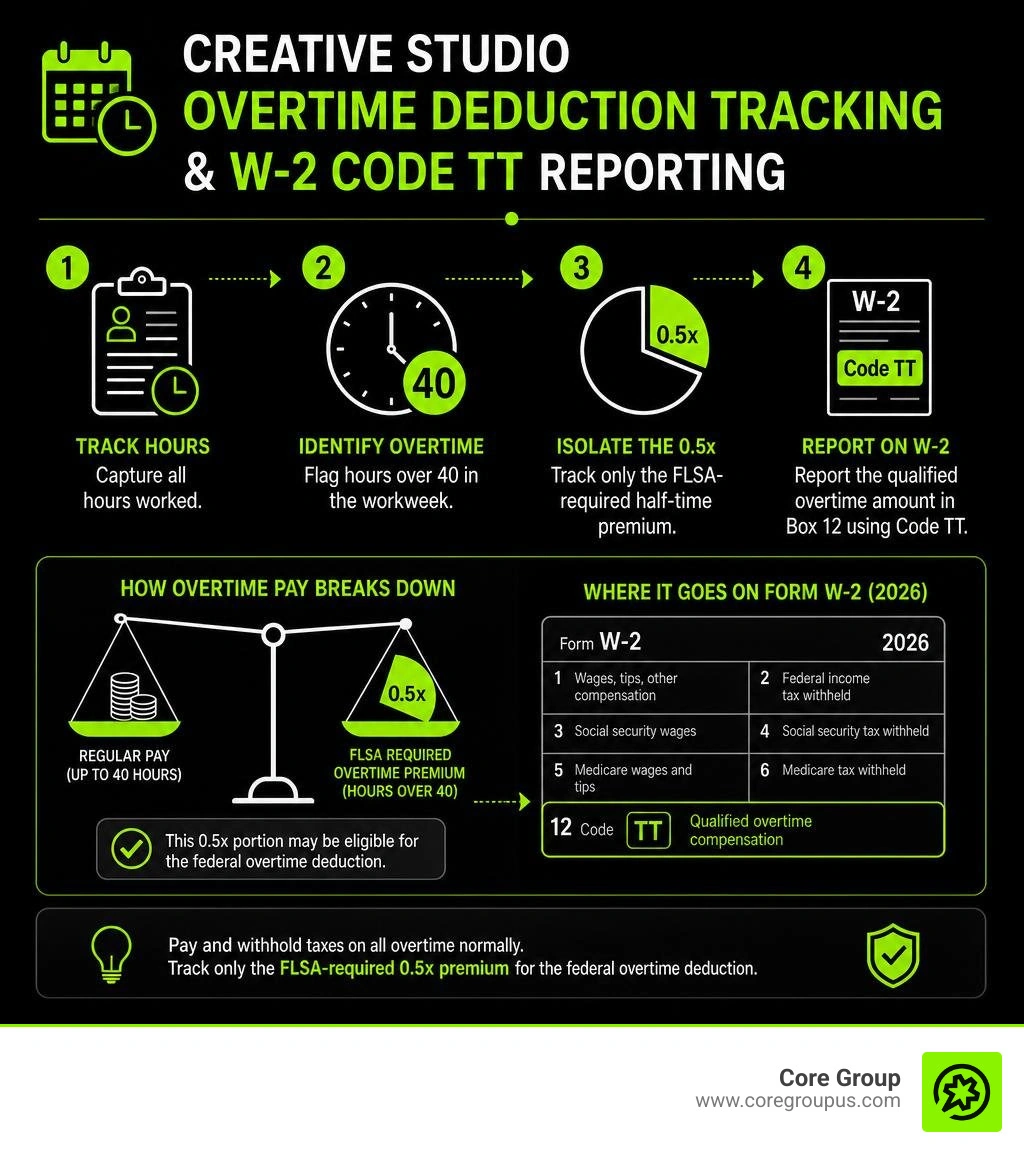
For creative studio overtime tax optimization, track each nonexempt employee's federal overtime premium separately from regular wages and other premium pay. Under the OBBBA, only the extra 0.5x portion required by the FLSA for hours over 40 in a workweek can support the federal deduction.
- Pay and withhold taxes on all overtime normally
- Track the FLSA-required half-time premium as qualified overtime compensation
- Report that amount on 2026 Forms W-2 in Box 12 using Code TT
- Do not count California daily overtime, contractual premiums, holiday pay, or voluntary extra pay unless it also meets the federal FLSA rule
The deduction can be worth real savings, but it is not a payroll-tax exemption. Eligible employees can deduct up to $12,500 when filing single or $25,000 when filing jointly, subject to MAGI phaseouts beginning at $150,000 and $300,000. Accurate classification and time records matter just as much as the tax calculation.
I am Christian Brim, and the next sections show how creative studios can build a compliant overtime process without letting payroll complexity take over the business.
Creative studio overtime tax optimization vocab to learn
Creative Studio Overtime Tax Optimization Framework for 2026

Creative production rarely fits into a neat forty-hour box. Late-night editing marathons, multi-day commercial shoots, and intense product launch crunches mean overtime is simply part of studio life. The One Big Beautiful Bill Act introduced Section 70202, codified under Internal Revenue Code Section 225, giving hourly nonexempt team members a temporary federal income tax deduction on their overtime premiums.
This tax break applies to tax years 2025 through 2028. It does not slash payroll taxes during each pay run, nor does it make overtime pay entirely tax-free. Instead, it provides an above-the-line deduction that eligible workers claim on their individual tax returns. Understanding how to calculate the actual overtime tax rate prevents costly payroll errors while keeping your team motivated during heavy production cycles.
Understanding Qualified Overtime Compensation versus Total Overtime Pay
Qualified Overtime Compensation represents only the premium portion required under Section 7 of the Fair Labor Standards Act. When a nonexempt motion designer or camera operator works 50 hours in a standard workweek, their overtime compensation divides into two distinct layers
- Straight-time base pay for all 50 hours (1.0x their regular hourly rate)
- The mandatory FLSA overtime premium for the 10 overtime hours (0.5x their regular hourly rate)
Only that extra 0.5x premium counts as qualified overtime compensation. Total overtime wages (the full 1.5x rate) do not qualify for the deduction. For example, if your studio pays a video editor $40 per hour, their overtime rate is $60 per hour. When they log 10 hours of overtime, they receive $600 in total overtime pay. Of that $600, exactly $200 (10 hours multiplied by the $20 premium) is qualified overtime compensation eligible for the federal tax deduction. The remaining $400 represents their regular straight-time wage component.
Studios must continue standard paycheck withholdings. You must withhold federal income tax, Medicare (1.45%), and Social Security (6.2% up to the 2026 taxable wage base of $184,500) on all overtime earnings.
Deduction Limits and Income Phase-Out Thresholds
The federal qualified overtime deduction features annual statutory caps and income phase-outs. Creative agency leaders and team members can estimate their specific personal tax benefits using an online qualified overtime calculator to project year-end deductions.
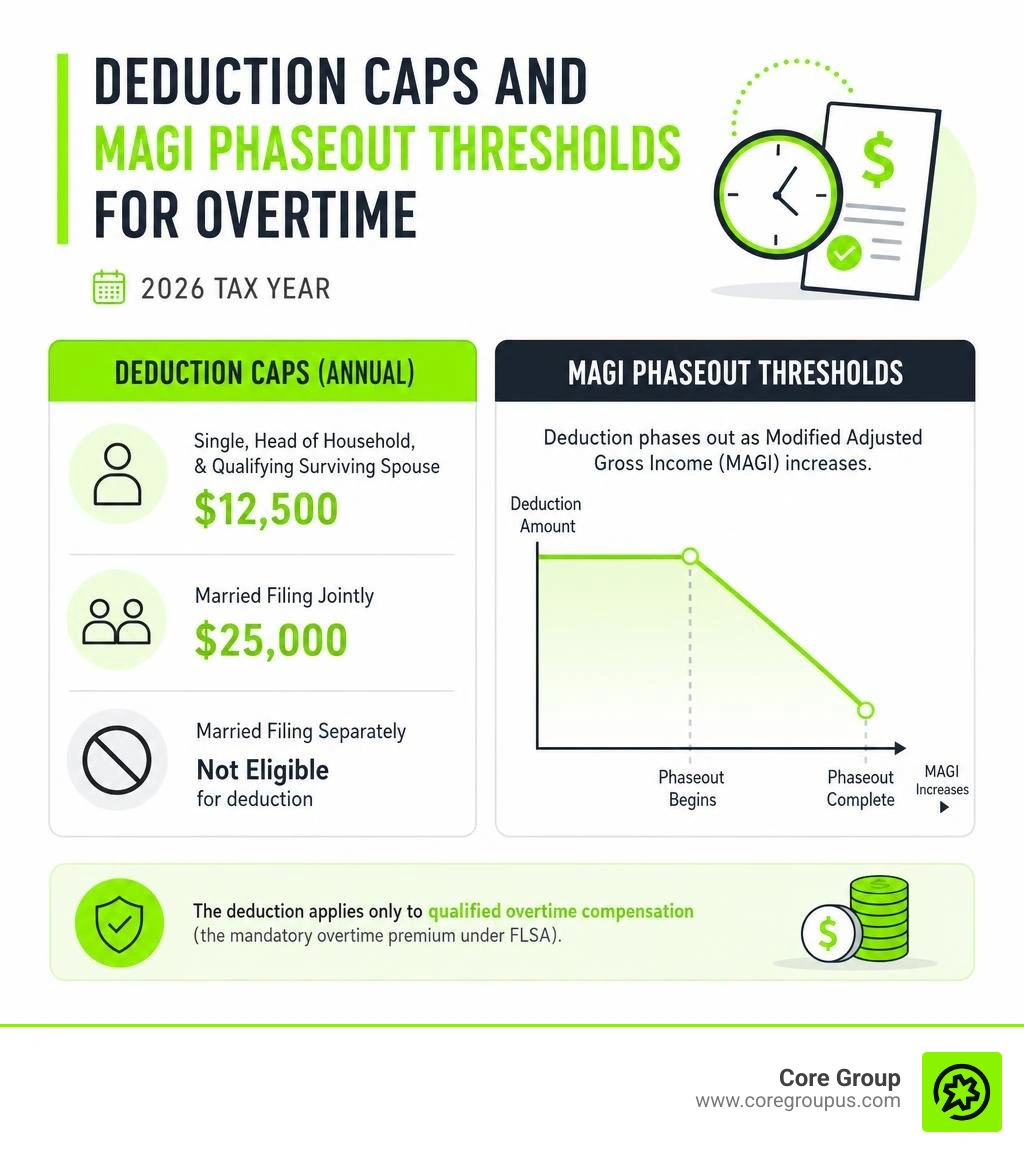
The statutory deduction limits for the 2026 tax year are structured below.
- Single, Head of Household, and Qualifying Surviving Spouse filers can deduct up to $12,500 of qualified overtime premiums per year.
- Married couples filing jointly can deduct up to $25,000 per year.
- Married Filing Separately taxpayers are explicitly disqualified from claiming the deduction under Section 225(e).
Phase-outs begin once Modified Adjusted Gross Income exceeds $150,000 for single filers or $300,000 for joint filers. The deduction reduces by $100 for every $1,000 of MAGI above those thresholds. For single filers claiming the maximum $12,500 deduction, the tax benefit phases out completely at $275,000 of MAGI. For joint filers claiming the full $25,000 deduction, the write-off reaches zero at $550,000 of MAGI.
For a mid-level creative professional in the 22% federal income tax bracket earning $12,500 in qualified FLSA overtime premiums, this tax deduction translates to approximately $2,750 in direct federal income tax savings.
Employee Classification and FLSA Compliance for Creative Agencies

Taking advantage of overtime tax relief requires clean employee classifications. A common pain point in creative agencies is determining whether specialized staff members qualify as exempt salaried professionals or hourly nonexempt workers. Proper classification starts with consistent creative entrepreneur bookkeeping that tracks compensable project hours accurately.
Creative Studio Overtime Tax Optimization and FLSA Exemption Rules
To qualify for the federal overtime tax deduction, a worker must be classified as nonexempt under the FLSA. Creative studio job titles alone do not determine exemption status. Instead, the Department of Labor applies both a salary basis test and a specific duties test.
The standard FLSA creative professional exemption requires that an employee's primary duty involves work requiring invention, imagination, originality, or talent in a recognized field of artistic or creative endeavor. High-level art directors, lead copywriters with wide editorial discretion, and executive creative directors generally meet this test if they earn at least $35,568 annually on a guaranteed salary basis.
Conversely, technical creative roles often fail the duties test and must remain nonexempt.
- Production assistants and studio stage hands
- Junior graphic production specialists working from established brand templates
- Sound recording engineers and video post-production assistants
- Digital image retouchers executing standardized client edit lists
Because these nonexempt team members are legally entitled to FLSA overtime pay, their 0.5x premium wages qualify directly for the deduction. Reviewing employer considerations for overtime tax helps studio owners establish compliant wage structures.
Risks of Reclassifying Salaried Creative Staff to Hourly Nonexempt
Some creative business owners wonder if they should convert salaried exempt employees to hourly nonexempt roles to capture overtime deductions. Proceed with caution. The Department of Labor and the IRS actively scrutinize artificial wage restructurings.
Lowering a senior designer's regular hourly rate while scheduling routine overtime hours to mimic their prior salary creates substantial legal liability. If the Department of Labor finds that base rates were depressed to manipulate tax outcomes, your studio could face reclassification audits, back taxes, and statutory interest.
Keep your senior creative strategists and project directors on standard exempt salaries if their primary duties qualify. Restrict overtime compensation programs to genuine nonexempt production personnel who perform work governed by FLSA Section 7.
Payroll Administration and W-2 Reporting Requirements for 2026
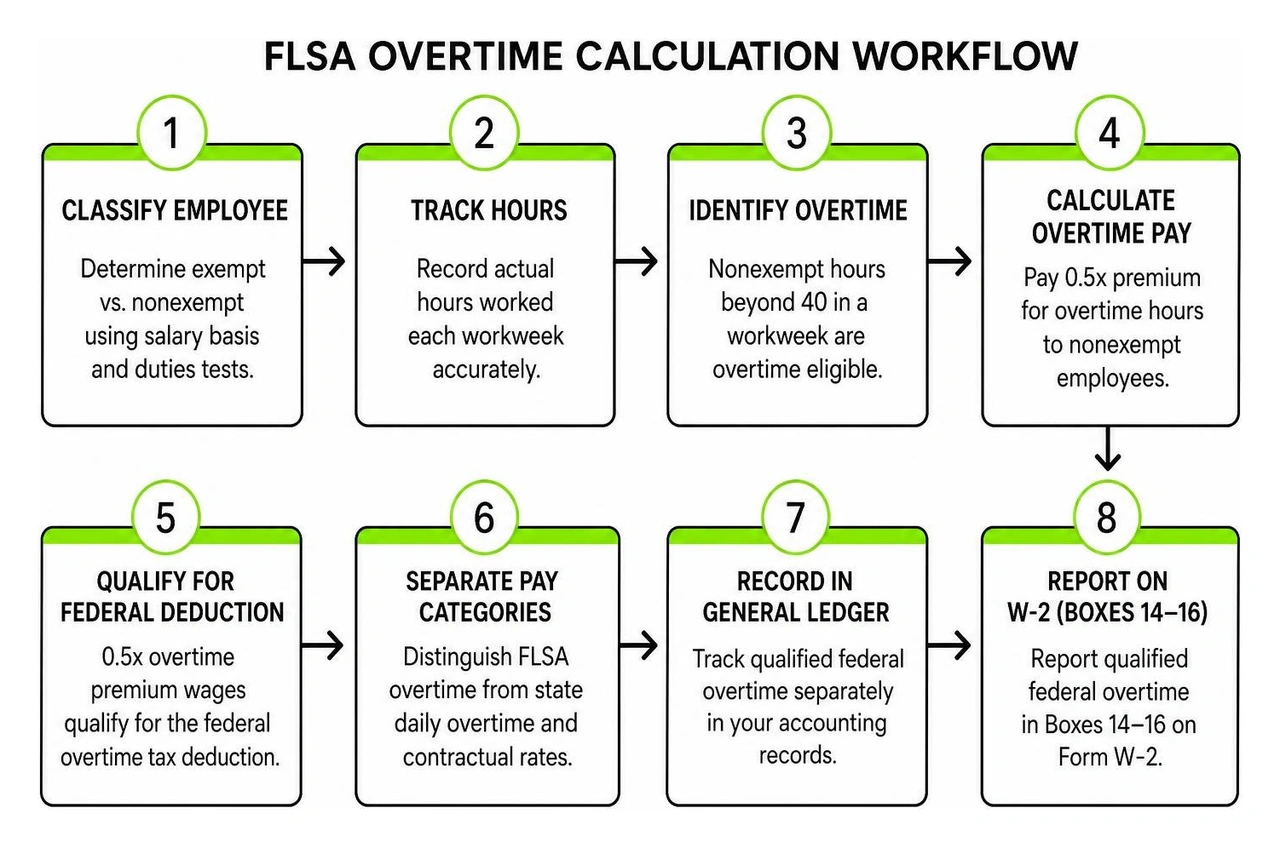
Payroll compliance shifted into a more structured phase starting in 2026. While the IRS offered temporary transition relief for the 2025 rollout, studios must now separate qualified federal overtime from state-mandated daily premiums and contractual rates in their general ledger. Reviewing our no tax overtime guide 2026 will help your internal payroll team align with current IRS expectations.
| Overtime Category | FLSA Overtime (Federal Deduction) | State Daily Overtime (Non-FLSA) | Contractual Double-Time |
|---|---|---|---|
| Trigger Condition | Hours worked beyond 40 in a single workweek | Daily hours over 8 without exceeding 40 weekly hours | Studio union or client project weekend double-time rates |
| Pay Multiplier | 1.5x regular hourly base pay | 1.5x or 2.0x hourly rate based on local labor laws | 2.0x regular hourly base pay |
| Qualifying Deductible Amount | The 0.5x premium portion | $0 (Non-qualifying) | Only the statutory 0.5x portion if weekly hours top 40 |
| Form W-2 Reporting | Reported in Box 12 under Code TT | Included in regular Box 1 taxable gross wages | Split between Box 1 gross pay and Box 12 Code TT |
Reporting Qualified Overtime Compensation on Form W-2 Box 12
For the 2026 tax year, the IRS requires employers to report each employee's annual total Qualified Overtime Compensation in Box 12 of Form W-2 using Code TT.
Your payroll software must separate straight-time earnings from the FLSA half-time premium throughout the year. Reconciling payroll summaries against quarterly Form 941 filings prevents year-end reporting mismatches. Incorrect information returns trigger IRS penalties under Section 6721.
- $60 per Form W-2 if corrected within 30 days of the due date
- $330 per Form W-2 for late or uncorrected forms
- $660 or more per Form W-2 for intentional disregard of the reporting rules
Accurate recordkeeping protects your studio from these escalating penalties and ensures employees receive valid tax documentation to claim their deductions on Schedule 1-A.
State Overtime Rules versus Federal FLSA Deductions
Many creative hubs, including California, Colorado, Alaska, and Nevada, enforce daily overtime mandates. In California, nonexempt employees earn time-and-a-half for hours worked beyond eight in a single day, regardless of total weekly hours.
Federal tax law does not conform to state daily overtime rules. If a freelance animator works twelve hours on Tuesday but only logs thirty hours total across the entire workweek, the four hours of daily overtime paid under California law do not count as qualified overtime compensation under federal Section 225. Because total weekly hours remained below forty, there was no FLSA Section 7 requirement.
When an employee works multiple roles at different hourly rates in a single week, your studio must calculate a weighted average regular rate. Divide total straight-time earnings by total hours worked to find the weighted base rate, divide that rate by two to isolate the 0.5x premium, and multiply by the weekly hours worked beyond forty.
Strategic Overtime Tax Planning for Creative Studio Owners and Staff
Optimizing creative agency tax liabilities involves harmonizing employee tax savings with corporate financial strategies. Exploring tailored creative overtime tax savings strategies ensures that your agency preserves cash flow while managing seasonal production bursts.
Dual Overtime Tax Benefits for S Corporation Studio Owners
Many boutique production houses operate as S Corporations where the founding creative acts as both a shareholder and a W-2 employee. If an owner-operator performs substantial technical, nonexempt production duties and logs compensable overtime hours, the business can capture a dual tax benefit.
- Corporate Level. The S Corporation deducts 100% of the overtime wages and the 7.65% employer matching FICA payroll taxes as ordinary and necessary business expenses on Form 1120-S.
- Individual Level. The owner-operator deducts the 0.5x qualified overtime premium on their personal Form 1040 via Schedule 1-A, subject to the $12,500 single or $25,000 joint cap.
This approach requires meticulous documentation. Owner-operators must keep time logs proving actual operational work beyond forty hours per week and ensure total compensation aligns with IRS reasonable salary standards.
Creative Studio Overtime Tax Optimization Through MAGI Management and Retirement Plans
Because Section 225 phases out rapidly above $150,000 in MAGI for single filers and $300,000 for married couples filing jointly, high-earning creatives can utilize tax-advantaged accounts to preserve eligibility. Using comprehensive tax planning strategies allows staff to manage their income thresholds effectively.
- Maximizing Traditional 401(k) Contributions. Deferring pre-tax income up to the $24,500 annual limit directly reduces adjusted gross income, pulling higher-earning senior creatives back under the phase-out threshold.
- Solo 401(k) and SEP-IRA Funding. Independent contractors and agency owners drawing modest salaries can leverage corporate retirement plans to lower taxable income while building long-term wealth.
- Deduction Stacking. The Section 225 deduction is an above-the-line deduction, meaning workers can stack the full overtime write-off directly on top of the standard deduction ($15,750 for single filers; $31,500 for married filing jointly) without itemizing.
Taking full advantage of these strategies before the statutory sunset on December 31, 2028, provides meaningful financial relief across production cycles.
Frequently Asked Questions about Creative Studio Overtime Taxes
What creative studio roles qualify for the overtime tax deduction?
Eligible roles include nonexempt W-2 employees such as junior video editors, assistant sound designers, production coordinators, lighting technicians, and graphic production staff whose positions do not meet FLSA professional exemption tests. Independent 1099 contractors, exempt salaried art directors, and exempt creative executives do not qualify for the Section 225 deduction.
What happens if a studio fails to report Code TT in Box 12 on 2026 W-2 forms?
Failing to include Code TT in Box 12 triggers IRS information return penalties under Section 6721, ranging from $60 per form for minor delays to over $660 per form for intentional non-compliance. Studios that discover omissions must issue Form W-2c corrections promptly to prevent penalties and enable employees to file Schedule 1-A.
Does the federal overtime deduction exempt studio workers from state and payroll taxes?
No. The deduction under IRC Section 225 applies solely to federal income tax. Overtime earnings remain subject to full FICA payroll taxes (6.2% Social Security and 1.45% Medicare) and standard state and local income taxes, as most states do not conform to the temporary federal deduction.
Conclusion
Managing overtime in a creative studio should not lead to administrative chaos or unexpected tax liabilities. Under the temporary OBBBA rules through 2028, accurately separating the 0.5x FLSA overtime premium from base hourly wages allows your nonexempt team to benefit from federal tax deductions while keeping your business fully compliant.
At Core Group, we provide financial management, bookkeeping, and tax services designed specifically for creative entrepreneurs. Our no-fluff, profit-first playbook delivers complete peace of mind, backed by our MacBook Pro guarantee, freeing you to focus on producing outstanding creative work. If you want to refine your payroll processes and lower your agency tax burden, master your studio overtime tax rate with our dedicated advisory team today.