The Easiest Way to Calculate Tax Deductions for Overtime
Calculate Your Design Business Overtime Tax Deduction
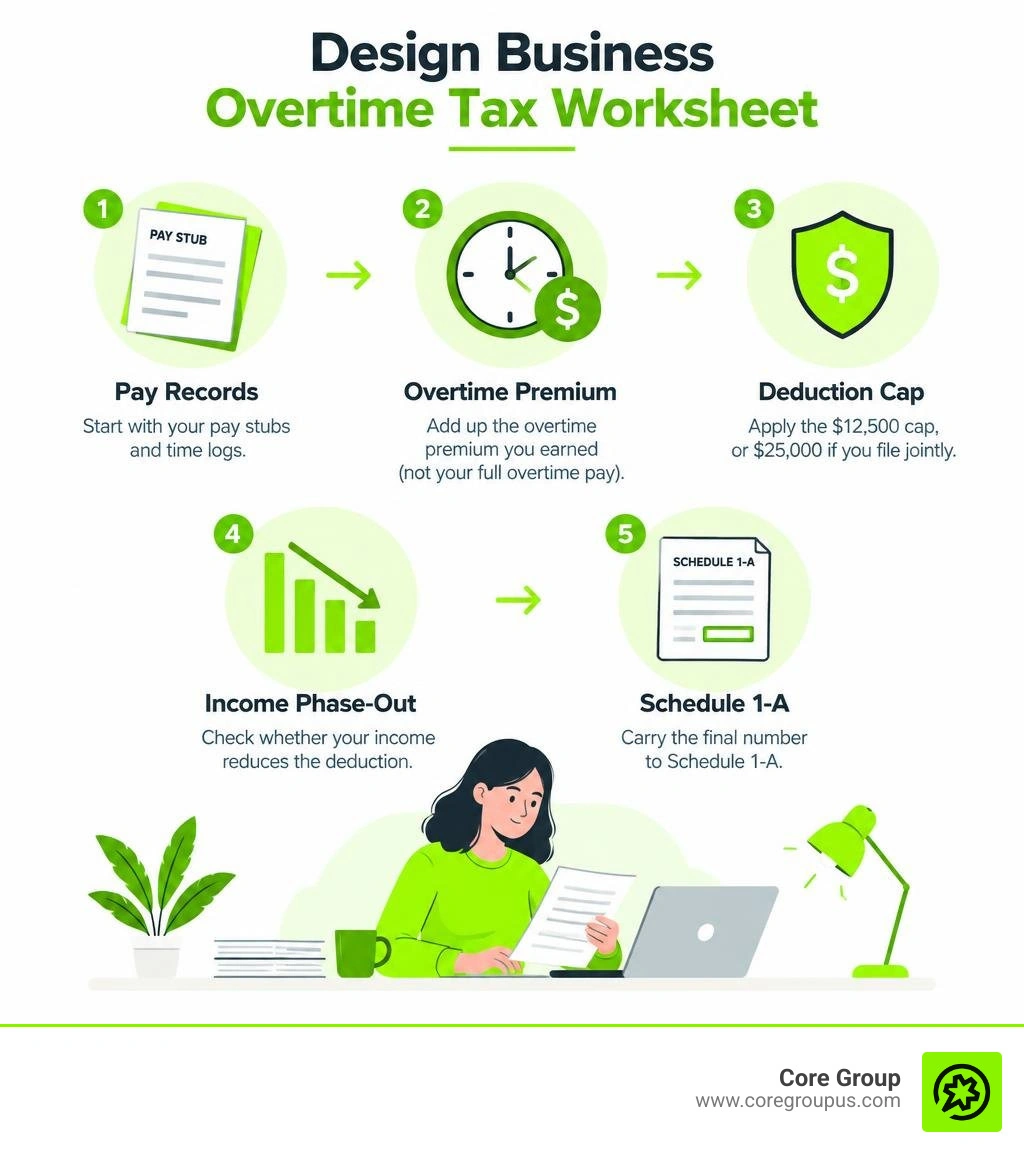
To build a design business overtime tax worksheet, start with your pay stubs and time logs. Add up the overtime premium you earned in 2025, not your full overtime pay. For standard time-and-a-half pay, the premium is one-third of the total paid for overtime hours. Then apply the $12,500 deduction cap, or $25,000 if you file jointly, and check whether your income reduces the deduction.
This federal deduction is for eligible employees who earn overtime under the Fair Labor Standards Act, not freelancers who simply bill extra hours. Your worksheet should give you a clear number to carry to Schedule 1-A when you prepare your tax return.
I'm Christian Brim, and I'll walk you through the records and calculations that make that number easier to trust.
Relevant articles related to design business overtime tax worksheet.
- creative studio overtime tax optimization
- managing overtime taxes small creative business
- overtime tax savings for artists
Understanding Qualified Overtime Compensation for Design Firms
Design studios often face crunch periods where project deadlines push teams into extended hours. Under federal tax legislation, non-exempt creative employees can subtract qualified overtime compensation from their taxable income for tax years 2025 through 2028. This temporary tax relief allows single filers to deduct up to $12,500 of qualified overtime pay, while married couples filing jointly can deduct up to $25,000.
To benefit from this rule, an employee must qualify for overtime under the Fair Labor Standards Act (FLSA). In the creative sector, this generally applies to non-exempt graphic designers, production artists, print technicians, and studio assistants who receive statutory overtime pay for working over 40 hours in a workweek.
It is important to remember that this tax provision does not make overtime entirely tax-free. Overtime earnings remain subject to standard payroll taxes, including Social Security and Medicare (FICA). The deduction acts as a below-the-line adjustment that reduces your federal taxable ordinary income, cutting taxes by an estimated average of $1,440 for qualifying filers across the country.
Understanding how to structure these figures is a central part of creative studio overtime tax optimization. The federal framework, as outlined in recent IRS guidance on tip and overtime deductions, provides clear parameters for which dollars qualify.
Overtime Premium vs. Regular Pay - The "Divide by Three" Rule
One common mistake design professionals make is assuming their entire overtime paycheck qualifies for the deduction. The law specifies that only the overtime premium is deductible. The overtime premium is the extra compensation paid above the standard hourly rate.
When an employee earns time-and-a-half (1.5 times their standard rate), their total overtime pay breaks into two parts.
- Base regular pay (two-thirds of the overtime total)
- Premium pay (one-third of the overtime total)
Because only the premium portion qualifies for the tax deduction, you can isolate it by dividing the total time-and-a-half overtime earnings by 3.
For example, if a production designer earns a standard rate of $30 per hour, their overtime rate is $45 per hour. If they work 10 overtime hours on an intensive branding launch, their gross overtime pay is $450.
- Base wage portion. $30 × 10 hours = $300
- Deductible overtime premium. $15 × 10 hours = $150
- Mathematical shortcut. $450 total overtime pay divided by 3 = $150
If your studio pays double-time (2.0 times the regular rate) for weekend or holiday work, the premium equals the base rate, which means half of the total double-time pay is deductible. In that scenario, divide the total double-time pay by 2. Knowing how to calculate qualified overtime correctly prevents inflated claims on your tax return.
W-2 Reporting Shifts - 2025 Box 14 vs. 2026 Box 12 Code TT
Because the deduction was implemented quickly, the IRS established a two-stage reporting framework for employers.
For the 2025 tax year, payroll systems were not universally updated with dedicated codes. The IRS allowed employers to report qualified overtime compensation in Box 14 of Form W-2 using an informational label, or in a separate statement attached to the wage form. In cases where the employer did not separately break out the premium, employees must calculate their own deductible premium using end-of-year pay stubs and timesheets.
For the 2026 tax year and beyond, reporting requirements become standardized. Employers must report qualified overtime compensation directly in Box 12 of Form W-2 using the newly designated Code TT.
| Tax Year | Reporting Location on Form W-2 | Employer Reporting Requirement | Employee Action Required |
|---|---|---|---|
| 2025 | Box 14 (Informational) or separate statement | Optional breakout; transition rules applied | Calculate deductible premium via pay stubs if omitted |
| 2026–2028 | Box 12 using Code TT | Mandatory reporting of qualified overtime premium | Enter Box 12 Code TT amount directly on tax schedule |
Design studio owners must ensure their payroll software is properly configured to meet these employer compliance considerations for overtime exemptions to prevent year-end reporting errors.
Step-by-Step Guide to Using a Design Business Overtime Tax Worksheet
Tracking overtime across fluctuating project cycles requires systematic documentation. Utilizing a specialized design business overtime tax worksheet helps studio bookkeepers and employees reconcile hours accurately before tax season arrives.

When managing overtime taxes for small creative businesses, having a structured worksheet ensures that every overtime hour aligns with approved timesheets, project budgets, and federal statutory caps.
Essential Inputs for Your Design Business Overtime Tax Worksheet
To calculate your annual deduction accurately, build or download a worksheet that includes the following core fields for every pay period.
- Pay period start and end dates
- Regular hourly pay rate
- Number of standard hours worked (up to 40)
- Number of overtime hours worked (over 40)
- Overtime multiplier applied (1.5x or 2.0x)
- Gross overtime wages paid
- Calculated overtime premium (total overtime wages divided by 3 for 1.5x pay)
- Cumulative annual overtime premium total
You can find specialized templates such as our artist overtime tax deduction worksheet designed to simplify this data entry process.

Calculating Deductions When Pay Stubs Lack Separate Overtime Codes
If your 2025 W-2 or pay statements combine regular wages and overtime into a single unbundled sum, do not guess your deduction amount. Follow these steps to audit your earnings.
- Gather all weekly or biweekly pay stubs for the full calendar year.
- Cross-reference your pay stubs with approved digital timesheets or time-tracking software logs.
- Multiply total regular hours by your base hourly rate to isolate standard wages.
- Subtract standard wages from your total gross pay to determine total overtime earnings.
- Apply the divide-by-three formula to the overtime earnings to isolate the deductible premium.
If the payroll documentation has substantial discrepancies, request a corrected wage statement (Form W-2c) from your employer. Professional accounting and tax services for graphic designers can help review complex payroll histories to verify deduction amounts before filing.
Navigating Income Phase-Outs and Interaction with Tip Deductions
The overtime deduction is targeted at low- and middle-income workers. Consequently, the tax law includes a phase-out mechanism based on your modified adjusted gross income (MAGI). Exploring creative overtime tax savings strategies early in the tax year allows high-earning designers to anticipate these reductions.
The phase-out thresholds begin at $150,000 for single filers and $300,000 for married couples filing jointly.
The MAGI Phase-Out Formula for High-Earning Designers
For every $1,000 of MAGI above the threshold, the available overtime deduction is reduced by $100 (a 10% phase-out rate). As a result, the deduction phases out completely at $275,000 for single filers and $550,000 for married joint filers.
Let us look at a practical example.
Consider a senior graphic designer filing as single with a MAGI of $180,000 who earned $14,000 in overtime premiums during major client brand launches.
- Calculate the baseline deduction cap. The worker earned $14,000 in premiums, but the annual statutory maximum for a single filer is $12,500. The starting deduction is capped at $12,500.
- Calculate excess MAGI. $180,000 MAGI minus the $150,000 threshold equals $30,000 in excess income.
- Calculate the phase-out reduction. $30,000 excess income divided by $1,000 equals 30 increments of $1,000.
- 30 increments × $100 reduction = $3,000 reduction.
- Determine the final allowed deduction. $12,500 starting cap minus $3,000 reduction equals a $9,500 allowable deduction.
This $9,500 is entered on the appropriate tax schedule to reduce federal taxable income.
Reconciling Overtime Deductions with Client Gratuities and Tips
In certain segments of the creative and service industries, workers may receive voluntary client tips in addition to hourly wages. The tax code provides a separate deduction for qualified tip income, capped at $25,000 per year.
Both the tip deduction and the overtime deduction operate concurrently under the same MAGI phase-out thresholds ($150,000 single / $300,000 joint). However, each deduction is calculated independently.
- Overtime deduction maximum. $12,500 (single) / $25,000 (joint)
- Tip deduction maximum. $25,000 (single or joint)
Client gratuities must be purely voluntary, cash or cash-equivalent, and earned in an occupation that customarily receives tips. Mandatory rush fees or fixed design service charges set by a studio do not qualify as tips under IRS rules.
IRS Filing Rules, Schedule 1-A, and Worker Classification
Claiming the overtime deduction requires proper completion of federal tax forms. The deduction is taken on Schedule 1-A and transferred to Form 1040.
Because the overtime deduction is a below-the-line deduction that does not require itemization, you can claim it whether you take the standard deduction or itemize your deductions on Schedule A.

Integrating Your Design Business Overtime Tax Worksheet with Schedule 1-A
Once your worksheet has compiled and verified your annual overtime premium, transfer the figures to Schedule 1-A using these steps.
- Enter your total qualified overtime premium from your worksheet or Form W-2 (Box 14 for 2025, Box 12 Code TT for 2026) on the designated line of Schedule 1-A.
- Apply the statutory maximum cap ($12,500 single, $25,000 joint).
- Complete the income phase-out worksheet on Schedule 1-A if your MAGI exceeds $150,000 ($300,000 joint).
- Enter the final allowable deduction amount on the summary line of Schedule 1-A.
- Transfer the total from Schedule 1-A to the appropriate line on Form 1040 to lower your adjusted taxable income.
Retain your completed worksheet, time logs, and year-end pay stubs in your permanent tax files to support the deduction in the event of an IRS inquiry.
W-2 Creative Staff vs. 1099 Freelance Contractors
A critical distinction in the tax code involves worker classification. The federal overtime deduction applies exclusively to non-exempt W-2 employees governed by FLSA overtime requirements.
Self-employed freelance designers, sole proprietors, partners, and independent contractors reporting income on Schedule C are not eligible for the federal overtime tax deduction.
- W-2 Non-Exempt Employees. Eligible for the deduction on statutory time-and-a-half overtime premiums up to the annual caps.
- 1099 Freelancers / Contractors. Ineligible. Premium rates billed to clients for rush work or weekend labor are treated as ordinary self-employment gross income subject to standard income and self-employment taxes.
Design studios should avoid reclassifying employees or restructuring contracts solely to claim tax benefits. Misclassifying workers can trigger substantial penalties under federal and state labor laws.
Frequently Asked Questions About Design Studio Overtime Taxes
How much overtime pay can a married design couple deduct in 2025?
A married couple filing jointly can deduct up to $25,000 of qualified overtime premiums on their joint tax return.
Each spouse calculates their deductible overtime premium from their respective W-2 forms. If both spouses work as non-exempt employees in a design agency, they can combine their premiums up to the $25,000 limit. The phase-out for joint filers begins when combined modified AGI exceeds $300,000, reducing the deduction by $100 for every $1,000 of MAGI above that amount until phasing out entirely at $550,000.
What records must creative employees retain to substantiate overtime claims?
To substantiate an overtime deduction claim, design professionals should maintain complete payroll documentation for at least three years from the date of filing.
Essential substantiation records include the following.
- All biweekly or monthly pay stubs showing hours worked, regular rates, and overtime line items
- Form W-2 showing Box 14 overtime entries (2025) or Box 12 Code TT entries (2026–2028)
- Approved digital time logs or project timesheets verifying hours worked beyond 40 per week
- Employer written overtime policies or employment agreements confirming non-exempt status
- A completed annual overtime tax worksheet detailing the premium calculations
Can self-employed freelance designers claim the federal overtime deduction?
No. The federal overtime deduction is strictly limited to employees receiving qualified overtime compensation under the Fair Labor Standards Act. Independent contractors, agency owners operating as sole proprietors, and freelance designers filing Schedule C cannot claim this deduction, even if they bill clients extra for rush jobs or working late nights.
Conclusion
Calculating your overtime deduction does not have to be an overwhelming process. By separating your deductible overtime premium from your regular base wages, monitoring MAGI phase-out thresholds, and keeping accurate pay records, you can claim the full tax relief you are entitled to under federal law.
At Core Group, we provide financial management, bookkeeping, and tax services tailored specifically for creative entrepreneurs and design studios. Our profit-first approach gives you complete financial clarity and peace of mind, freeing you up to focus on delivering outstanding creative work.
To learn more about optimizing your studio's payroll structure and maximizing your tax savings, explore our comprehensive overtime tax rate planning guide.