Employer Gifts: When They're Taxable and When They're Not
Why Employer Gift Taxability Matters for Your Business

Employer gifts taxable — these three words cause confusion for creative entrepreneurs and business owners every holiday season. If you're wondering whether that thoughtful thank-you gift to your team will create a tax headache, you're alone.
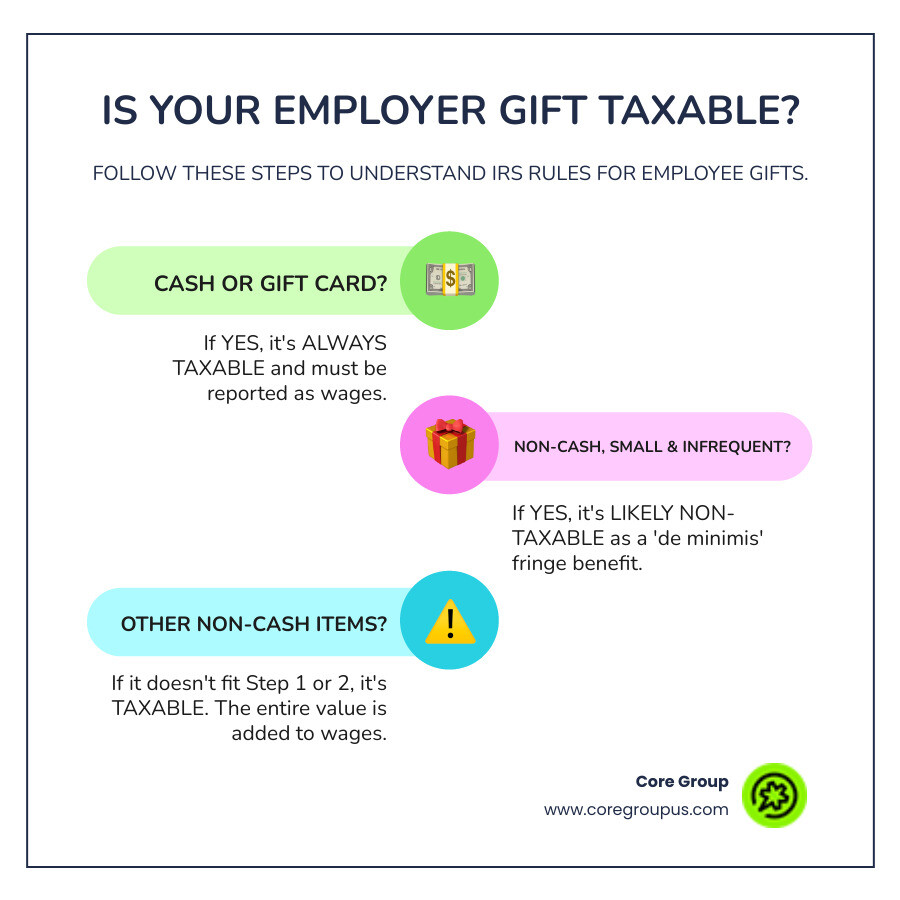
Quick Answer: Are Employer Gifts Taxable?
- Cash or gift cards: Always taxable, no matter the amount
- Non-cash gifts over $100: Generally taxable (entire amount, not just excess)
- Non-cash gifts under $100: May qualify as "de minimis" (tax-free) if infrequent
- Employee achievement awards: Special rules apply, up to $1,600 tax-free for qualified plans
- Holiday parties or group meals: Usually tax-free as de minimis benefits
The IRS doesn't see most employer "gifts" the same way you do. Under IRC Section 102(c), any transfer from an employer to an employee is presumed to be taxable compensation, not a true gift. This means that holiday bonus, team appreciation gift, or congratulatory present typically counts as wages — subject to income tax withholding, Social Security, and Medicare taxes.
The good news? There are legitimate exceptions. Small, infrequent, non-cash gifts often qualify as "de minimis fringe benefits" and won't trigger a tax bill for your team. But the rules are nuanced, and getting them wrong can mean surprise tax bills, penalties, or compliance headaches.
As a creative entrepreneur managing a team, understanding these rules helps you show appreciation without creating unintended tax consequences. Whether you're planning holiday gifts, celebrating a big project win, or recognizing years of service, knowing what's taxable — and what's not — keeps both you and your team happy.
The General Rule: Why Most Employer "Gifts" Are Taxable Compensation
When we, as employers, provide a benefit or item of value to an employee, our first thought might be that it's a generous "gift." However, the IRS views these transactions through a different lens. The general IRS rule is simple: almost anything of value an employer provides to an employee is considered taxable income unless a specific exclusion applies. This is crucial for understanding why most employer gifts taxable status defaults to "taxable."

This default position stems from Internal Revenue Code (IRC) Section 102(c). This section explicitly states that any amount transferred by an employer to an employee (or for their benefit) cannot be excluded from the employee's gross income as a gift. The IRS presumes that because an employer-employee relationship exists, any transfer is compensation for services rendered, not a gift born of "disinterested generosity." This means that even if we intend a transfer to be a "gift," the IRS will likely treat it as wages or a fringe benefit, subject to taxes.
This principle is rooted in the landmark Duberstein case, which established that for a transfer to be considered a true gift, it must originate from "detached and disinterested generosity" and not from "the constraining force of any moral or legal duty" or "the anticipation of an economic benefit." In the employer-employee context, such "disinterested generosity" is rarely found, as the transfer is typically tied, directly or indirectly, to the employment relationship.
For us, this means that the fair market value (FMV) of most items or benefits we provide to our team will be considered part of their taxable wages. This includes not just direct cash payments, but also the value of goods or services. Navigating these rules can be complex, but ensuring compliance is vital for both our business and our employees' financial well-being. For more detailed insights into managing your business's financial obligations, explore our tax services.
What Makes a "Gift" Taxable Compensation?
The employer-employee relationship is the primary factor that triggers taxability. If we provide something of value to an employee, it's generally considered compensation if it's tied to their employment or performance. This includes:
- Bonuses: Any cash bonus, whether for holidays, performance, or retention, is taxable.
- Performance-based rewards: If we give an employee a reward for meeting sales goals or outstanding achievement, its value is typically taxable. Monetary prizes and non-monetary bonuses, such as vacation trips for sales goals, are considered taxable compensation.
- Any payment for services: This is the broad catch-all. If the benefit is provided because of the employee's service to us, it's likely taxable.
- Reporting on Form W-2: The value of these taxable "gifts" must be included in the employee's gross wages on their Form W-2.
It's also important to consider gifts received by our employees from clients or third parties. While not directly from us, these can still have tax implications for our employees. Direct cash gifts from clients to our employees are generally treated as taxable tip income, subject to income and FICA taxes. If the amount exceeds $20 per month, it must be reported by the employee. The tax treatment can vary depending on whether the gift is direct, channeled through a fund, or given to the employer for distribution, but often it still ends up as taxable income for the employee.
The Rare Exception: When Is It a True, Non-Taxable Gift?
While rare, a transfer from an employer to an employee can be considered a non-taxable gift under very specific circumstances. This exception primarily applies when the transfer can be overwhelmingly attributed to a familial or quasi-familial relationship, completely unrelated to the employment.
For instance, if a business owner gives a substantial birthday gift to their son, who also happens to work for the company, it might be considered a non-taxable gift. However, we would need strong factual support to prove that the gift was made purely for personal reasons, out of "detached and disinterested generosity," and not in any way connected to the son's employment or performance. The IRS scrutinizes such situations closely. Merely being fond of an employee or having a close working relationship (like a mentor) is not enough to override the default taxability rule. The burden of proof for such a claim is very high, and in most cases, it's safer to assume taxability.
The "De Minimis" Exception: When Small, Infrequent Gifts Are Tax-Free
Here's where we find a bit of breathing room! The "de minimis" fringe benefit exception is one of the most common ways that employer-provided items can be non-taxable for employees. Under IRC Section 132(e), a de minimis fringe benefit is one for which, considering its value and the frequency with which it is provided, accounting for it would be unreasonable or impractical. It must also not be a form of disguised compensation.
This exception allows us to provide small, occasional tokens of appreciation to our team without creating a tax burden for them. The key is "small," "infrequent," and "impractical to account for." The IRS provides more detailed guidance on De Minimis Fringe Benefits.
What Qualifies as a De Minimis Gift?
These are the types of non-cash gifts that often make the cut for de minimis treatment:
- Holiday turkey or ham: A traditional holiday gift of food with a low fair market value.
- Occasional coffee and donuts: Providing these in the breakroom for general employee enjoyment.
- Flowers for a special occasion: Such as for an illness, birthday, or personal event.
- Company-logo water bottle, t-shirt, or mug: Items of nominal value with our company branding.
- Infrequent event tickets: For example, tickets to a local sporting event or theater production given occasionally.
- Group meals: An occasional holiday party, group meal, or picnic for employees.
- Occasional use of company photocopier: For minor personal tasks.
- Personal use of a business cell phone: If the phone is primarily used for business and the personal use is minimal.
- Fruit baskets or books: Under special circumstances and of low value.
These examples highlight the "occasional" and "low value" aspects. The administrative burden of tracking and accounting for such small, infrequent items would indeed be unreasonable.
What Does NOT Qualify as De Minimis?
Just as important as knowing what qualifies is understanding what doesn't. These items generally do not qualify as de minimis fringe benefits and are typically taxable:
- Cash or cash equivalents: This is a hard rule. We'll dive deeper into this next, but cash, gift cards, and gift certificates are almost never de minimis.
- Season tickets: Providing season tickets to sporting or theatrical events is considered a significant benefit and not de minimis, regardless of the individual ticket price.
- Use of company property for personal reasons: Such as a company apartment, hunting lodge, or boat for a weekend. The value of such personal use is substantial.
- Frequent meal allowances: While occasional overtime meal money can be de minimis, a regular or frequent meal allowance is typically taxable.
- High-value electronics: Even if they have our company logo, items like laptops, tablets, or high-end headphones are generally too valuable to be considered de minimis.
- Any benefit that is a form of disguised compensation: If it feels like a bonus, it probably is.
The Murky Waters of Dollar Limits
The IRS has never provided a "bright-line test" or a specific dollar limit to define "de minimis." This can make it challenging for us to know for sure. However, they have given us some strong indicators. In one ruling, the IRS stated that items with a value exceeding $100 could not be considered de minimis, even under unusual circumstances. This effectively sets a general rule of thumb: if a non-cash gift is valued at $100 or more, it's certainly not de minimis.
Here's the critical point: if a non-cash gift exceeds the de minimis threshold, the entire value of the gift becomes taxable to the employee, not just the amount that exceeds the threshold. For example, if we give an employee a non-cash gift valued at $120, the full $120 is taxable income, not just the $20 difference above the $100 guideline. This is why value and frequency are so important.
Navigating Cash, Gift Cards, and Special Awards
When it comes to showing appreciation, cash and gift cards are often the go-to, but they come with significant tax implications. Special achievement awards, on the other hand, have their own unique set of rules.

The Hard Rule on Cash and Gift Cards
This is perhaps the clearest rule in the book: cash gifts or cash equivalents are always taxable income to the employee, regardless of the amount. This includes:
- Cash: Any cash bonus or payment.
- Gift cards: Because they are redeemable for general merchandise or have a cash equivalent value, gift cards and gift certificates are almost always considered taxable. Their value is easily accounted for, so they don't meet the "administratively impractical" criterion of de minimis benefits.
- For a deeper dive, check out our guide: Is there tax on gift cards.
There is a very narrow exception: occasional money provided for meals or transportation to enable an employee to work overtime can be considered de minimis. However, this exception is specific and doesn't apply to general gift cards or cash bonuses. If the meal money is based on hours worked, it is typically taxable.
Understanding Employee Achievement Awards
Employee achievement awards are a special category with specific rules that can allow them to be non-taxable, or partially non-taxable, to employees. These awards are typically given for:
- Length of service: Recognizing significant milestones in an employee's tenure (e.g., 5, 10, 15 years).
- Safety achievements: Honoring employees for maintaining safety records or contributing to a safe work environment.
To qualify for favorable tax treatment, these awards must meet several criteria:
- Tangible personal property: The award must be tangible personal property (e.g., a watch, a plaque, a piece of jewelry). It cannot be cash, cash equivalents (like gift cards), vacation packages, meals, lodging, tickets, stocks, or bonds.
- Meaningful presentation: The award must be presented as part of a meaningful ceremony or presentation.
- Not disguised wages: The circumstances under which it's awarded must not suggest it's a form of disguised compensation.
There are also dollar limits. While the specific rules are complex, the tax-free value for all such awards to one employee in a year is limited:
- $400 for awards that are not part of a qualified plan.
- $1,600 for awards that are part of a "qualified plan award" (a written plan that doesn't discriminate in favor of highly compensated employees).
For more detailed information, you can refer to the Internal Revenue Code Section 74(c) – Exception for Certain Employee Achievement Awards. If an award exceeds these limits, the excess value is taxable.
How to Handle and Report When Employer Gifts Are Taxable
When we determine that an employer gift taxable status is "taxable," our responsibilities shift from simply giving a gift to properly reporting and withholding taxes. This is a critical step for compliance and to avoid penalties.
For Employers: Your Reporting and Withholding Duties
If a gift or benefit is taxable, its fair market value (FMV) must be included in the employee's wages. Here’s what that means for us:
- Include FMV in wages: The taxable value of the gift or benefit must be added to the employee's regular wages.
- Form W-2 Box 1: This total amount (regular wages plus the gift's FMV) is then reported in Box 1 of the employee's Form W-2 (Wages, tips, other compensation).
- Income tax withholding: We must withhold federal income tax from this amount, just as we would for regular wages.
- Social Security (FICA) and Medicare taxes: The taxable value is also subject to Social Security and Medicare taxes (FICA), which we must withhold from the employee's pay and match as the employer.
- Payroll records: Accurate and meticulous payroll records are essential to track these taxable benefits and ensure correct reporting.
For creative entrepreneurs, managing payroll and tax compliance can feel like a labyrinth. Our team at Core Group can help simplify this process, ensuring all taxable benefits are correctly reported and withheld. Learn more about our accounting services.
Key Differences: Employer Gifts Taxable Rules vs. Customer Gift Deductions
It's important not to confuse the tax rules for employee gifts with those for gifts to customers. While both involve giving something of value, their tax treatment differs significantly:
- Employee gifts: As we've discussed, these are generally considered compensation and are taxable to the employee (unless they meet a specific exclusion like de minimis). For us, the employer, all gifts to employees are deductible business expenses, regardless of whether they are taxable to the employee.
- Customer gifts: Gifts we give to customers, clients, or prospects are treated differently. They are considered business expenses, but our deduction is limited. We can generally only deduct up to $25 per recipient per year for business gifts. This $25 limit applies to the recipient, meaning gifts to a customer's family also count towards that customer's limit. Incidental costs such as engraving, packaging, and mailing typically do not count against the $25 limit.
So, while we can deduct the cost of a gift to an employee (even if it's taxable to them), our deduction for a customer gift is capped at a much lower amount.
Frequently Asked Questions about Employer Gift Taxability
We know these rules can be confusing, so let's tackle some common questions we hear from creative entrepreneurs.
Are gift cards from my employer ever non-taxable?
Generally, no. Gift cards or gift certificates are almost always considered taxable income to the employee. The IRS views them as cash equivalents because they can be easily exchanged for merchandise or services, and their value is readily accounted for. This means they don't meet the criteria for a de minimis fringe benefit.
The only rare exception is for occasional meal money or transportation money provided to enable an employee to work overtime. This is a very specific circumstance and does not apply to general gift cards given as appreciation or bonuses.
If a non-cash gift is worth $120, do I only pay tax on the $20 excess?
No, unfortunately, that's a common misconception that can lead to tax trouble. If a non-cash gift from us to an employee exceeds the de minimis threshold (which, as a rule of thumb, is anything valued at $100 or more), the entire value of the gift is taxable. So, if we give a non-cash gift worth $120, the full $120 must be included in the employee's taxable wages, not just the $20 that exceeds an arbitrary limit.
Is a company holiday party considered a taxable gift?
Generally, a company holiday party is not considered a taxable gift to employees. Most company holiday parties, group meals, or picnics qualify as de minimis fringe benefits. This is because they are typically:
- Infrequent: They don't happen often.
- Primarily for employees: The benefit is primarily for the employees, not a select few.
- Not lavish or extravagant: While there's no strict definition, a reasonable party is usually fine.
The cost of these events is often considered an ordinary and necessary business expense for us, and employees typically don't have to report the value of attending on their taxes.
Conclusion: Keep Your Gifts Generous and Compliant
Navigating the rules around employer gifts taxable status can feel like a labyrinth, but with a clear understanding, we can show appreciation to our team without creating unintended tax consequences.
Here are the key takeaways:
- The default is taxable: The IRS generally treats anything of value we provide to an employee as taxable compensation unless a specific exclusion applies.
- De minimis is the key exception: Small, infrequent, non-cash gifts (typically under $100) that are administratively impractical to account for can be tax-free.
- Cash and gift cards are taxable: This is a hard and fast rule, with very few exceptions.
- Employee achievement awards have special rules: Non-cash awards for length of service or safety can be tax-free up to certain limits ($400 or $1,600, depending on the plan), provided they meet specific criteria.
- Proper bookkeeping is crucial: For any taxable gifts, we must include their fair market value in employee wages on Form W-2 and withhold appropriate income, Social Security, and Medicare taxes.
As a creative entrepreneur, your focus should be on your craft, not complex tax rules. Understanding these guidelines allows us to thoughtfully reward our team while maintaining compliance with IRS regulations. If you ever find yourself uncertain about the tax implications of an employee gift or any other financial matter for your business, expert help is available.
Let us handle the numbers so you can focus on creativity and growth. Get expert help with your business tax planning.