Smart Tax Write-Offs for Filmmakers and Videographers
Why Filmmaker Tax Deductions Matter for Your Bottom Line

Filmmaker tax deductions can be the difference between a production that breaks even and one that's a financial success. Whether you're shooting a feature film, a documentary, or creating online content, understanding what you can write off is crucial.
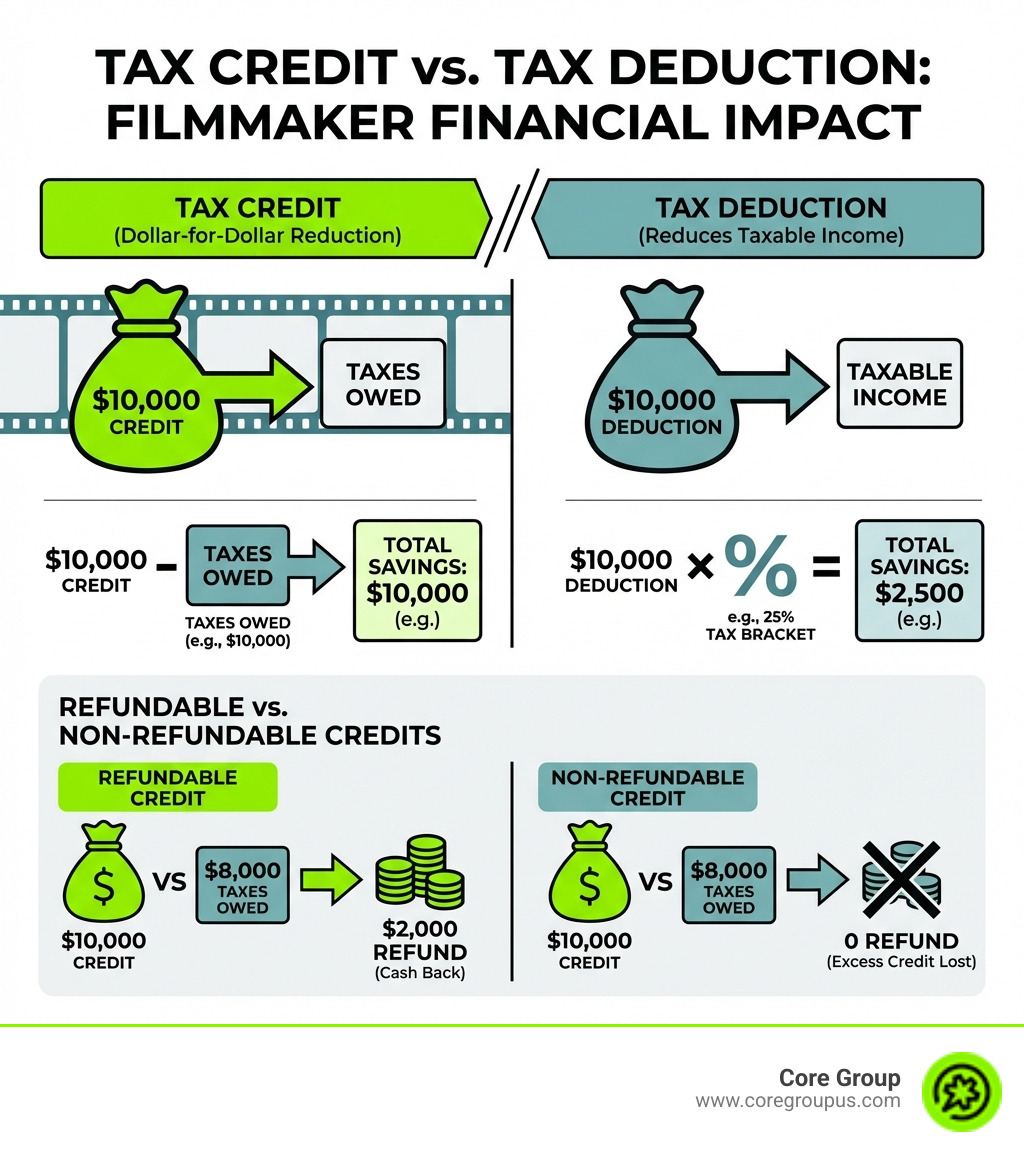
It's important to know the difference between a tax deduction and a tax credit. A deduction reduces your taxable income, so a $1,000 deduction might save you $250 in a 25% tax bracket. A tax credit, however, is a dollar-for-dollar reduction of your tax bill. A $1,000 credit saves you $1,000. Credits can be non-refundable (only reducing your tax liability to zero) or refundable (paid out to you even if you owe no tax), making them a powerful tool for filmmakers.
Quick Guide to Key Film & TV Incentives:
- US Federal (Section 181): Expense up to $15M in production costs ($20M in specific areas).
- California: Offers a base credit plus bonuses for filming outside LA, VFX work, and local hiring.
- Ontario (OFTTC): Provides a 35% refundable tax credit on eligible labor, with bonuses for first-time producers and regional filming.
- British Columbia (FIBC): A refundable, labor-based credit for Canadian-controlled productions.
- Common Deductible Expenses: Equipment rentals, crew wages, location fees, post-production costs, and insurance.
Navigating these rules can be complex, but the financial rewards are significant. This guide will break down the key incentives and how to claim them.
Understanding the Basics: Tax Credits vs. Deductions
Navigating filmmaker tax deductions and credits can feel like deciphering a complex script. However, understanding the fundamental differences between these two powerful financial tools is crucial for maximizing your savings and ensuring the profitability of your creative projects. Both aim to reduce your tax burden, but they do so in distinct ways.
Tax deductions work by reducing your taxable income. This means that for every dollar you deduct, you're taxed on one less dollar of income. The actual cash savings depend on your tax bracket. For instance, if you're in a 25% tax bracket and claim a $1,000 deduction, you save $250 in taxes. Deductions are typically available for business expenses, such as equipment rentals, crew wages, or location fees.
Tax credits, on the other hand, are a direct reduction of the tax you owe, dollar for dollar. If you have a $1,000 tax credit, your tax bill immediately drops by $1,000. This is a much more powerful incentive than a deduction, as its value isn't dependent on your tax bracket. Many government film incentives are structured as tax credits to directly encourage production activity.
For more information on general tax planning, you can always check out our resources on More info about tax planning.
What's the Difference and Why It Matters
The distinction between a tax credit and a tax deduction is vital for strategic financial planning in the film industry. A tax deduction reduces the amount of income on which you are taxed, lowering your overall tax liability. The benefit you receive from a deduction is your marginal tax rate multiplied by the deduction amount. So, a $10,000 deduction for a filmmaker in a 30% tax bracket would save them $3,000.
A tax credit, however, provides a dollar-for-dollar reduction in the actual amount of tax you owe. If you owe $10,000 in taxes and receive a $5,000 tax credit, your tax bill is immediately reduced to $5,000. This direct reduction makes credits incredibly valuable, often seen as "cash back incentives" from the government for meeting specific criteria, like filming in a certain location or employing local talent. Understanding this difference is key to accurately forecasting your project's budget and potential returns.
Refundable vs. Non-Refundable Credits Explained
Within the field of tax credits, there's a further distinction: refundable versus non-refundable. This difference is particularly important for filmmakers, as many production incentives are refundable.
A non-refundable tax credit can reduce your tax liability to zero, but it won't generate a refund if the credit amount exceeds the tax you owe. For example, if you owe $5,000 in taxes and have a $7,000 non-refundable credit, your tax bill becomes $0, but you won't get a $2,000 refund. Any unused portion of the credit might be carried forward to future tax years, depending on the specific program rules.
A refundable tax credit, conversely, can not only reduce your tax payable to zero but also result in a direct payment (a refund) if the credit amount is greater than the tax you owe. This is a huge advantage for productions, as it means even if your company has a lean year or no taxable income, you can still receive a cash payment, injecting crucial liquidity back into your business. Many provincial film tax credits in Canada, such as the Film Incentive BC (FIBC) and the Ontario Film and Television Tax Credit (OFTTC), are examples of refundable credits, making them highly attractive to filmmakers.
Major US Filmmaker Tax Deductions and Incentives
The United States offers a diverse landscape of incentives for filmmakers, ranging from federal deductions to state-specific tax credits designed to attract production and stimulate local economies. For creative entrepreneurs operating in states like California, Arizona, Colorado, or New York, understanding these opportunities is paramount.

While the federal government provides broad-stroke benefits through its tax code, individual states often layer on their own generous programs, creating a compelling financial environment for film and television production. We'll explore how these federal and state incentives can significantly impact your bottom line.
Key US Federal Filmmaker Tax Deductions: Section 181
One of the most significant federal provisions for filmmakers is 26 USC 181: Treatment of certain qualified productions. This section of the US tax code allows taxpayers to elect to treat the cost of any qualified film or television production, live theatrical production, or sound recording production as an expense, rather than capitalizing it over time. This means you can deduct these costs in the year they are incurred, providing an immediate tax benefit.
The election under Section 181 is subject to specific dollar limitations:
- For qualified film/television or live theatrical productions, the deduction is generally limited to $15,000,000 in aggregate costs.
- A higher dollar limitation of $20,000,000 applies if the production costs are significantly incurred in a low-income community or a distressed county/isolated area. This is a fantastic incentive to bring production to underserved regions.
- For qualified sound recording productions, the limit is $150,000 per taxable year.
To be eligible for this federal deduction, a key criterion is that at least 75% of the total compensation must be 'qualified compensation.' This refers to compensation for services performed in the United States by actors, production personnel, directors, and producers. Importantly, participations and residuals are excluded from this definition of compensation.
For television series, each episode is treated as a separate production, but only the first 44 episodes are taken into account for the purposes of this deduction. This ensures that long-running series can still benefit substantially. Qualified live theatrical productions also have specific criteria, including being a live staged production of a play in a venue with an audience capacity of not more than 3,000 (or a series of venues with a majority capacity of not more than 3,000).
It's crucial to note that if you make this election, no other depreciation or amortization deduction is allowed for the basis of that production. The election must be made by the due date of your tax return (including extensions) for the year costs are first incurred and generally cannot be revoked without IRS consent. This provision is set to apply to productions commencing before December 31, 2025, so planning is essential. For the precise legal text, refer to 26 USC 181: Treatment of certain qualified productions.
Spotlight on California: A Multi-Layered Approach
California, a global hub for entertainment, offers a robust and evolving Film and Television Tax Credit Program designed to keep production within the state. This program has seen significant investment, with the amount allocated increasing to $750,000,000 for each fiscal year from July 2025 through June 2030. This substantial funding underscores the state's commitment to supporting its film industry.

The California program goes beyond a base credit, offering several additional incentives for strategic production choices:
- Out-of-Zone Filming Bonus: Productions that shoot original photography outside the Los Angeles Zone can receive an additional 5% tax credit on qualified expenditures. This encourages filming in diverse locations across California, from the deserts to the mountains.
- Visual Effects (VFX) Credit: For productions with significant visual effects, an additional 5% tax credit is available. To qualify, the California VFX work must represent either 75% or more of the total worldwide VFX expenditures or a minimum of $10 million in qualified California VFX expenditures. This promotes high-tech post-production work within the state.
- Local Hire Labor Credit: To boost employment in regions outside major production hubs, an additional 10% tax credit (or 5% for Relocating TV series) is offered for qualified wages paid to California residents who reside outside the LA Zone for work performed outside the LA Zone. This incentivizes productions to tap into local talent pools across the state.
Beyond these direct credits, California also provides a valuable mechanism for filmmakers to offset sales and use tax liabilities. The Film and Television Tax Credit sales and use tax offset allows qualified taxpayers to apply their credits against these taxes. For the 2024, 2025, and 2026 calendar years, this offset is limited to $5,000,000 in each of those years for each claimant. This can significantly reduce the cost of renting equipment, purchasing materials, and other expenditures subject to sales and use tax. For a comprehensive guide on this, refer to the Tax Guide for Film and Television.
Navigating Canadian Film Production Incentives
Canada has established itself as a highly attractive destination for film and television production, thanks in large part to its comprehensive system of federal and provincial tax credits. These incentives are designed to foster Canadian content creation, support local talent, and attract international productions, contributing significantly to the nation's economy.
A key aspect of Canadian incentives is the emphasis on "Canadian content" rules and labor expenditures. While federal programs exist, much of the direct financial benefit for filmmakers comes through provincial tax credits, each with its own unique eligibility criteria and benefits. We'll focus on the prominent programs in Ontario, British Columbia, and Nunavut, which are relevant to our operations.
Maximizing Canadian Filmmaker Tax Deductions at the Provincial Level
Canada's provincial tax credits are a cornerstone of the country's film and television industry. These programs offer significant financial relief, primarily through refundable tax credits based on eligible labor expenditures. Here’s a comparison of some key provincial programs:
| Feature | Ontario Film and Television Tax Credit (OFTTC) | Film Incentive BC (FIBC) | Nunavut Film Rebate |
|---|---|---|---|
| Type | Refundable Tax Credit | Refundable Tax Credit | Rebate (on local spend) |
| Credit Rate | 35% of eligible Ontario labour expenditures (base) | Varies by initiative, labour-based | 27% (Majority Nunavut Ownership), 17% (Equal/Minority Nunavut Ownership) |
| Bonuses | - 40% on first $240,000 for first-time producers - 10% for filming outside GTA (regional) | Varies by initiative (e.g., Regional, Training, DAVE) | - Up to 3% for employing additional Nunavut key creative personnel - 5% or 10% for Inuktut language production/versioning |
| Key Eligibility | - Canadian-controlled company, permanent establishment in Ontario - Eligible Ontario production (Canadian content points) - Primarily shot and posted in Ontario - At least 75% of total final costs are Ontario expenditures - New rules for online distribution | - Canadian owned and controlled production corporation - Permanent establishment in British Columbia - Apply to Creative BC for eligibility | - Eligible production spending > $25,000 on goods/services in Nunavut - Ownership structure determines rebate rate |
| Administered By | Ontario Creates (for eligibility certificate), Canada Revenue Agency (for credit claim) | Creative BC (for eligibility certificate), Canada Revenue Agency (for credit claim) | Nunavut Film Development Corporation |
For videographers and filmmakers aiming to maximize their provincial tax benefits, understanding these programs is essential. We, at Core Group, are well-versed in navigating these complex guidelines to ensure you're leveraging every available incentive. Check out our industry-specific services for Industries: Videographers.
Deep Dive: Ontario (OFTTC) and British Columbia (FIBC)
The Ontario Film and Television Tax Credit (OFTTC) is a refundable credit calculated as 35% of eligible Ontario labour expenditures. It includes bonuses for first-time producers (40% on the first $240,000) and a 10% regional bonus for filming outside the Greater Toronto Area. As of 2022, productions released exclusively online can also qualify if they meet certain budget thresholds.
The Film Incentive BC (FIBC) is a similar refundable, labour-based credit for Canadian-controlled productions in British Columbia. Applications are managed through Creative BC, and the credit is claimed via the Canada Revenue Agency (CRA). FIBC also offers various add-on credits for regional filming, training, and digital effects.
Unique Opportunities in the North: The Nunavut Rebate
The Nunavut Film Development Corporation offers a direct rebate on production costs, which is a powerful incentive for filming in Canada's Arctic.
- Rebate Rate: Up to 27% of eligible costs for goods and services purchased in Nunavut, depending on the level of local ownership.
- Bonuses: Additional rebates are available for hiring local creative personnel (up to 3%) and for producing content in the Inuktut language (up to 10%).
The Application Process and Staying Compliant
Securing filmmaker tax deductions and credits requires careful planning and strict compliance with each program's rules. Missing a step or a deadline can jeopardize your funding.
General Application Steps and Deadlines
While processes vary, they generally follow these steps:
- Eligibility Certificate: Apply to the relevant film commission (e.g., Ontario Creates, Creative BC) before or during production to confirm your project qualifies.
- Completion Certificate: After production, submit final audited costs to receive a completion certificate confirming the eligible credit amount.
- Tax Filing: File the certificate with your corporate income tax return to the appropriate tax authority (e.g., CRA, IRS).
- Documentation: Maintain meticulous records, including budgets, cost reports, payroll, contracts, and daily production reports. Deadlines are strict, so timely submission is crucial.
Defining Eligible Costs and Compensation
Understanding what costs qualify is key.
- Qualified Compensation (US Section 181): Refers to wages for services performed in the U.S. by key production personnel. It excludes participations and residuals.
- Eligible Labour (Canada): Generally includes salaries and wages paid to residents of the specific province where the credit is being claimed. Residency status is critical.
- Assistance and Crowdfunding: Government grants, subsidies, and even some forms of crowdfunding are considered "assistance" and will typically reduce the amount of your tax credit. Check the CRA's policy on assistance for details.
Navigating Special Cases
- COVID-19 Provisions: Many jurisdictions offered temporary extensions and provisions for pandemic-related costs. Check the CRA’s COVID-19 FAQ for specific guidance.
- Inter-Provincial Co-Productions: For projects filming in multiple provinces, it's often best to set up separate corporations in each jurisdiction to clearly track and claim eligible expenditures for each province's tax credit program.
- Crowdfunding: The structure of your crowdfunding campaign can impact your tax credit eligibility. If it's considered assistance, it may reduce your final credit amount.
Frequently Asked Questions about Filmmaker Tax Deductions
We often hear similar questions from creative entrepreneurs trying to make sense of filmmaker tax deductions. Here are some common ones that cut through the complexity.
Can I claim deductions for a film that is only released online?
Yes, many programs now accommodate online-only releases. For example, Ontario's OFTTC allows it for productions started after November 1, 2022, provided they meet specific budget thresholds (e.g., at least $250,000) and a per-minute cost requirement. However, certain genres like reality TV or news are often excluded. Always check the specific guidelines for your jurisdiction.
What happens if my production fails to meet the eligibility requirements?
Failing to meet eligibility requirements means you will not receive the tax credit. This can be financially devastating, especially if you've secured financing based on that expected credit. You may be required to repay any advanced funds, potentially with interest. This highlights the importance of careful planning and consulting with a tax professional early in the process.
How are 'Canadian Content' points determined for tax credits?
To qualify for many Canadian tax credits, a production must be certified as "Canadian Content." This is determined by a points system administered by the Canadian Audio-Visual Certification Office (CAVCO). Points are awarded based on the number of Canadians in key creative roles, such as director, screenwriter, and lead actors. A production typically needs to score at least six out of ten points and meet other requirements related to Canadian production control. Official treaty co-productions are often exempt from the points test but must adhere to the terms of the specific international agreement. For more details, you can review government resources like Public Notice 2017-02 and Public Notice 2017-03.
Conclusion
Navigating the intricate world of filmmaker tax deductions and credits is a strategic imperative for any creative entrepreneur. From federal provisions like US Section 181 to state and provincial programs in California, Ontario, and British Columbia, these incentives can significantly improve your project's profitability.
The key is proactive financial management. By planning your production with tax incentives in mind—choosing locations strategically, hiring local talent, and carefully documenting expenditures—you can maximize your returns. The difference between a tax deduction and a refundable tax credit can mean thousands of dollars back in your pocket.
We know that for filmmakers and videographers, your passion is creating compelling content. The last thing you want to be "taxed out" by is complex financial paperwork. That's where expert guidance becomes invaluable. At Core Group, we specialize in offering a no-fluff, profit-first playbook, providing financial management, bookkeeping, and tax services for creative entrepreneurs. We help simplify these complexities, ensuring you leverage every available write-off and credit, so you can focus on what you do best: bringing your stories to life.
Don't let potential savings slip through your fingers. Take control of your finances and ensure your creative endeavors are as profitable as they are impactful.
Take control of your finances with our videographer services