An Essential Guide to Financial Consulting for Artists
Why Financial Consulting for Artists is Essential

As a creative professional, you steer a financial landscape unlike any other, marked by fluctuating income and unique business challenges. Financial consulting for artists provides specialized guidance to manage this unpredictability, turning financial stress into creative freedom.
Unlike traditional financial advice, which often assumes a steady paycheck, we understand the feast-or-famine cycle of artistic careers. We help you build a solid financial foundation by addressing key areas:
- Budgeting for irregular income
- Tax planning and deductions
- Retirement planning for the self-employed
- Business structure and entity selection
- Income diversification strategies
- Intellectual property protection
As one musician from The Journey to Financial Epiphany shared: "Being a working artist is achievable, and at some point, you're going to have to deal with money." With the right guidance, you can build sustainable wealth and make strategic decisions that support both your art and your future.
Why Artists Face Unique Financial Problems
If you're an artist, you know your career path is anything but ordinary. While the passion and creativity are boundless, the financial landscape can often feel like a maze without a map. Many artists focus on their craft, sometimes at the expense of financial education. This can lead to poor financial decisions and missed opportunities for growth.

This is why specialized financial consulting for artists is so crucial. It addresses the unique challenges that often leave creatives feeling intimidated when it comes to money. From unpredictable income to complex contracts, the financial world can seem designed for everyone but you. We're here to help you move From Intimidated to Empowered: A Creative's Guide to Financial Epiphanies.
The Challenge of Volatile Income
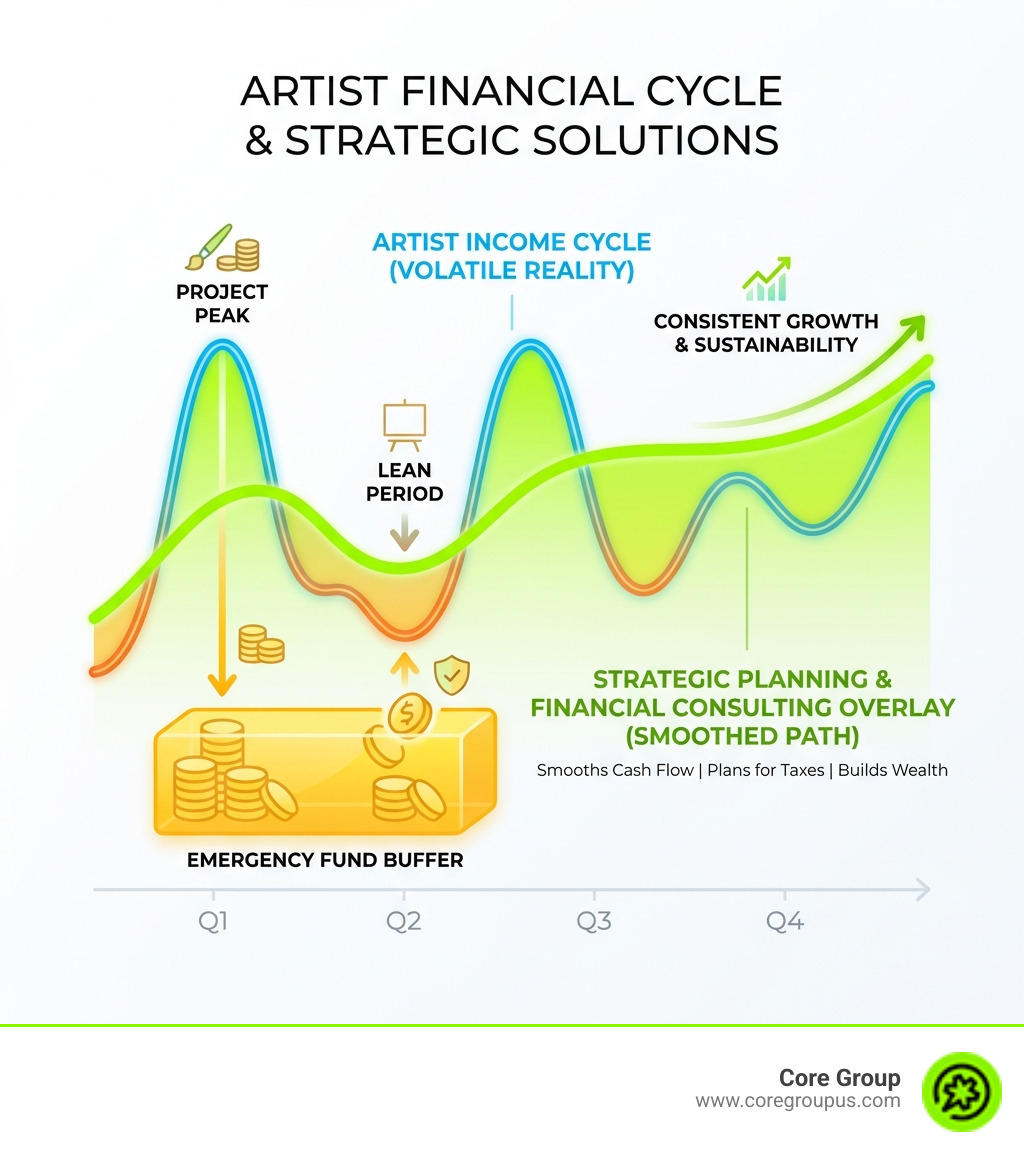
Imagine a typical artist's income as a rollercoaster - thrilling highs followed by stomach-dropping lows. This "feast or famine" cycle is a reality for many creative professionals. One month, you might land a lucrative project, and the next, your income could drop significantly. This unpredictability makes traditional budgeting incredibly difficult.
Project-based work means inconsistent paychecks. You might receive a large lump sum payment, only to face a long stretch with no income. Without a solid financial plan, these large payments can quickly disappear. Our approach to financial consulting for artists focuses on smoothing out this volatility, helping you create a financial buffer that provides confidence.
The Business of Being an Artist
As an artist, you're not just a creator; you're an entrepreneur, a marketer, a negotiator, and a bookkeeper. From pricing your work fairly to negotiating contracts that protect your interests, the business side of art is a full-time job in itself.
Unlike employees who receive regular paychecks and benefits, artists often lack traditional support systems like employer-sponsored health insurance or retirement plans. This means you're responsible for setting up your own benefits and planning for your future entirely on your own. That's why we focus on The Art of Business, helping you manage the complexities so your creativity can flourish.
Building Your Financial Foundation: A 5-Part Plan
Every great masterpiece starts with a strong foundation, and your financial life is no different. We believe that a robust financial plan for artists encompasses five key components: budgeting, saving, debt management, investing, and protection.
Budgeting and Saving for Creatives
For artists, budgeting isn't about restriction; it's about empowerment. We champion the power of a 50/30/20 budget: 50% for obligations (your needs), 30% for discretionary spending (your wants), and 20% for savings.
Creating a budget that accounts for both your fixed and variable expenses is foundational. Once you have a clear picture, the next step is saving. We always say, "pay yourself first." Aim to save 10-20% of your income. Set up automatic transfers into your savings each pay cycle. You can get started with downloading this budget template.
Due to the unpredictability of your income, it's especially important to allocate a portion of your earnings to an emergency fund. We recommend aiming to save at least six months' worth of living expenses to provide confidence during lean periods.
Managing Debt and Investing for the Future
Debt can quickly become a burden if not managed properly. We advise artists to avoid high-interest loans and credit card debt. If you need to borrow, consider lower-interest options and create a clear repayment plan.
Once you've gotten rid of high-interest debt and built some cash savings, it's time to get the magic of compounding working for you. We like people to invest 10-20% of their income, or whatever they can - anything is better than nothing.
For artists, we recommend a strategy that balances growth with accessibility. Consider options like index funds, which provide diversification by spreading investments across various assets. Target-date funds can also be a great option, as they automatically adjust their asset allocation as you approach retirement. To learn more about financial literacy, we highly recommend the book All Your Worth.
Protecting Your Income and Intellectual Property
For artists, your work is your livelihood, making protection paramount. Ensure your work is copyrighted, trademarked, or patented where applicable. Licensing your work strategically can also be a significant income stream.
Beyond your IP, protecting your ability to earn an income is crucial. Consider these essential insurance types:
- Disability Insurance: Replaces a portion of your income if you become unable to work
- Health Insurance: Crucial for managing healthcare costs as a self-employed individual
- Liability Insurance: Protects you from claims of injury or property damage
- Property Insurance: Covers your studio, equipment, and artwork
- Life Insurance: Provides financial security for your loved ones
The Power of Specialized Financial Consulting for Artists
We know that as an artist, your time is best spent creating. That's why specialized financial consulting for artists isn't just a luxury; it's a strategic partnership that offers peace of mind and frees up your valuable time. Instead of wrestling with spreadsheets and tax codes, you can focus on your craft, knowing your financial future is in expert hands. We see ourselves as an extension of your team, providing professional expertise custom to your unique journey.
Our vision is to educate and serve artists through personalized financial advice so you can live your best life today and tomorrow. This financial empowerment means you gain clarity, reduce stress, and make informed decisions that support your long-term goals. We're here to help creatives of all kinds, from musicians to photographers. Take a look at Who We Help to see how we can support your journey.
Your Advisory Board: Who You Need on Your Team
No artist is an island, and building a strong "advisory board" of professionals is key to navigating the financial complexities of your career. This team works together to ensure all aspects of your financial life are managed effectively, allowing you to focus on your art.
| Professional Role | Key Responsibilities |
|---|---|
| Financial Advisor | Helps you create a comprehensive financial plan, manage your investments, and plan for long-term goals like retirement, coordinating with other professionals so your overall strategy is cohesive. |
| Accountant | Manages your books, prepares tax returns, and helps ensure you're compliant with tax laws. They can identify deductions and credits specific to your creative work. We offer accounting services custom to the needs of artists. |
| Entertainment Lawyer | Handles contracts, licensing agreements, and intellectual property issues. They protect your rights, negotiate favorable terms, and help ensure your work is legally safeguarded. |
| Business Manager | For artists with more complex careers, a business manager can oversee day-to-day financial operations, such as paying bills, tracking royalties, and managing tour or project budgets. |
How to Choose the Right Financial Consulting for Artists
Choosing the right financial consultant is a critical decision. Here is what to look for:
- Fee Structure: A flat-fee model provides transparency and helps align your advisor's interests with yours, unlike commission-based models that may incentivize product sales.
- Fiduciary Duty: Look for a Registered Investment Advisor (RIA). As an RIA, we are legally bound to act in your best interest at all times.
- Specialization: Your financial advisor should understand the unique challenges of a creative career, from managing irregular income to navigating industry-specific tax deductions. We specialize in working with creative professionals, including photographers.
When interviewing potential advisors, ask about their experience with artists, how they are compensated, and how they approach financial planning for non-traditional careers.
Building Your Financial Foundation: A 5-Part Plan
Every great masterpiece starts with a strong foundation, and your financial life is no different. We believe that a robust financial plan for artists encompasses five key components: budgeting, saving, debt management, investing, and protection. This holistic approach ensures you're not just reacting to financial challenges but proactively building a secure and prosperous future.
Budgeting and Saving for Creatives
For artists, budgeting isn't about restriction; it's about empowerment. It's about gaining control of how much money you get, spend, and save. We champion the power of a 50/30/20 budget: 50% for obligations (your needs), 30% for discretionary spending (your wants), and 20% for savings. This simple rule helps you track your income and expenses diligently and determine which expenses fall into each category.
Creating a budget that accounts for both your fixed and variable expenses is foundational. For artists, variable costs like art supplies or studio rentals might fluctuate, so understanding these patterns is key. Once you have a clear picture, the next step is saving. We always say, "pay yourself first." Consider saving as an expense, and aim to save 10-20% of your income. Set up automatic transfers of money into your savings each pay cycle. Making it automatic ensures you're building your financial future consistently. Studies show that many people who create a budget tend to stick to it, gaining control over their finances. You can get started with a helpful resource like downloading this budget template.
Due to the unpredictability of your income, it's especially important to allocate a portion of your earnings to an emergency fund. This fund will provide support in months with lighter cash flow. We recommend aiming to save at least six months’ worth of living expenses (your needs) to provide confidence that you can meet your near-term needs and remain focused on your craft. A line of credit is not an emergency fund; true savings provide peace of mind.
Managing Debt and Investing for the Future
Debt can quickly become a burden if not managed properly. We advise artists to avoid high-interest loans and credit card debt, as these can compound rapidly and eat into your limited resources. If you need to borrow, consider lower-interest options and create a clear repayment plan. Prioritizing the payoff of high-interest debt frees up your cash flow and reduces financial stress.
Once you’ve gotten rid of high-interest debt and built some cash savings, then it’s time to get the magic of compounding working for you. The key here is that it’s important to take advantage of the power of compounding, because it can make or break your finances over time. Investing is a powerful tool for long-term financial growth, and the good news is that investing has gotten really easy. We like people to invest 10-20% of their income, or whatever they can—anything is better than nothing.
For artists, we recommend a strategy that balances growth with accessibility, given your variable income. Consider options like index funds, which are collections of many stocks and bonds that provide diversification, reducing risk by spreading investments across various assets. Target-date funds can also be a great option, as they automatically adjust their asset allocation to become more conservative as you approach a specific retirement date. Work with us to develop an investment strategy that aligns with your risk tolerance and financial goals. To learn more about financial literacy, we highly recommend the book All Your Worth.
Protecting Your Income and Intellectual Property
For artists, your work is your livelihood, making protection paramount. Intellectual property (IP) protection is vital. Ensure your work is copyrighted, trademarked, or patented where applicable. For instance, a musician would copyright their songs, a visual artist might copyright their original pieces, and a designer could trademark their brand logo. Licensing your work strategically can also be a significant income stream, but it requires careful contractual agreements.
Beyond your IP, protecting your ability to earn an income is crucial. Consider insurance policies that protect against the loss of income due to unforeseen circumstances like illness or injury. Disability insurance, for example, can provide a financial safety net if you're unable to work. Liability insurance is also essential, especially if you have a studio, teach classes, or your work involves public interaction. Here's a list of essential insurance types for artists:
- Disability Insurance: Replaces a portion of your income if you become unable to work due to illness or injury.
- Health Insurance: Crucial for managing healthcare costs, especially as a self-employed individual.
- Liability Insurance: Protects you from claims of injury or property damage caused by your work or on your premises.
- Property Insurance: Covers your studio, equipment, and artwork against theft, damage, or loss.
- Life Insurance: Provides financial security for your loved ones in the event of your passing.
- Errors & Omissions (E&O) Insurance: Important for artists providing professional services, protecting against claims of negligence or mistakes.
The Power of Specialized Financial Consulting for Artists
We know that as an artist, your time is best spent creating. That's why specialized financial consulting for artists isn't just a luxury; it's a strategic partnership that offers peace of mind and frees up your valuable time. We see ourselves as an extension of your team, providing professional expertise custom to your unique journey.
Our vision is to educate and serve artists through personalized financial advice so you can live your best life today and tomorrow. We're here to help creatives of all kinds. Take a look at Who We Help to see how we can support your journey.
Your Advisory Board: Who You Need on Your Team
No artist is an island, and building a strong "advisory board" of professionals is key to navigating the financial complexities of your career.
| Professional Role | Key Responsibilities |
|---|---|
| Financial Advisor | Helps you create a comprehensive financial plan, manage your investments, and plan for long-term goals like retirement |
| Accountant | Manages your books, prepares tax returns, and helps ensure you're compliant with tax laws. We offer accounting services custom to artists |
| Entertainment Lawyer | Handles contracts, licensing agreements, and intellectual property issues |
| Business Manager | For artists with more complex careers, oversees day-to-day financial operations |
How to Choose the Right Financial Consulting for Artists
Choosing the right financial consultant is a critical decision. Here is what to look for:
- Fee Structure: A flat-fee model provides transparency and helps align your advisor's interests with yours
- Fiduciary Duty: Look for a Registered Investment Advisor (RIA) who is legally bound to act in your best interest
- Specialization: Your financial advisor should understand the unique challenges of a creative career. We specialize in working with creative professionals, including photographers
When interviewing potential advisors, ask about their experience with artists, how they are compensated, and how they approach financial planning for non-traditional careers.
Advanced Strategies for a Thriving Artistic Career
Once you've established a solid financial foundation, we can explore advanced strategies designed to propel your artistic career forward. These strategies include optimizing your tax situation, building robust retirement plans, and intelligently diversifying your income streams. It's all part of Unlocking Creativity: The Business of Art.
Tax Planning and Business Structure
For artists, tax planning is about strategic optimization. The tax code was written with businesses in mind, and as an artist, you are a business!
- Business Structure: Choose between a sole proprietorship (simple but no liability protection) or an LLC (offers liability protection and tax advantages). Getting an EIN for your business is often necessary
- Separating Finances: Keep your personal and business finances separate to simplify bookkeeping and taxes
- Quarterly Estimated Taxes: As a self-employed artist, you're responsible for paying estimated taxes every three months
- Common Tax Deductions: Many expenses are tax-deductible, including studio rent, art supplies, marketing costs, and home office expenses
Retirement Planning for the Self-Employed
Retirement planning for artists requires a flexible approach. Since you likely don't have an employer-sponsored 401(k), we explore powerful alternatives:
- SEP IRA: Excellent for self-employed individuals, allowing for significant tax-deductible contributions
- Solo 401(k): Offers even higher contribution limits than a SEP IRA
- Traditional vs. Roth IRA: Choose between tax-deductible contributions now (Traditional) or tax-free withdrawals in retirement (Roth)
The key to long-term growth is consistency and understanding the power of compounding interest.
Diversifying Your Income Streams
Relying solely on one source of income can be risky. We work with artists to strategically diversify their revenue streams, building a more stable financial model. This approach is central to The Profitable Creative mindset.
Consider these avenues for diversification:
- Teaching Opportunities: Share your skills through workshops, online courses, or private lessons
- Selling Merchandise: Create and sell prints, merchandise, or digital products based on your art
- Licensing Your Work: Allow others to use your art for a fee
- Grants and Residencies: Actively seek out funding opportunities
- Passive Income: Explore ways to generate income that requires minimal ongoing effort
By building multiple income streams, you create a financial buffer that helps manage the inherent volatility of an artistic career.
Frequently Asked Questions about Financial Consulting for Artists
We often hear similar questions from artists navigating their financial journeys. Here are some of the most common, along with our insights.
How do I manage unpredictable income and royalties?
Managing unpredictable income is one of the core challenges we address in financial consulting for artists. Our strategy focuses on creating a robust cash flow plan and building substantial reserves.
First, we help you create a dynamic budget that accounts for fluctuating income. Building a significant emergency fund (at least six months of living expenses) acts as your buffer during leaner periods. For royalties or large payments, we explore income-smoothing techniques, such as negotiating installment payments rather than lump sums. By working with a financial professional, you can proactively plan for these fluctuations.
What is the best way to structure my business as an artist?
The best business structure depends on your specific needs and goals:
- Sole Proprietorship: Simplest structure but no legal separation between you and your business
- Limited Liability Company (LLC): Popular choice offering personal liability protection and tax flexibility
- S-Corporation: Can potentially reduce self-employment taxes for some artists
- Partnership: Suitable if you collaborate with other artists and share ownership
Consulting with legal and tax professionals is key to choosing the structure that best suits your financial goals.
How can I avoid large tax bills on advance payments or big commissions?
Large advance payments can lead to surprisingly high tax bills if not managed strategically:
- Spreading Payments: Negotiate contracts to spread large payments across multiple tax years
- Maximizing Deductions: Track and claim all legitimate business expenses
- Setting Aside for Taxes: Immediately set aside a percentage of every large payment for taxes
Working with us to optimize income distribution and leverage tax strategies can help reduce tax burdens and create a more consistent financial foundation.
Conclusion
Your artistic journey is a unique and valuable one, and your financial life should support, not hinder, that creativity. We've seen how financial consulting for artists can transform uncertainty into confidence, allowing you to focus on your passion. Taking control of your finances is not about becoming a business mogul; it's about building a sustainable career that offers both creative freedom and financial peace of mind.
Our "no-fluff, profit-first playbook" is specifically designed for creative entrepreneurs like you. We guarantee peace of mind and save you time, giving you the freedom to concentrate on what you do best. Don't let financial overwhelm dim your creative spark. We believe that professional financial advice should be accessible, transparent, and custom to your extraordinary path.
Ready to build a financial future as vibrant as your art? Take the first step towards financial empowerment. Book a Call with us today to discuss how we can help you thrive.