An Essential Guide to Comparing Full Service Payroll Options
How full service payroll takes work off your plate
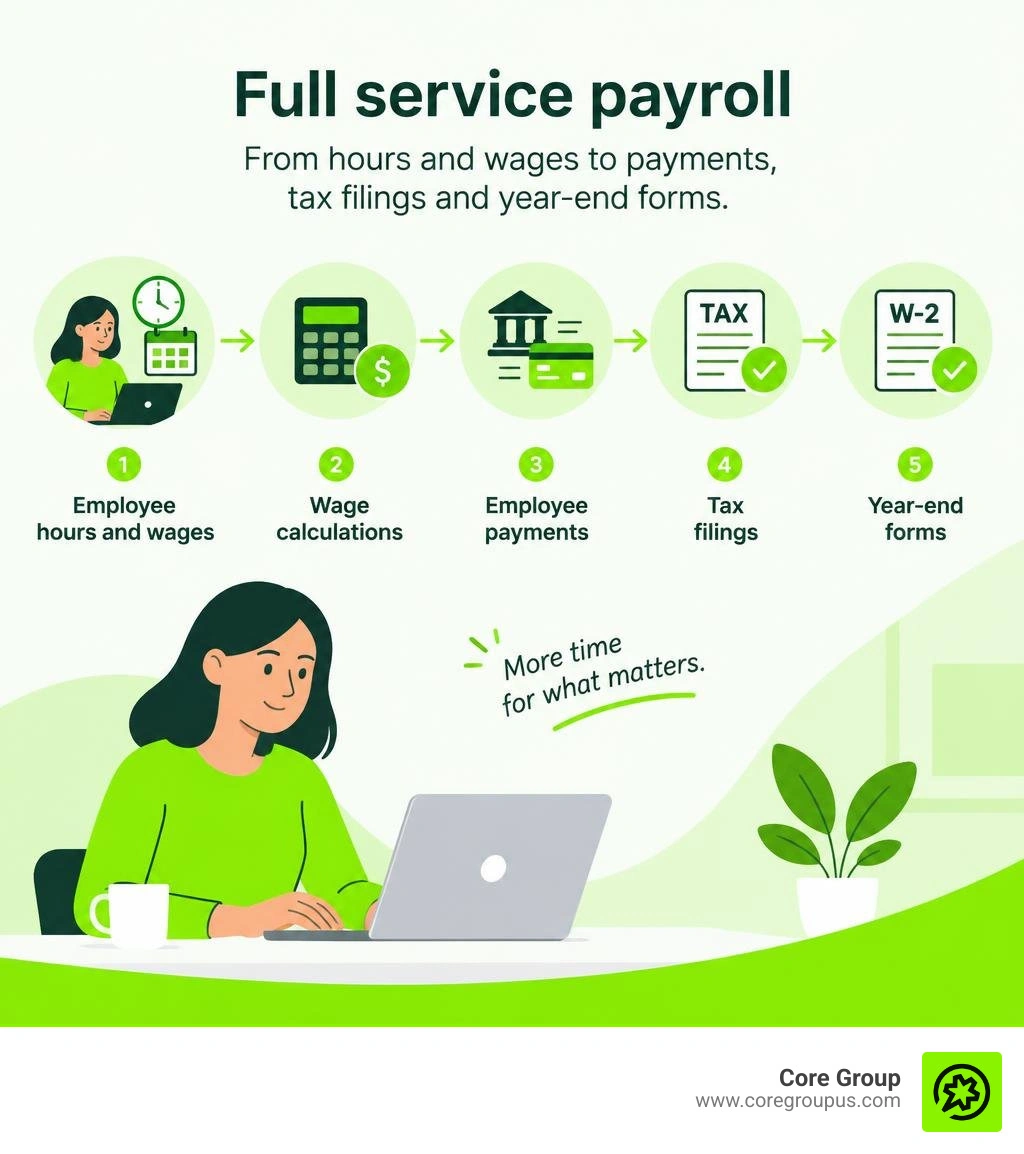
Full service payroll handles wage calculations, employee payments, payroll tax filings, and year-end forms. To choose a provider, check which taxes it files, whether it connects to your accounting system, what support you get, and what the total fee covers. Ask which steps still need your approval.
For a creative business, the right setup can mean less time spent on pay runs and more time for client work. It does not remove your responsibility to keep employee details and hours accurate. I'm Christian Brim, and I'll walk you through what to compare before you commit.
Glossary for full service payroll
Understanding Full Service Payroll and How It Operates
Managing wages accurately requires constant attention to shifting rates, filing windows, and employee changes. A complete payroll platform removes the friction of manual bookkeeping by coordinating gross-to-net calculations, electronic fund disbursements, and government remittances inside an automated environment.
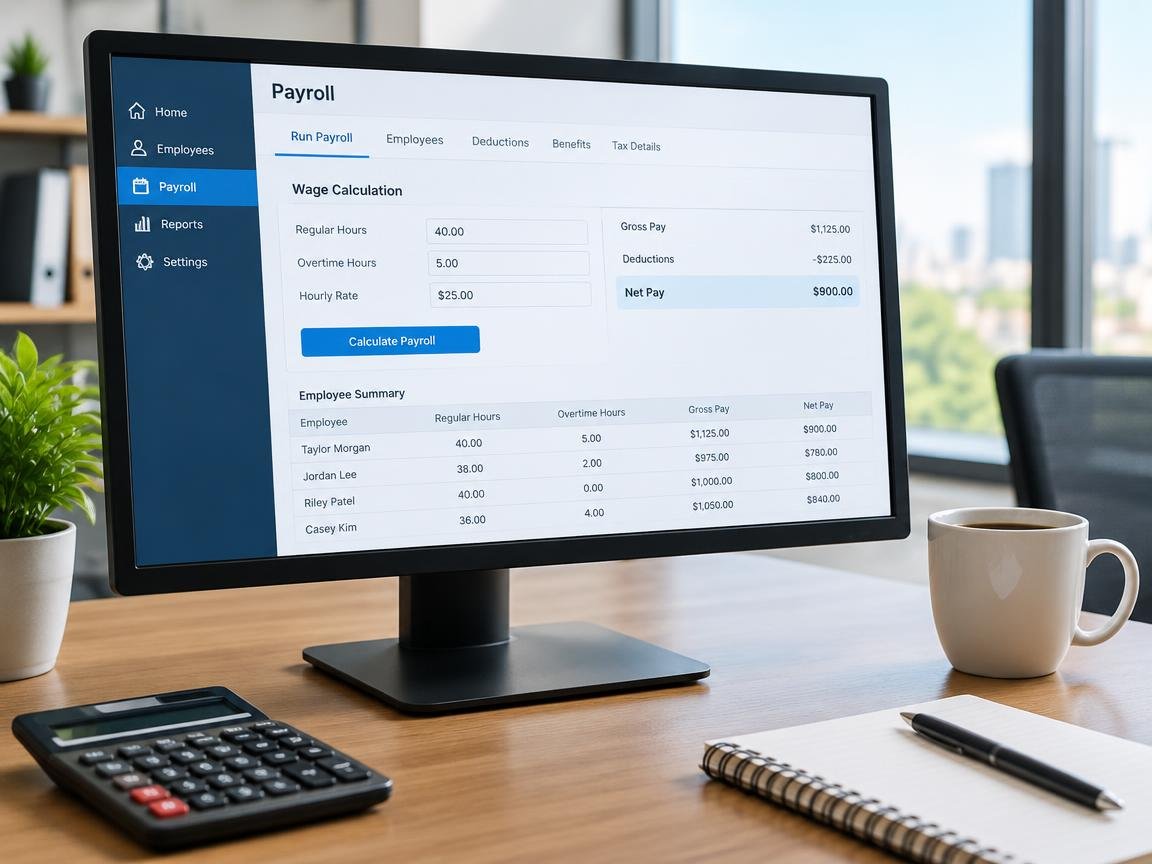
When you configure compensation schedules, the system determines the precise amounts to withhold for federal income tax, Social Security, Medicare, and applicable state or municipal obligations. Net earnings are then distributed securely through payroll direct deposit or direct-to-card systems, ensuring your team receives their pay on time every pay cycle.
Beyond simple wage disbursements, full systems coordinate directly with state agencies to verify identification numbers, process registrations, and ensure that employer tax filings stay aligned with statutory standards. Many state authorities, including resources found via Payroll Service Companies, outline how authorized third-party processors electronically submit tax withholdings to maintain accurate merchant accounts.
Core Capabilities of Full Service Payroll Platforms
Modern payroll software handles complex regulatory tasks automatically. Rather than requiring business owners to calculate liabilities manually on spreadsheets, these systems prepare, sign, and submit quarterly returns such as federal Form 941 and annual unemployment declarations under Form 940. State unemployment tax filings and local withholding reports are prepared and submitted directly to the relevant tax departments.
At the close of the calendar year, platforms generate, distribute, and file Form W-2 for direct staff and Form 1099 for external independent contractors. Mandatory new hire reports are sent to state directories within required deadlines, keeping your hiring practices fully compliant. By unifying these functions, companies maintain continuous payroll tax compliance while embedding reliable payroll management in HR processes across the organization.
Key Business Benefits of Full Service Payroll
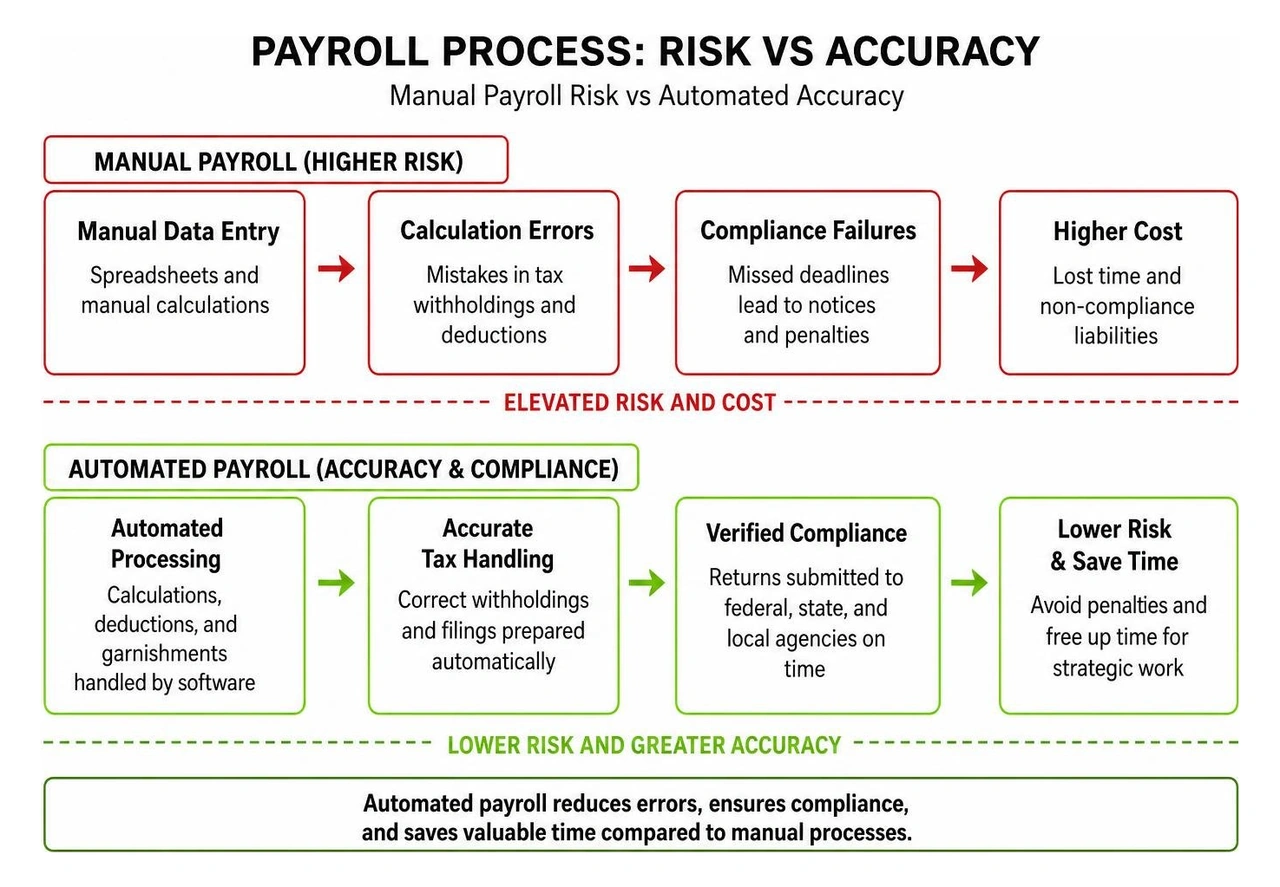
Outsourcing payroll tasks to a purpose-built platform drastically lowers the risk of human calculation error. Manual mathematical mistakes on tax withholdings often trigger immediate notices and penalties from tax agencies, draining financial resources and operational energy.
Full service solutions automate complex wage garnishments, calculate voluntary pre-tax deductions, track accrued paid time off, and provide secure self-service portals where employees can access pay statements and tax documents on demand. Whether your company operates on a bi-weekly cycle or a semi-monthly pay period, an automated infrastructure ensures consistent execution without unnecessary manual oversight.
Full Service Payroll Compared to DIY Processing
Handling wage runs internally using desktop spreadsheets or manual checks might appear cost-effective at first glance. However, the true expense often reveals itself through lost productive hours and severe non-compliance liabilities.
| Feature Area | Full Service Payroll | DIY Manual Processing |
|---|---|---|
| Processing Time | Minutes per pay run | Several hours per pay run |
| Tax Filing Responsibility | Handled and guaranteed by provider | 100 percent employer responsibility |
| Error and Penalty Risk | Minimized via automated calculations | Elevated due to manual data entry |
| Year-End Reporting | Automated W-2 and 1099 generation | Manual form preparation and postal mailing |
| System Integration | Direct sync with accounting ledgers | Manual journal entries required |
Relying on manual workflows leaves your business open to missed statutory deadlines and calculation discrepancies. As explained in our payroll bookkeeping complete guide, moving away from manual entry is essential even for a micro business payroll model where administrative bandwidth is limited.
Evaluating Total Cost of Ownership and Time Savings
A proper cost evaluation compares the basic subscription rate against the valuable hours reclaimed by leadership. When founders spend five to ten hours every month managing wage tables, tracking tax updates, and fixing filing mistakes, those hours are taken away from strategic growth, creative output, and client development.
Standard pricing structures usually feature a predictable monthly base fee paired with a modest per-employee monthly charge. Even when managing a small business payroll one employee setup, the expense is readily offset by eliminating late-filing fees and freeing up internal capacity. Choosing an optimized payroll for SMB platform generates clear returns by replacing manual labor with dependable software workflows.
Critical Features to Look for When Evaluating Vendors
Selecting the right provider requires a close look at how well the software connects with your existing administrative and financial tech stack. When evaluating options, prioritize platforms that feature reliable bidirectional communication with your accounting books.

Synchronizing data cleanly with your core bookkeeping tools avoids tedious reconciliations at month-end. You can establish seamless financial workflows by implementing payroll accounting integrations or setting up a dedicated cloud bookkeeping integration to log wage entries, tax liabilities, and cash transfers automatically into the general ledger.
Multi-State Compliance and Global Workforce Management
Modern businesses frequently hire talent across multiple jurisdictions, which introduces complex tax obligations. When your team works in different locations, your payroll provider must accurately deduct local withholdings, manage state-specific unemployment funds, and keep pace with distinct regional labor statutes.
Implementing robust payroll compliance for remote teams prevents expensive registration oversights. For businesses expanding beyond national borders, partnering with scalable global payroll solutions ensures international contractor disbursements and foreign tax mandates are handled smoothly. State-level resources such as Connecticut State Payroll show how public agencies standardize payroll records across varied employee roles, illustrating the precision needed for any distributed workforce.
Data Security and Regulatory Infrastructure
Payroll systems house highly sensitive corporate data, including bank account numbers, salary structures, home addresses, and Social Security identifiers. Top-tier providers protect this information using advanced security frameworks.
Look for enterprise-grade protections such as AES 256-bit data encryption at rest and in transit, multi-factor authentication protocols for all user logins, and SOC 2 Type II compliance credentials. Strict role-based permission settings ensure that managers and department leaders only see the specific personnel records necessary for their daily responsibilities.
Implementation Assistance and Vendor Support Standards
Switching to a new payroll engine should never disrupt your regular pay schedules. High-quality vendors provide structured onboarding assistance to guide you through historical wage data imports, bank routing verifications, and parallel test runs before going live.
Working with experienced professionals simplifies technical steps like HR and payroll for small business deployments or setting up an S Corp payroll setup designed to maintain reasonable compensation rules. Dedicated onboarding specialists help map your accounts correctly, test direct deposit connections, and train your administrative team so regular operations run without a hitch.
Frequently Asked Questions About Full Service Payroll
How do full-service payroll systems handle quarterly and annual tax filings
Full-service payroll platforms calculate exact tax liabilities during every individual pay run based on current tax codes. When quarterly and annual deadlines arrive, the software automatically populates, signs, and electronically submits federal forms like 941 and 940, alongside state and local filings. Year-end W-2 and 1099 documents are generated automatically and delivered to workers digitally or by mail without requiring manual calculation from your staff.
What is the typical onboarding timeline when switching payroll providers
Most businesses complete their onboarding process within one to three weeks. The overall timeline depends on how quickly you gather historical wage data, verify corporate banking accounts, set up employee profiles, and conduct a parallel test run. Gathering your prior quarterly tax filings and current year-to-date pay registers beforehand speeds up the transition significantly.
How does full-service payroll manage garnishments and voluntary benefit deductions
Automated platforms allow administrators to enter deduction parameters once into the employee profile. The system then automatically calculates and deducts pre-tax healthcare premiums, retirement plan contributions, and court-ordered child support from every paycheck. Coordinating your payroll and benefits inside one unified hub ensures voluntary and statutory deductions are processed accurately and remitted directly to the proper agencies.
Conclusion
Automating your wage processing and tax reporting eliminates costly administrative overhead and protects your company from preventable compliance fines. Rather than struggling with manual calculations and stressful tax deadlines, working with a comprehensive payroll framework allows you to direct your valuable focus back to serving clients and growing your business.
At Core Group, we deliver financial management, bookkeeping, and tax services designed specifically for creative entrepreneurs. We apply a no-fluff, profit-first playbook that guarantees peace of mind and saves you time, allowing you to focus on your creative work backed by our MacBook Pro guarantee. Explore our comprehensive payroll services small business guide to see how our streamlined systems can elevate your financial operations.