How to Optimize Freelance Overtime Taxes in Less Than an Hour a Day
Georgia freelance overtime tax planning starts with one key check
Georgia freelance overtime tax planning starts by separating 1099 work from W-2 wages. Working more than 40 hours on freelance projects does not, by itself, qualify your 1099 income for the federal overtime deduction. If you also hold a job that pays qualifying overtime, keep its pay records and verify whether you can claim the federal deduction alongside Georgia's separate exclusion of up to $1,750.
For your freelance work, track income and expenses every week, set aside funds for income and self-employment taxes, and review your quarterly estimated tax payments. Developing that routine takes less than an hour and helps you plan accurately without relying on deductions you may not qualify for under current state guidelines.
I am Christian Brim, and I will walk you through the essential tax checks that matter for your 2026 filings. Taking control of your tax obligations early in the year prevents unwelcome surprises when filing deadlines arrive.

Georgia freelance overtime tax planning resources include helpful guidance on overtime tax savings for artists, practical tools for managing overtime taxes small creative business operations, and proven creative overtime tax savings strategies.
Step by Step Guide to Georgia Freelance Overtime Tax Planning
Managing your taxes as an independent creative in Georgia requires a clear view of both federal law and local state regulations. Under federal law, the qualified overtime compensation deduction under Internal Revenue Code Section 225 provides targeted relief on qualified premium pay. For independent workers, leveraging creative overtime tax savings strategies means knowing exactly which portions of your earnings qualify under Fair Labor Standards Act Section 7 definitions.

To navigate these rules smoothly, you need to understand that the federal deduction applies strictly to the premium portion of overtime compensation. That means only the extra half-rate above your standard hourly baseline counts toward the deduction, rather than the entire hourly payment received from clients or employers.
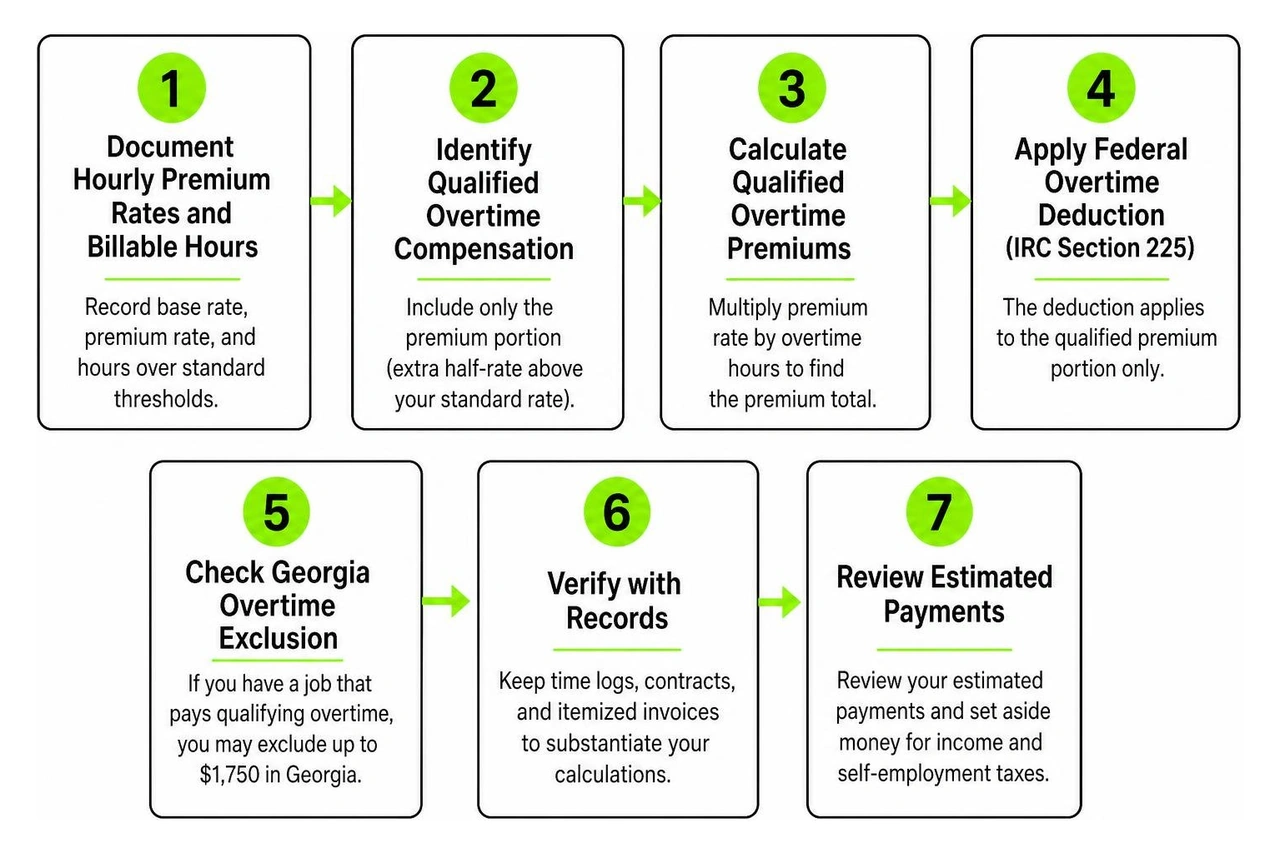
Step 1 Document Hourly Premium Rates and Billable Hours
The cornerstone of any reliable tax strategy is pristine documentation. When structuring client agreements, freelancers and consultants should explicitly establish regular base rates versus overtime or surge rates. If you provide professional creative services, our guide on marketing consultant overtime tax planning outlines how clear contract language protects your deductions during state and federal audits.
Maintain daily time logs that record the exact hours worked per project, the baseline hourly rate, and the premium rate billed for hours exceeding standard thresholds. Keeping digital backups of signed client contracts alongside itemized invoices substantiates your figures if tax authorities request verification. Clear records prevent confusion between ordinary project billings and qualified surge compensation.
Step 2 Calculate Federal IRC Section 225 Deductions and Phaseouts
Under IRC Section 225, single filers can deduct up to $12,500 of qualified overtime premium pay, while married couples filing jointly can deduct up to $25,000. Knowing how to calculate overtime tax rate thresholds allows you to accurately forecast your federal taxable income and structure your yearly estimated payments accordingly.
Federal deductions begin phasing out for individual taxpayers whose modified adjusted gross income exceeds $150,000, or $300,000 for married joint filers. The phaseout reduces your available deduction by $100 for every $1,000 of income earned above these statutory thresholds. Monitoring these income thresholds throughout the tax year guarantees accurate calculations.
Understanding Federal and Georgia State Overtime Rules
State tax laws do not always mirror federal policies. Georgia enacted House Bill 1199 to update its Internal Revenue Code conformity date to January 1, 2026, while explicitly decoupling from the broader federal overtime provisions of Section 225. Instead of full conformity, Georgia passed House Bill 463 to create a separate, capped state-level exclusion.
| Feature | Federal IRC Section 225 | Georgia HB 463 |
|---|---|---|
| Maximum Deduction Cap (Single) | $12,500 | $1,750 |
| Maximum Deduction Cap (Joint) | $25,000 | $1,750 |
| Income Phaseout Threshold | $150,000 single / $300,000 joint | N/A |
| Effective Tax Rate | Progressive federal brackets | Flat 4.99% |
| Applicable Tax Years | 2025 through 2028 | 2026 through 2028 |
Because Georgia decouples from federal Section 225, taxpayers claiming the federal deduction must add back the federal amount on their Georgia return before applying the state-level $1,750 exemption.
How Georgia Freelance Overtime Tax Planning Navigates the HB 463 Exclusion Cap
Under Georgia HB 463, taxpayers can exclude up to $1,750 of qualified overtime earnings directly from their Georgia taxable net income. With Georgia shifting to a flat individual income tax rate of 4.99% for 2026, the maximum state tax savings from this exclusion is roughly $87.
For a creative freelancer earning $6,500 in qualifying overtime premiums, the full federal deduction applies on Form 1040, while the Georgia return caps the state deduction at $1,750. Multiplying $1,750 by the 4.99% flat tax rate yields approximately $87 in direct state tax savings. While modest compared to federal savings, combining both deductions ensures you keep more of your earnings across every tax filing.
Georgia Standard Deductions and Quarterly Estimated Tax Adjustments
Georgia provides substantial standard deductions, set at $15,000 for single filers and $30,000 for married couples filing jointly in 2026. Understanding whether does overtime get taxed at a higher rate helps you make precise quarterly estimated payments without second-guessing your baseline calculations.
When updating your quarterly tax estimates, factor in Georgia's 4.99% flat rate alongside your federal liabilities. Adjusting your quarterly vouchers prevents underpayment penalties while avoiding large overpayments that tie up your working capital. Balancing these quarterly obligations creates consistent financial security throughout the entire calendar year.
Step by Step Tax Filing and Reporting for Independent Contractors
When preparing your annual returns, report qualified overtime deductions accurately across federal and state schedules. Freelancers must account for both standard business write-offs and specific premium deductions to lower their net tax liability effectively.

Federal overtime deductions are reported on Schedule 1-A of Form 1040, which flows directly into your adjusted gross income calculations. On your Georgia return, calculate your state add-back adjustments before claiming the allowable HB 463 deduction. For complete self-employed write-offs, explore our breakdown of 1099 self-employment deductions to ensure you claim all eligible business expenses. The federal overtime deduction only reduces income tax liabilities, meaning self-employment taxes for Social Security and Medicare remain fully applicable across all net earnings.
Daily and Weekly Workflows for Georgia Freelance Overtime Tax Planning
Optimizing your tax position takes less than an hour a day when integrated into a structured weekly habit. Dedicating fifteen minutes every Friday to log billable hours and categorize overtime premiums prevents year-end administrative bottlenecks.
For long-term financial health, review our foundational guide on how to plan for taxes as a freelancer to build solid budgeting practices. Back up digital timesheets, update contract rates regularly, and perform quarterly reconciliations to keep your business fully compliant with both state and federal filing requirements.
Frequently Asked Questions About Freelance Overtime Taxes in Georgia
Is freelance overtime income completely exempt from self-employment taxes?
No. Federal and state overtime deductions apply strictly to income taxes. All net freelance earnings remain subject to standard self-employment taxes, which cover Social Security and Medicare obligations at the statutory 15.3% rate across your net business income.
How does the Georgia 1750 dollar overtime exemption interact with federal deductions?
Because Georgia decoupled from federal IRC Section 225 under HB 1199, you must add back your federal overtime deduction on your Georgia return. You then subtract Georgia's state-specific $1,750 exclusion under HB 463 to determine your final Georgia taxable net income accurately.
What happens if my modified adjusted gross income exceeds 150000 dollars?
For single filers earning over $150,000 or joint filers earning over $300,000, the federal Section 225 deduction phases out at a rate of $100 per $1,000 of excess modified adjusted gross income. High-earning creatives should use retirement contributions and business expense planning to manage their adjusted gross income and retain tax advantages.
Can pure freelance 1099 work qualify for the federal overtime deduction?
Pure 1099 freelance earnings generally do not qualify unless explicit statutory overtime conditions are met. Maintaining dual-status documentation clarifies your eligible income streams.
Conclusion
Mastering your freelance overtime taxes in Georgia comes down to consistent record-keeping and understanding how state and federal rules interact. By spending just a few minutes each week tracking project hours and applying state-specific caps, you protect your profits and eliminate tax-season stress.
At Core Group, we provide financial management, bookkeeping, and tax services designed specifically for creative entrepreneurs. Our no-fluff, profit-first playbook guarantees peace of mind and saves you valuable time, all backed by our MacBook Pro guarantee. Explore our resources on optimizing your overtime tax rate to keep your creative business thriving and financially sound throughout every tax season.