Gross Pay vs. Net Pay: Why Your Salary Shrinks by Payday
What Gross Pay Meaning Really Is (And Why It Matters)
gross pay meaning is simple and it is the total amount of money you earn before any taxes or deductions are taken out.
Here is a quick breakdown of what gross pay includes and how it differs from what you actually take home
| Gross Pay | Net Pay | |
|---|---|---|
| What it is | Total earnings before deductions | Take-home pay after deductions |
| Includes | Wages, salary, overtime, bonuses, commissions | What remains after taxes and withholdings |
| Used for | Tax calculations, loan applications, payroll | Budgeting, daily expenses |
| Where to find it | Top of your pay stub | Bottom of your pay stub |
So if your salary is $60,000 a year and you get paid biweekly, your gross pay per paycheck is roughly $2,307. But the number that actually hits your bank account will be smaller, sometimes significantly smaller.
That gap between what you earn and what you keep is where a lot of confusion and financial stress lives.
If you run a small business or work as a creative professional, understanding this gap is not just useful. It is essential for managing cash flow, filing taxes correctly, and planning for growth.
This guide breaks down exactly how gross pay works, how to calculate it, and why it affects so much more than just your paycheck.
Understanding the Gross Pay Meaning and Its Components
When we talk about gross pay meaning in a professional context, we are looking at the foundational number of your compensation package. Whether you are an employee looking at a job offer or a business owner setting up payroll hr services small business 17ba8, this figure represents the total cost of labor before any legislative or voluntary slices are taken from the pie.

Gross pay is not just your base hourly rate or your annual salary. It is an umbrella term that covers every dollar your employer owes you for your work during a specific period. This includes several different types of compensation.
First, there is the base pay. This is the core amount you agreed to when you signed your contract. For many, this is the most significant part of the gross pay meaning equation. However, the total can grow quickly when you add other elements.
Overtime pay is a major component for many workers. If you work more than 40 hours in a week, federal law generally requires that you are paid at a higher rate for those extra hours. Bonuses are another key factor. Whether it is a holiday bonus or a performance incentive, these lump sums are added to your regular earnings to increase your gross total for that pay period.
Sales commissions are also included. If you work in a role where you earn a percentage of the sales you generate, those commissions are part of your gross earnings. Finally, taxable fringe benefits might be included. These are perks provided by an employer that the IRS considers taxable, such as a company car or certain types of insurance coverage.
The Gross Pay Meaning for Hourly Workers
For those of us working on an hourly basis, the gross pay meaning is tied directly to time tracking. Your gross pay is calculated by multiplying the number of hours you worked during the pay period by your agreed-upon hourly rate.
If you earn $25 per hour and work 40 hours, your base gross pay is $1,000. But what happens when you stay late? This is where the overtime tax rate and calculation rules come into play. Generally, overtime is paid at 1.5 times your regular rate. Using that same $25 rate, any hour over 40 would be worth $37.50 in gross pay.
Hourly workers often deal with shift differentials too. This is extra pay for working less desirable hours, like the night shift or weekends. These differentials are added to your base rate before the final gross total is calculated. Because hours can change from week to week, hourly workers often see more seasonal fluctuations in their gross pay than salaried staff do.
The Gross Pay Meaning for Salaried Professionals
For salaried professionals, the gross pay meaning is usually more predictable. You have an annual salary, such as $78,000, which is then divided by the number of pay periods in the year.
The frequency of these payments changes the amount of each check. If you are paid biweekly, there are 26 pay periods. If you are paid semimonthly, there are 24. A $78,000 salary divided by 26 periods results in a gross pay of $3,000 per paycheck.
Maintaining payroll tax compliance for salaried employees requires understanding their status. Exempt employees are typically paid a set salary regardless of how many hours they work and are not eligible for overtime. Nonexempt salaried employees, however, must still be paid overtime if they work more than 40 hours in a week, even though they have a base salary.
Gross Pay vs Net Pay and Why the Difference Matters
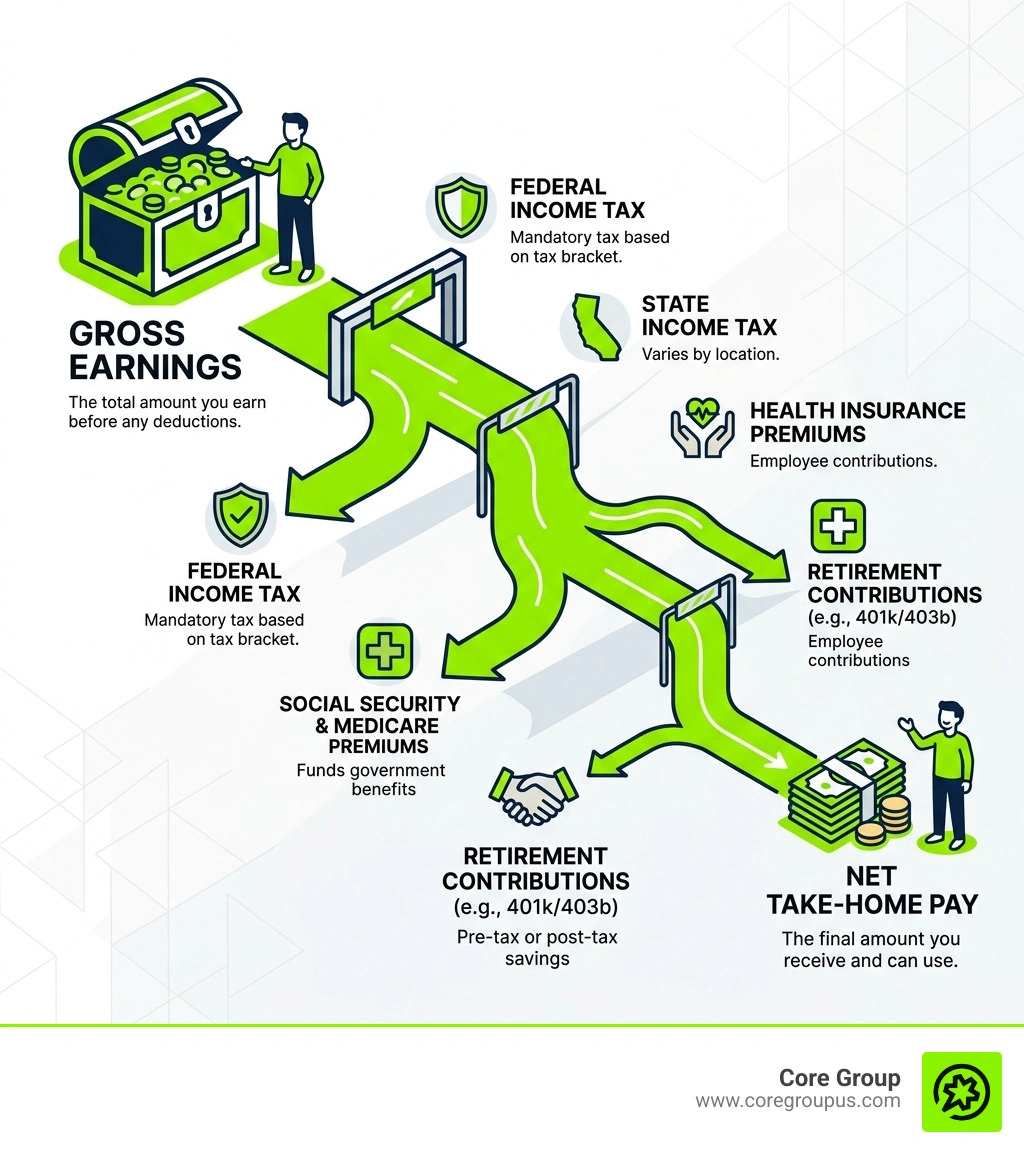
The difference between gross and net pay is often the source of "sticker shock" for new employees. While gross pay is the total earned, net pay is the actual "take home" amount that lands in your pocket.
Understanding this difference is vital for budgeting accuracy. If you try to build a life based on your gross pay, you will quickly find yourself in financial trouble because a portion of that money is never actually yours to spend. It is diverted to various entities before you ever see it.
| Feature | Gross Pay | Net Pay |
|---|---|---|
| Purpose | Basis for taxes and loans | Personal budgeting and spending |
| Mandatory Deductions | None yet | Federal, State, and FICA taxes removed |
| Voluntary Deductions | None yet | Insurance and retirement removed |
| Legal Importance | Determines tax brackets | Determines actual lifestyle |
Mandatory withholdings include federal income tax, state and local taxes, and FICA taxes, which fund Social Security and Medicare. Voluntary deductions are things you choose to have taken out, like health insurance premiums, 401(k) contributions, or life insurance.
For business owners, understanding hr and payroll for small business means recognizing that you are responsible for calculating these differences accurately for every single team member.
How to Calculate Gross Pay for Different Employment Types
Calculating gross pay is the first step in any payroll process. It sounds simple, but accuracy is everything.

For a salaried employee, the formula isAnnual Salary / Number of Pay Periods = Gross Pay per Period
If you are a creative entrepreneur handling small business payroll one employee, you need to know your pay period constants
- Weekly with 52 periods
- Biweekly with 26 periods
- Semimonthly with 24 periods
- Monthly with 12 periods
For hourly employees, the formula is slightly more involved(Regular Hours x Hourly Rate) + (Overtime Hours x Overtime Rate) + Bonuses/Commissions = Gross Pay
Let's look at a real-world example. If an employee earns $20 per hour and works 45 hours in one week, their calculation would be
- Regular pay of 40 hours x $20 = $800
- Overtime pay of 5 hours x $30 (which is $20 x 1.5) = $150
- Total gross pay for the week of $950
Why Gross Pay is Critical for Financial Planning and Compliance
Gross pay is the "north star" for many financial and legal institutions. When you apply for a mortgage or a rental apartment, the lender or landlord doesn't usually ask for your net pay. They want to know your gross income because it represents your total earning potential before your personal choices, like high retirement contributions or expensive health plans, reduce your take-home amount.
Lenders use your gross pay to calculate your debt-to-income ratio. This ratio helps them determine how much of a monthly payment you can safely handle. If your gross monthly income is $5,000 and your total debts are $1,500, your ratio is 30%.
Gross pay also determines your payroll tax obligations. FICA taxes are a major part of this according to the IRS. As of April 2026, the Social Security tax rate remains 6.2% for the employee and 6.2% for the employer. The Medicare tax is 1.45% for each. It is important to remember that there is a Social Security earnings cap. In 2021, this cap was $142,800, meaning any earnings above that amount were not subject to the 6.2% Social Security tax. By 2026, these caps are adjusted for inflation, so staying current is essential.
Additionally, if an employee earns more than $200,000 in gross earnings, an additional Medicare tax of 0.9% applies. Gross pay also dictates retirement contribution limits. Most 401(k) or IRA contributions are calculated as a percentage of your gross pay.
Finally, gross pay is the basis for wage garnishments. Approximately 10% of employees in the U.S. owe wage garnishments for things like student loans or child support. These are legal requirements for employers to withhold money from an employee's pay, and the amount allowed to be taken is often a percentage of the gross or disposable earnings.
Frequently Asked Questions about Gross Pay
Where can I find my gross pay information?
The easiest place to find your gross pay is on your pay stub. It is almost always the largest number and is located at the top of the earnings statement. It might be labeled as "Total Earnings" or "Gross Earnings." You can also find this information in your company's employee portal or on your annual W2 form, which summarizes your total gross pay for the entire year.
What factors can influence my total gross pay?
Several things can shift your gross pay up or down. Your experience level and education often dictate your base salary. Geographic location is also huge. A creative professional in New York City or San Francisco will likely have a higher gross pay than someone in a smaller market to account for cost of living adjustments. Industry standards and your specific job title also play a role in what a "fair" gross pay looks like for your position.
Does gross pay include my bonuses and tips?
Yes. Any money you receive as compensation for your work is part of your gross pay. This includes performance incentives, holiday bonuses, and gratuities. For workers in the service industry, tips are a significant part of their taxable income and must be reported as part of their gross earnings. Commission structures for sales roles are also included in the total gross figure.
Conclusion
Understanding the gross pay meaning is the first step toward true financial literacy. Whether you are an employee trying to understand why your paycheck seems smaller than expected or a business owner striving for bookkeeping excellence, clarity on these numbers brings peace of mind.
At Core Group, we believe that creative entrepreneurs should be able to focus on their craft without being weighed down by the complexities of payroll and tax compliance. Our "no-fluff, profit-first playbook" is designed to give you back your time and ensure your financial management is as sharp as your creative vision. We even back our services with a MacBook Pro guarantee because we are that confident in our ability to streamline your business.
If you are ready to move past the confusion of gross vs. net and start building a more profitable, sustainable business, we are here to help. More info about accounting services is just a click away. Let us handle the numbers so you can handle the big picture.