Proving Your Gambling Losses Online Without Angering the IRS
Why Proving Gambling Losses to the IRS Is Harder Than It Looks
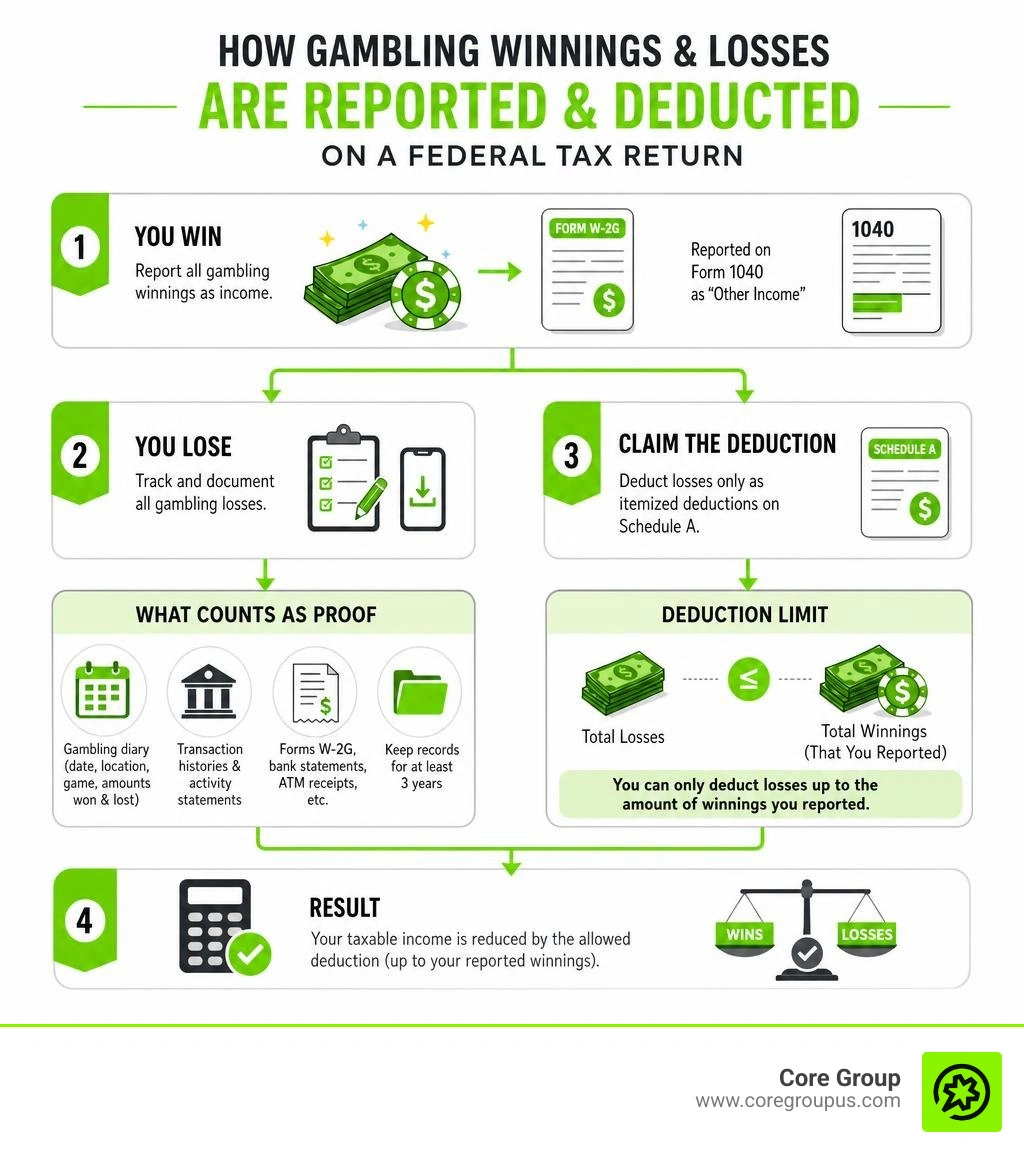
Knowing how do I prove gambling losses on my taxes online comes down to four things the IRS expects you to have ready.
Quick Answer on How to Prove Gambling Losses to the IRS
- Keep a detailed gambling diary or log for every session (date, location, type of game, amounts won and lost)
- Download transaction histories and activity statements from your online platforms (FanDuel, DraftKings, BetMGM, etc.)
- Save supporting documents such as Form W-2G, bank statements, ATM receipts, and deposit/withdrawal records
- Claim losses only as itemized deductions on Schedule A, and only up to the amount of winnings you reported
That is the short version. The details matter a lot, though, especially if the IRS ever asks questions.
In 2023, US gamblers lost an astonishing $264 billion. That works out to roughly $1,026 for every adult in the country. A significant portion of those losses could have offset taxable winnings on a federal return. But without the right records, the IRS will not allow the deduction at all.
The rules for online gambling follow the same framework as in-person play. The difference is where your proof lives. Instead of paper tickets and ATM slips, your evidence is buried in app dashboards, email confirmations, and bank transfers. That makes it easy to ignore during the year and stressful to reconstruct come tax season.
This guide walks you through exactly what you need, how to get it, and how to put it all together before you file.
The Golden Rules of Claiming Gambling Losses on Your Taxes
Before we look at the digital files you need, we must understand the fundamental tax rules that govern gambling. The IRS does not allow you to simply subtract your losses from your wins and report the net amount.
To claim any losses at all, you must itemize your deductions on Schedule A of Form 1040. If you take the standard deduction, you cannot deduct a single penny of your losses. This is a massive trap for casual players. Since the standard deduction is quite high in 2026, most taxpayers do not itemize.
For the 2026 tax year, the standard deduction is $16,100 for single filers and $32,200 for married couples filing jointly. If your other itemized deductions, such as mortgage interest and state taxes, do not push you over those thresholds, itemizing just to claim gambling losses might actually hurt your overall tax position. You can read more about this in our guide on Are Gambling Losses Itemized Deductions.
To help you visualize how this math works, we have put together a comparison of taking the standard deduction versus itemizing.
Standard Deduction versus Itemized Deduction for a Single Filer in 2026
| Tax Scenario | Standard Deduction | Itemized Deduction |
|---|---|---|
| Non-Gambling Itemized Deductions | $12,000 | $12,000 |
| Gambling Winnings | $10,000 | $10,000 |
| Documented Gambling Losses | $8,000 | $8,000 |
| Total Itemized Deductions | $0 (Takes Standard) | $20,000 (Includes Losses) |
| Deduction Applied to Return | $16,100 (Standard) | $20,000 (Itemized) |
| Taxable Gambling Winnings | $10,000 | $10,000 |
| Net Tax Benefit of Losses | $0 | $3,900 extra deduction |
As you can see, if you do not have enough other deductions to exceed the standard deduction, claiming those losses provides zero tax relief.
Reporting Winnings and Itemizing on Schedule A
If you do choose to itemize, you must report 100% of your winnings as taxable income on your Form 1040. You do this by listing your total winnings on Schedule 1. Then, you claim your allowable losses on Schedule A under the section for other miscellaneous deductions.
Many people ask us if they can just net their wins and losses. We discuss this exact scenario in our article on why Gambling Losses Should Just Offset My Gambling Winnings Right. The short answer is no. The IRS requires you to report the gross winnings as income and the losses as a separate deduction. If you won $5,000 and lost $7,000, you must report $5,000 of income and deduct $5,000 on Schedule A. The extra $2,000 in losses is gone forever. You cannot carry it forward to future tax years.
The New Ninety Percent Deduction Limit for Tax Year 2026
There is a major legislative change that takes effect for the 2026 tax year. Under the tax reform bill known as the One Big Beautiful Bill, a new cap has been placed on gambling loss deductions.
Previously, you could deduct losses up to 100% of your reported winnings. Starting in 2026, you can only deduct up to 90% of your qualified losses against your winnings.
For example, if you have $10,000 in sports betting winnings and $10,000 in documented losses, you can only deduct $9,000 on Schedule A. This means you will still pay income tax on the remaining $1,000 of winnings, even though you broke even for the year. You can read the full details of this law in the 2026 Gambling Loss Deduction guide.
How Do I Prove Gambling Losses on My Taxes Online
Now that you know the rules, let us focus on the practical steps of gathering your digital proof. To satisfy an IRS auditor, you need a clear electronic audit trail.

When you wager online, you have a distinct advantage over cash gamblers. Every transaction is tracked electronically. However, you cannot just show an auditor your phone and expect them to approve your deductions. You must compile these records into a clean, professional format. You can learn more about building this trail in our guide on How to Use Bank Statements for Gambling Loss Tax Deductions.
Digital Records and Online Platform Statements
Your primary source of truth will be the online platforms themselves. Whether you use sportsbooks, online casinos, or digital poker rooms, these platforms are required to track your activity.
Log into each account on a computer rather than a mobile app to access the full settings. Look for tabs labeled document center, account history, or tax information.
You need to download two specific items from each platform. First, download your annual player activity statement. This document shows your total deposits, total wagers, total wins, total losses, and withdrawals for the entire year. Second, download the detailed transaction history. This is a line-by-line spreadsheet of every bet you placed, which serves as your raw evidence.
Reconciling Bank Statements and Digital Wallets
Platform statements are great, but the IRS likes to see corroborating evidence. This is where your bank and digital wallet statements come in.
Go through your bank accounts, credit card statements, and PayPal or Venmo accounts. Highlight every deposit made to a gambling platform and every withdrawal received. Match these transactions directly to your platform statements. If your bank statement shows a $500 deposit to a sportsbook on March Madness weekend, and your platform history shows that $500 was wagered and lost, you have a solid, verified link.
Essential Documentation and the IRS Session Method
Even with perfect bank statements, the IRS can still disallow your losses if you do not track them correctly. The IRS officially recognizes what is called the session method.
According to Topic no. 419, Gambling income and losses, you must track your wins and losses by individual session rather than by individual bet or by entire year. A session is a continuous period of play on a single game or platform.
If you log into an online slot platform at 8 PM and log out at 10 PM, that is one session. If you started with $100 and ended with $40, you have a $60 loss for that session. You do not need to record every single virtual spin of the reels, just the net result of that continuous session.
How Do I Prove Gambling Losses on My Taxes Online Using a Diary
The single most important document you can own is a contemporaneous gambling diary. Contemporaneous simply means you update it at the time of the activity, not months later during tax season.
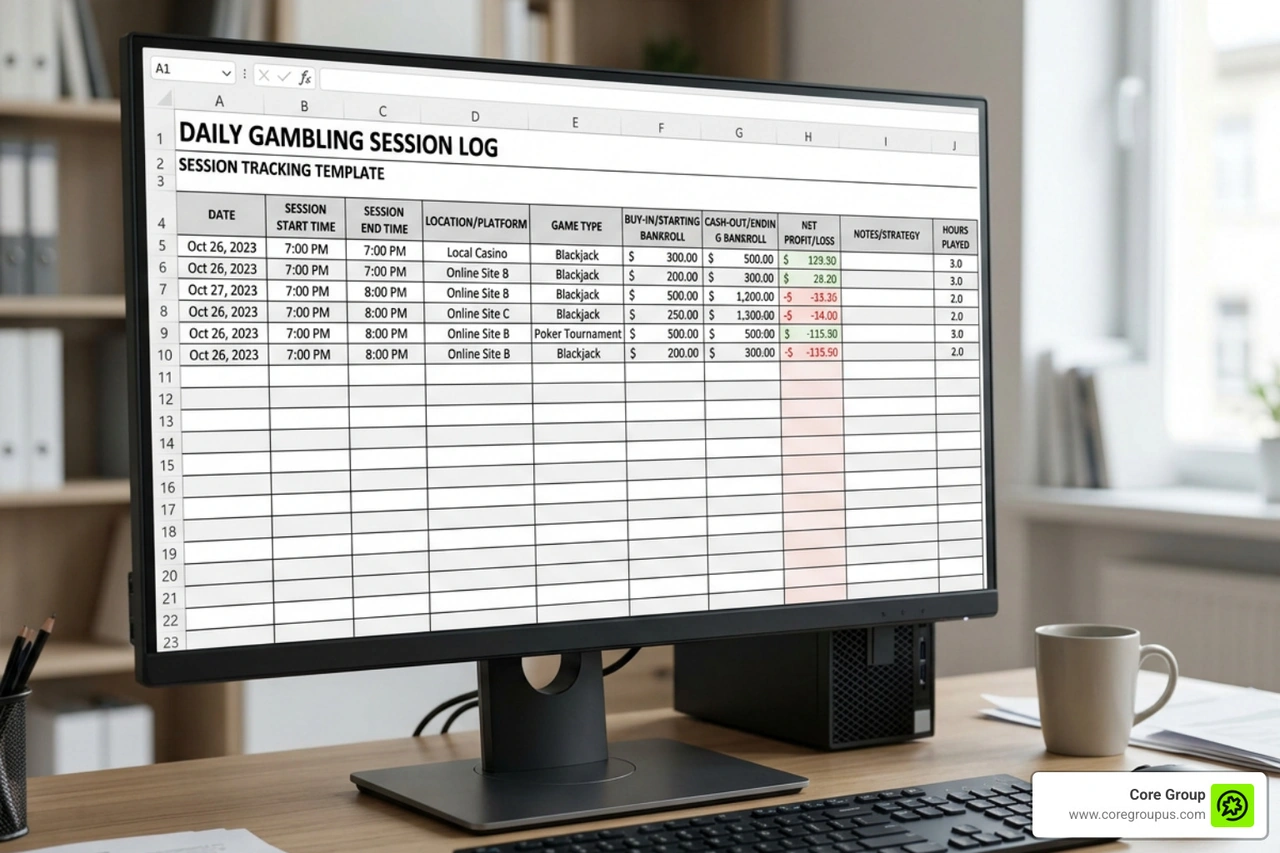
Your digital diary can be a spreadsheet on Google Sheets or Excel. For every session, you must record the following details.
- The date and time of the session
- The specific online platform or app used
- The type of game or wager placed
- The names of any companions or witnesses, which for online play can include your account username or table ID
- The starting amount of money
- The ending amount of money
- The final win or loss amount for that session
By keeping this log updated weekly, you create an unbreakable shield against IRS audits.
Why Player Club Statements Are Not Enough on Their Own
Many casual gamblers think they can just request a year-end win or loss statement from a casino or an app and call it a day. This is a major mistake.
The IRS regularly rejects player club statements and simple casino summaries when they are presented as the sole proof of losses. These documents are designed for marketing and loyalty purposes, not for tax compliance. They often contain disclaimers stating that the information is not guaranteed to be accurate.
Furthermore, player cards do not track every transaction. They do not show when you used cash, and they do not prove that you were the actual person placing the bets. A player card statement is excellent supporting evidence, but it must be paired with your personal diary and bank records.
Special Tax Situations for Gamblers
Depending on how you gamble and your residency status, the rules for proving your losses can shift. We cover the foundational elements of these deductions in our article on IRS Gambling Deductions.
How Do I Prove Gambling Losses on My Taxes Online as a Professional
If you gamble as your primary source of income and operate with a clear profit motive, you may qualify as a professional gambler.
Professional gamblers do not use Schedule A. Instead, they file Schedule C as a sole proprietorship. This allows them to deduct their losses directly from their winnings as business expenses. It also means they are not subject to the standard deduction limitations that recreational players face.
However, the IRS heavily scrutinizes professional status. To prove you are a professional, you must show that you run your gambling like a business. This means keeping immaculate digital ledgers, maintaining separate bank accounts for your gambling bankroll, and proving you spend significant hours on the activity. If you cannot prove this, the IRS will reclassify you as a recreational player and disallow your Schedule C deductions.
Rules for Nonresident Aliens and Canadian Residents
If you are a nonresident alien playing on US-based online platforms, your tax situation is unique. Nonresident aliens must file Form 1040-NR.
Under general IRS rules, nonresident aliens are taxed at a flat 30% rate on their US gambling winnings, and they are not allowed to deduct any gambling losses.
There is a major exception for Canadian residents, however. Thanks to the US-Canada tax treaty, Canadian players can deduct their gambling losses on Form 1040-NR, but only up to the amount of their US winnings. They must follow the exact same record-keeping and session-method rules as US citizens to claim these treaty benefits.
Frequently Asked Questions About Gambling Tax Audits
Audits are stressful, but knowing what to expect can help you prepare. Here are the answers to the most common questions we hear about gambling tax audits.
What happens if the IRS audits my return and I lack proof
If the IRS audits you and you cannot provide a contemporaneous diary or matching statements, they will disallow your loss deductions entirely. This means you will owe income tax on the full amount of your reported winnings. You will also face back taxes, interest charges, and accuracy-related penalties, which can add up to thousands of dollars.
Can I deduct travel and hotel expenses related to gambling
For recreational gamblers, the answer is a firm no. You can only deduct the actual cost of your wagers. Travel, lodging, meals, and other personal expenses incurred during a trip to a casino or a sports event are completely non-deductible. Only qualified professional gamblers filing Schedule C can write off these business travel costs.
Do I have to report winnings if I did not receive a W2G form
Yes, you must report every single dollar of gambling winnings, regardless of whether you receive a Form W-2G. The thresholds for receiving a W-2G, such as $1,200 on slots or $1,500 on keno, are simply reporting requirements for the casinos and apps. The law requires you to report all income, even if it is a $10 win on a casual sports bet. Failing to do so is considered tax evasion.
Conclusion
Proving your online gambling losses does not have to be a nightmare. By staying organized, using the session method, and keeping a digital diary, you can claim your deductions with complete confidence.
At Core Group, we understand that managing taxes can feel overwhelming when you are trying to focus on your creative business. We offer financial management, bookkeeping, and tax services specifically tailored for creative entrepreneurs.
Our no-fluff, profit-first playbook is designed to guarantee peace of mind and save you valuable time, allowing you to focus on what you do best. We back our services with our unique MacBook Pro guarantee. If you are ready to simplify your business finances and stay on the right side of the IRS, let us help you build a profitable, compliant future. You can learn more about how we handle complex tax scenarios by visiting our guide on IRS Gambling Deductions.