Working Hard or Hardly Taxed? How to Calculate Overtime Tax Savings
Your Overtime Pay Just Got a Major Tax Break
How to calculate overtime tax rate savings under the new rules comes down to a few clear steps:
- Find your total overtime pay from your paystub or W-2
- Calculate the deductible premium portion
- Time-and-a-half: divide total overtime pay by 3
- Double-time: divide total overtime pay by 4
- Apply the deduction cap ($12,500 for single filers, $25,000 for married filing jointly)
- Check your income against the phase-out threshold (starts at $150,000 MAGI for single filers)
- Claim the deduction on Schedule 1-A, which reduces your federal taxable income
Note: FICA taxes (Social Security and Medicare) still apply to all overtime pay.
If you work in film, media, or any creative field and log extra hours on a project, you may be sitting on a tax deduction you don't even know about yet.
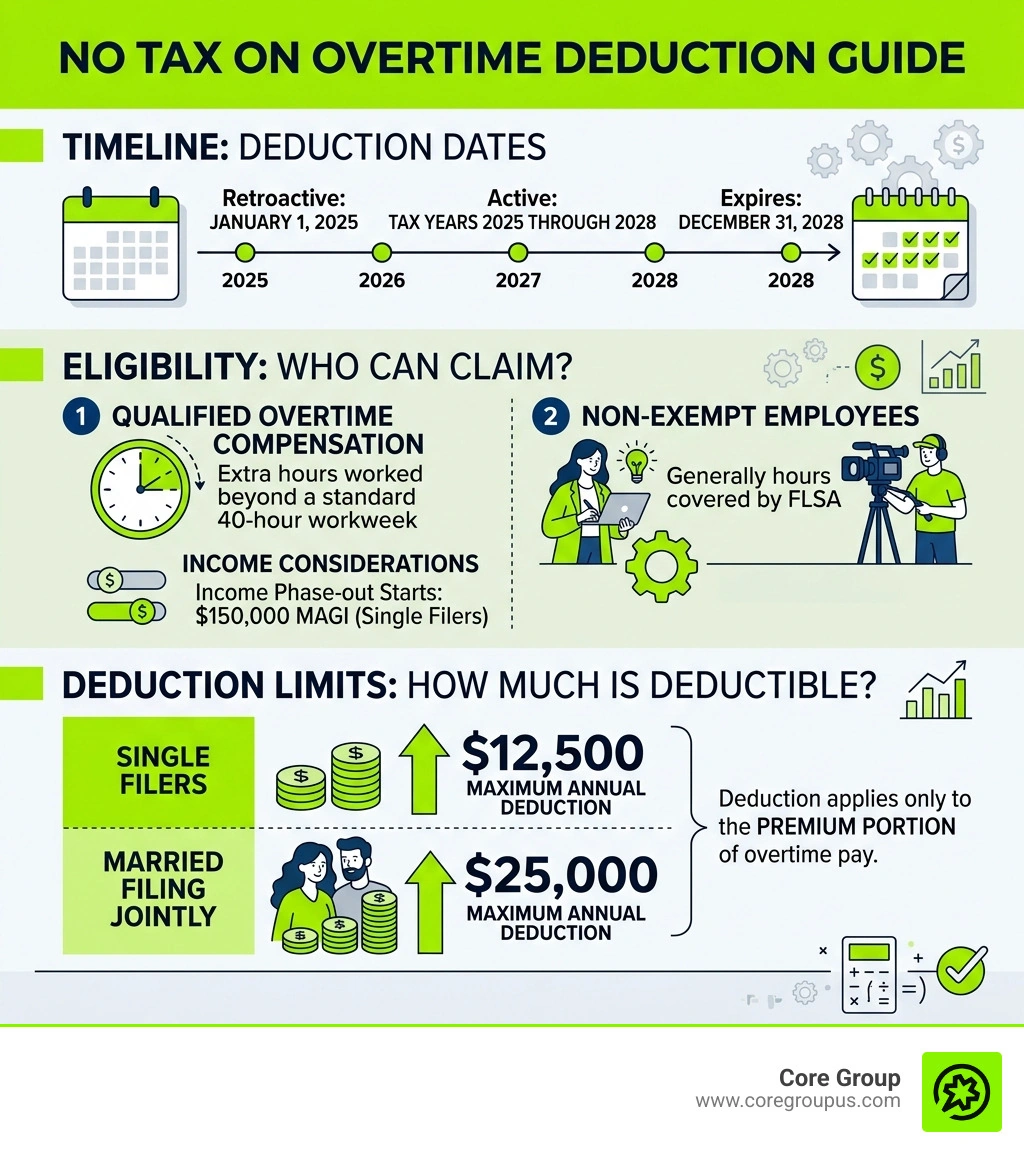
The One Big Beautiful Bill Act introduced a brand-new federal deduction for overtime pay, retroactive to January 1, 2025. It covers tax years 2025 through 2028. By early March 2026, more than 15.5 million Americans had already claimed it, making it the most claimed of the recent tax cuts. Average refunds are running more than 10% higher this year as a result.
But here is the catch. The deduction does not wipe out your entire overtime check. It only covers the premium portion, which is the extra amount above your regular hourly rate. Knowing exactly how to calculate that number is what separates a bigger refund from leaving money on the table.
Understanding Overtime Deduction Rules and Eligibility
We want to make sure you understand that this deduction is specifically for qualified overtime compensation. Under the Fair Labor Standards Act (FLSA), this generally refers to hours worked beyond 40 in a single workweek. If you are a non-exempt employee, you are likely already familiar with the time and a half pay structure.
The federal government now allows you to deduct the premium part of that pay from your taxable income. For single filers, the maximum annual deduction is $12,500. If you are married and filing jointly, that limit jumps to $25,000. These limits are generous, but they do come with income restrictions.
The deduction starts to phase out once your modified adjusted gross income (MAGI) exceeds $150,000 for single filers or $300,000 for those filing jointly. If you earn significantly more, the benefit tapers off. For instance, the deduction disappears entirely for single filers with a MAGI of $275,000 or more, and for joint filers at $550,000.
It is also important to note that the overtime tax rate is not a separate, special rate. Instead, the deduction simply lowers your total taxable income, which means you pay less at your standard marginal tax bracket rate. To dive deeper into the legal specifics of these changes, you can review Overtime Pay Rules and the New Tax Exemption.
How to Calculate Overtime Tax Rate Savings Step by Step

When we look at a paystub, the numbers can feel overwhelming. To figure out your savings, you first need to isolate your premium portion from your regular rate. The regular rate includes your base hourly pay plus any non-discretionary bonuses or shift differentials.
The premium portion is the "extra" money you get for working those late nights or weekends. Because the IRS only allows you to deduct this extra amount, you need to use specific formulas based on how you were paid. You can find more detailed math in this Overtime Pay Formula Guide.
| Overtime Type | Pay Rate | Deductible Premium Formula | Portion of OT Pay |
|---|---|---|---|
| Time and a Half | 1.5x Regular Rate | Total OT Pay divided by 3 | 1/3 |
| Double Time | 2.0x Regular Rate | Total OT Pay divided by 4 | 1/4 |
How to calculate overtime tax rate for time and a half pay
For most of us, overtime is paid at time and a half. To find the deductible amount, we use the one third rule. If you earned $1,500 in total overtime pay at a 1.5x rate, your premium portion is $500. This $500 is what you subtract from your taxable income on your federal return.
This calculation is vital because employers often do not break this down for you on your weekly check. You have to take your gross overtime earnings and apply that 0.5 multiplier math yourself to see the reduction in taxable income. For a refresher on how this looks on a standard check, see How to figure paycheck taxes for overtime.
How to calculate overtime tax rate for double time pay
If you are lucky enough to work a holiday or a seventh consecutive day, you might earn double time. In this case, the math changes to the one fourth rule. If you earned $2,000 in double time pay, your premium portion is $500 (which is 0.5 divided by 2.0).
Even though you are earning more money per hour, the deductible premium is actually a smaller percentage of the total overtime check compared to time and a half. However, because your total income is higher, the federal tax savings can still be quite substantial, especially if those extra earnings would have pushed you into a higher income tax bracket.
Claiming Your Overtime Tax Benefits on Your Return

Now that you have the numbers, you need to know where to put them. For the 2025 tax year, which we are filing now in 2026, you will use Schedule 1-A. This is a new form specifically designed for the No Tax on Overtime deduction. Once you calculate your total qualified overtime premium, you enter it on Schedule 1-A and then carry that total over to Form 1040 line 13b.
Finding the data on your W-2 might be a little tricky this year. For 2025, employers were not strictly required to report overtime separately, though many chose to put it in Box 14. Moving forward into the 2026 tax year, it will be mandatory for employers to use Box 12 with Code TT to report this income.
We must remind you that this deduction only applies to federal income tax. You still have to pay FICA taxes, which include Social Security and Medicare, on every dollar of overtime you earn. Social Security is typically 6.2 percent and Medicare is 1.45 percent. If you want to see how these withholdings impact your final take home pay, check out this Overtime Tax Calculator and Withholdings tool.
Frequently Asked Questions about Overtime Taxes
As we help creatives navigate these new waters, a few questions keep coming up. With 15.5 million returns already processed using this deduction, the data shows that people are eager to save. Most major tax software programs have now integrated Schedule 1-A, but manual errors are still common. One frequent mistake is trying to deduct the entire overtime check rather than just the premium portion.
Does the deduction apply to state income taxes?
Generally, no. This is a federal income tax deduction. State tax laws vary wildly. For example, Alabama has its own specific overtime rules that might offer different types of relief, while California has strict daily overtime requirements that do not always align with federal FLSA definitions. In most cases, you will still owe the full state tax liability on your overtime earnings.
Will this deduction change my weekly paycheck withholding?
For the 2025 tax year, most people saw the benefit as a larger tax refund because payroll systems had not yet been updated. However, in this current year of 2026, many payroll software providers have updated their algorithms.
This means your employer might already be adjusting your withholding so you see more money in your pocket each week. Be aware that payroll systems often assume your current check represents what you will earn all year. This can lead to bracket creep where too much tax is withheld during a particularly busy month, but you will get that over-withheld amount back when you file your return.
Can married couples filing separately claim the deduction?
This is a significant restriction to keep in mind. If you are married but choose to file separately, you cannot claim the No Tax on Overtime deduction. To get the benefit, you must file a joint return. When filing jointly, you can combine the overtime income from both spouses up to the $25,000 limit.
Conclusion
At Core Group, we understand that for creative entrepreneurs, time is the most valuable asset. When you spend that time working extra hours to perfect a project or meet a deadline, you deserve to keep as much of that hard-earned money as possible. Our no-fluff, profit-first playbook is designed to give you peace of mind by handling the complexities of the tax code for you.
We are here to ensure you never miss out on deductions like the No Tax on Overtime provision. Whether you are in New York, California, or any of the other states we serve, our goal is to save you time so you can get back to the work you love. We even back our service with a MacBook Pro guarantee. If you are ready to stop stressing over forms and start focusing on your craft, let us help you with your tax planning today.