S Corp Setup Made Simple: The Ultimate How-To Guide
Why Smart Business Owners Are Choosing S Corporation Status

How to form S corp status can transform your business taxes and protect your personal assets. For creative entrepreneurs, this business structure could save you thousands in taxes while simplifying your finances.
Quick Answer: The Essential Steps
- Form a legal entity - File Articles of Incorporation (for a corporation) or Articles of Organization (for an LLC) with your state.
- Get an EIN - Apply for an Employer Identification Number through the IRS website.
- File Form 2553 - Submit your S corporation election to the IRS within 2 months and 15 days of starting your business (or by March 15 for existing businesses).
- Meet eligibility requirements - Ensure you have 100 or fewer shareholders who are U.S. citizens or residents, and only one class of stock.
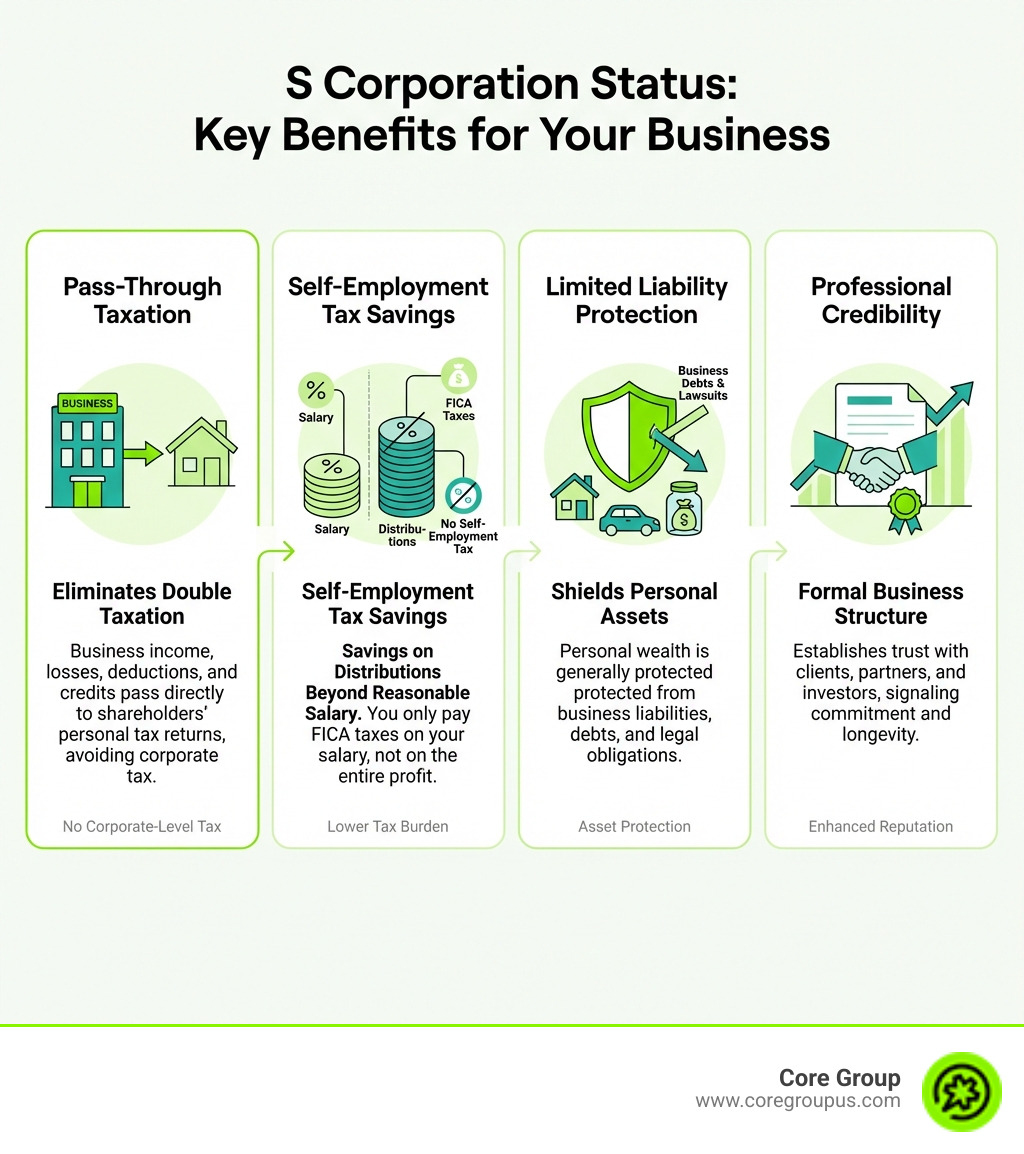
An S corporation combines the liability protection of a corporation with the tax advantages of a partnership. S corps use pass-through taxation, avoiding the double taxation of C corporations. Business profits pass through to your personal tax return, and you only pay self-employment tax on your salary, not on your entire business profit.
This structure offers creative entrepreneurs peace of mind, allowing you to focus on your craft knowing your personal assets are protected and your tax burden is optimized.
The process is more straightforward than you might think. This guide will walk you through each step, from choosing your business name to filing the critical paperwork with the IRS.
What is an S Corp and Is It Right for Your Business?
An S corporation (S corp) is a special IRS tax designation. It's not a business entity itself, but a tax election an LLC or corporation can choose. This allows business income, losses, deductions, and credits to pass through to the owners' personal income, avoiding corporate-level taxes.
For creative entrepreneurs, understanding how to form S corp status can be a game-changer. The primary benefit is tax savings on self-employment taxes. As an owner, you pay yourself a "reasonable salary" subject to FICA taxes. Any additional profits distributed are generally not subject to these taxes, offering significant savings over a sole proprietorship where all net income is subject to self-employment tax.
An S corp also offers limited liability protection, meaning your personal assets—like your home, savings, and car—are generally shielded from business debts and lawsuits.
However, S corps have stricter operational requirements and more administrative work than an LLC. If your business is profitable and you want tax optimization and liability protection, an S corp could be a great fit. For a deeper dive, check out our article, Should Creative Entrepreneurs Become an S Corp?.
Here's a quick look at how an S corp stacks up against other common business structures:
| Feature | Sole Proprietorship | LLC (Single-Member, disregarded) | S Corp (tax election for LLC/Corp) | C Corp |
|---|---|---|---|---|
| Legal Status | Owner and business are one | Separate legal entity | Separate legal entity | Separate legal entity |
| Liability Protection | None (personal assets at risk) | Limited (personal assets protected) | Limited (personal assets protected) | Strongest (personal assets protected) |
| Taxation of Profits | Pass-through (all net income subject to SE tax) | Pass-through (all net income subject to SE tax) | Pass-through (salary subject to SE tax, distributions are not) | Double taxation (corporate tax + shareholder dividend tax) |
| Formation Complexity | Very simple | Moderate | Moderate to High (requires existing entity + IRS election) | High |
| Ongoing Compliance | Minimal | Moderate | High (corporate formalities, payroll) | Very High (extensive record-keeping) |
| Shareholders/Owners | One individual | One or more members | Up to 100 shareholders | Unlimited shareholders |
| Stock Classes | N/A | N/A | One class only | Multiple classes allowed |
S Corp vs. Other Business Structures: Understanding Taxation
The core difference lies in taxation.
C Corporations: A C corp is a separate taxable entity. It pays corporate income tax on its profits. When profits are distributed as dividends, shareholders pay personal income tax on them. This is known as "double taxation."
S Corporations: An S corp avoids corporate income tax. Profits and losses "pass through" to the owners' personal tax returns, eliminating double taxation. The business files an informational tax return (Form 1120-S), but taxes are paid at individual rates.
Sole Proprietorships/LLCs (default taxation): All net income is subject to both income tax and self-employment tax. An S corp election mitigates the self-employment tax on distributions, making it a powerful strategy for profitable businesses.
For more detailed information on various business structures, visit our More on business structures page.
S Corp vs. LLC: Flexibility and Formalities
Many entrepreneurs start with an LLC for its simplicity and liability protection. As a business grows, the tax advantages of an S corp become more appealing. You can form an LLC and then elect S corp status for tax purposes.
Here's how they differ:
- Formation Process: Forming an LLC (filing Articles of Organization) is simpler than a corporation. To become an S corp, you must first form an LLC or corporation, then file an election with the IRS.
- Ownership Flexibility: LLCs are flexible, allowing various owner types and custom profit allocation. S corps are stricter: up to 100 shareholders (U.S. citizens/residents only), no corporate or partnership owners, and only one class of stock.
- Management Structure: LLCs can be managed by members or appointed managers. S corps require a more formal structure with a board of directors and officers, even for a single owner.
- Profit/Loss Allocation: LLCs can allocate profits flexibly. S corps must allocate profits and losses strictly based on each shareholder's ownership percentage.
- Corporate Formalities: S corps require more formalities than standard LLCs, such as annual meetings and detailed record-keeping. Neglecting these can risk your S corp status and limited liability protection.
Eligibility and Pre-Filing Requirements
Before you learn how to form S corp status, you must ensure your business qualifies. The IRS has specific requirements to elect and maintain S corp status.

Here are the critical IRS requirements:
- Domestic Corporation: Your business must be a domestic entity organized in a U.S. state or D.C. An LLC must be eligible to elect corporate status.
- Shareholder Limit: An S corp can have no more than 100 shareholders. A family can be treated as a single shareholder for this count.
- Allowable Shareholders: Shareholders must be individuals, certain trusts, or estates. Partnerships, corporations, and non-resident aliens cannot be shareholders.
- One Class of Stock: An S corp can only have one class of stock, meaning all shares have identical rights to distributions and liquidation proceeds. Differences in voting rights are permitted.
- Not an Ineligible Corporation: Certain businesses, like some financial institutions and insurance companies, are ineligible for S corp status.
It's vital to ensure your business continuously meets these requirements. We highly recommend you Check the IRS website for eligibility requirements for the most up-to-date information.
Key Considerations Before You Learn How to Form an S Corp
Understanding these requirements is crucial. The shareholder restrictions (no corporations or non-resident aliens) and the 100-shareholder limit mean S corps are best for smaller, closely-held businesses and are not ideal for raising venture capital. The "one class of stock" rule ensures all shareholders are treated equally regarding profits, simplifying tax reporting. These rules are foundational to the S corp's structure and tax benefits and can save you headaches down the line.
How to Form an S Corp: A Step-by-Step Guide
Forming an S corp is a two-part process: first, create a legal entity (LLC or corporation) with your state, and second, elect S corp tax status with the IRS. Here are the steps. We recommend consulting a professional to ensure everything is set up correctly for your specific situation.
Step 1: Choose a Business Name and Form a Legal Entity
Your journey to how to form S corp status begins by establishing a legal entity, typically an LLC or a C corporation.
Choose Your Business Name:
- Check State Availability: Ensure your name is available in your state by searching on the Secretary of State's website.
- Trademark Search: Check the USPTO database to avoid trademark conflicts.
- Name Suffix: Your name must include a designator like "Inc." for a corporation or "LLC" for a limited liability company.
Form Your Legal Entity with the State:
- Articles of Incorporation (for a Corporation): File this document with your state to form a corporation. It includes basic company information.
- Articles of Organization (for an LLC): File this document with your state to form an LLC.
- Registered Agent: You must designate a registered agent with a physical address in your state to receive legal documents. Professional services are available.
The filing fees for creating your legal entity can vary significantly by state, typically ranging from $40 to $550.
Step 2: Obtain Your Employer Identification Number (EIN)
After registering your entity, you need an Employer Identification Number (EIN). This unique nine-digit number from the IRS is like a Social Security Number for your business.
Why is an EIN Necessary?
- Tax Filing: Required for filing business tax returns.
- Bank Accounts: Needed to open a business bank account and separate finances.
- Payroll: Required for hiring employees and managing payroll taxes.
- Other Activities: Needed for business licenses, permits, and credit.
How to Get Your EIN:
Applying for an EIN is a quick and easy process through the IRS.
- Online Application: The fastest way is to apply online via the EIN information page on the IRS website. You'll receive your EIN immediately upon completion.
- Fax or Mail: Alternatively, you can fax or mail Form SS-4, but this process is slower.
Step 3: File Form 2553 to Elect S Corp Status
With your legal entity and EIN, the final step in how to form S corp status is to elect S corp tax status by filing IRS Form 2553, "Election by a Small Business Corporation."
What is Form 2553?
This form officially notifies the IRS of your S corp election. Without it, your entity will be taxed under its default status (C corp, partnership, or sole proprietorship).
How to File Form 2553:
- Gather Information: You'll need your business's name, address, EIN, desired effective date, and information for each shareholder (name, address, SSN, shares).
- Shareholder Consent: All shareholders must sign the consent statement on Form 2553.
- Determine the Effective Date: To be effective for the current tax year, you must file Form 2553 within the first 2 months and 15 days of that tax year (by March 15 for a calendar-year business). For a new business, the deadline is 2 months and 15 days from its start date. You can also file anytime during the preceding tax year for the election to take effect the following year.
- Mail or Fax: Send the completed form to the correct IRS Service Center as specified in the form instructions. Keep a copy and consider using certified mail for proof of filing.
- Late Election Relief: If you miss the deadline, the IRS may grant relief if you can show "reasonable cause" for the delay.
The IRS Form 2553 page on the IRS website provides the latest form and detailed instructions, which we highly recommend reviewing thoroughly before filing.
Ongoing Compliance and Financial Management
Forming your S corp is just the beginning. Maintaining your status requires ongoing compliance and financial management, including proactive bookkeeping, payroll, and tax planning.
Running an S corp means adhering to corporate formalities:
- Holding Annual Meetings: Hold and document annual shareholder and director meetings.
- Maintaining Corporate Records: Keep minutes, bylaws, and stock ledgers.
- Separating Finances: Keep business and personal funds separate to maintain liability protection.
- Accurate Bookkeeping: Maintain accurate books to track finances and ensure compliance. Explore our Accounting services for expert help.
Staying on top of these requirements ensures your S corp status remains intact and your personal assets stay protected.
How an S Corp Handles Payroll and Reasonable Compensation
A key S corp benefit is saving on self-employment taxes, but this requires you, as an owner-employee, to pay yourself a "reasonable salary."
- The "Reasonable Salary" Rule: The IRS requires owner-employees to receive a reasonable salary for their work, comparable to what another company would pay for similar services. Paying too little can trigger audits and penalties. Consult a tax professional to determine a defensible salary.
- Payroll Taxes: Your salary is subject to payroll taxes (income tax withholding, Social Security, and Medicare), and the S corp pays the employer's share.
- Distributions vs. Salary: After paying your salary, remaining profits can be taken as distributions, which are not subject to self-employment taxes. This is the primary tax benefit of an S corp.
- Setting Up Payroll: You must set up a payroll system, which includes registering as an employer with your state. Our Payroll services can help manage this.
Properly managing payroll and reasonable compensation is key to realizing the tax benefits of your S corp and staying compliant.
Understanding Ongoing Filing Requirements and Deadlines
Staying compliant means meeting all federal and state filing deadlines to avoid penalties or revocation of your S corp status.
Federal Filing Requirements:
- Form 1120-S, U.S. Income Tax Return for an S Corporation: This annual informational return reports the business's finances. The deadline is March 15 for calendar-year businesses. An extension is available via Form 7004.
- Schedule K-1 (Form 1120-S): Each shareholder receives a K-1 detailing their share of the company's income or loss, which they report on their personal tax return.
- Employment Tax Forms: File quarterly Form 941 for payroll taxes, annual Form 940 for federal unemployment (FUTA) taxes, and Form 1099-NEC for independent contractors.
- Quarterly Estimated Taxes (Form 1040-ES): Shareholders usually need to pay quarterly estimated taxes on their income to avoid penalties.
State-Level S Corp Taxation and Requirements:
State requirements vary. While S corps avoid federal corporate tax, many states have their own taxes and reporting rules.
- Annual Reports & Franchise Taxes: Most states require an annual report and a franchise or privilege tax, which is a fee for doing business in the state.
- State Income Tax: Some states tax S corps at the corporate level, while others follow the federal pass-through model.
- Local Licenses and Permits: Remember to maintain local business licenses and permits.
It's crucial to research the specific requirements for your state(s) of operation. The State corporate income tax rates resource from the Tax Foundation can give you a starting point for understanding your state's corporate tax landscape.
Frequently Asked Questions about S Corps
Here are answers to common questions we hear from creative entrepreneurs about S corps.
What are the main tax advantages of an S Corp?
The main tax advantages are avoiding double taxation and reducing self-employment taxes.
- Avoiding Double Taxation: Profits are not taxed at the corporate level. They pass through to shareholders and are taxed once at individual rates, unlike C corporations.
- Savings on Self-Employment Taxes: Only your "reasonable salary" is subject to self-employment taxes. Additional profits taken as distributions are not, which can lead to significant savings compared to sole proprietorships.
- Tax-Free Distributions (up to basis): You can take distributions tax-free up to the amount of your stock basis.
These advantages can significantly boost your take-home pay and overall financial efficiency.
Can I form an S Corp myself or should I hire a professional?
You can form an S corp yourself using forms from the IRS and your state's business registration website. However, hiring a professional is often recommended.
Hiring a professional is often wise due to the complexity of the paperwork and compliance requirements. A professional ensures accuracy, helps determine a "reasonable salary," saves you time, and provides peace of mind that everything is set up correctly. For many, the cost of professional assistance is well worth the assurance of proper setup.
What is the deadline for filing an S Corp election?
The filing deadline for Form 2553 is critical.
- For the Current Tax Year: File within 2 months and 15 days of the start of the tax year (e.g., by March 15 for a calendar-year business).
- For the Following Tax Year: File anytime during the preceding tax year.
Special Rules for New Businesses: The 2-month and 15-day window begins on the date your business started, acquired assets, or had shareholders.
Late Election Relief: If you miss the deadline, the IRS may grant relief if you have "reasonable cause." We recommend seeking professional guidance in this situation.
Always double-check the latest IRS instructions for Form 2553, as rules and deadlines can sometimes be updated.
Conclusion
Mastering how to form S corp status can be a pivotal move for your creative business. This guide has covered the definition, eligibility, formation process, and ongoing compliance to simplify the task.
The S corp structure offers creative entrepreneurs limited liability protection and significant tax advantages. By using pass-through taxation and paying a reasonable salary, you can optimize your tax burden and increase your profits.
While S corps require more administration than an LLC, the benefits often outweigh the effort as your business grows. The peace of mind from a compliant financial structure lets you focus on your creative work—whether that's filmmaking, design, writing, or production.
At Core Group, we understand the needs of creative entrepreneurs. Our "no-fluff, profit-first playbook" saves you time and provides peace of mind. If navigating this process feels overwhelming, we can help open up your business's full potential. Get expert help with your tax planning today, and let's craft your financial success story together.