Small Business HR & Payroll: Your Go-To Guide for Choosing the Right Service
Why HR and Payroll for Small Business Matters More Than Ever

HR and payroll for small business is the system that manages your team's payments, benefits, taxes, and employment records. Here's what you need to know:
Core Components:
- Payroll - Calculating wages, deducting taxes, issuing payments, filing tax forms, and maintaining records
- HR Functions - Managing employee benefits, tracking work hours, ensuring labor law compliance, and handling onboarding/offboarding
- Tax Compliance - Automatic remittances to federal and state agencies, staying current with changing tax laws
Why It Matters:
- Small businesses paid nearly $5 billion in penalties in 2018 alone from payroll errors
- Manual payroll administration consumes 40-65% more staff time than automated solutions
- The right system helps you attract and retain talent through better benefits and self-service tools
As a creative entrepreneur, your genius lies in your craft—not in calculating overtime rates or filing quarterly tax forms. Yet managing payroll and HR isn't optional. Every missed remittance or misclassified worker carries real financial risk.
The good news? Modern HR and payroll solutions can handle the heavy lifting. They automate calculations, ensure compliance, and give you back the mental space to focus on what you do best: creating exceptional work.
Whether you're running a small production company with three employees or scaling a media business to fifty, the right system grows with you. It protects you from costly mistakes while streamlining the administrative burden that pulls you away from billable work.
The Benefits of an Integrated HR and Payroll System
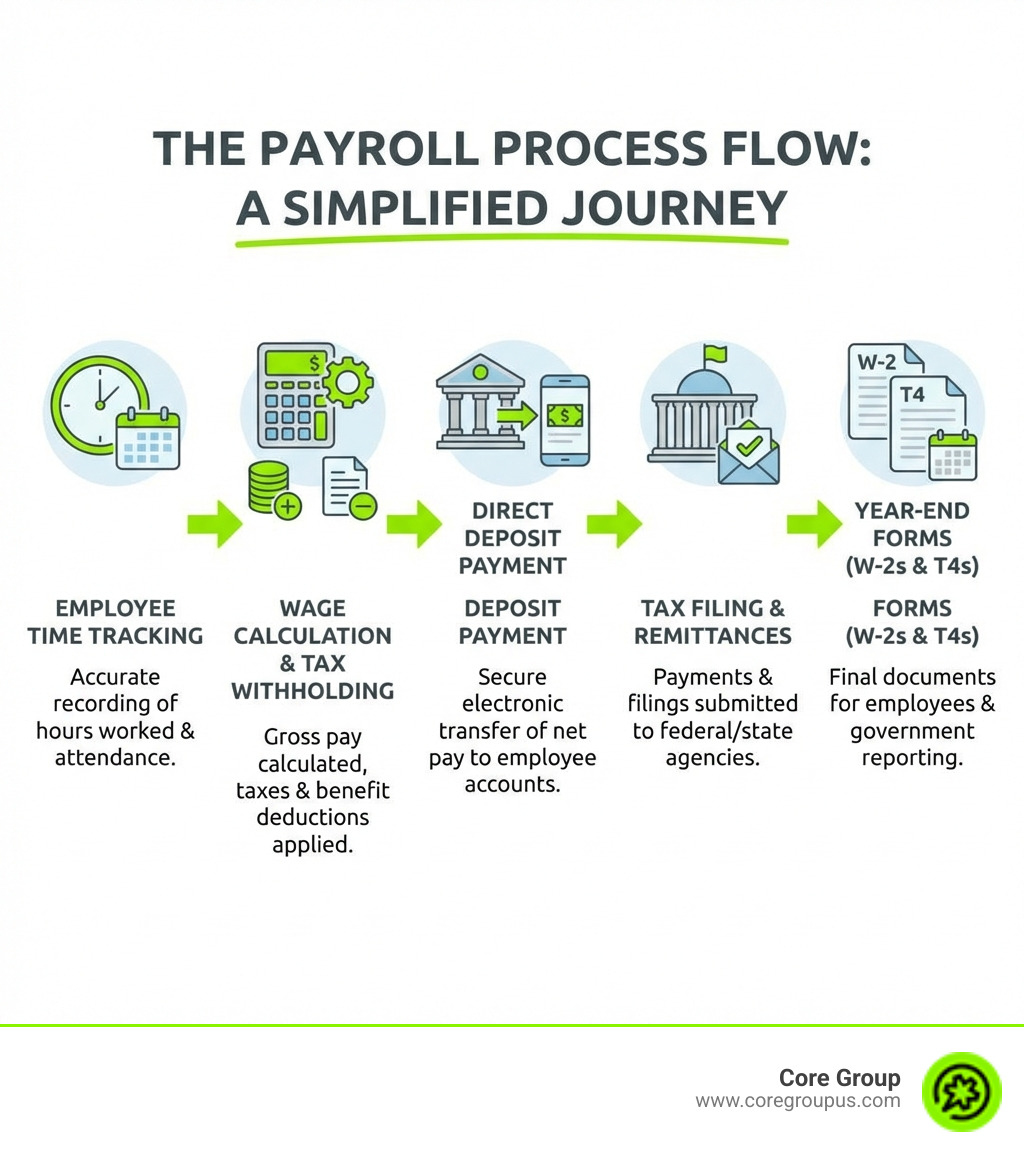
For many small businesses, HR and payroll often operate as separate entities, leading to duplicated efforts, inconsistencies, and potential compliance headaches. However, integrating these two crucial functions offers a holistic approach that can transform how you manage your workforce. An integrated hr and payroll for small business system brings together everything from time tracking and wage calculation to benefits administration and tax filing under one roof.
Why combine HR and payroll? Simply put, it creates a single source of truth for all your employee data. This eliminates the need for manual data entry across multiple systems, drastically reducing the chances of human error. Think of it as having a well-oiled machine where all the gears work in perfect synchronicity, rather than two separate engines sputtering along.
The benefits extend far beyond mere convenience. We're talking about significant time savings, which translates directly into cost savings for your business. With automated processes, your team spends less time on administrative tasks, freeing them up to focus on strategic initiatives or, for creative entrepreneurs, on the core work that drives your business forward. Reduced errors mean fewer penalties from the IRS or state agencies, protecting your hard-earned profits.
An integrated system also plays a pivotal role in attracting and retaining talent. Modern employees expect seamless digital experiences, and a robust system with employee self-service portals meets this expectation. Furthermore, having a clear, efficient system for managing benefits and accurate payroll can improve employee satisfaction and trust. Finally, these systems provide invaluable data-driven insights into your workforce, helping you make informed decisions about staffing, compensation, and growth. As your business expands, a scalable integrated solution ensures that your HR and payroll infrastructure can grow with you, accommodating more employees and complex requirements without missing a beat. More info about our approach on The Planner Blog.
Streamlining Your Operations
One of the most compelling reasons to adopt an integrated hr and payroll for small business system is the sheer efficiency it brings. Research indicates that such systems can lead to 40-65% less staff time required for manual HR and payroll administration. Imagine what your team could achieve with that much extra time!
This efficiency stems from several key areas:
- Automated Calculations: Say goodbye to spreadsheets and manual calculations. The software automatically computes wages, overtime, deductions, and taxes based on predefined rules and employee data. This not only saves time but also drastically reduces the risk of costly calculation errors.
- Single Source of Truth: All employee data, from personal details and compensation to benefits enrollment and time-off requests, resides in one centralized database. This eliminates data silos, ensures consistency, and makes it easy to access accurate, up-to-date information whenever you need it.
- Simplified Reporting: Generating reports for internal analysis, tax purposes, or compliance audits becomes a breeze. With all data integrated, the system can quickly pull together comprehensive reports, saving hours of manual data compilation. This is particularly valuable for financial planning and understanding your labor costs.
By streamlining these operations, you're not just saving time; you're building a more resilient and agile business infrastructure.

Empowering Your Team
Beyond the operational efficiencies for your business, an integrated HR and payroll system significantly empowers your employees through features like employee self-service portals. These portals are a game-changer for enhancing the employee experience and reducing the administrative burden on HR staff.
With self-service portals, your team members can:
- Access Pay Stubs and Tax Forms: Employees can securely view and download their current and historical pay stubs, as well as essential tax documents like W-2s, whenever they need them, without having to ask HR.
- Update Personal Information: They can easily update their contact details, banking information for direct deposit, and even adjust their tax withholdings (W-4 forms), ensuring accuracy and reducing manual data entry for your team.
- Request Time Off: Modern systems allow employees to submit time-off requests, check vacation balances, and see their team's schedule, making the process transparent and efficient for everyone involved.
This level of access and control not only fosters a sense of autonomy among your employees but also reduces inquiries to HR, allowing your administrative staff to focus on more complex, strategic tasks. It contributes to a more engaged and satisfied workforce, which is invaluable for any small business.
Key Features to Look for in a Small Business HR and Payroll Solution
When exploring solutions for hr and payroll for small business, the comparison between manual processes and dedicated software reveals a clear winner. While manual payroll might seem "cheaper" initially, the hidden costs of time, errors, and potential penalties quickly add up.
Here's a quick look at the fundamental differences:
| Feature | Manual Payroll | Payroll Software |
|---|---|---|
| Calculation Accuracy | Prone to human error, complex for deductions | Automated, high accuracy, handles varied deductions |
| Tax Compliance | Requires constant monitoring of changing laws | Automatically updates laws, handles remittances |
| Time Savings | Time-consuming, repetitive tasks | Significant time reduction through automation |
| Reporting | Manual data compilation, time-intensive | Instant, customizable, comprehensive reports |
| Security | Risk of lost/misplaced physical records | Encrypted data, secure access controls |
| Scalability | Becomes exponentially harder with more employees | Grows with your business, easy to add employees |
| Integration | None, data silos | Connects with accounting, HRIS, time tracking |
| Employee Self-Service | Non-existent, requires HR intervention | Empowers employees with direct access |
| Penalty Risk | High due to errors/missed deadlines | Significantly reduced through automation |
The core value proposition of payroll software lies in its ability to automate, ensure compliance, and integrate with other business tools. It's about providing robust reporting and analytics, maintaining top-tier security for sensitive data, and offering scalability that supports your business growth.
Essential Features for HR and Payroll for Small Business
When choosing an hr and payroll for small business solution, certain features are non-negotiable for ensuring efficiency, compliance, and employee satisfaction. These are the workhorses that will do the heavy lifting for you:
- Automated Tax Calculation and Filing: This is perhaps the most critical feature. The software should automatically calculate federal, state, and local taxes, Social Security, and Medicare withholdings. Crucially, it should also handle the automatic payment (remittances) and filing of these taxes with the relevant authorities. This prevents costly errors and penalties that can arise from manual calculations or missed deadlines.
- Direct Deposit: A modern payroll system must offer direct deposit. It's an expected convenience for employees and eliminates the time, cost, and security risks associated with printing and distributing paper checks.
- Year-End Reporting (W-2s and 1099s): The software should automatically generate and file year-end tax forms like W-2s for employees and 1099-MISC (or 1099-NEC) for contractors. This simplifies a traditionally complex and time-consuming year-end task, ensuring compliance with IRS deadlines.
- Time Tracking Integration: For businesses with hourly employees, seamless integration with time tracking systems is essential. This ensures accurate wage calculations based on actual hours worked, including overtime, and reduces manual data entry errors. Many systems offer built-in time tracking or easy integration with popular third-party solutions.
These features form the backbone of an effective payroll system, allowing us to focus on our creative endeavors rather than administrative burdens.
Advanced Integrations and Scalability
As your creative business grows, your hr and payroll for small business needs will evolve beyond basic processing. This is where advanced integrations and scalability become paramount. A truly effective solution isn't just about paying people; it's about connecting all your vital business functions.
- Connecting with Accounting Software: Seamless integration with your accounting software (like QuickBooks or Xero) is crucial. This means payroll data—wages, taxes, deductions, and liabilities—automatically syncs to your general ledger. This eliminates manual data entry for your bookkeeper or accountant, saving time and ensuring financial records are always accurate. It means you don't have to manually calculate the splits between wages, taxes, and liabilities, saving you time and reducing errors.
- HRIS Functionality: Beyond payroll, look for systems that offer Human Resources Information System (HRIS) capabilities. This might include robust employee record management, performance tracking, and compliance management tools, all integrated with payroll data.
- Onboarding New Hires: A comprehensive system can streamline the entire onboarding process, from digital offer letters and new hire paperwork (like I-9s and W-4s) to benefits enrollment and system access. This creates a professional first impression for new team members and ensures all necessary documentation is completed efficiently.
- Benefits Administration: Managing employee benefits can be complex. An integrated system can automate benefits enrollment, deductions, and reporting, making it easier to offer and manage health insurance, retirement plans, and other perks that attract and retain top talent.
Finally, consider scalability. Solutions for hr and payroll for small business often cater to different business sizes:
- 1-49 Employees: For smaller teams, we often prioritize ease of use, affordability, and core payroll functions with basic HR features.
- 50-999 Employees: As you grow, you'll need more sophisticated HRIS capabilities, advanced reporting, and robust benefits administration. The system should be able to handle increased complexity without requiring a complete overhaul.
Choosing a system that can evolve with your business means you won't outgrow it quickly, saving you the time and expense of switching providers down the line. Find more Accounting Resources here.
Navigating Compliance: Employees, Contractors, and Taxes
Compliance is arguably the most intimidating aspect of hr and payroll for small business. The stakes are high: small businesses paid nearly $5 billion in penalties in 2018 alone due to payroll and compliance issues. The landscape of federal and state labor laws, tax regulations, and reporting requirements is constantly shifting, making it a minefield for the unprepared.
The importance of accuracy cannot be overstated. A single miscalculation, a missed deadline, or an incorrect worker classification can trigger audits, fines, and legal challenges that can severely impact your business. We know you're busy creating, but understanding the basics of compliance is crucial for protecting your bottom line and your peace of mind. Our goal is to help you steer these complexities, ensuring your business stays on the right side of the law. Explore our Tax Planning Resources.
Paying Employees vs. Independent Contractors
One of the most common pitfalls for small businesses is misclassifying workers. The IRS considers all workers to be employees unless proven otherwise, and the distinction between an employee and an independent contractor is critical for hr and payroll for small business. Misclassification can lead to significant penalties, including back taxes, interest, and fines.
The key differentiator is control and independence:
- Employees: You control what they do and how they do it. You typically provide tools, set hours, and offer training.
- Independent Contractors: They control how they do the work. They often provide their own tools, set their own hours, and work for multiple clients. You dictate the results of the work, not the means.
Tax Implications:
- Employees: As an employer, you withhold federal income tax, Social Security, and Medicare taxes from their paychecks. You also pay employer portions of FICA (Social Security & Medicare), FUTA (federal unemployment), and SUI (state unemployment) taxes.
- Independent Contractors: Generally, you do not withhold taxes from a contractor's pay. They are responsible for their own self-employment taxes. You pay them their agreed-upon rate, and they handle their own tax obligations. An exception is backup withholding, which applies if a contractor doesn't provide a valid Taxpayer Identification Number (TIN) on their W-9.
Relevant Labor Laws:
- Employees: Subject to federal laws like the Fair Labor Standards Act (FLSA) for minimum wage and overtime, and potentially the Family and Medical Leave Act (FMLA) if you have 50 or more employees. State-specific labor laws also apply, covering aspects like break times, paid sick leave, and unemployment insurance. The Occupational Safety and Health Act (OSHA) ensures a safe workplace.
- Independent Contractors: Generally not covered by these labor laws, simplifying your obligations, but making correct classification even more important.
Necessary Forms:
- For Employees:
- Form I-9, Employment Eligibility Verification: To confirm their legal right to work in the U.S.
- Form W-4, Employee's Withholding Certificate: To determine the correct amount of federal income tax to withhold.
- For Independent Contractors:
- Form W-9, Request for Taxpayer Identification Number and Certification: To obtain their Taxpayer Identification Number (TIN) for tax reporting purposes. For foreign individuals, a Form W-8BEN may be required.
Understanding these distinctions is paramount to avoiding penalties and ensuring smooth operations for your creative business.
How Software Simplifies Tax Compliance for HR and Payroll for Small Business
The complexities of tax compliance can be a significant source of stress for small business owners. This is where dedicated hr and payroll for small business software truly shines, changing a daunting task into a manageable process.
- Automated Remittances: A good payroll system will automatically calculate and remit federal, state, and local payroll taxes on your behalf. This ensures payments are made accurately and on time, significantly reducing the risk of penalties. The software keeps track of all the varying deadlines, so you don't have to.
- Staying Updated on Tax Law Changes: Tax laws, rates, and regulations are constantly evolving at both federal and state levels. Manually keeping up with these changes is a full-time job. Payroll software providers continuously monitor these updates and automatically incorporate them into their systems, ensuring your payroll is always compliant.
- Generating Tax Forms: At year-end, the software will automatically generate and e-file critical tax forms like W-2s for employees and 1099-MISC (or 1099-NEC) for contractors. Some systems can even create and deliver these forms directly to your employees and contractors, further lightening your administrative load.
- Reducing Penalty Risk: By automating calculations, remittances, and form generation, payroll software drastically minimizes the chances of human error, which is a primary cause of tax penalties. The financial consequences of non-compliance can be severe; small businesses paid nearly $5 billion in penalties in 2018 alone. Investing in reliable software is a proactive step to safeguard your business against such risks. This IRS publication highlights the risk of penalties.
By leveraging the power of payroll software, we can gain peace of mind, knowing that our tax obligations are handled efficiently and accurately, allowing us to dedicate our energy to what we do best.
Frequently Asked Questions about HR & Payroll
We understand that diving into hr and payroll for small business can bring up a lot of questions. Here, we address some of the most common inquiries we hear from creative entrepreneurs like you.
How much does payroll software for a small business cost?
The cost of hr and payroll for small business software is a common concern, and it can vary widely based on the features you need, the number of employees you have, and the provider you choose. Generally, pricing models include:
- Base Fees: Most providers charge a monthly or annual base fee for access to their platform. This covers the core software and some basic features.
- Per-Employee Fees: In addition to the base fee, you'll typically pay a per-employee fee each month or per payroll run. This scales the cost according to your workforce size.
- Tiered Plans: Many providers offer different service tiers (e.g., Basic, Plus, Premium) with increasing features and support at higher price points.
For example, some basic payroll solutions for small businesses can start around $39 per month, plus an additional $5 per employee. While this might seem like an upfront cost, it's crucial to consider the Return on Investment (ROI). The value of your time, the cost of potential errors, and the penalties for non-compliance often make payroll software far more cost-effective than manual processing in the long run. As one source noted, the penalty for a forgotten $5,000 payroll tax deposit for three weeks could be $500 plus interest. Avoiding such incidents often means the software pays for itself quickly.
What are the most common payroll mistakes small businesses make?
Even with the best intentions, small businesses often stumble into common payroll pitfalls that can lead to financial penalties and employee dissatisfaction. For hr and payroll for small business, these mistakes can be particularly disruptive:
- Misclassifying Employees vs. Contractors: As we discussed, incorrectly classifying a worker can lead to significant back taxes, penalties, and legal challenges from the IRS and state labor departments. The IRS views all workers as employees unless proven otherwise.
- Late or Incorrect Tax Payments and Filings: Missing deadlines for federal and state tax deposits or filing incorrect forms (like W-2s or 1099s) can result in substantial penalties. The IRS can impose penalties ranging from 2% to 15% for late deposits, plus interest, and up to 25% for late form filings.
- Poor Record-Keeping: Failing to maintain accurate and organized payroll records (e.g., timesheets, pay stubs, tax forms) makes audits incredibly difficult and can lead to fines. Most federal and state laws require records to be kept for at least three to four years.
- Ignoring Overtime Rules: Many small businesses overlook the complexities of overtime calculations, especially for non-exempt employees. The Fair Labor Standards Act (FLSA) mandates overtime pay at 1.5 times the regular rate for hours worked over 40 in a workweek, and state laws may have additional requirements.
- Inaccurate Wage Calculations: Simple errors in calculating gross pay, deductions, or net pay can lead to underpayment or overpayment, causing frustration for employees and requiring time-consuming corrections.
How Automation Helps Avoid These:Modern hr and payroll for small business software is designed to prevent these common mistakes. It automates calculations, tracks deadlines for tax payments and filings, helps with worker classification guidance, and ensures accurate record-keeping. By taking the guesswork out of payroll, these systems provide a critical safety net for your business.
How does payroll software integrate with other business tools?
One of the standout advantages of modern hr and payroll for small business software is its ability to seamlessly integrate with other essential business tools. This connectivity creates a unified ecosystem, enhancing efficiency and data accuracy across your operations.
- APIs (Application Programming Interfaces): Most robust payroll platforms offer APIs that allow them to communicate and share data with other software applications. This is the underlying technology that enables smooth integration.
- Syncing with Accounting Software: As mentioned earlier, this is a critical integration. Payroll software can automatically push payroll data—such as wages, taxes, deductions, and liabilities—directly into your general ledger in accounting platforms like QuickBooks, Xero, or Sage. This eliminates manual data entry, reduces errors, and ensures your financial records are always up-to-date.
- Connecting to Time Tracking Apps: If your business uses a separate time tracking system (or if your payroll software has one built-in), integration ensures that employee hours are automatically imported for payroll processing. This is vital for accurate wage and overtime calculations.
- HRIS and Benefits Administration Platforms: Many payroll systems are part of a larger HRIS suite or can integrate with specialized benefits administration platforms. This means employee data, benefits enrollment, and deduction information flow smoothly between HR, payroll, and benefits providers.
- Benefits of a Unified System: A unified system provides a single source of truth for all employee-related data. This not only streamlines administrative tasks but also offers a holistic view of your workforce, enabling better decision-making and ensuring consistency across all your business functions. It means less time spent on admin and more time focused on your creative output.
Conclusion: Choosing the Right Partner for Your Business
Navigating the complexities of hr and payroll for small business doesn't have to be a solo journey fraught with peril. We've explored how integrated solutions can offer immense benefits, from streamlining operations and empowering your team to ensuring robust tax compliance and avoiding costly penalties. The right software provides automated calculations, essential year-end reporting, direct deposit, and seamless integration with your accounting and time tracking tools. It's an investment that pays dividends in saved time, reduced errors, and invaluable peace of mind.
For creative entrepreneurs, this peace of mind is paramount. We understand that your passion lies in your craft—designing, writing, innovating, building. The administrative burden of payroll and HR can stifle that creativity, pulling you away from the work that drives your business and brings you joy. By entrusting these critical functions to a reliable, integrated system, you free up your mental space and precious time.
At Core Group, we specialize in offering a "no-fluff, profit-first playbook" that guarantees peace of mind and saves time for creative entrepreneurs. We believe you should be able to focus on your business, knowing that your financial management, bookkeeping, and tax services are handled with expertise. Let us handle the numbers so you can create. Discover our expert Payroll Resources.