Don't Panic Over IRS Transcript Code 806
What the IRS Code 806 Meaning Actually Tells You
The IRS code 806 meaning is straightforward and it shows the total federal income tax withheld from your paychecks, W-2s, and 1099s throughout the year, recorded as a credit on your tax account transcript.
Quick answer
- Code 806 is a transaction code on your IRS tax account transcript
- It represents federal income tax your employer or payer withheld on your behalf during the year
- It appears as a negative number, which means it is a credit in your favor
- It does not tell you your refund amount on its own
- It is one piece of the puzzle the IRS uses to calculate what you owe or what you get back
So if you pulled up your transcript and saw a code labeled 806 with a dollar amount next to it, that number reflects what was already paid to the IRS out of your earnings. Think of it as proof that taxes were collected before you ever filed.
For creative freelancers and media professionals juggling multiple income sources, this code shows up often, since withholding can come from several W-2s, 1099s, or both.
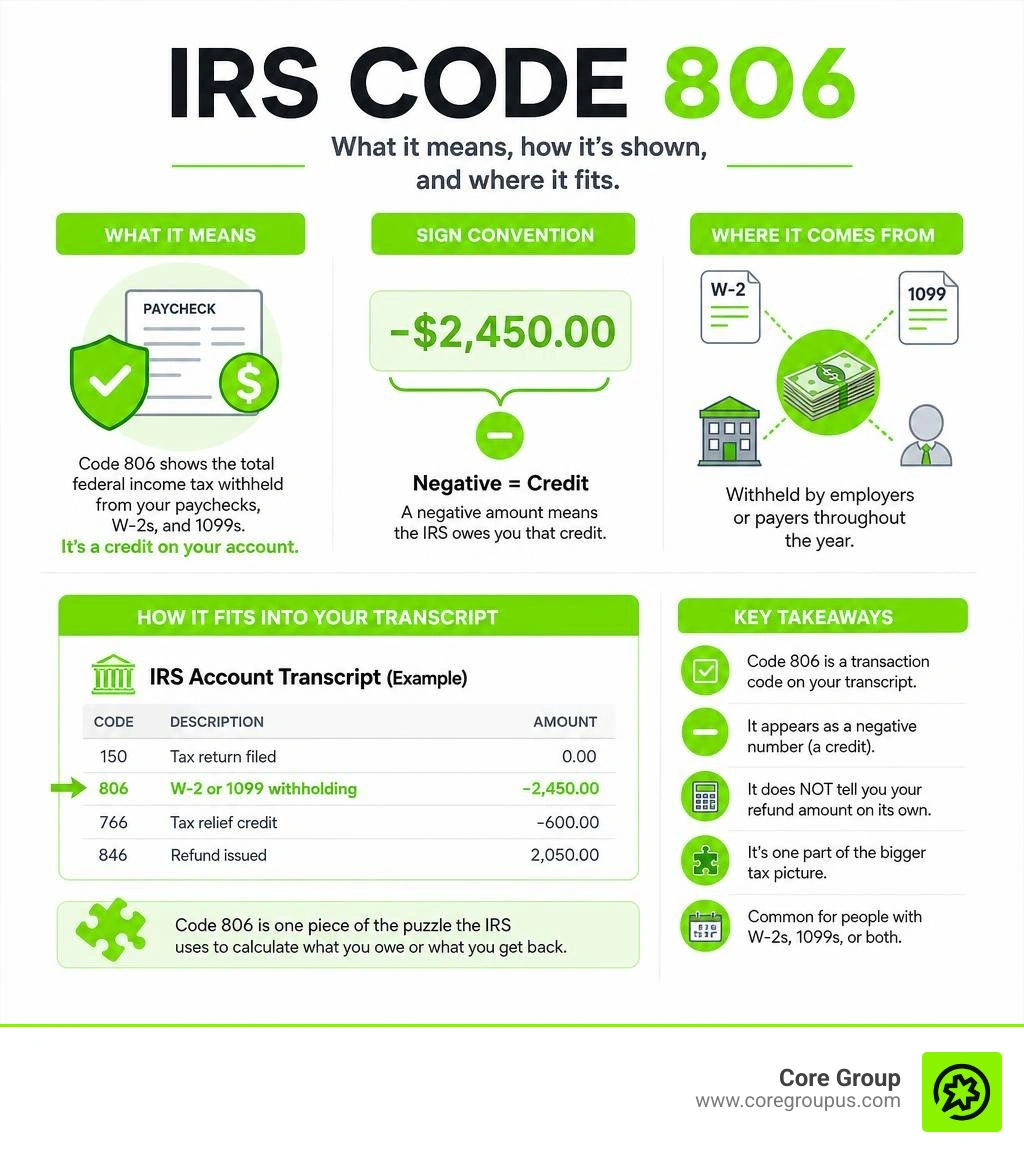
Basic IRS code 806 meaning vocab
Understanding the IRS code 806 meaning on Your Transcript
When you log into your online IRS portal to check your tax records, you might feel overwhelmed by the rows of dates, numbers, and three digit codes. These are transaction codes used by the IRS processing system to log specific actions on your account.

The transaction code 806 is officially defined as the credit for withheld taxes and excess FICA. When the IRS receives and uploads your tax return into their system, they look at the total amount of tax your employers or clients withheld from your earnings. Once they verify this amount, they post it to your transcript under this specific code.
Understanding this code is essential because it represents actual money that has already been sent to the government. For a complete look at how the IRS formats these details on your official documents, you can check out the Taxpayer Advocate Service guide on transcripts.
How the IRS code 806 meaning Relates to Your W2 and 1099 Withholding
Every time you receive a paycheck or a payout, a portion of that money is typically sent directly to the IRS to cover your federal income tax liability. This is known as withholding. At the end of the year, your employers and clients compile these numbers and send them to both you and the IRS.
When the IRS processes your tax return, they sum up the withholding listed on your various forms. This combined total is what generates your code 806 credit.
Common withholding documents that feed into this total include
- Form W2, which is used for traditional employment wages
- Form 1099-NEC, which is used for nonemployee compensation for freelancers and contractors
- Form 1099-MISC, which is used for miscellaneous income like royalties or rent
- Form 1099-R, which is used for distributions from pensions, annuities, or retirement accounts
- Form 1040 or Form 1041, which can include claims for excess Social Security or FICA taxes withheld if you worked multiple jobs and exceeded the annual wage limit
Interpreting Positive and Negative Amounts Next to Code 806
One of the most confusing parts of reading an IRS transcript is the way positive and negative numbers are displayed. In IRS transcripts, standard accounting rules are flipped.
A negative balance next to code 806 is actually excellent news. This negative sign indicates a credit in your favor. It means the IRS has credited your account for the taxes that were withheld during the year, which reduces your overall tax liability.
Conversely, a positive balance next to code 806 is highly unusual and typically indicates an account adjustment or a reversal. If the IRS determines that some of your claimed withholding could not be verified, they might post a positive amount to reverse a portion of the credit. This increases your outstanding tax liability and could mean you owe money or will receive a smaller refund.
How Code 806 Interacts With Other IRS Transcript Codes
Your tax transcript tells a story through a sequence of transaction codes. Code 806 does not exist in a vacuum. It interacts with several other codes to determine your final tax situation.
To help you visualize this, we have put together a comparison of the most common codes you will see alongside code 806.
| Transaction Code | Official Name | What It Means for You |
|---|---|---|
| Code 150 | Tax Assessed | The total tax liability you owe based on your return |
| Code 806 | Credit for Withheld Taxes | The federal income tax already paid through withholding |
| Code 766 | Credit to your Account | Refundable tax credits like the Child Tax Credit |
| Code 846 | Refund Issued | The final approved refund amount being sent to you |
These codes usually follow a specific sequence as the IRS processes your return. First, the IRS assesses your tax liability under Code 150. Then, they apply your withholding credit under code 806 and any other refundable credits under IRS Code 766. If your total credits outweigh your tax liability, the IRS will calculate your final refund and issue it under code 846 Refund Issued.
Why the IRS code 806 meaning Does Not Equal an Automatic Refund
A common misunderstanding is assuming that the dollar amount next to code 806 is the exact refund you will receive. This is not the case. Code 806 only represents your total withholding, which is just one factor in the final refund calculation.
To determine your refund, the IRS uses a simple formula
Total Withholding (Code 806) + Tax Credits (Code 766) - Tax Assessed (Code 150) = Your Refund or Amount Owed
If your withholding and credits are greater than the tax you owe, you will get a refund. If they are less, you will have a balance due. To understand how the IRS schedules these calculations and when they update your account, read our IRS Cycle Code Complete Guide.
Tracking the Timeline and Updates for Code 806
The IRS receives millions of returns every year. For context, during the 2025 tax season, the IRS received over 140,633,000 individual tax returns, with 92% of taxpayers choosing to file electronically. With electronic filing, transcripts are usually updated within two to three weeks of submission. If you file a paper return, it can take six to eight weeks for code 806 to appear.
Sometimes, you might see a Code 570 appear directly after your code 806. This means the IRS has placed a temporary hold on your account. This hold often happens when there is a mismatch between the withholding you claimed and the forms your employers submitted.
To keep track of how your return moves through these processing stages, you can learn more about What is an IRS Cycle Code and how to read your specific Cycle Code IRS.
How to Verify and Correct Your Code 806 Withholding Amount
As a creative entrepreneur, you might have multiple W-2s and dozens of 1099s from different clients. With so many moving parts, it is easy for mistakes to happen.
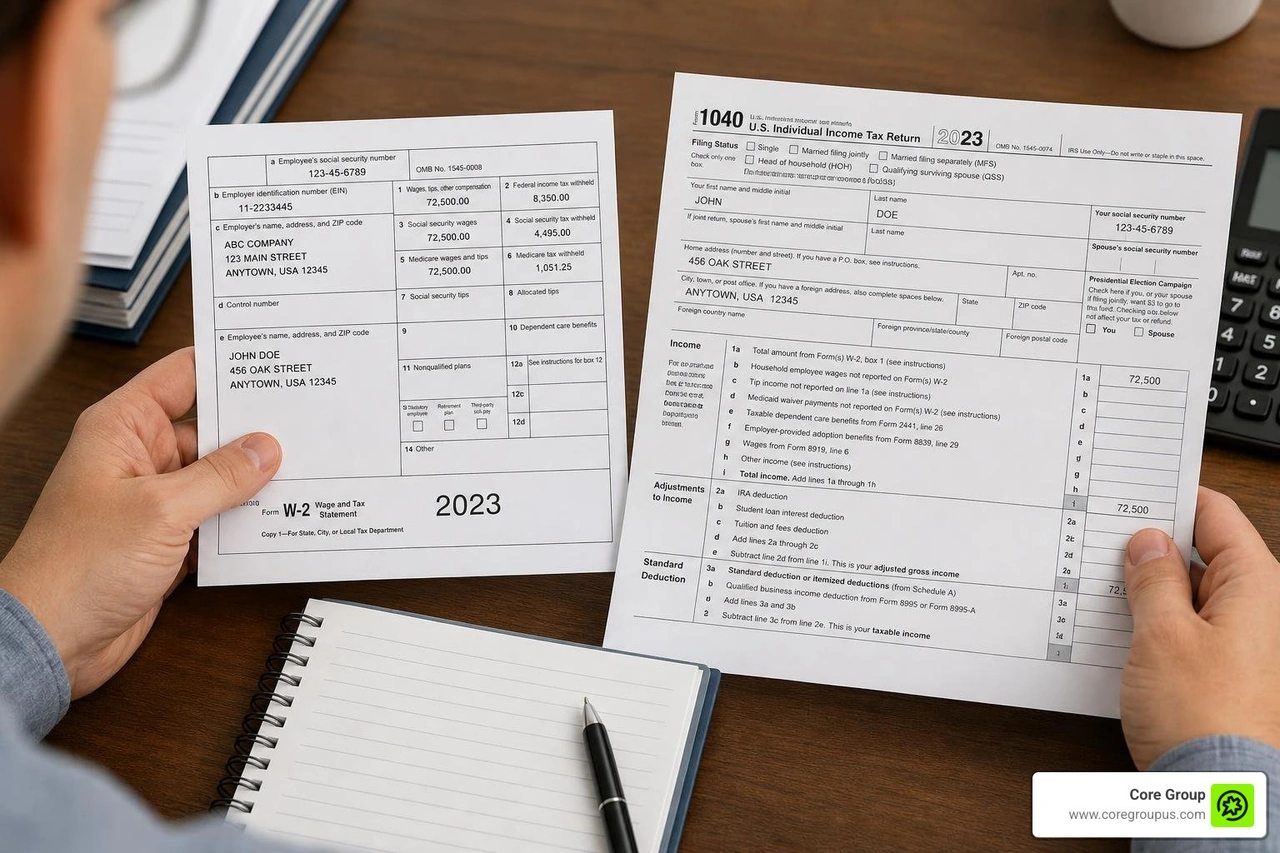
To verify that the IRS has the correct information, you should compare the code 806 amount on your transcript directly to your filed tax return. Specifically, look at Form 1040 Line 25d, which represents your total federal income tax withholding.
If the number next to code 806 on your transcript matches Form 1040 Line 25d, your withholding has been verified. If there is a mismatch, the IRS may delay your refund and send you a notice requesting clarification.
Steps to Take If Your Code 806 Amount Is Incorrect
If you discover that the code 806 amount on your transcript is incorrect or does not match your records, you need to act quickly to avoid penalties or prolonged refund delays.
First, double check all of your W-2 and 1099 forms to ensure you did not make a math error when filing. If the error was made by your employer or a client, contact them immediately and request a corrected Form W-2c or an updated Form 1099.
Second, if your employer refuses to help or has gone out of business, you can file Form 4852. This form acts as a substitute for Form W-2 and allows you to estimate your withholding based on your final paystubs.
Third, if you have already filed your return with the wrong information, you will need to submit an amended return using Form 1040X. For additional support, you can access IRS taxpayer assistance resources to speak with a representative, or reach out to a professional tax team like us at Core Group to help you sort out the mess.
Frequently Asked Questions About IRS Code 806
Does Code 806 include estimated tax payments
No, code 806 only reflects federal income tax withheld from your wages or payments by an employer or client. It does not include quarterly estimated tax payments that you make yourself throughout the year.
If you are self-employed and pay quarterly taxes, those payments are recorded on your transcript under a different code, usually Code 670 or Code 971.
What does a future date next to Code 806 mean
It is common to see a future date listed next to code 806 on your transcript. This can be alarming, but it is standard IRS processing procedure.
The future date typically represents the official due date of the tax return, which is usually April 15, or the date the IRS officially posts the transaction to their master file. It does not mean your refund is delayed until that date.
What was the historical IRC Section 806 small life insurance company deduction
If you search the internet for code 806, you might run into legal articles discussing Internal Revenue Code Section 806. This is entirely different from the transaction code 806 on your personal tax transcript.
Historically, IRC Section 806 referred to the Small Life Insurance Company Deduction. This deduction was officially repealed by Congress under the Tax Cuts and Jobs Act in late 2017. You can read the legislative history of this repeal on the Cornell Law School legal database. Unless you own a life insurance company, this historical tax code has no impact on your personal tax transcript.
Conclusion
Seeing unfamiliar codes on your IRS transcript can cause unnecessary stress, but understanding the IRS code 806 meaning helps you stay in control of your financial health. Code 806 is simply the record of the hard-earned money you already paid toward your taxes throughout the year.
For creative entrepreneurs, managing multiple income streams, withholding documents, and tax filings can quickly become a full-time job. That is where we come in. At Core Group, we offer comprehensive financial management, bookkeeping, and tax services specifically tailored for creatives.
We use our signature profit first playbook to guarantee peace of mind and save you valuable time, allowing you to focus entirely on your craft. We even back our services with a MacBook Pro guarantee to ensure you get the absolute best support.
If you want to take the guesswork out of your taxes and ensure your business is set up for long-term profitability, explore our Core Group resources today.