Decoding Your Tax Transcript: What Is an IRS Cycle Code?
Why Your IRS Cycle Code Matters for Tracking Your Tax Refund
What is an IRS cycle code? It is an eight-digit number that appears on your IRS Account Transcript, showing the exact date your tax return was posted to the IRS Master File — the government's internal system for tracking your tax account.
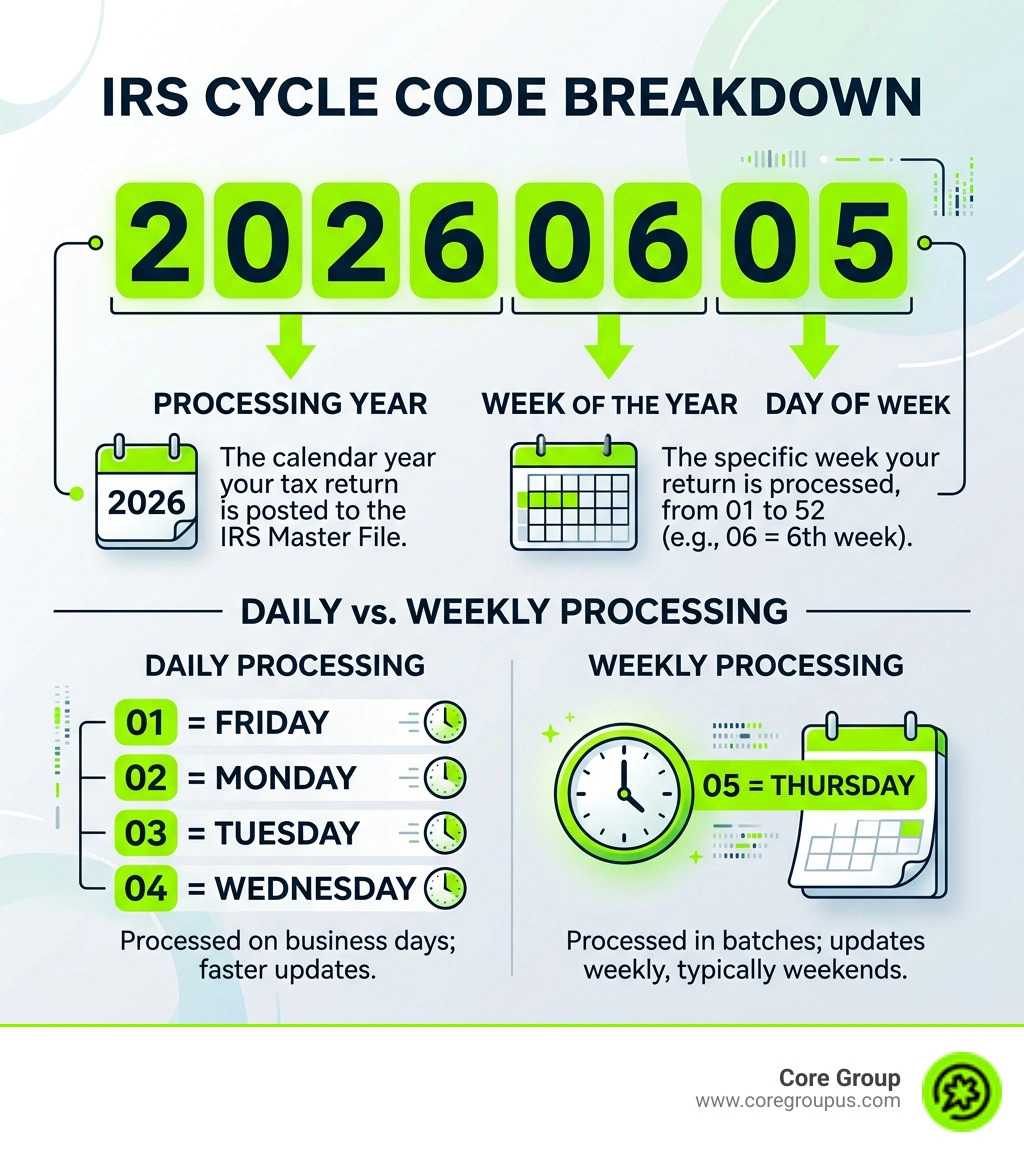
Here is a quick breakdown of what the code means:
| Digits | What It Represents | Example |
|---|---|---|
| First 4 | Processing year | 2025 |
| Digits 5-6 | Week of the year | 06 (6th week) |
| Digits 7-8 | Day of the week | 05 (Thursday) |
The last two digits tell you whether you are on a daily or weekly processing schedule:
- 01 = Friday (daily)
- 02 = Monday (daily)
- 03 = Tuesday (daily)
- 04 = Wednesday (daily)
- 05 = Thursday (weekly)
Every tax season, millions of taxpayers are left staring at their phone, refreshing refund trackers and wondering where their money is. If that sounds familiar, you are not alone.
The good news is that your IRS Account Transcript holds a clue most people overlook entirely — the cycle code. Once you know how to read it, you can stop guessing and start making sense of when your refund is actually moving through the system.
This guide breaks it all down in plain English, so you can spend less time anxious about your refund and more time focused on what you actually do best.
Understanding what is an IRS cycle code
At its core, what is an IRS cycle code? It is an internal 8-digit tracking number used by the Internal Revenue Service to manage the massive volume of tax returns they receive every year. Think of it like a digital "timestamp" or a batch number on a factory assembly line.
When you file your taxes and the IRS accepts your return, it doesn't just sit in a pile. It is uploaded to the Individual Master File, which is the primary system the IRS uses to store and process individual tax accounts. Once your return is officially logged into this master file, the system assigns it a cycle code.
This code is found in the "Transactions" section of your tax transcript. It represents the specific posting date—the moment the IRS system officially acknowledged your return for that tax year. While it might look like a random string of numbers, it is actually a highly structured piece of data that tells us exactly which year, which week of the filing season, and which day of the week your account was processed.
Steps to identify what is an IRS cycle code on your records
Finding this code isn't as difficult as it sounds, but you do need to look at the right document. You won't find it on the copy of the 1040 form you filed; instead, you need to look at your Account Transcript.

To find your code, follow these steps:
- Log into your IRS online account.
- Navigate to the "Tax Records" section and select the Get Transcript tool.
- Choose the "Account Transcript" for the specific tax year you are tracking.
- Scroll down to the "Transactions" section.
- Look for the column labeled "Cycle."
- You will see an 8-digit number (usually near Transaction Code 150, which represents your tax return being filed).
Accessing your tax records through the IRS portal
To get your hands on that transcript, you'll need to use the official IRS.gov portal. If you haven't already, you will likely need to set up an account through ID.me, which is the high-security identity verification system the IRS now uses. You’ll need a photo ID (like a driver's license or passport) and a smartphone to complete this process.
Once you are in, go to the "Tax Records" tab. You will see several types of transcripts available:
- Tax Return Transcript: Shows most line items from your original return.
- Account Transcript: This is the one we want! It shows changes, payments, and the all-important cycle code.
- Record of Account Transcript: A combination of the two above.
- Wage and Income Transcript: Shows data from W-2s and 1099s.
For the purpose of tracking a refund and understanding your processing schedule, always reach for the Account Transcript.
Breaking down the eight digits of your cycle code
The cycle code follows a YYYYWWDD format. Let's use an example like 20250605 to see how this works in the real world.
- The first four digits (2025): This is the processing year. This is the year the IRS is processing the return, which is usually the year after the tax year you are filing for (e.g., you process your 2024 taxes in 2025).
- The next two digits (06): This is the cycle week. The IRS doesn't use standard calendar weeks; they count the weeks of the internal "filing season" cycle. In our example, "06" means the sixth week of the IRS processing year.
- The last two digits (05): This is the processing day of the week. This is the "secret sauce" that tells you how often your account updates.
Differences between daily and weekly processing cycles
The last two digits are the most important for your sanity because they dictate when you should bother checking for updates.
Daily Batches (01, 02, 03, 04)If your code ends in 01 through 04, your account is considered a "daily" account. This means the IRS system can update your information any day from Friday through Wednesday. Typically, daily accounts see their transcripts update on Tuesdays and their "Where’s My Refund" status update on Wednesdays.
Weekly Batches (05)If your code ends in 05, you are on a "weekly" cycle. This is very common for taxpayers who have certain credits (like the Earned Income Tax Credit), those who have had identity theft issues in the past, or those with more complex returns. Weekly accounts are processed on Thursdays. Consequently, you will usually see transcript updates on Friday nights or Saturday mornings, and "Where’s My Refund" updates on Saturdays.
Reasons why what is an IRS cycle code could update during processing
Sometimes, you might notice that your cycle code changes or a new one appears. This can be a bit stressful, but there are logical reasons for it.
- Manual Review: If the IRS system flags your return for a human to look at, the processing "pauses." When it resumes, it may be assigned a new cycle code reflecting the new week it was re-entered into the master file.
- The PATH Act: If you claim the Earned Income Tax Credit (EITC) or Additional Child Tax Credit (ACTC), the law requires the IRS to hold your refund until mid-February. This often results in "weekly" (05) status and specific update windows.
- System Errors or Backlogs: During peak filing season, the IRS might experience operational shifts or technical glitches that move a batch of returns from one week to the next.
- Legislative Updates: If Congress passes a tax law change in the middle of tax season (it happens!), the IRS may have to update their systems, shifting everyone's processing cycle.
Predicting your refund date using transcript codes
While the cycle code tells you when the return was processed, it doesn't technically give you the exact "money in the bank" date. For that, you need to look for another code on your transcript: Transaction Code 846.
Transaction Code 846 is the "Refund Issued" code. When you see this on your transcript, it will be accompanied by a date. That date is the official deadline for the IRS to send your refund. Usually, if you have opted for direct deposit, the money arrives on or very near that date.
The cycle code helps you predict when that 846 code will appear. If you are a "weekly 05" filer, you know there is no point in checking your transcript on a Tuesday; you should wait until Saturday morning to see if the 846 code has popped up.
Typical update schedules for transcripts and refund status
To save you from "obsessive refreshing syndrome," here is the general schedule the IRS follows:
- Daily Accounts (01-04):
- Transcripts update: Tuesday
- Where’s My Refund updates: Wednesday
- Weekly Accounts (05):
- Transcripts update: Friday night / Saturday morning
- Where’s My Refund updates: Saturday
In most cases, the IRS aims to issue refunds within 21 days of the "processing date" associated with your cycle code. If you see a processing date of February 10th on your transcript, you can generally expect movement by early March.
Using cycle code charts for future tax years
Because the IRS weeks don't align perfectly with the calendar, we often look at cycle code charts to translate those numbers into real dates. For example, the IRS 2025 Cycle Code Calendar provides the exact mapping for each week of the 2025 processing year.
For the upcoming 2026 season, the IRS will release a new calendar that accounts for holidays (like Presidents' Day) and leap years. These charts are essential for pinpointing the exact day your return hits the master file. For instance, a cycle code of 20260401 would correspond to a Friday in the 4th week of the 2026 cycle.
Frequently Asked Questions about tax processing cycles
When do transcripts update for weekly accounts?
Weekly accounts (those ending in 05) typically update once a week. The processing happens on Thursdays, which means the updates usually "push" to the public-facing transcript system late Friday night or early Saturday morning. If you don't see an update by Saturday afternoon, you likely won't see one until the following weekend.
What should I do if my cycle code is missing?
If your transcript is "blank" or says "no return filed" and there is no cycle code, don't panic. This usually just means the IRS has received your return but hasn't yet uploaded it to the Individual Master File. During peak season, this can take a week or two. If it remains blank for more than 21 days after you filed electronically, you may want to check for a "Verification of Identity" letter in the mail.
Can my cycle code change after I file?
Yes, it can. If your return requires additional verification or is moved to a different processing department (like the department that handles injured spouse claims or identity verification), a new cycle code may be assigned. This usually indicates a slight delay in processing, as your return has essentially been moved to a new "batch."
Conclusion
Understanding what is an IRS cycle code is like having a secret map to the IRS's internal schedule. Instead of guessing when your refund might arrive, you can use your transcript to see exactly where you stand in the queue.
At Core Group, we know that for creative entrepreneurs, time is the most valuable asset you have. You shouldn't have to spend it deciphering government codes or worrying about tax timelines. Our "no-fluff, profit-first playbook" is designed to handle the heavy lifting of financial management, bookkeeping, and tax services so you can stay focused on your business.
We are so committed to your peace of mind that we even offer a MacBook Pro guarantee. If you are looking for more ways to stay ahead of the curve this tax season, explore our tax planning resources or reach out to us for a consultation. Whether you are a "daily 01" or a "weekly 05," we are here to ensure your business finances are always moving in the right direction.