Don't Let the Taxman Take Your Overtime Joy in California
What California Workers Need to Know About Overtime and Taxes
Is overtime taxed at a higher rate in California? The short answer is no, but there is an important catch.
Here is the quick breakdown
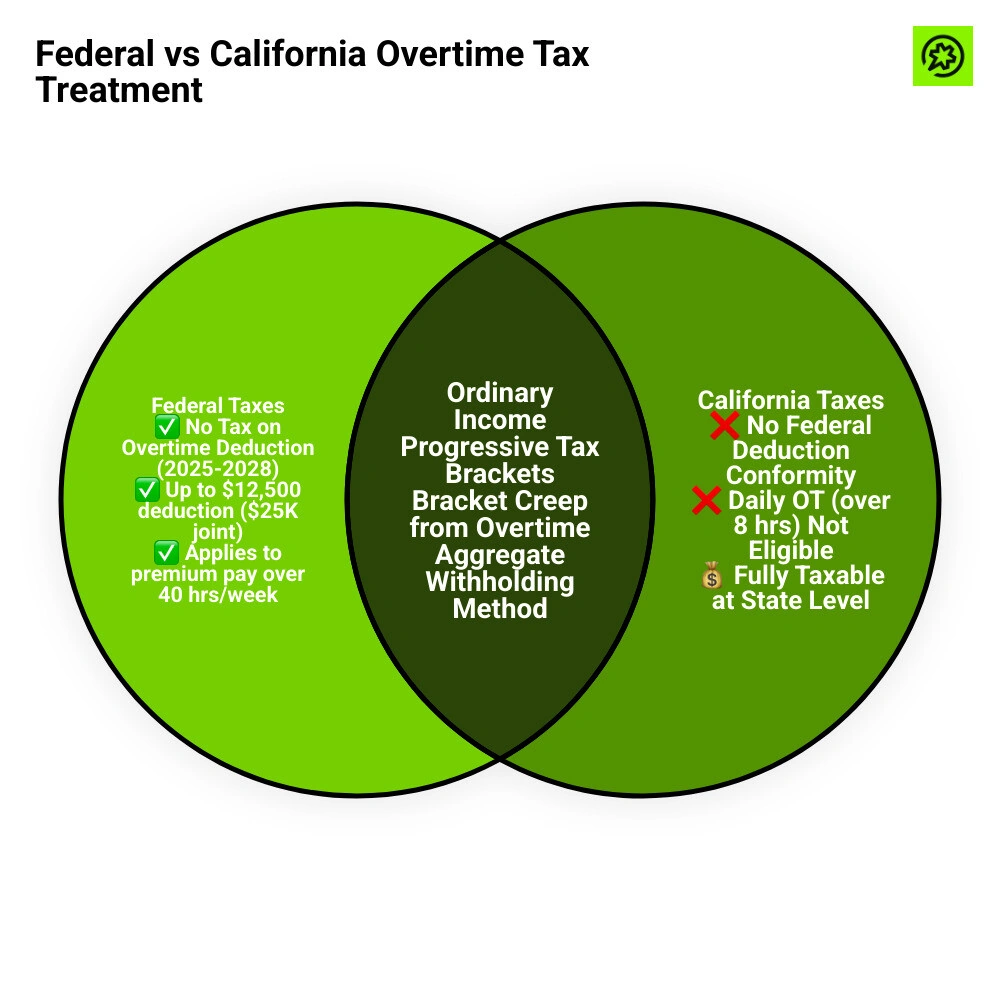
- Overtime pay is treated as ordinary income, taxed at the same federal and California state rates as your regular wages
- However, earning more overtime can push your total income into a higher tax bracket, which means a portion of your earnings gets taxed at a higher marginal rate
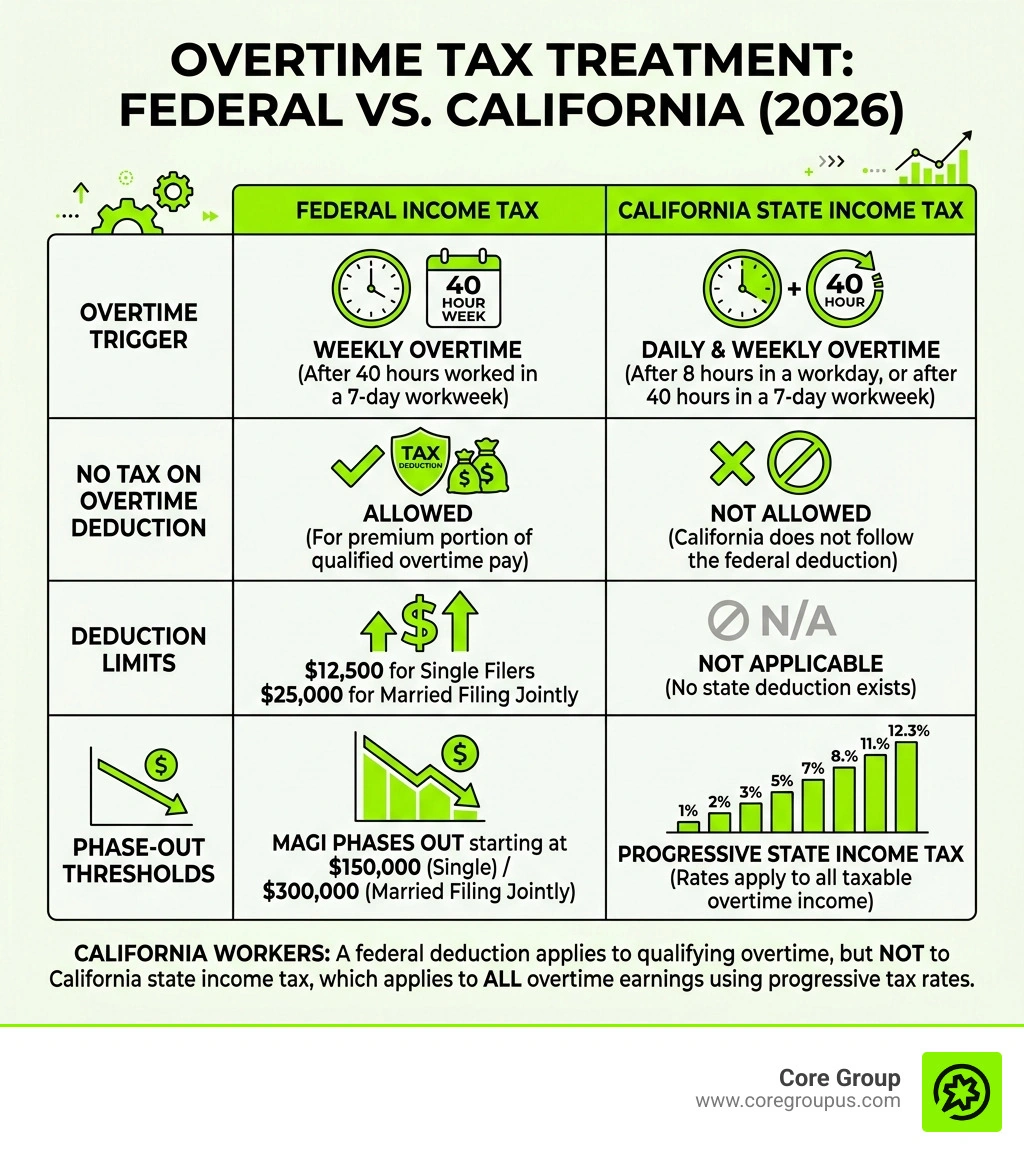
- A new federal deduction called "No Tax on Overtime" (2025-2028) lets eligible workers deduct up to $12,500 (or $25,000 if married filing jointly) of qualified overtime premium pay from their federal taxes
- California does not conform to this federal deduction, so all overtime remains fully taxable at the state level
- California's daily overtime rules (over 8 hours in a day) do not qualify for the federal deduction either, only hours over 40 in a workweek do
If you work in film, media, or any creative field in California, this gap between federal and state treatment can hit harder than you expect, especially when a big production week suddenly changes your tax picture.
More than 80% of California workers are technically eligible for overtime, yet the tax rules around it are widely misunderstood. Many people assume a bigger overtime paycheck means the government is grabbing a larger slice at a special "overtime rate." That is not how it works, but the reality is still complicated enough to cost you money if you are not paying attention.
Understanding if overtime is taxed at a higher rate in california
When you see a large chunk of your hard earned overtime missing from your paycheck, it is easy to assume that the government has a special, higher tax rate just for your extra hours. We hear this from creative entrepreneurs and employees all the time. However, the truth is that overtime is considered ordinary income. This means the IRS and the California Franchise Tax Board view those extra dollars the same way they view the dollars you earn during your first hour of work on a Monday morning.
The confusion often stems from how taxes are withheld. Employers frequently use the aggregate withholding method. When you work a lot of overtime in a single pay period, your payroll software looks at that one check and assumes you will make that much money every single week of the year. This can make it look like you have suddenly jumped into a much higher tax bracket, leading to a larger percentage being taken out for that specific check.
In reality, your actual tax liability is determined by your total annual income. If your total income for the year stays within the same progressive tax bracket, your tax rate remains the same. If the extra money from your overtime pushes you over the threshold into a new bracket, only the dollars above that threshold are taxed at the higher marginal rate. You can find more details on how these brackets work in this guide to the Overtime Tax Rate.
It is also worth noting that some employers use a flat supplemental withholding rate, often around 22 percent for federal taxes, for bonuses and sometimes overtime. This is just a placeholder. When you file your taxes in April 2026, everything is reconciled. To understand more about the mechanics of your paycheck, you can check out this resource on Is overtime taxed more? Here is what happens to your paycheck.

The Federal No Tax on Overtime Deduction and California Workers
As we move through April 2026, many workers are taking advantage of the federal No Tax on Overtime deduction. This provision, which began with the 2025 tax year, allows eligible workers to deduct a portion of their overtime pay from their federal taxable income. By early March of this year, over 15.5 million returns had already claimed this deduction.
The deduction is specifically for what the law calls qualified overtime compensation. This does not mean your entire overtime check is tax free. Instead, you can deduct the premium portion of your pay. If you earn $20 per hour and your overtime rate is $30 per hour, the $10 premium is what qualifies for the deduction.
The limits for this federal benefit are set at $12,500 per year for single filers and $25,000 for those who are married and filing jointly. While this is great news for your federal return, it creates a unique challenge for those in the Golden State. For a deep dive into how this specifically impacts our local workforce, see How “No Tax on Overtime” affects workers in California OOTB.
Why California daily overtime is taxed at a higher rate in california than federal overtime
One of the biggest surprises for California workers is that our state’s generous overtime laws do not always line up with federal tax breaks. Under California Labor Code Section 510, you earn overtime after working 8 hours in a single day. However, the federal Fair Labor Standards Act (FLSA) generally only recognizes overtime after 40 hours in a workweek.
The federal No Tax on Overtime deduction only applies to overtime required by federal law. If you work three 10 hour days and then take the rest of the week off, you have worked 30 total hours. In California, you are owed 6 hours of overtime pay (2 hours for each day over the 8 hour limit). But because you did not exceed 40 hours for the week, those 6 hours do not qualify for the federal tax deduction. In this specific scenario, your is overtime taxed at a higher rate in california concern feels very real because those hours are fully taxable at both the federal and state levels without any deduction. You can learn more about these daily versus weekly triggers at California Overtime Laws 2026 Daily and Weekly Rules.
How income limits affect whether overtime is taxed at a higher rate in california
Even if your overtime qualifies under federal rules, your income level might prevent you from taking the deduction. The No Tax on Overtime benefit starts to phase out once your Modified Adjusted Gross Income (MAGI) hits $150,000 for single filers or $300,000 for married couples filing jointly.
If you are a successful creative entrepreneur or a highly compensated professional, your overtime might still be fully taxed if you exceed these thresholds. This is often referred to as tax bracket creep. As you work more to grow your business or finish a project, the extra income can push you past the point where these deductions provide relief. For more information on these specific limits and how they interact with California's 2026 updates, visit Overtime Laws in California (2026) regarding Pay Rates, Exemptions and Tax Deduction.
Calculating Your Overtime Tax Liability and Take Home Pay
To get a clear picture of your take home pay, you have to look at several different layers of taxation. While we have focused on income tax, your overtime is also subject to payroll taxes. This includes Social Security (6.2 percent up to the annual wage cap) and Medicare (1.45 percent). These payroll taxes apply to every dollar of overtime you earn, regardless of the new federal deduction.
In California, we also have a progressive state income tax with rates ranging from 1 percent to 12.3 percent. Because California does not follow the federal overtime deduction, you must add that income back when calculating your state taxes.
If you work more than 12 hours in a single day, California requires your employer to pay you double time. This extra premium is a fantastic benefit for workers, but from a tax perspective, it is treated the same as regular overtime. It increases your gross pay, which might increase your total tax liability for the year. For a complete guide on how to calculate these rates correctly, see the Ultimate Guide to California Overtime Pay for Employees.
Common Misconceptions and Reporting Requirements for Employers
There is a common myth that you can ask your employer to pay your overtime under the table or as a bonus to save on taxes. This is illegal and can lead to massive penalties for both you and your employer. In California, employers are required to pay overtime by the next regular payday after the wages were earned.
For the 2025 and 2026 tax years, the IRS has introduced new reporting requirements. Employers should be tracking qualified overtime premiums separately. You might see these amounts noted in Box 12 or Box 14 of your W-2 form. If your employer does not provide a specific breakdown, the IRS has allowed for any reasonable method to be used by employees to calculate their deduction for the 2025 transition year, but by 2026, reporting should be more standardized.
Employers must also include non-discretionary bonuses and commissions when calculating your regular rate of pay for overtime. If you received a production bonus, your overtime rate for that period should actually be higher than your standard time and a half. You can find more official guidance on these calculations at the California Department of Industrial Relations page on Overtime.
Frequently Asked Questions about California Overtime Taxes
Can I waive my right to overtime pay to save on taxes?
No. Under California law, the right to overtime pay is considered a non-waivable protection. Even if you and your employer both agree that you would rather have a flat salary or just regular pay for extra hours to keep your tax bracket lower, the agreement is not legally binding. Employers who fail to pay required overtime can be held liable for back wages, interest, and heavy penalties. For more on why these rights are set in stone, visit California Overtime Law - What Every Worker Needs to Know.
Does the federal deduction apply to double time pay?
Yes, but only to the premium portion. If your regular rate is $20 and you are earning double time ($40), the $20 premium is what the federal government considers for the deduction. However, this only applies if you have also exceeded the 40 hour weekly federal threshold. California's double time rules are much stricter than federal standards, so many double time hours earned in California will not qualify for the federal deduction. You can explore more about these facts at Is Overtime Taxed Differently - Discover Key Facts - Harvest.
What should I do if my overtime is misreported?
If you believe your overtime has been calculated incorrectly or your tax documents do not reflect your actual earnings, you should first speak with your employer or payroll department. If the issue is not resolved, you can file a wage claim with the California Division of Labor Standards Enforcement (DLSE). For tax reporting errors, you may need to file IRS Form 4852, which serves as a substitute for Form W-2 when your employer provides an incorrect one.
Conclusion
Navigating California overtime can feel like a full time job in itself. Between the daily triggers, the double time rules, and the new federal deductions that the state refuses to follow, it is no wonder so many creative entrepreneurs feel overwhelmed. At Core Group, we specialize in helping creatives manage these complexities with a no-fluff, profit-first playbook.
Our goal is to give you the financial peace of mind you need to focus on your craft, whether you are on a film set in Los Angeles or running a design studio in San Francisco. We handle the bookkeeping and tax planning so you don't have to worry about whether your is overtime taxed at a higher rate in california. If you want to stop stressing over your paycheck and start focusing on your growth, we are here to help. More info about tax planning services is just a click away.