Maryland LLC Taxes: From Formation to Filing, Your Complete Handbook
Why Maryland LLC Tax Obligations Matter for Creative Entrepreneurs

Maryland LLC tax obligations use a pass-through structure, affecting how you report income and pay taxes. Here's what you need to know:
Key Maryland LLC Tax Requirements:
- No separate state income tax on LLCs by default—income passes through to your personal return
- Form 510 required annually for Pass-Through Entity (PTE) Income Tax Return
- $300 annual report fee due April 15th to maintain good standing
- 8.25% corporate tax rate only if you elect C Corp status
- Additional withholding obligations if you have nonresident members
- Sales tax registration needed if selling taxable goods or services
Starting or restructuring a business affects your taxes and liability. For creative entrepreneurs, Maryland's tax system can feel overwhelming when you'd rather focus on your craft.
The good news is Maryland's LLC structure is flexible. Unlike corporations facing double taxation, most LLCs use pass-through taxation, where the business itself doesn't pay state income tax. Instead, profits and losses flow to your personal tax return.
But this simplicity has requirements. You must manage annual reports, personal property tax returns, nonresident member withholding, and S Corp or C Corp elections. Missing deadlines or misunderstanding rules can lead to penalties, loss of good standing, or unexpected tax bills.
This guide covers Maryland LLC taxes—from formation to compliance—so you can make informed decisions and maintain peace of mind.
How Maryland LLCs Are Taxed by Default
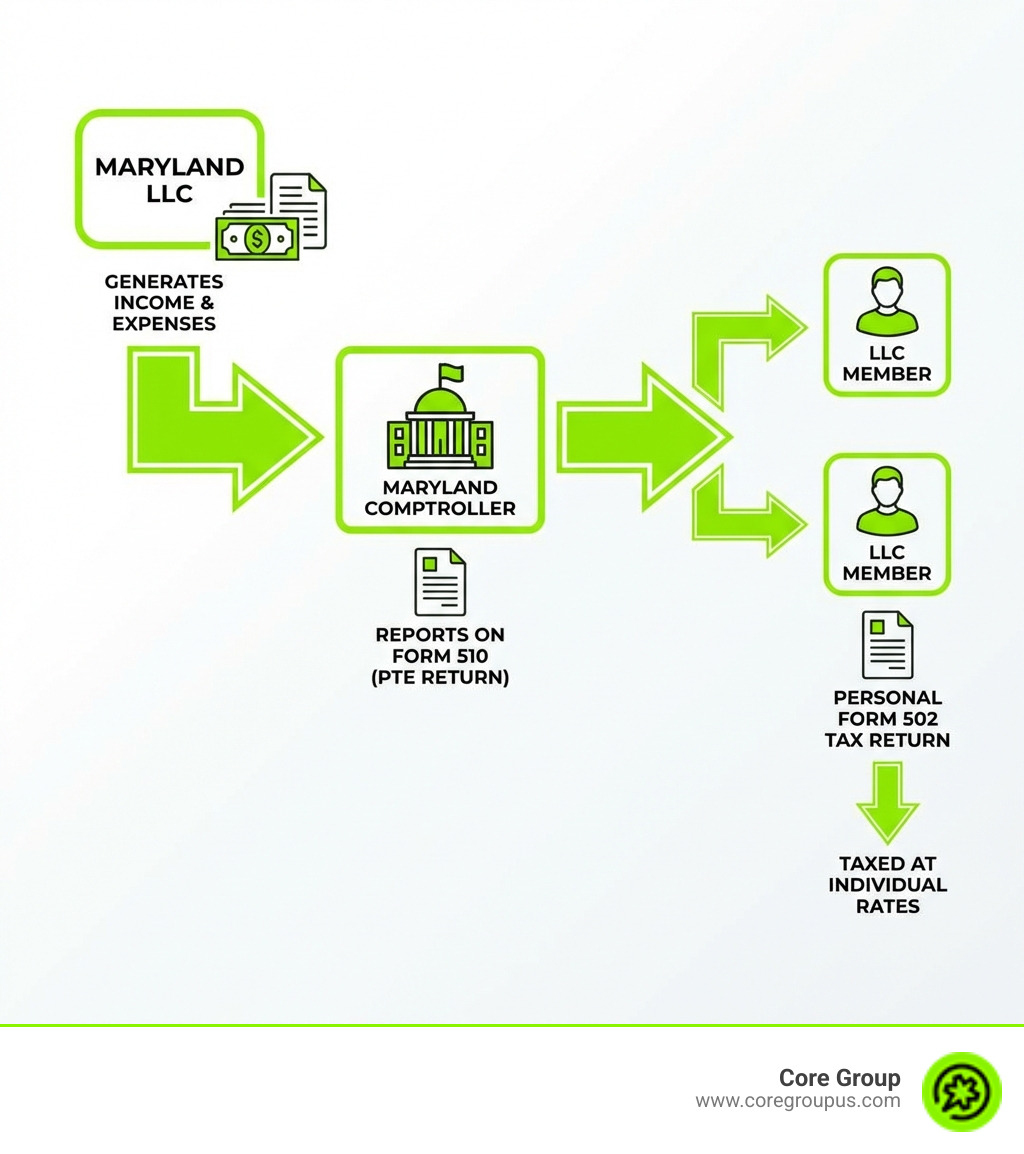
A key feature of an LLC is its tax flexibility. By default, Maryland treats an LLC as a "pass-through entity" (PTE), meaning the business itself isn't subject to state income tax. Instead, profits and losses "pass through" to the owners' personal income tax returns.
Maryland's approach mirrors the IRS "check-the-box" regulations, which let LLCs choose their federal tax classification. A single-member LLC is usually a "disregarded entity" (like a sole proprietorship), while a multi-member LLC defaults to a partnership. In both cases, income is reported on the owner's personal federal tax return.
Maryland follows this federal classification. If your LLC is a disregarded entity or partnership for federal taxes, it's treated the same for Maryland state income tax. This means no entity-level state income tax on your LLC's profits unless you elect otherwise, simplifying your accounting.
Accurate record-keeping of your LLC's income and expenses is crucial. Solid Accounting practices ensure you're ready for tax season.
Understanding the Default Maryland LLC Tax Treatment: Pass-Through
With the default pass-through status, the process is straightforward. Your LLC doesn't pay income tax directly to the state but acts as a reporting entity.
Multi-member LLCs (and single-member LLCs electing partnership status) must file Form 510, the Maryland Pass-Through Entity Income Tax Return. This form reports the LLC's income, gains, and losses allocable to Maryland. The LLC itself doesn't pay tax on this return (unless it has nonresident members).
Each member receives a K-1 form detailing their share of income or loss, which they report on their individual Maryland tax return, Form 502. The income is then taxed at individual state rates (up to 5.75%) plus any applicable local income taxes.
This system avoids the "double taxation" of C corporations by taxing income only once at the owner's level, a major advantage for small businesses. You can Learn More about Pass-Through Entities directly from the Maryland Comptroller's Office.
The Impact of Nonresident Members
If your LLC has nonresident members with Maryland-sourced income, the LLC must pay Maryland income tax on their behalf. This crucial aspect of Maryland LLC tax often surprises out-of-state members.
The tax rates for nonresident members are as follows:
- Nonresident Individual and Fiduciary Members: The LLC must pay a tax of 5.75%, plus a special nonresident tax of 2.25%, for a total of 8.0% of their share of income allocable to Maryland.
- Nonresident Entity Members: If a member is another entity, the LLC must pay tax at the rate of 8.25% of income allocable to Maryland on their behalf.
To simplify, the LLC can file a composite return (Form 510C) to report and pay the tax for multiple nonresident individual members on one form. These payments can be made as estimated taxes. You can Pay PTE Estimated Taxes online.
Tax Elections: Comparing LLC, S Corp, and C Corp in Maryland
Choosing the right business structure is a critical decision, impacting taxes, liability, administration, and your ability to attract investors. While an LLC offers excellent liability protection, its default tax treatment isn't always the most efficient as a business grows. This is where electing S Corp or C Corp tax status can help.
Balancing liability protection and tax burden is key. An LLC separates personal and business assets, but default pass-through taxation means all profits are subject to self-employment taxes. For some, this is a significant burden. Effective Tax Planning helps steer these choices.
Electing S Corp Status for Your LLC
As a business grows, electing S Corp status can offer significant tax advantages. This election is made with IRS Form 2553. Your business remains an LLC legally, retaining liability protection, but is taxed as an S Corp.
The primary benefit of an S Corp election is potential self-employment tax savings. As an owner-employee, you must pay yourself a "reasonable salary," which is subject to payroll taxes. However, remaining profits distributed to you as an owner are generally not subject to self-employment taxes. This can lead to substantial savings, and many solo LLCs consider this election once income exceeds $60,000–$70,000.
This election adds administrative tasks like payroll and has stricter compliance rules. It's a strategic move requiring professional advice. For more insights, see our blog post, Should Creative Entrepreneurs Become an S-Corp?, or our podcast, The Essential Guide to S-Corporations.
Electing C Corp Status: A Different Approach to Maryland LLC Tax
Less common for small businesses, an LLC can also elect to be taxed as a C corporation by filing IRS Form 8832. If classified as a C Corp federally, Maryland will tax it as one too.
As a C Corp, your business is a separate taxable entity, filing Form 500 with the Maryland Comptroller. The state corporate tax rate is 8.25% of net income. The main drawback is "double taxation": the corporation pays tax on profits, and shareholders pay tax on dividends.
Despite this, C Corp status can be advantageous for businesses seeking venture capital, as it offers a structure investors prefer. It also allows for retaining earnings for reinvestment. This choice is typically for high-growth businesses with specific investment goals. For guidance, see the Maryland Business Express portal and the Business Income Tax Filing Information page.
Here's a quick comparison of the Maryland tax implications for each structure:
| Feature | Default LLC (Pass-Through) | S Corp Election (for LLC) | C Corp Election (for LLC) |
|---|---|---|---|
| Federal Tax Form | Schedule C (single-member) or Form 1065 (multi-member) | Form 1120-S | Form 1120 |
| Maryland Tax Form | Form 510 (for PTE) + Form 502 (individual) | Form 510 (for PTE) + Form 502 (individual) | Form 500 (corporate) |
| Entity-Level MD Tax | No (unless nonresident members) | No (unless nonresident members) | Yes, 8.25% on net income |
| Owner-Level MD Tax | Income taxed at individual rates (Form 502) | Salary taxed at individual rates; distributions generally not | Dividends taxed at individual rates (double taxation) |
| Self-Employment Tax | Yes, on all net profits | Yes, on reasonable salary only (distributions exempt) | No, owners are employees/shareholders |
| Liability Protection | Yes | Yes | Yes |
| Administrative Burden | Moderate | Higher (payroll, more forms) | Highest (payroll, complex regulations) |
Annual Filings and Other Key Maryland LLC Tax Obligations
Beyond income tax, your Maryland LLC tax journey includes other filings with the State Department of Assessments and Taxation (SDAT) and the Comptroller of Maryland. The Maryland Tax Connect portal streamlines many of these processes, making it easier to manage business taxes online. You can File Your Business Taxes Online via this portal.
Annual Report and Personal Property Tax Return
Every Maryland LLC must file an annual report with SDAT to maintain "good standing" and its liability protection. Failure to file risks losing your liability shield, a key benefit of an LLC.
This annual report is combined with the Personal Property Tax Return (PPR) on Form 1. The deadline for filing is April 15th each year, and the filing fee is $300.
"Personal property" includes items like furniture, fixtures, tools, and inventory. You must file a PPR if your business owns or leases personal property with an original cost of $20,000 or more, or if you hold a trader's license. Even with no personal property, you must still file Form 1, indicating "none" or "exempt." Certain assets, like computer equipment, have specific depreciation rates, which you can learn more about by visiting Visit DAT.
For a detailed breakdown, Nolo's Maryland LLC Annual Report and Tax Filing Requirements in Maryland and the Maryland Department of Assessments and Taxation website are valuable resources.
Employer Taxes: Withholding and Unemployment
If your Maryland LLC has employees, you'll have additional payroll tax responsibilities.
Here's a list of key employer tax responsibilities:
- Employer Identification Number (EIN): You'll need an EIN from the IRS if you have employees. It's like a social security number for your business. You can Obtain an EIN online.
- Maryland Combined Registration Application (CRA): Register with the Comptroller for tax accounts like withholding and unemployment insurance using the Maryland Combined Registration Application.
- Withholding Tax: You must withhold state and local income taxes from employee wages and remit them to the Comptroller. This involves filing Form MW506 periodically and Form MW508 annually. The Comptroller's employer withholding section and the Employer Withholding Guide offer guidance.
- Unemployment Insurance (UI) Tax: Register with the Maryland Division of UI using the CRA or Maryland's BEACON UI application. You'll then report wages and pay UI taxes quarterly.
Sales and Use Tax Requirements
If your LLC sells taxable goods or services, you have Maryland LLC tax obligations for sales and use tax. The state rate is six percent (6%), and local governments generally do not add their own sales taxes.
Obtain a sales and use tax license via the CRA. You must then collect sales tax from customers and remit it to the Comptroller.
Filing is typically quarterly but can become monthly with high sales volume. Understand which goods and services are taxable versus exempt (e.g., manufacturing machinery, items for resale).
Remember use tax: if you buy goods from out-of-state vendors who don't collect Maryland sales tax, you must remit it yourself. The Comptroller's sales and use tax section and Learn More Sales and Use Tax pages are great resources.
Staying Compliant: Deadlines, Resources, and Consequences

Staying compliant with your Maryland LLC tax obligations is paramount. Missing deadlines can lead to financial penalties and the loss of your LLC's good standing. If your LLC loses good standing, it forfeits its limited liability protection, potentially exposing your personal assets to business debts. In some cases, individuals can even be held personally liable for unpaid taxes.
Key Deadlines and Extensions
Keeping track of tax deadlines is vital for compliance. Here are some key deadlines for Maryland LLCs:
- April 15th: This is the deadline for your LLC's Annual Report and Personal Property Tax Return (Form 1) with SDAT, as well as the Maryland Pass-Through Entity Income Tax Return (Form 510) with the Comptroller.
- Corporate Tax Deadlines: If your LLC has elected C Corp status, its corporate income tax return (Form 500) is also due on April 15th for calendar year filers.
If you need more time, extensions are available. Use Form 500E for corporate tax and Form 510/511E for pass-through entities. You can often request an extension online. An extension grants more time to file, but not to pay. You must pay estimated taxes by the original deadline to avoid penalties. For details, refer to Administrative Release No. 4 or View Maryland Tax Deadlines on the Comptroller's website.
Official Maryland Tax Resources
When in doubt, use official state resources. Maryland offers extensive help for business taxpayers:
- Comptroller of Maryland: The primary agency for income, sales, and employer taxes. Their website has forms, info, and online services. Visit the Maryland Comptroller's Office for guidance or Get Business Tax Help from their portal.
- State Department of Assessments and Taxation (SDAT): SDAT handles annual reports, personal property tax, and entity registration. Use their State Department of Assessments and Taxation website for these filings.
- Maryland Business Express: This portal at Maryland Business Express is recommended by SDAT for filing business documents like formation and annual reports. It simplifies and expedites the process.
These resources are designed to help you steer the complexities of Maryland LLC tax compliance. Don't hesitate to use them!
Frequently Asked Questions about Maryland LLC Taxes
Here are answers to common questions we hear about Maryland LLC tax obligations.
Does a Maryland LLC pay a franchise tax?
No, a Maryland LLC generally does not pay a state franchise tax.
Unlike states like Delaware or California, Maryland does not impose a general franchise tax on LLCs. This is a significant advantage, meaning one less annual fee for the privilege of doing business in the state.
The exception is for public utility companies, which isn't a concern for most creative entrepreneurs.
What is the main difference between how a sole proprietorship and an LLC are taxed in Maryland?
Both sole proprietorships and default LLCs are pass-through entities for tax purposes. The key difference is their legal structure, which impacts liability and certain tax filings.
- Sole Proprietorship: The owner and business are legally one. Income is reported on the owner's personal Schedule C (Form 1040) and flows to their Maryland Form 502. This simple structure offers no liability protection, putting personal assets at risk. We discuss strategies for this in our Section 105 Plan for Sole Proprietors Filing Schedule C blog post. More information is available on the Comptroller's Individuals Income Tax page and the IRS web site.
- Limited Liability Company (LLC): An LLC is a separate legal entity providing crucial liability protection. A single-member LLC is taxed like a sole proprietorship (Schedule C), while a multi-member LLC is taxed as a partnership (Form 1065). Income passes through to the owners' personal Form 502. However, multi-member LLCs (and some single-member LLCs) must also file Maryland's Pass-Through Entity Income Tax Return (Form 510).
The takeaway: Both face self-employment tax, but an LLC provides vital personal asset protection.
Do I have to file anything if my LLC made no money?
Yes. Even if your Maryland LLC was inactive or had no income, you still have filing obligations.
For a Maryland LLC tax perspective:
- Annual Report and Personal Property Tax Return (Form 1): File with SDAT by April 15th annually, regardless of income. This maintains your LLC's good standing and liability protection. Failure to file can lead to forfeiture of your LLC.
- Maryland Pass-Through Entity Income Tax Return (Form 510): Partnership or S Corp LLCs must file Form 510 with the Comptroller, even with zero income, to report the year's activity.
- Federal Tax Filings: You must also file the appropriate federal returns (Schedule C, Form 1065, or Form 1120-S) with the IRS, even with no income.
These filings maintain your business's legal integrity and compliance, not just paying taxes.
Focus on Your Craft, We'll Handle the Taxes
Navigating Maryland LLC tax obligations—from pass-through taxation and nonresident member rules to annual reports and sales tax—can be daunting for creative entrepreneurs. But you don't have to do it alone.
Your passion should be your priority. We empower you to manage your finances confidently, so you can focus on creating. Proactive tax management isn't just about compliance; it's strategic planning that helps your business thrive.
Core Group specializes in financial management, bookkeeping, and tax services for creative entrepreneurs. Our no-fluff, profit-first playbook provides peace of mind and saves you time. Let us handle the numbers, so you can handle the magic.
Ready to simplify your financial life and ensure your Maryland LLC tax obligations are perfectly aligned with your business goals? Let's talk about how we can help you with expert Master your business finances with expert Tax Planning.