Smart Money Tips for Financial Planning
Why Money Management Tips Matter for Creative Entrepreneurs

Money management tips are essential strategies for controlling your finances, building wealth, and achieving peace of mind. Whether you're a filmmaker, media producer, or other creative professional, managing money effectively means understanding where your money comes from, where it goes, and how to make it work toward your goals.
Quick Answer: Essential Money Management Tips
- Track everything - Know your income and expenses
- Create a budget - Use methods like zero-based or 50/30/20
- Save first - Automate transfers to build emergency funds (3-6 months expenses)
- Pay down debt - Prioritize high-interest debt using snowball or avalanche methods
- Build credit - Keep utilization under 30%, pay bills on time
- Start investing - Begin early to leverage compound interest
- Plan for retirement - Contribute to 401(k) or IRA, especially with employer match
- Reduce spending leaks - Cut unnecessary subscriptions and impulse purchases
- Protect yourself - Monitor accounts, guard against fraud
- Get help - Seek professional guidance when needed
Here's a common scenario: You're brilliant at your creative work, but when tax season arrives or an unexpected expense hits, financial stress takes over. Only about half of U.S. states mandate personal financial literacy courses before high school graduation, so many creative professionals are left to figure out money management on their own as adults.
The good news? Financial well-being isn't about how much you make—it's about having control over day-to-day finances, feeling secure about your future, and having freedom to make choices that let you enjoy life while pursuing your creative passion.
This guide breaks down money management into actionable steps specifically designed for creative entrepreneurs who want to focus on their craft, not their spreadsheets. We'll cover everything from basic budgeting to investment strategies, helping you build a financial foundation that supports both your art and your peace of mind.
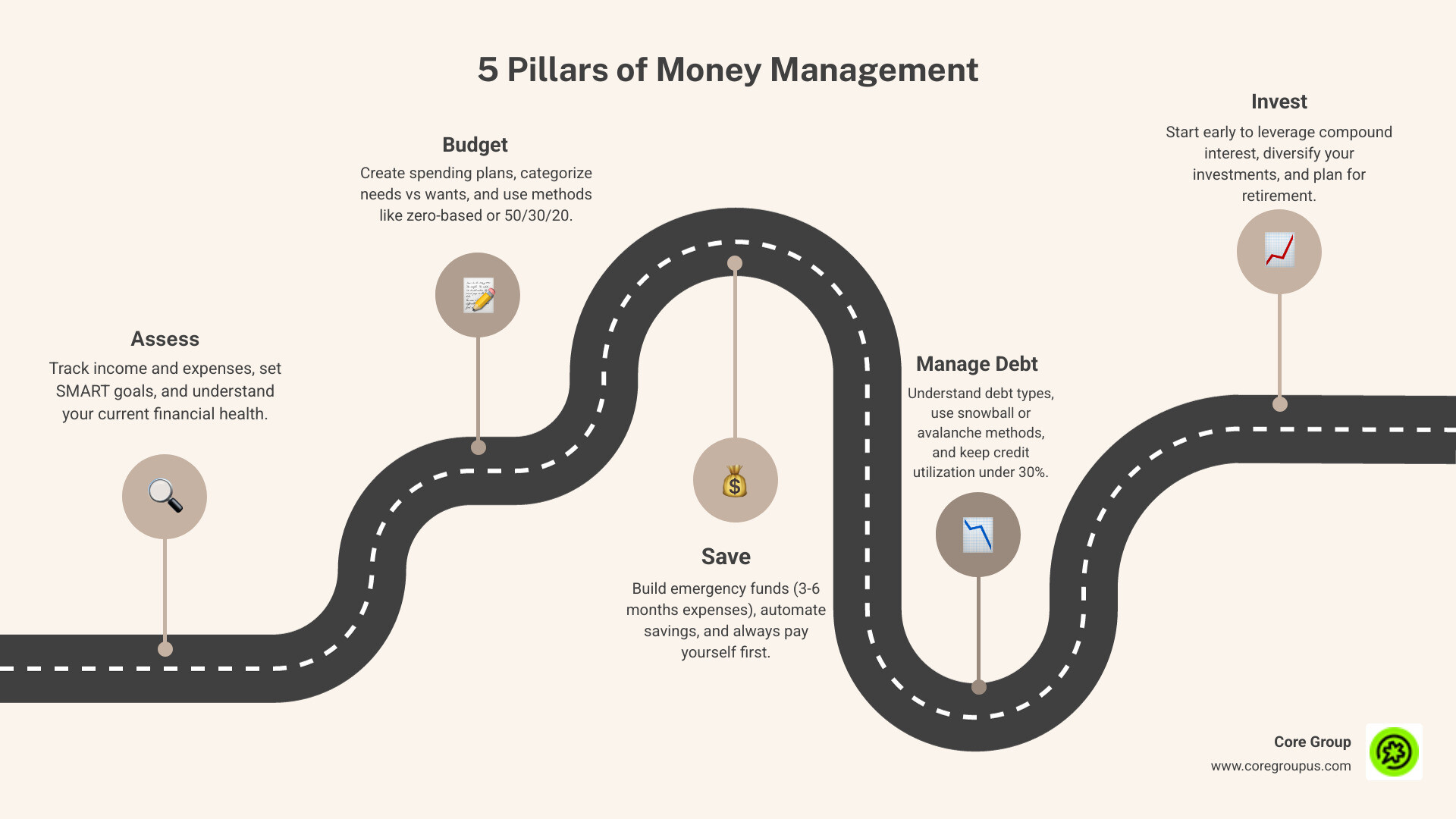
Laying the Foundation: Assess, Budget, and Save

Before we can make smart financial moves, we need a clear picture of our current financial landscape. This involves assessing our financial health, setting clear goals, and then building a robust budget to guide our spending and saving.
Assess Your Financial Health and Set Goals
The first fundamental principle of money management tips is knowing where you stand. Our financial well-being is unique to us and is determined by factors that tell a larger story about our relationship to money, not just our income or net worth. It’s about having control over daily finances, a cushion for shocks, and the ability to meet goals.
To start, we recommend taking inventory of your income and expenses. What are you earning (after taxes) from all your creative endeavors, side gigs, or other sources? Use an Income Tracker to get a complete picture of where your money comes from. Next, track where your money goes. This can be the heaviest lift, but logging your spending so you get a realistic picture of what your money, on an average month, is going to is crucial. Our Spending Tracker can help you both log and sort your spending by categories like utilities, housing, and even eating out.
Once you understand your cash flow, it's time to set financial goals. Whether it's saving for new equipment, a down payment on a home, or retirement, having an end goal provides motivation. Break down your financial goals so that they’re Specific, Measurable, Achievable, Relevant, and Time-bound (SMART). While dreams tend to be aspirational and often vague, setting actionable SMART goals can help you reach your dreams. You can use tools like the CFPB's guide to Break down your financial goals.
Understanding your paycheck is also a key step. Your paycheck explained helps you know how much your employer pays you, what deductions are taken out, and why. This clarity helps in managing your money more effectively and ensures you're aware of all your income sources.
Essential money management tips for creating a budget
Budgeting is the cornerstone of effective money management tips. It's our financial blueprint, designing a plan to allocate our resources to balance income and expenses. A budget helps ensure we have enough money for the things we need and want, while still building savings for future goals.
For creative entrepreneurs with variable income, budgeting might seem challenging, but it's even more critical. We can use past income averages and project conservative estimates. Our Budget Worksheet pulls everything together so you have a working and realistic budget.
One popular method is a zero-based budget. A zero-based budget is one that provides every dollar a name and specific function before it ever comes in for the month. This means every dollar is allocated to an expense, savings, or debt repayment, making sure no money is unaccounted for. This philosophy encourages making short-term sacrifices for long-term financial freedom and aligns perfectly with zero-based budgeting.
Another common budgeting rule is the 50/30/20 method: 50% of your income goes to needs, 30% to wants, and 20% to savings and debt repayment. This brings us to a vital distinction: differentiating between needs and wants. Needs are essential for survival (housing, food, utilities), while wants are discretionary (dining out, entertainment, subscriptions). For instance, 56% of Americans eat out three times a week. Do you need to eat out that often? Do you need that gourmet cup of coffee in the morning? Tracking your spending helps you notice if you're spending on needs or wants. By shifting "want money" into saving or investing, we can accelerate our financial growth.
A budget is a living document. We should regularly review and adjust it as our financial circumstances change. If there are certain weeks when money is especially tight, we can contact creditors and utility companies and request new due dates that better align with our income.
Building Your Financial Safety Net: Savings and Emergency Funds
Once we have a budget, the next crucial step in our money management tips journey is building a financial safety net through savings and an emergency fund. The "pay yourself first" strategy is one of the best ways to get your savings to grow. This means making saving a non-negotiable expense in your budget, allocating a certain amount to savings before anything else. U.S. consumers save 4.3% of their income on average, but we encourage our clients to aim higher if possible. You can set your own personal savings rule to live by and make a plan on how to achieve it.
An emergency fund is paramount. It's a dedicated savings account designed to cover unexpected expenses like medical bills, car repairs, or job loss. We recommend aiming for at least three to six months' worth of living expenses in this fund. Start by saving a few hundred dollars to create a buffer, and then gradually build it up. High-yield savings accounts can be beneficial here, offering annual percentage yields (APYs) of 4% and up, compared to an average of 0.42% for traditional savings accounts.
Automating savings is a powerful strategy. By setting up automatic transfers from your checking account to your savings account each payday, you ensure consistent contributions without relying on willpower. Consider also using "sinking funds" for specific savings goals, like a new camera, software, or a down payment on a home. This helps prevent dipping into your emergency fund for planned, but larger, expenses.
Mastering Debt and Credit for Financial Freedom
Managing debt and building strong credit are indispensable money management tips for long-term financial freedom. Debt isn't inherently bad, but understanding its types and how to manage it responsibly is key.
Effective Strategies for Managing and Paying Off Debt
We differentiate between "good debt" and "bad debt." Good debt, like a mortgage or student loan for a valuable education, can help build assets or increase earning potential. Bad debt, typically high-interest consumer debt like credit cards, can quickly spiral out of control. Understanding the difference between What is the Difference Between Short-Term and Long-Term Debt? is also important for strategic repayment.
For high-interest debt, effective repayment strategies are crucial. Two popular methods are the debt snowball and debt avalanche. The debt snowball involves paying off the smallest debts first for motivational wins, while the debt avalanche prioritizes debts with the highest interest rates to save the most money over time. As financial advisors, we often recommend the avalanche method for its mathematical efficiency, but acknowledge the psychological benefits of the snowball for some. We've even discussed some of the pros and cons of popular debt repayment philosophies in our blog posts, which you can explore in Part 1 and Part 2 of our series.
Debt consolidation can also be an option, where multiple debts are combined into a single loan, often with a lower interest rate. For example, consolidating high-interest debts into a lower-interest home equity line of credit (HELOC) can simplify payments and potentially save on interest. However, always evaluate the terms and fees.
Prepaying loans, especially mortgages, can save a significant amount of interest and shorten the loan term. For instance, if you take out a $120,000 mortgage at a 4.5 percent interest rate, making just one extra mortgage payment per year can cut years off the loan and save tens of thousands in interest.
Student loan repayment is another critical area. Experts recommend that educational loan payments represent no more than 10 to 15 percent of income. It's important to understand the potential consequences of not paying student loans, which can include damaged credit, wage garnishment, and even loss of professional licenses. Fortunately, various repayment options are available, including income-driven plans, deferment, and forbearance, which can offer flexibility during financial hardship.
A general rule of thumb for managing debt is the 20-10 Rule: limit the amount you borrow to less than 20% of your annual net income and limit monthly payments to less than 10% of your monthly net income.
Build a Strong Credit History
Your credit score is a vital component of your financial health, impacting everything from loan approvals to insurance rates. Building a strong credit history is one of the most important money management tips we can offer. The most important factor in your credit score is your payment history; 97 percent of Americans pay their bills on time. We recommend setting up automatic bill pay when you can, and scheduling time once a month to pay bills to alleviate the hassle.
Another key factor is your credit utilization ratio, which is the amount of credit you're using compared to your total available credit. We advise keeping this ratio below 30% of available credit; those with the highest credit scores tend to keep it under 10%. For example, if you have a credit card with a $10,000 limit, try to keep your balance below $3,000.
Responsible credit card usage is essential. Credit cards are loans, and if not paid in full, they accrue interest, often at high APRs (average 22.16% for credit cards vs. 11.48% for personal loans). Understand the differences between debit cards and credit cards. Debit cards draw directly from your checking account and don't build credit, while credit cards can help build credit if used responsibly. Use credit cards for convenience and rewards, but always pay your statement balance in full and on time.
Finally, regularly reviewing your credit report is crucial. You can get a free credit report from each of the three consumer credit bureaus—Experian, TransUnion, and Equifax—at AnnualCreditReport.com. Check for errors or signs of identity fraud, which we will discuss later.
Advanced Money Management Tips for Long-Term Growth

Once we've established a solid foundation of budgeting, saving, and debt management, we can turn our attention to advanced money management tips for long-term wealth creation. This involves investing and planning strategically for retirement.
Start Investing to Build Wealth
Investing is how we make our money work for us, allowing it to grow over time. Many creative entrepreneurs face common barriers to investing, such as a perceived lack of sufficient savings (65%) or income (64%), as cited by Generation Z adults ages 18-25 in a FINRA Foundation study. However, 56% of Gen Z adults already own some kind of investment, proving that investing is more accessible than ever. The journey to financial epiphany can transform intimidating concepts into empowering actions, helping creatives overcome these barriers. We've explored this in our blog posts like The Journey to Financial Epiphany and From Intimidated to Empowered: A Creative's Guide to Financial Epiphanies.
Diversification is a key principle of investing. It means spreading your investments across different asset classes (like stocks, bonds, and mutual funds) to reduce risk. This way, if one investment performs poorly, others might perform well, balancing your overall portfolio.
For creative entrepreneurs, understanding various business structures can also impact investment strategies. Whether you're a sole proprietor, LLC, or S-Corp, these structures have different tax implications and opportunities for investment. We have resources like Should Creative Entrepreneurs Become an S-Corp? and The Essential Guide to S-Corporations that can provide further guidance.
Understanding your risk tolerance is crucial. Some creatives might prefer lower-risk investments, while others are comfortable with higher potential returns balanced by higher risk.
Plan for Retirement Early
Time is the most important variable in retirement investing, thanks to the power of compound interest. Compound interest is essentially interest earned upon interest. It can work in your favor by exponentially growing your savings or work against you by increasing your debt. If you invest $1,000 at a 10% annual return, it grows to $7,328 in 20 years, but $53,700 in 40 years. That's the magic of compounding! You can explore this further with a Compound interest calculator.
The best ways to start retirement planning include utilizing tax-advantaged accounts like 401(k)s and IRAs.
- 401(k)s: Often employer-sponsored, contributions are typically pre-tax, reducing your current taxable income. Many employers offer matching contributions, which is essentially "free money" for your retirement.
- IRAs: Individual Retirement Accounts (Traditional or Roth) are self-directed. Traditional IRA contributions can be tax-deductible, while Roth IRA contributions are made with after-tax money but grow tax-free and withdrawals in retirement are also tax-free.
For creative entrepreneurs who might not have access to an employer-sponsored 401(k), IRAs are an excellent option. We also have resources like Do 401(k) Contributions Reduce MAGI? to help you understand the tax implications of these accounts.
It's also important to plan for healthcare costs in retirement. Healthcare is a significant expense for retirees. Consider options like Health Savings Accounts (HSAs) and Flexible Spending Accounts (FSAs) while working. If eligible, saving money in an HSA or FSA can help you save on health care costs. Contributions are made pre-tax, reducing your taxable income. HSA funds roll over year-to-year and can even be invested, unlike most FSAs which are "use-it-or-lose-it." An HSA can be a powerful tool for long-term healthcare savings.
Smart Spending and Lifestyle Choices for Creatives
Beyond the big financial strategies, everyday choices significantly impact our financial health. These money management tips focus on smart spending and lifestyle decisions.
Practical money management tips for everyday expenses
One of the most effective money management tips is to plug spending leaks. These are small, often unnoticed expenses that add up over time. This includes re-evaluating dining out habits (remember, 56% of Americans eat out three times a week!), cutting unnecessary subscriptions, and curbing impulse buys. Track your spending closely for several months, and you’ll start to see places where you can make adjustments and move money into savings.
Transportation costs can be a major drain. Consider carpooling, public transport, or biking. If you own a car, regular maintenance can prevent costly repairs, and shopping around for insurance can yield savings.
Curbing technology expenses is also important. As creatives, we often need the latest tools, but carefully assess needs versus wants. Can a refurbished model suffice? Are there free or cheaper alternatives to expensive software? Mindful housing selection also plays a huge role in financial well-being. Weighing the costs and benefits of renting versus owning, or living with roommates, can significantly impact your budget. For creative entrepreneurs using a home office, understanding the Tax Implications When You Sell Your House With a Home Office is a valuable insight.
Protecting Your Finances and Finding Professional Guidance
Protecting your hard-earned money from identity fraud is a critical money management tip. Identity fraud can happen through phishing scams, data breaches, or stolen personal information. Students are particularly vulnerable and often the least likely to detect identity fraud themselves. We recommend regularly monitoring your bank and credit card statements for suspicious activity, shredding sensitive documents, and being cautious about sharing personal information online. If you suspect identity fraud, act quickly to report it to your bank, credit bureaus, and the police.
Leveraging bank technology for managing finances offers numerous benefits. Online banking, mobile apps, and automatic alerts can help you monitor activity, pay bills on time, and track your spending effortlessly. This makes managing your checking account responsibly and monitoring its activity much easier.
Finding the right healthcare coverage that fits your needs and budget is another crucial decision. Explore options through your family's plan, school-provided plans, or the healthcare marketplace. Understanding your options can save you significant money and stress.
For students, earning extra money through a job while studying can provide valuable income, practical experience, and reduce reliance on loans. Many colleges offer on-campus jobs with flexible hours.
Finally, don't hesitate to seek guidance on financial matters. Resources are available, including financial advisors, credit counselors, and educational workshops. For creative entrepreneurs, specialized guidance in accounting and tax planning is invaluable. We provide dedicated Accounting Resources, Tax Planning Resources, and even Payroll Resources to help you steer the unique financial landscape of your business.
Frequently Asked Questions about Money Management
What is the best first step to improve my finances?
The best first step is to assess your current financial situation. This means tracking your income using an Income Tracker and carefully logging your spending with a Spending Tracker. Gaining awareness of where your money comes from and where it goes is foundational. Once you have this clear picture, you can create a simple budget to guide your spending and saving, which is a great first step toward healthier money habits.
How much should I have in an emergency fund?
We recommend having at least three to six months of essential living expenses saved in an emergency fund. This fund acts as a crucial financial buffer for unexpected events like job loss, medical emergencies, or significant equipment failure for creatives. Start small, perhaps with a few hundred dollars, and build it up consistently. Store it in a high-yield savings account where it's accessible but separate from your everyday spending.
Is it better to pay off debt or start investing?
This often depends on the interest rates of your debt. If you have high-interest debt, such as credit card balances with APRs upwards of 20%, prioritizing paying off that debt is generally more beneficial. The guaranteed return from eliminating high-interest debt often outweighs the potential returns from investing. However, if your debt has low interest rates (e.g., some mortgages or student loans), and especially if you receive an employer match on a 401(k), it can be wise to invest enough to get the match while also making consistent payments on your debt. A balanced approach, addressing high-interest debt aggressively while making some investment contributions, is often the most prudent strategy.
Conclusion: Take Command of Your Creative and Financial Future
Financial empowerment for creative entrepreneurs isn't just a dream; it's an achievable reality. By implementing these money management tips—from assessing your financial health and building a smart budget, to mastering debt, investing wisely, and making conscious spending choices—you can build a robust financial foundation. Consistency is key; small, consistent actions over time lead to significant long-term success.
At Core Group, we understand the unique financial landscape of creative entrepreneurs. Our "no-fluff, profit-first playbook" is designed to give you peace of mind and save you time, allowing you to focus on what you do best: your creative work. We're here to help you steer the complexities of financial management, ensuring your business thrives and your personal finances support your dreams.
Ready to take command of your financial future? Learn more about who we help and find how our expertise can transform your financial well-being.