Say Goodbye to Full Deductions Under the New 2026 Gambling Tax Law
What the New Gambling Tax Law 2026 Means for Your Wallet
The new gambling tax law 2026 changes something that millions of bettors have relied on for years, specifically the ability to fully offset gambling winnings with losses.
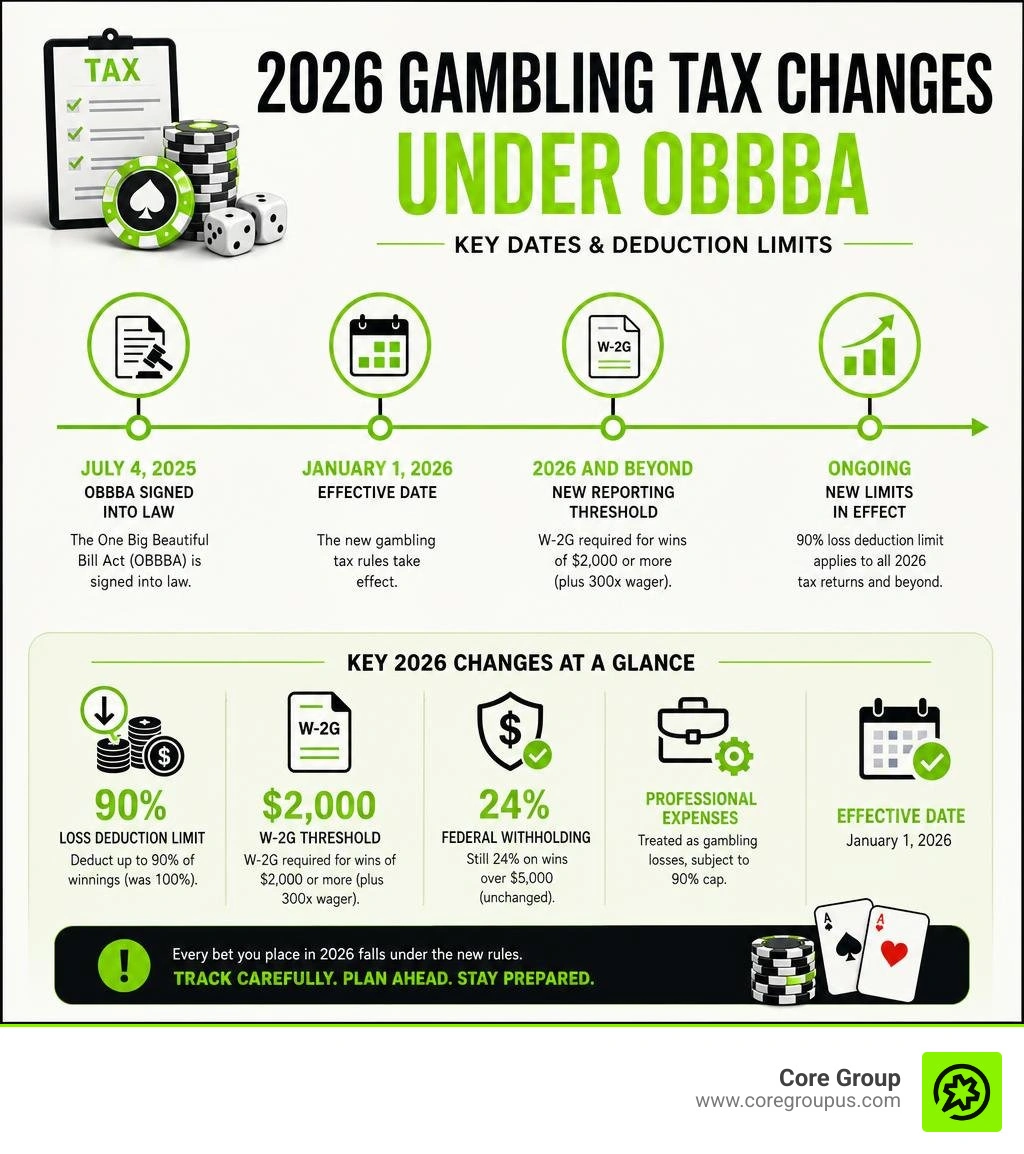
Here is a quick summary of the key changes now in effect
| What Changed | Old Rule | New Rule (2026) |
|---|---|---|
| Gambling loss deduction limit | 100% of winnings | 90% of winnings |
| Sports betting W-2G threshold | $600 | $2,000 (plus 300x wager) |
| Federal withholding on wins over $5,000 | 24% | 24% (unchanged) |
| Professional gambling expenses | Fully deductible on Schedule C | Treated as gambling losses, subject to 90% cap |
| Effective date | Prior to 2026 | January 1, 2026 |
These changes come from the One Big Beautiful Bill Act (OBBBA), signed into law on July 4, 2025. The rules took effect on January 1, 2026, meaning every bet you place this year falls under the new limits.
The impact is real and immediate. If you win $5,000 and lose $5,000, you no longer break even on your taxes. You can only deduct $4,500 of your losses, leaving $500 of taxable income even though you are not actually up a single dollar.
For creative entrepreneurs who gamble recreationally or professionally, this is the kind of tax shift that can quietly create a surprise bill at year-end if you are not tracking your activity carefully.
How the New Gambling Tax Law 2026 Limits Your Loss Deductions
For decades, the basic math of gambling taxes was straightforward. If you itemized your deductions, you could subtract your documented losses directly from your winnings up to the total amount you won. If you had a rough year and lost more than you won, you could not write off the net loss against your salary, but you could at least wipe out the tax burden on your winnings.
That system is officially gone. Under the One Big Beautiful Bill Act, the federal government has capped the deductibility of gambling losses at ninety percent of your total winnings. This change represents a major shift in how the government views wagering income and it introduces a concept known as phantom income.
Phantom income is money that you are taxed on but never actually put into your pocket. Under the old rules, a break-even year resulted in zero net taxable income. Under the new law, breaking even is a taxable event.
Let we look at how this math works in practice.

If you are trying to understand how this affects your yearly tax filing, it helps to see the numbers side by side. We can look at how a typical year of wins and losses compares under the old system versus the new 2026 rules.
| Total Winnings | Total Losses | Deductible Losses (Old Rule) | Deductible Losses (New Rule) | Taxable Winnings (Old Rule) | Taxable Winnings (New Rule) |
|---|---|---|---|---|---|
| $5,000 | $5,000 | $5,000 | $4,500 | $0 | $500 |
| $10,000 | $12,500 | $10,000 | $9,000 | $0 | $1,000 |
| $50,000 | $50,000 | $50,000 | $45,000 | $0 | $5,000 |
| $100,000 | $95,000 | $95,000 | $85,500 | $5,000 | $14,500 |
As you can see, even when your losses exceed your total winnings, you are still left with taxable income. In the case of a gambler who wins $10,000 but loses $12,500, they cannot carry forward the extra $2,500 in losses to future years. Instead, they are forced to pay taxes on $1,000 of phantom winnings.
This change was heavily debated during the legislative process. You can read more about the political context and how this provision was designed to satisfy Senate procedural rules in this article on how the Tax break to change for gambling with Trump's 'Big, Beautiful Bill' .
For amateur gamblers, this means the financial stakes of recreational play have risen. If you want to understand the foundational rules of how wagering write-offs used to work, you can review our guide on Taxes on Gambling Losses.
The Rise of Phantom Income for Casual and Professional Bettors
The introduction of the ninety percent cap does not just affect casual slot players or weekend sports fans. It strikes a massive blow to professional gamblers who make their living on the casino floor or through online sportsbooks.
Professional gamblers historically reported their wagering activity on Schedule C as a business. This allowed them to deduct ordinary and necessary business expenses, including travel, lodging, meals, and tournament entry fees, directly from their business revenue.
Under the new gambling tax law 2026, the IRS has reclassified these professional business expenses. Travel, lodging, and other costs associated with professional play are now treated as gambling losses. Consequently, they are lumped together under the ninety percent deductibility cap.
Consider a professional poker player who travels the circuit. Over the course of the year, they win $250,000 in tournament payouts. However, they spend $50,000 on travel, hotel rooms, and meals, and they accumulate $200,000 in tournament buy-ins and losses.
In previous years, their $250,000 in total business expenses would fully offset their $250,000 in winnings, leaving them with zero dollars in taxable business income.
Under the 2026 rules, their entire $250,000 in combined losses and travel expenses is subject to the ninety percent cap. They can only deduct $225,000. This leaves them with $25,000 in taxable phantom income, despite walking away from the year with absolutely zero net profit.
For casual bettors, the situation is equally frustrating. Many casual players assume that they only need to report their net profit at the end of the year. In reality, the tax code requires you to report your gross winnings as income and then claim your losses as an itemized deduction. If you want to explore the mechanics of how this works, you can read our detailed breakdown on Gambling Losses Should Just Offset My Gambling Winnings Right.
New Reporting Thresholds and Withholding Rules for Sports Betting
With the rise of legalized mobile sports betting across the United States, the IRS has also updated its reporting thresholds to better capture digital wagers.

Starting in 2026, the minimum threshold for issuing a Form W-2G for sports betting winnings is $2,000, provided the winnings are at least 300 times the amount of the original wager. This is a significant increase from the previous $600 threshold, which casino operators and sportsbooks argued was outdated and administratively burdensome.
While the higher reporting threshold means you might receive fewer tax forms for smaller wins, it does not change your legal obligation to report all gambling income. Whether you receive a W-2G or not, the federal government expects you to list every dollar of winnings on your tax return.
The rules for federal tax withholding remain strict. If you secure a sports betting win of $5,000 or more, the betting platform or casino will automatically withhold twenty-four percent of your winnings for federal income taxes.
For example, if you hit a parlay on a mobile app that pays out $6,000 on a $10 bet, the platform will immediately withhold $1,440 and send it to the IRS. You will receive the remaining $4,560 along with a Form W-2G detailing the transaction.
When tax season arrives, you must report the full $6,000 as income. If you had $6,000 in documented losses throughout the year, you can only deduct $5,400 of those losses under the ninety percent cap. This means you will still owe taxes on $600 of that win, but you can use the $1,440 already withheld to cover your tax bill and potentially claim a refund for the excess withholding.
Essential Recordkeeping Strategies to Protect Your Deductions
Because the IRS is limiting your ability to deduct losses, keeping flawless records is more important than ever. If you get audited and cannot prove your losses, the IRS will disallow your deductions entirely, leaving you responsible for taxes on one hundred percent of your gross winnings.
To protect yourself, you must move away from relying solely on year-end win/loss statements provided by casinos. The IRS often views these statements as secondary evidence because they do not track every cash transaction or uncarded play.
Instead, you should maintain a real-time gambling diary. According to IRS Publication 529, your records should include the following information for every gambling session
- The date and time of your activity
- The specific location, such as the name of the casino or online platform
- The type of wager or game you played
- The names of any people who were with you at the time
- The exact amounts you won and lost
Different types of wagering require different supporting documents. For slot machines, you should record the machine number and keep a log of all payouts. For table games, note the table number and any credit card or buy-in records. For sports betting and lotteries, save your physical tickets, digital receipts, and bank statements.
If you are wondering whether these losses are worth the effort of tracking, you can read our analysis of whether Are Gambling Losses Itemized Deductions.
State Level Impacts and Global Policy Shifts in 2026
The changes to federal tax law are also rippling through state tax systems and international markets. Because many states base their income tax calculations on federal adjusted gross income, the federal cap on losses will automatically increase state tax liabilities for residents in those areas.
Some states are taking matters into their own hands. For instance, Colorado introduced HB25-1311 to address deductions for net sports betting proceeds. Other states maintain their own strict withholding rules. Massachusetts, Connecticut, and Ohio require state tax withholding on winnings as low as $600, which is much lower than the new federal $2,000 threshold for sports betting.
In Arkansas, state regulators are monitoring how the new rules affect high rollers, as a few big bettors can significantly impact state gaming tax revenues if they reduce their betting volume in response to the new tax penalties.
Meanwhile, across the Atlantic, the United Kingdom is executing its own massive overhaul of gambling taxation. Under the Finance Act 2026, the UK government is raising the Remote Gaming Duty from twenty-one percent to forty percent for accounting periods beginning on or after April 1, 2026. This dramatic increase is expected to raise over one billion pounds per year to support public finances.
Additionally, the UK will introduce a new twenty-five percent General Betting Duty rate for remote bets starting April 1, 2027, while completely abolishing the Bingo Duty on April 1, 2026. If you want to understand the policy reasons and administrative impacts behind these international shifts, you can read the official announcement on Gambling duty changes - GOV.UK .
Bipartisan Efforts and Industry Pushback to Repeal the Cap
The ninety percent deduction cap has faced intense backlash from the gaming industry, professional players, and sports executives. Many argue that the law penalizes legal, regulated betting and will drive recreational bettors back to illegal, offshore sportsbooks where taxes are ignored.
Prominent figures have stepped up to lobby against the law. UFC President Dana White sent a letter directly to President Trump, arguing that the ninety percent cap makes it financially irrational to bet in the United States. White pointed out that under this law, active bettors could easily end up with a tax bill that exceeds their actual net winnings for the year.
The political impact of this lobbying was felt immediately. On the Kalshi prediction market platform, the odds that the ninety percent gambling loss deduction cap would be repealed in 2026 jumped from twenty percent to thirty-seven percent shortly after White's letter became public, before settling around twenty-nine percent.
In Congress, lawmakers from states with major gaming economies are leading the charge for a legislative fix. Bipartisan efforts have emerged, including the My FAIR BET Act, championed by Representative Dina Titus of Nevada. This proposed legislation aims to restore the one hundred percent deduction for gambling losses and prevent the creation of phantom taxable income.
Until these repeal efforts succeed, however, the ninety percent cap remains the law of the land.
Frequently Asked Questions About the New Gambling Tax Law 2026
Navigating these new rules can be confusing. Here are answers to some of the most common questions we receive about the 2026 tax changes.
What is the new gambling tax law 2026 reporting threshold for sports betting
Starting in 2026, the minimum threshold for sports betting platforms to issue a Form W-2G is $2,000. However, this threshold only applies if the winnings are at least three hundred times the amount of the wager. This is an increase from the previous $600 limit, but you must still report all winnings on your tax return, even if you do not receive a W-2G.
How does the new gambling tax law 2026 affect professional gamblers
Professional gamblers who file using Schedule C must now treat business expenses, such as travel, lodging, and entry fees, as gambling losses. This means all of their business deductions are subject to the new ninety percent cap. Even if a professional breaks even on the year, they will owe income tax on ten percent of their gross winnings.
Can I still deduct my losses if I take the standard deduction
No. Amateur gamblers can only deduct gambling losses if they itemize their deductions on Schedule A. Because the standard deduction remains high, the vast majority of casual players do not itemize. If you take the standard deduction, you must report one hundred percent of your gambling winnings as taxable income, and you cannot deduct any of your losses.
Conclusion
The new gambling tax law 2026 represents a massive shift in how the IRS treats wagering income. By capping loss deductions at ninety percent and reclassifying professional business expenses, the One Big Beautiful Bill Act has made it essential for every bettor to practice meticulous recordkeeping.
At Core Group, we understand that managing taxes can feel like a distraction from your passion. We offer financial management, bookkeeping, and tax services specifically tailored for creative entrepreneurs. Our no-fluff, profit-first playbook is designed to guarantee peace of mind and save you time, allowing you to focus on growing your business. We even back our service with a MacBook Pro guarantee.
If you want to make sure your financial strategy is optimized for these new rules, you can read more about how the IRS handles IRS Gambling Deductions, or reach out to us today to see how we can help you keep more of your hard-earned money.