How to Put Profit First and Stop Feeding the Cash-Eating Monster
Why So Many Business Owners Feel Broke Even When Sales Are Strong
The Profit First book by Mike Michalowicz starts with a brutal truth that most business owners are one bad month away from collapse, even when revenue looks healthy on the outside.
Here is a quick overview of what the book covers and what you will learn from it
- What it is is a cash management system that guarantees profit by changing how you allocate money, not how much you make
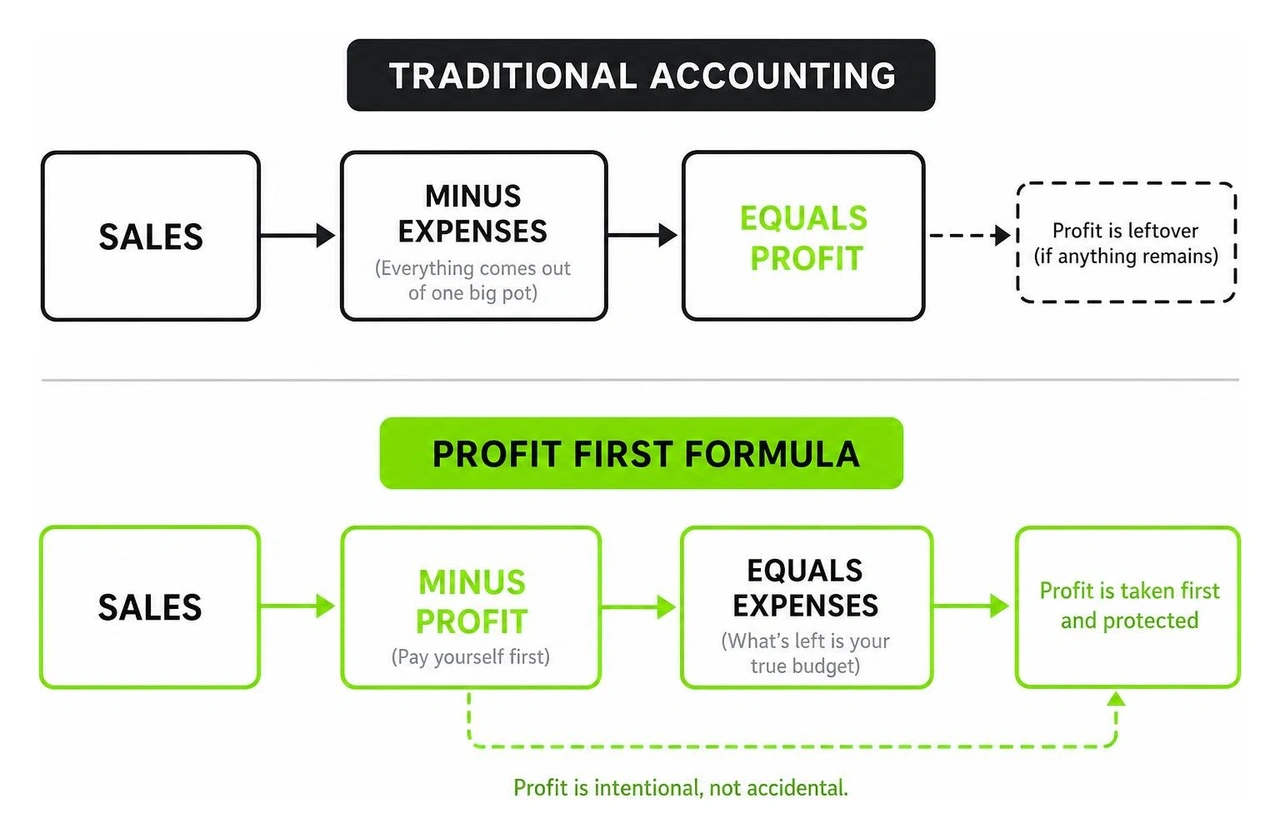
- The core formula is Sales minus Profit equals Expenses (instead of the traditional Sales minus Expenses equals Profit)
- How it works, where you split incoming revenue across multiple dedicated bank accounts before paying any bills
- Who it is for, including entrepreneurs, small business owners, freelancers, and creative professionals struggling with cash flow
- The main benefit is that you stop running your business on whatever is left over and start building real financial reserves
Think about the last time a big payment came in. Did it disappear faster than expected? That is exactly the problem this system is designed to fix.
The author, Mike Michalowicz, built and sold two multi-million dollar businesses before losing nearly everything. He eventually found himself on February 14, 2008, with only $10,000 left in the bank and $28,000 in taxes due. From that rock bottom, he developed a simple behavioral approach to cash management that has since been adopted by over one million companies worldwide.
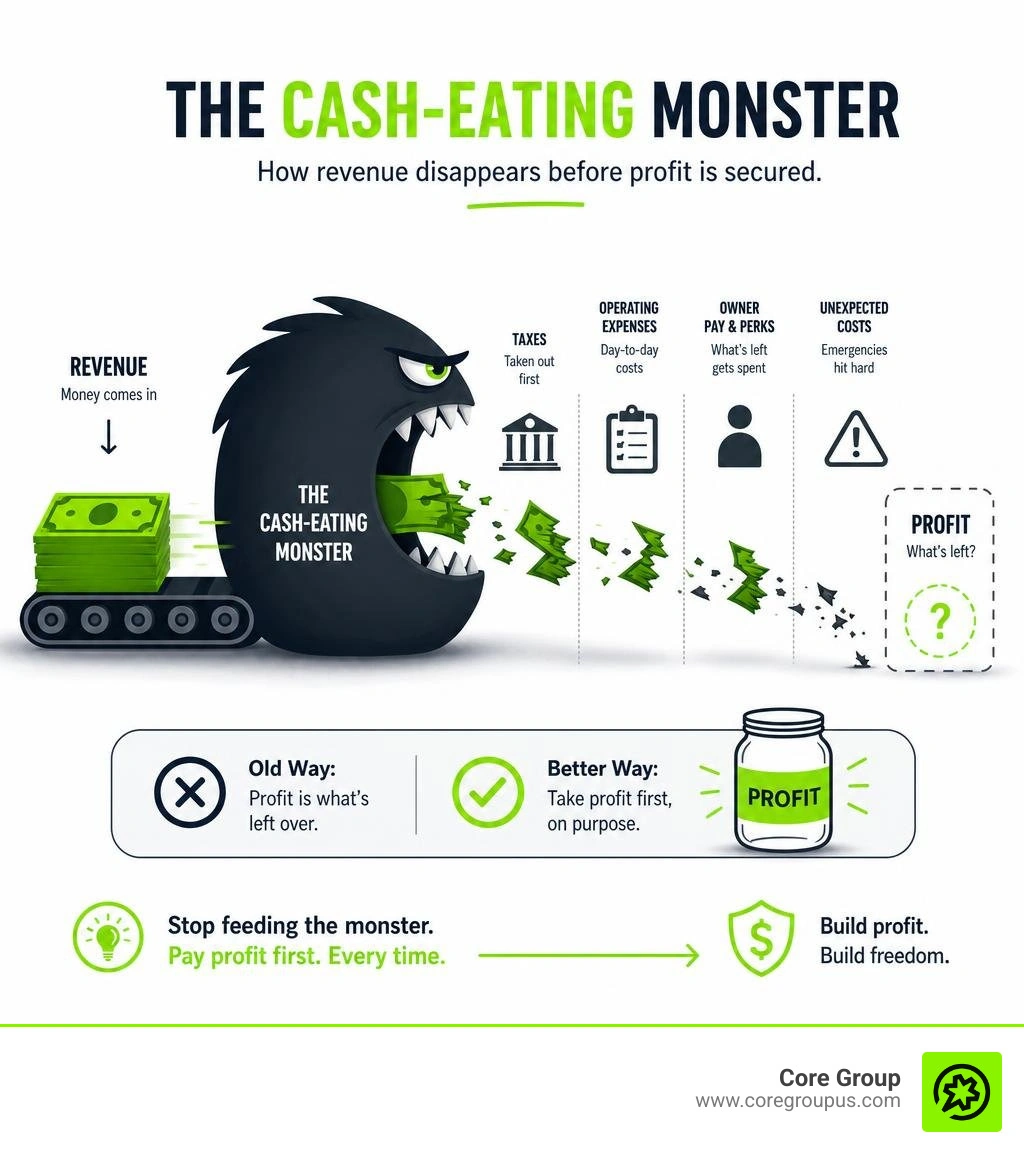
The big insight is that profit is not what is left after you pay your bills. It is what you take first, on purpose, every single time money comes in.
For creative entrepreneurs especially, this matters. You are brilliant at your craft. Financial systems, not so much. Profit First gives you a structure that works with your habits, not against them.
Learn more about the profit first book through these resources
The Core Philosophy of the Profit First Book
To understand why so many businesses struggle, we have to look at the psychology of how we handle money. Most business owners believe that if they just increase their sales, their financial problems will magically disappear. However, the profit first book reveals that growing your top line revenue without a proper system in place only builds a larger, hungrier cash eating monster.
At its heart, the system leverages behavioral psychology rather than cold, robotic logic. Traditional accounting is designed for rational spreadsheet models, but humans are emotional and driven by habits. When we see a large balance in our main bank account, we naturally feel wealthy and spend more.
The system utilizes Parkinson's Law to explain this behavior. This law states that our demand for a resource expands to match the supply of that resource. If you have a massive block of time to complete a project, you will take the entire time. If you have a single, large pool of cash in one bank account, your business expenses will naturally expand to consume every dollar available.
By restricting the amount of money available for operating expenses, we force ourselves to become more innovative, efficient, and frugal. You can learn more about this philosophy on the official Profit First website.
Flipping the Traditional Accounting Formula
The traditional accounting formula is taught in every business school and used by almost every certified public accountant. This formula states that Sales minus Expenses equals Profit. While this formula is mathematically logical, it is behaviorally flawed.
When profit is treated as the final leftover, it becomes an afterthought. Business owners spend money on rent, software, inventory, and team members, hoping that there will be something left over at the end of the month or year. Usually, there is not.
The profit first book flips this equation on its head. The new formula is Sales minus Profit equals Expenses.
Under this system, when revenue comes into your business, you immediately take a predetermined percentage as profit and move it to a safe, separate account. What remains is your true budget for operating expenses. If you cannot afford to pay your bills with what is left, it means your business is operating with too much overhead, and you must find ways to cut costs.
For a deeper dive into how this shifts your financial perspective, read our detailed What Is the Profit First Method Guide.
Core Takeaways from the Profit First Book
One of the most famous analogies in the book is the smaller plates weight loss strategy. If you want to eat less food, trying to use willpower while staring at a giant plate usually fails. Instead, if you serve your meals on smaller plates, you naturally eat smaller portions without feeling deprived.
In business finance, your bank accounts are your plates. If you keep all of your money in one massive account, you will serve yourself a giant portion of expenses. By splitting your money into smaller, dedicated bank accounts, you naturally limit your spending portions.
This behavioral hack is one of the reasons why the book is so highly rated by readers. You can read reviews and personal transformations from other business owners on Profit First on Goodreads.
Implementing this system shifts your focus from top line vanity metrics to bottom line sanity. A small, highly profitable business is worth significantly more to its owner than a large, complex business that generates millions in revenue but barely breaks even.
How the Profit First System Works in Practice
Implementing this system is not about changing your accounting software or firing your bookkeeper. It is about changing how you interact with your cash on a daily and weekly basis. Instead of logging into complex accounting dashboards, you manage your business by looking at your actual bank balances. This is what the author calls bank balance accounting.
Most business owners check their bank balances every morning to decide if they can afford a new purchase. The system works with this habit by ensuring that the balance you see in your operating expenses account is the actual amount you have permission to spend.

Setting Up the Five Foundational Bank Accounts
To make this system work, you must set up five foundational checking accounts at your bank. While having five accounts might make a traditional bookkeeper cringe initially, it is the only way to physically separate your money and remove temptation.
The five core accounts are listed below.
- Income Account, which is your primary receiving account. All revenue from sales, client payments, and deposits must land here first. You never pay bills or run payroll out of this account.
- Profit Account, which is your savings safety net. You transfer a set percentage from the Income account here. This money accumulates over time and is used for quarterly distributions to reward the business owner.
- Owner's Pay Account, which is used to pay your personal salary. Many entrepreneurs run successful businesses but fail to pay themselves a consistent wage. This account ensures you are compensated for your daily labor.
- Tax Account, which is used to save for your business and personal tax liabilities. When tax season arrives, you will have the funds sitting ready, eliminating the annual tax bill panic.
- Operating Expenses Account, which is your primary spending account. After you have allocated money to your Profit, Owner's Pay, and Tax accounts, the remaining cash is transferred here to pay for daily business costs.
To explore the mechanics of managing these accounts, check out our guide on the Profit First Method.
How to Transition Your Business Using the Profit First Book
You do not want to jump straight into aggressive allocation targets on day one. If your business is currently operating with 99 percent of its revenue going to expenses, trying to immediately take a 15 percent profit allocation will starve your business of cash and cause a crisis.
Instead, the profit first book recommends starting with an Instant Assessment to determine your Current Allocation Percentages (CAPs). This shows you exactly where your money is going right now.
Once you know your baseline, you establish your Target Allocation Percentages (TAPs), which are the ideal percentages your business should reach based on your revenue tier. You then transition slowly by adjusting your allocations by just one or two percent every quarter.
For example, you might start by allocating just 1 percent to Profit, 40 percent to Owner's Pay, 15 percent to Taxes, and 44 percent to Operating Expenses. Over time, you systematically increase your Profit and Owner's Pay percentages while forcing your Operating Expenses percentage down.
To find the right target percentages for your specific business size, refer to our breakdown of Profit First Percentages.
Benefits and Criticisms of the Cash Management Method
Like any financial system, this method has both passionate supporters and notable critics. Understanding both sides will help you determine how to best apply these principles to your creative business.

Improved Cash Flow and Reduced Financial Stress
The most immediate benefit of implementing this system is the eradication of entrepreneurial stress. When you build cash reserves, you no longer have to worry about how you will cover payroll or pay your quarterly taxes.
The statistics surrounding the system are highly encouraging. Over 175,000 companies have successfully implemented these concepts, and the book ranks number one in Financial Accounting on Amazon with over 9,600 global ratings.
Real world case studies show incredible results.
- One business owner reported moving their company from break even to profitable within a single month of setting up the accounts.
- Another entrepreneur implemented the system across two businesses and increased overall profits by 21 percent.
- A business owner set aside nearly $50,000 in profit within just ten months of starting the method.
- A business successfully paid off $200,000 in debt by utilizing the disciplined allocation structure.
By forcing yourself to operate within the constraints of your Operating Expenses account, you naturally identify and eliminate wasteful subscriptions, unnecessary services, and inefficient processes.
Common Drawbacks and the Crash Diet Analogy
Despite its popularity, some financial professionals warn against using the system blindly. One of the main criticisms is that the system can sometimes act like a temporary crash diet. If a business owner sets up the accounts but lacks the long term discipline to maintain the transfers, they will quickly slide back into old spending habits.
Other potential drawbacks include the following.
- Administrative Overhead, where managing five or more bank accounts can be tedious and can lead to increased banking fees if you do not use a modern, business friendly banking platform.
- Growth Constraints, because aggressively limiting operating expenses might starve a high growth startup of the capital it needs to scale, hire key talent, or invest in research and development.
- Triage vs. Strategy, as some financial advisors point out that while the system is an excellent cash flow triage tool, it does not replace traditional financial analysis. It will not tell you why a specific product line is unprofitable or how to price your creative services for maximum margin.
For some businesses, a modified version with fewer accounts might be more sustainable in the long run.
Frequently Asked Questions
Understanding how this cash management system fits into the broader financial landscape can help you make the right decisions for your company.
Who is the Profit First system designed for
The system is primarily designed for small business owners, bootstrapped startups, freelancers, and creative entrepreneurs who struggle with cash flow discipline. It is particularly helpful for founders who manage their businesses by checking their bank balances rather than reading complex balance sheets.
It may not be suitable for venture backed startups that prioritize rapid scale over immediate profitability, or businesses with extremely thin margins and highly complex inventory requirements.
How does Profit First differ from traditional accounting
Traditional accounting focuses on compliance, tax reporting, and historical performance. It relies on accrual methods that can make a business look highly profitable on paper even when the bank account is completely empty.
The system outlined in the profit first book is a cash flow management tool that works alongside traditional accounting. It focuses on real time cash availability and behavioral psychology, ensuring that cash is physically set aside for profit and taxes before it can be spent on operational costs.
What tools and professionals can help with implementation
To implement this system successfully, you can use modern digital banking platforms that allow you to open multiple checking accounts without monthly fees or minimum balances. Many of these platforms even let you set up automated transfer rules to handle your allocations on the 10th and 25th of every month.
You can also read the UK edition of the book for regional perspectives through Profit First by Mike Michalowicz | Orion - Bringing You News From Our World To Yours.
Working with a certified financial professional who understands the system can save you time, keep you accountable, and help you customize the allocation percentages to fit your unique business model.
Conclusion
Putting your profit first is not just a financial strategy; it is a mindset shift that transforms you from a stressed business owner into a confident leader. By working with your natural behavioral habits instead of fighting them, you can build a business that serves your life rather than consuming it.
At Core Group, we specialize in helping creative entrepreneurs implement a tailored, profit first playbook that guarantees peace of mind and saves you time. We handle the numbers so you can focus on your creative genius, all backed by our MacBook Pro guarantee.
Ready to take control of your cash flow and build a permanently profitable business? Explore our Core Group accounting resources today and let us help you stop feeding the cash eating monster.