Meeting Essential S Corp Requirements and Deadlines
Why S Corp Eligibility Requirements Matter for Your Creative Business

S corp eligibility requirements are the specific rules set by the IRS that determine whether your business can elect S corporation tax status. Understanding these requirements is crucial because choosing the right business structure can save you thousands in taxes annually—but only if you qualify.
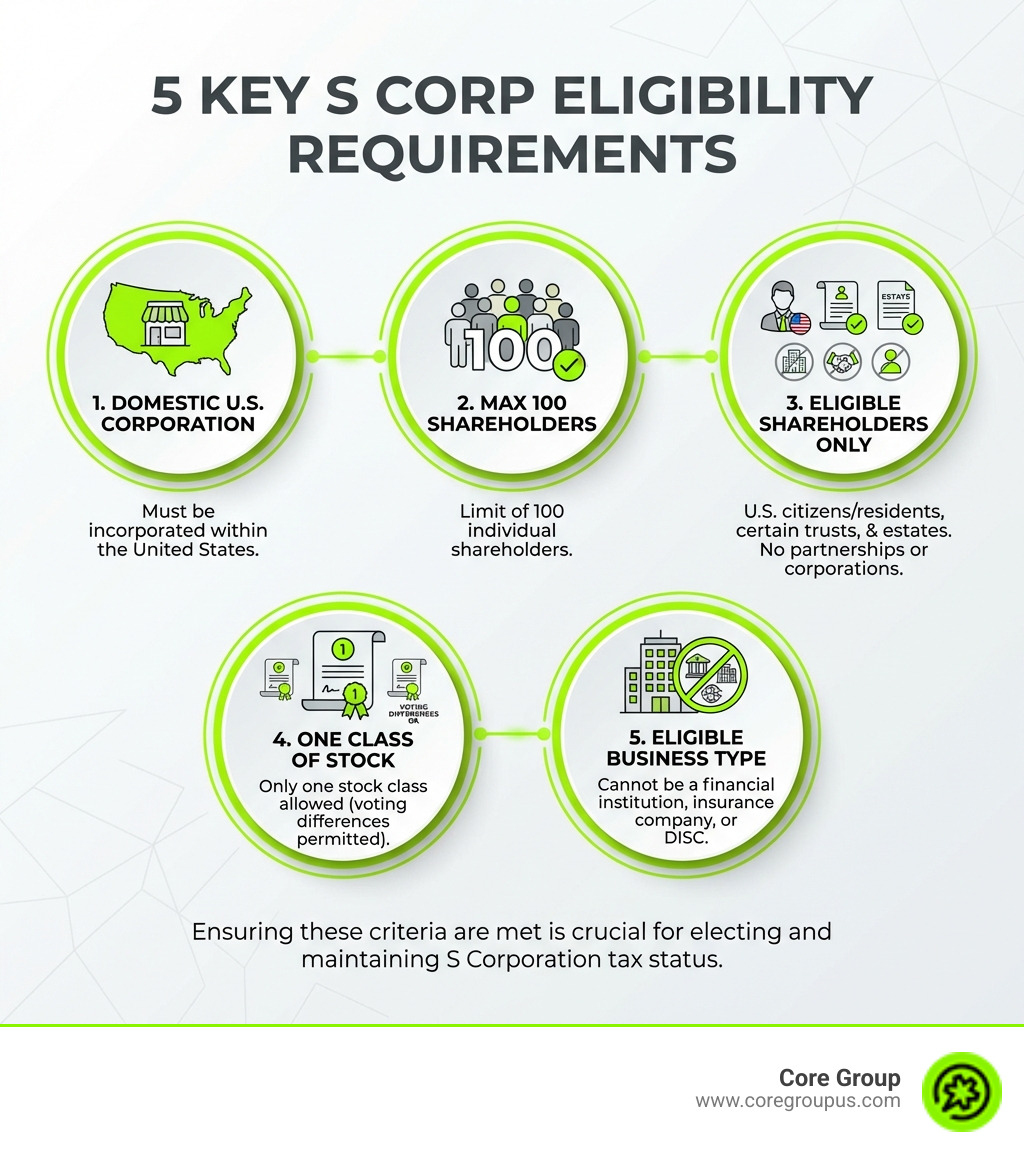
The 5 Core S Corp Eligibility Requirements:
- Domestic Corporation - Your business must be incorporated in the United States
- 100 Shareholders or Fewer - No more than 100 individual shareholders allowed
- Eligible Shareholders Only - Only U.S. citizens, residents, certain trusts, and estates (no partnerships, corporations, or nonresident aliens)
- One Class of Stock - Only one class of stock permitted (though voting rights can differ)
- Eligible Business Type - Cannot be a financial institution, insurance company, or domestic international sales corporation (DISC)
As a creative entrepreneur juggling film projects or media productions, you're probably drawn to the tax savings potential of an S corp. The structure allows you to split your income between salary and distributions, potentially reducing your self-employment tax burden. But here's the catch: the IRS has strict rules about who qualifies.
Unlike a standard LLC or sole proprietorship, an S corporation isn't a business structure—it's a tax election. This means you form a corporation or LLC first, then elect to be taxed as an S corp by filing Form 2553 with the IRS. But you can only make this election if you meet all the eligibility requirements.
The good news? Most small creative businesses naturally qualify. The bad news? One wrong shareholder or missing deadline can disqualify you entirely, triggering unexpected tax consequences and IRS scrutiny.
Whether you're a solo filmmaker considering incorporation or a growing production company with multiple partners, understanding these requirements is your first step toward making an informed decision. For more foundational guidance, check out The Essential Guide to S Corporations from Core Group.
What is an S Corporation? A Primer for Creatives
Let's start with the basics. What exactly is an S corporation, and why might a creative entrepreneur like you be interested in it? At its heart, an S corporation isn't a separate legal entity like an LLC or a C corporation; it's a special tax designation. Think of it as a "pass-through" entity. This means that for federal tax purposes, the business itself generally doesn't pay income taxes. Instead, the company's profits, losses, deductions, and credits "pass through" directly to the owners' personal tax returns.
This pass-through taxation is a game-changer, especially for avoiding the dreaded "double taxation" that C corporations face. In a C corp, the business pays taxes on its profits, and then shareholders pay taxes again on any dividends they receive. With an S corp, the income is taxed only once, at the shareholder level. This can lead to significant tax savings, which for creative businesses, means more money to invest back into your craft or your team.
As an S corp shareholder, you're responsible for paying individual income taxes on your share of the business's income, regardless of whether you actually take that money out of the business. This is where the concept of "shareholder tax responsibility" comes in. You report your share of the S corp's financial activity on your personal tax return (Form 1040/1040-SR) via a Schedule K-1.
Beyond the tax benefits, an S corp also provides limited liability protection, similar to a C corp or an LLC. This means your personal assets are generally protected from business debts and lawsuits, a comforting thought in the unpredictable world of creative ventures.
One of the most appealing aspects for many creative entrepreneurs is the potential for self-employment tax savings. If you're a sole proprietor or an LLC taxed as a partnership, all your business profits are subject to self-employment taxes (Social Security and Medicare), which can be as high as 15.3%. In an S corp, if you actively work in the business, you must pay yourself a "reasonable salary" as an employee. This salary is subject to payroll taxes. However, any additional profits distributed to you as a shareholder are generally not subject to self-employment taxes. This distinction between "reasonable salary" and "distributions" is key to maximizing your tax efficiency. Our Accounting services can help you steer this balance effectively.
For creative entrepreneurs, this structure can offer a powerful blend of personal asset protection and tax efficiency. However, these benefits come with strict S corp eligibility requirements and ongoing compliance duties, which we'll dive into next.
The Core S Corp Eligibility Requirements
Meeting the S corp eligibility requirements is non-negotiable if you want to enjoy the tax benefits of this structure. The IRS has a clear set of rules your creative business must meet.

First and foremost, your business must be a domestic corporation. This means it must be incorporated in the United States under the laws of a U.S. state.
The IRS calls an eligible S corp a "small business corporation." This refers not to revenue but to its structural and ownership limitations. These limitations are detailed in the IRS guidelines and are designed for closely held businesses.
Let's break down these crucial requirements.
Shareholder Rules: A Key S Corp Eligibility Requirement
The rules around who can own a piece of your S corp are among the most stringent.
- 100 Shareholder Limit: Your S corp can have no more than 100 shareholders. This limit is designed to keep S corps closely held. For this limit, all members of a family (a common ancestor, their lineal descendants, and spouses) can be treated as a single shareholder. This helps family-run creative businesses.
- US Citizens or Residents: All shareholders must be U.S. citizens or permanent residents. Nonresident aliens are strictly prohibited from being direct shareholders. If you plan to have international investors who aren't U.S. residents, an S corp is not an option.
Allowable Shareholders: The IRS is very particular about who can hold stock in an S corp.
- Individuals: Shareholders are typically individuals.
- Certain Trusts: Not all trusts qualify, but several types do, including:
- Grantor Trusts: Where the creator is treated as the owner for tax purposes.
- Qualified Subchapter S Trusts (QSSTs): A trust distributing all income to a single beneficiary who elects to be treated as the S corp stock owner.
- Electing Small Business Trusts (ESBTs): A trust with multiple beneficiaries, where the trust itself is taxed on the S corp income.
- Testamentary Trusts: Trusts created by a will, holding stock for a limited time (typically two years).
- Voting Trusts: Trusts created solely to exercise stock voting rights.
- IRA Trusts: Certain IRA trusts holding bank stock (a niche rule).
- Estates: The estate of a deceased shareholder or an individual in bankruptcy can also be a shareholder.
- Certain Exempt Organizations: Specific tax-exempt organizations (like those under Section 401(a) or 501(c)(3) of the IRC) can be shareholders.
Prohibited Shareholders: It's also crucial to know who cannot be a shareholder.
- Partnerships: General partnerships, limited partnerships, or limited liability partnerships cannot be S corp shareholders.
- Corporations: C corporations or other S corporations generally cannot be shareholders.
- Nonresident Aliens: As mentioned, individuals who are not U.S. citizens or residents are ineligible.
Here's a quick reference list of eligible versus ineligible shareholder types:
Eligible S Corp Shareholder Types:
- Individuals (U.S. citizens or residents)
- Estates (including estates of individuals in bankruptcy)
- Grantor Trusts
- Qualified Subchapter S Trusts (QSSTs)
- Electing Small Business Trusts (ESBTs)
- Testamentary Trusts (for a limited period)
- Voting Trusts
- Certain Exempt Organizations (e.g., 501(c)(3) public charities)
Ineligible S Corp Shareholder Types:
- Nonresident Aliens
- C Corporations
- Partnerships (including LLCs taxed as partnerships)
- Most other types of Trusts (unless specifically permitted)
- Other S Corporations (except for Qualified Subchapter S Subsidiaries, which are treated differently)
Stock & Business Type: Final S Corp Eligibility Requirements
Beyond shareholder rules, the IRS has strict guidelines for your company's stock structure and business type.
- Single Class of Stock: An S corp can only have one class of stock. This means all shares must have identical rights to distribution and liquidation proceeds. However, differences in voting rights are permitted and do not create a second class of stock. So, you can have voting and non-voting shares, which is useful for maintaining control while bringing in non-voting investors. This can impact raising capital from investors who often require multiple stock classes. Debt must be structured carefully to avoid being reclassified as a second stock class; "straight debt" safe harbor rules provide guidance.
- Ineligible Corporations: Not every business type can be an S corp. Certain "ineligible corporations" are excluded from electing S corp status, including:
- Financial institutions that use the reserve method of accounting for bad debts.
- Insurance companies subject to tax under Subchapter L of the Internal Revenue Code.
- Domestic International Sales Corporations (DISCs) or former DISCs.
For a deep dive into the legal definitions, you can refer to the source: 26 USC 1361 - S corporation defined. Knowing these foundational rules is essential for compliance.
Electing S Corp Status: The Process and Deadlines
So, you've reviewed the S corp eligibility requirements, and your creative business looks like a perfect fit. Fantastic! Now, let's talk about how you actually make the election. It's not automatic; you need to tell the IRS you want to be taxed as an S corp.
The first step, if you haven't already, is to form a corporation or an LLC with your state. S corp is a tax election, not a legal entity structure. So, you'll first incorporate as a C corp or form an LLC with your state's Secretary of State (or equivalent office). This involves tasks like selecting a unique business name, preparing and filing articles of incorporation (for a corporation) or articles of organization (for an LLC), and obtaining an Employer Identification Number (EIN) from the IRS.
Once your legal entity is established, the next crucial step is filing Form 2553, "Election by a Small Business Corporation," with the IRS. This is the official document that informs the IRS of your desire to be treated as an S corp.
A critical part of filing Form 2553 is obtaining shareholder consent. All shareholders must consent to the S corp election. This means every individual, trust, or estate that owns stock in your company must sign Form 2553, agreeing to the S corp status. This ensures that everyone is on board with the tax implications.
Now, for the part that often causes the most headaches: election deadlines. The IRS is quite particular about when you can file Form 2553.
- To be effective for the current tax year, you must file Form 2553 either:
- During the preceding taxable year (meaning, at any time in the year before the one you want the election to take effect).
- On or before the 15th day of the third month of the taxable year for which the election is to take effect. For a calendar year corporation (which most small businesses are), this typically means by March 15th.
For instance, if you want your S corp election to be effective for the 2024 tax year, you would need to file Form 2553 by March 15, 2024. If you miss this deadline, your election generally won't take effect until the next tax year.

What if you miss the deadline? Don't panic just yet! The IRS does provide some late election relief under certain circumstances. If you can demonstrate "reasonable cause" for missing the deadline and you act quickly to correct the oversight, the IRS may grant you an extension. However, it's always best to avoid this situation by planning ahead.
Understanding these deadlines is paramount, especially for creative entrepreneurs who might be focused on their next project rather than their tax forms. Making a timely and correct election ensures your business can reap the benefits of S corp status without any unexpected surprises. For more insights on whether this election is right for your creative business, explore our blog post: Should Creative Entrepreneurs Become an S Corp.
S Corp vs. Other Structures: A Comparative Look
Choosing the right business structure is crucial; each has its strengths and weaknesses. When considering S corp eligibility requirements, it's helpful to see how this tax designation stacks up against other common business structures: C corporations and Limited Liability Companies (LLCs). This comparison highlights the S corp's pros and cons regarding taxation, ownership, and flexibility.
| Feature | S Corporation | C Corporation | Limited Liability Company (LLC) |
|---|---|---|---|
| Taxation | Pass-through (no corporate tax); shareholders pay individual income tax; potential self-employment tax savings on distributions. | Double taxation (corporate tax + shareholder dividend tax). | Pass-through (default); members pay individual income tax; can elect C corp or S corp tax status. |
| Eligibility/Formation | Must first be a C corp or LLC; strict S corp eligibility requirements (100 shareholders max, US citizens/residents, one class of stock, etc.). | Formed by filing Articles of Incorporation with the state; no federal eligibility restrictions. | Formed by filing Articles of Organization with the state; few federal eligibility restrictions. |
| Ownership Restrictions | Max 100 shareholders; no partnerships, corporations, or nonresident aliens as shareholders; only one class of stock. | Unlimited shareholders; any entity can be a shareholder; multiple classes of stock allowed. | Unlimited members; any entity can be a member; no residency restrictions (default). |
| Management Flexibility | More structured (board of directors, officers, corporate formalities required). | Highly structured (board of directors, officers, corporate formalities required). | Highly flexible (member-managed or manager-managed; can tailor operating agreement). |
| Profit/Loss Allocation | Allocated strictly by ownership percentage (due to one class of stock rule). | Allocated by stock class and ownership (e.g., preferred vs. common stock). | Highly flexible; can allocate profits/losses disproportionately to ownership percentages (default partnership taxation). |
| Liability Protection | Limited liability for shareholders. | Limited liability for shareholders. | Limited liability for members. |
| Fringe Benefits | Taxable for 2%+ owner-employees. | Tax-deductible for employees (including owners). | Generally not tax-deductible for owners (unless taxed as C corp). |
| Capital Raising | Limited (due to shareholder/stock restrictions). | Very flexible (multiple stock classes appeal to investors). | Flexible (can bring in investors, but equity types may be complex). |
Let's dig into some key differences and potential disadvantages:
- Taxation Differences: While both S corps and LLCs (by default) offer pass-through taxation, the key distinction is often self-employment taxes. For an LLC owner, all business income is subject to self-employment tax. For an S corp owner who actively works in the business, only the "reasonable salary" portion is subject to payroll taxes. Distributions beyond that salary are generally free from self-employment tax. This is a significant advantage for profitable creative businesses. Our Payroll services can help manage this complex area.
- Ownership Restrictions: The tight S corp eligibility requirements regarding shareholders (max 100, US citizens/residents, no corporations/partnerships) are a major differentiator. C corps have no such limits, making them ideal for seeking venture capital or going public. LLCs are also more flexible, allowing foreign investors and various entities as members.
- Management Flexibility & Profit/Loss Allocation: LLCs are known for their flexibility. Their operating agreements can be customized to allow disproportionate allocation of profits and losses. S corps, due to the one-class-of-stock rule, must allocate profits and losses strictly by stock ownership. This lack of flexibility is a disadvantage if partners with different contributions want disproportionate compensation. C corps, with multiple stock classes, offer more flexibility here.
- Formation and Ongoing Expenses: S corps can offer tax savings but often have higher administrative costs. You'll need to maintain corporate formalities (like annual meetings), and the tax preparation (Form 1120-S) is more complex than for an LLC. These ongoing expenses can deter very small creative businesses.
- IRS Scrutiny: S corps, particularly regarding the "reasonable compensation" of owner-employees, attract closer IRS scrutiny. The IRS ensures owners don't take an unreasonably low salary to avoid payroll taxes.
- Taxable Fringe Benefits: For employee-shareholders owning more than 2% of an S corp, many fringe benefits (like health insurance premiums) are considered taxable income. In a C corp, these benefits are generally tax-deductible for the corporation and non-taxable to the employee.
Understanding these trade-offs is crucial. The S corp's rigid structure, ownership limitations, and administrative burden might make an LLC or C corp a better fit, depending on your long-term goals for growth, capital raising, and international expansion.
Staying Compliant: The IRS's Role and Ongoing Duties
After making the S corp election, your journey with the IRS is just beginning. The IRS plays a continuous role in overseeing S corporations, and maintaining your status requires diligence and adherence to ongoing duties.
The IRS closely monitors S corps, especially regarding the characterization of income and expenses. As mentioned, the "reasonable compensation" rule for owner-employees is a common area of IRS scrutiny. Your salary must be commensurate with your responsibilities and industry standards. Failure to do so can lead to the IRS reclassifying distributions as wages, resulting in back taxes and penalties.
To maintain your S corp status, you'll have several ongoing requirements:
- Annual Tax Return (Form 1120-S): An S corp must file its own informational tax return, Form 1120-S, "U.S. Income Tax Return for an S Corporation." This form reports the corporation's financials, but the S corp itself generally doesn't pay tax. If your S corp files 10 or more returns annually, e-filing of Form 1120-S is required.
- Schedule K-1s for Shareholders: Along with Form 1120-S, the S corp must issue a Schedule K-1s to each shareholder. This document details each shareholder's share of the corporation's financials, which they report on their personal tax returns.
- Payroll Tax Filings: If you or other shareholders receive a salary, the S corp must manage payroll taxes, filing forms like Form 941 (Employer's Quarterly Federal Tax Return) and Form 940 (Employer's Annual Federal Unemployment (FUTA) Tax Return).
- State-Level Compliance: Remember state compliance. Your state may have its own S corp recognition and filing requirements. Some states, like California, may impose an annual franchise tax on S corporations. Always check your specific state's rules.
- Maintaining Eligibility: You must continuously meet all the initial S corp eligibility requirements. This means:
- Keeping your shareholder count at 100 or fewer.
- Ensuring all shareholders remain eligible.
- Maintaining only one class of stock.
- Not becoming an ineligible corporation.
Failing to meet these requirements can lead to serious consequences of termination. If your S corp ceases to be a "small business corporation," your S election can be terminated.
When an S corp election terminates, you enter an S termination year. This year is split into an "S short year" and a "C short year." This creates complex tax calculations and may subject your business to corporate-level taxes.
If your S corp status is terminated, you generally cannot re-elect S corp status for five years without IRS consent. This is a significant setback, making proactive compliance the best strategy. The IRS has provisions for "inadvertent terminations," but relying on this relief is risky.
For creative businesses, understanding these ongoing duties is crucial. Compliance ensures you enjoy the tax benefits without the stress of IRS audits or unexpected tax liabilities.
Conclusion
Navigating S corp eligibility requirements might seem daunting, but for many creative entrepreneurs, the benefits can be well worth the effort. We've explored what an S corporation is, its unique tax advantages, and the strict rules the IRS imposes on its formation and maintenance.
To recap, the core requirements for a successful S corp election boil down to:
- Being a domestic corporation.
- Having no more than 100 shareholders.
- Ensuring all shareholders are eligible (U.S. citizens/residents, certain trusts, estates).
- Maintaining only one class of stock.
- Operating as an eligible business type.
Meeting these marks allows your creative business to enjoy pass-through taxation, avoid double taxation, and potentially reduce your self-employment tax burden—all while benefiting from limited liability protection. However, the journey doesn't end with the election. Continuous compliance, timely filings, and adherence to the rules are paramount to avoid IRS scrutiny and maintain your S corp status.
At Core Group, we understand the unique financial landscapes of creative entrepreneurs. Our expertise is in helping you steer these complexities, ensuring peace of mind so you can focus on your artistic vision. We believe in a "no-fluff, profit-first playbook" that simplifies financial management and empowers you to make informed decisions.
Don't let the intricacies of tax law overshadow your creative potential. For more insights and resources custom to creative entrepreneurs, check out The Planner Blog.
Ready to optimize your business structure and tax strategy? Take control of your business finances with expert tax planning from Core Group. We're here to help your creative venture thrive.