Safe Harbor 401(k) Overview: Your IRS-Approved Guide
Why Safe Harbor 401(k) Plans Matter for Small Business Owners

A safe harbor 401(k) is a retirement plan that eliminates complex IRS nondiscrimination testing in exchange for mandatory employer contributions. It's designed to make retirement benefits simpler for small businesses while helping all employees—including owners—maximize their retirement savings.
If you are a creative entrepreneur running a lean team, you may have bumped into the limits of a traditional 401(k). Maybe your plan failed testing, you had to refund contributions to yourself or other highly paid team members, or your payroll provider gave you a confusing compliance report at year-end. Safe harbor is the IRS-approved shortcut that removes most of that friction.
Quick Answer: What You Need to Know
- What it is: A 401(k) plan that skips annual IRS compliance testing by making required employer contributions.
- Main benefit: Business owners and highly compensated employees can contribute the full IRS limit without restrictions.
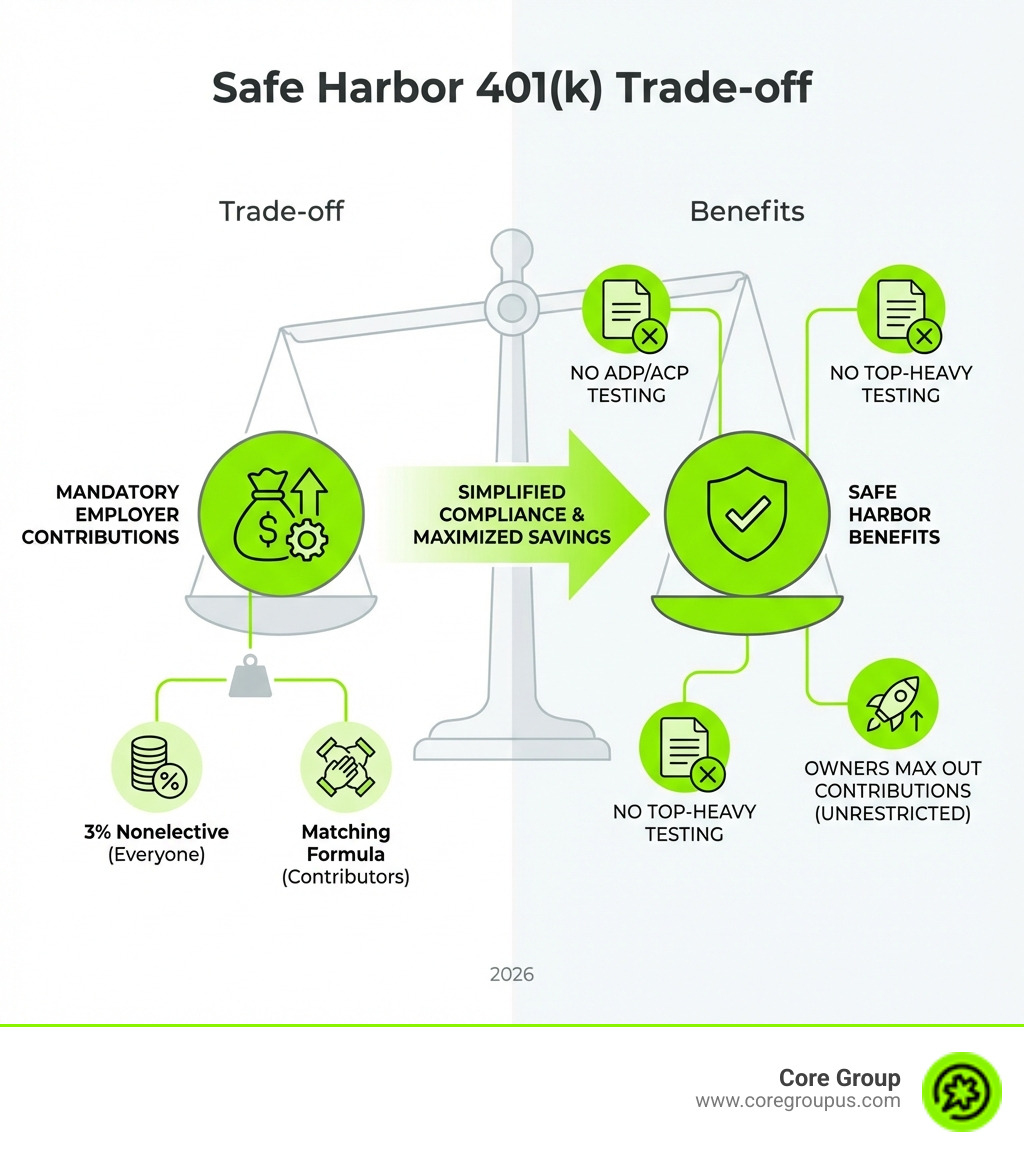
- The trade-off: Employers must contribute either 3% of pay to all eligible employees OR match employee contributions using a specific formula.
- Vesting: Employer contributions are typically 100% vested immediately.
- Best for: Small businesses where owners want to maximize their own retirement savings and avoid administrative headaches.
For busy creative entrepreneurs, navigating IRS rules for a traditional 401(k) is a major headache. These plans require annual testing to ensure highly paid employees aren't benefiting disproportionately. If your plan fails, you could face costly corrections and contribution refunds.
A safe harbor 401(k) eliminates this risk. By committing to a specific employer contribution, the IRS exempts your plan from these complex tests. This allows you and your key employees to save aggressively for retirement without worrying about compliance failures.
Because the rules are clear and the contribution formulas are standardized, safe harbor plans also pair well with a profit-first approach. You can build the required employer contributions into your fixed monthly expenses, just like software subscriptions or studio rent, instead of wondering if you will owe an unpredictable true-up later.
On top of that, offering a clearly structured 401(k) with guaranteed employer contributions can be a powerful recruiting tool. Many creative professionals compare benefits packages—especially remote workers who can choose among agencies, studios, and freelance-friendly firms in states like California, New York, Texas, or Washington. A safe harbor 401(k) signals that you are serious about financial wellness, not just paychecks.
In the rest of this guide, you will see how safe harbor 401(k)s work, how they compare to other plan types, and how they fit into a streamlined, no-fluff financial system for your business.
What is a Safe Harbor 401(k) Plan and How Does It Work?
A safe harbor 401(k) plan is a special type of 401(k) that lets you bypass complex annual IRS nondiscrimination tests (like the ADP and ACP tests). These tests are designed to ensure retirement plans don't unfairly favor Highly Compensated Employees (HCEs). By meeting specific employer contribution requirements, your plan is automatically deemed to pass these tests. This is a huge advantage for business owners who want to maximize their own contributions without worrying about year-end compliance issues. In short, you make guaranteed contributions to your employees' accounts, and in return, you get simplified plan administration.
For creative businesses that operate in multiple states, this simplicity matters even more. Whether your team is spread across California, New York, Texas, or working remotely from smaller markets like Idaho or Maine, one consistent safe harbor design can keep your plan compliant across the board. Your payroll and bookkeeping stay cleaner because the rules for contributions are uniform and predictable every pay period.
Safe Harbor Contribution Formulas Explained
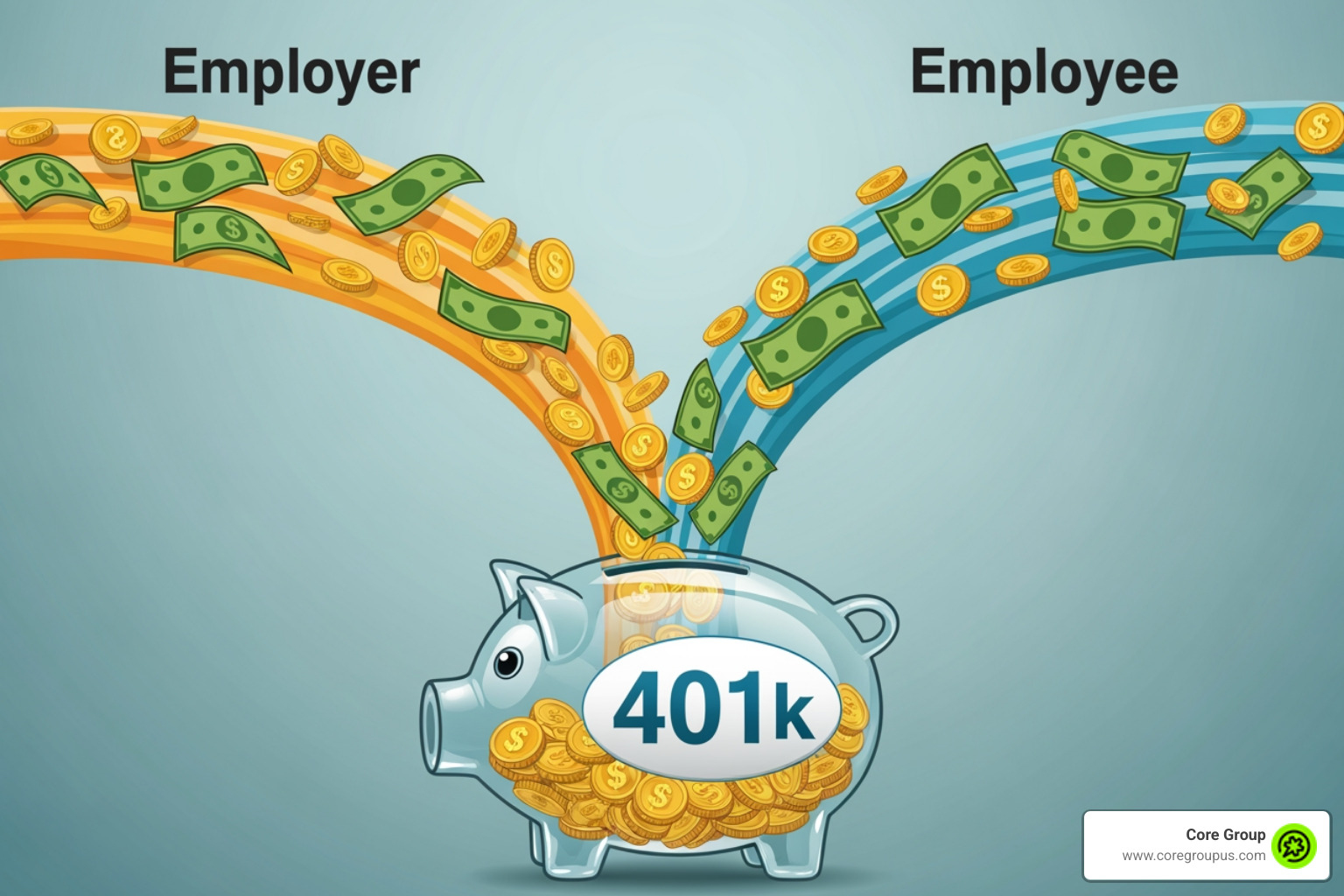
The core of a safe harbor plan is its mandatory employer contribution, which must be 100% immediately vested. You can choose from one of these formulas:
- Basic Match: The employer matches 100% of an employee's contributions on the first 3% of their pay, plus 50% on the next 2%. If an employee contributes 5% of their pay, the employer contributes 4%.
- Improved Match: A more generous formula, such as the employer matching 100% of employee contributions up to 4% of their pay. It must be at least as generous as the basic match.
- Non-Elective Contribution: The employer contributes at least 3% of compensation to all eligible employees, whether they contribute to the plan or not. This is often the simplest option to administer.
From a planning standpoint, many owners like the 3% non-elective contribution because it is straightforward to forecast. You can run scenarios in your budgeting tool or with your accountant: if payroll is $400,000 for the year, your safe harbor cost will be at least $12,000. For agencies or studios with more variable payroll—due to project-based contractors transitioning to full-time, for example—the matching formulas can feel more flexible because they scale with actual employee deferrals.
If you want to dive into the exact legal requirements, they are laid out in 26 CFR § 1.401(k)-3 - Safe harbor requirements.-3)
Understanding Vesting in a Safe Harbor 401(k)
One of the best features for employees is that these mandatory safe harbor contributions are 100% immediately vested. This means the money belongs to the employee as soon as it's deposited into their account. They can take it with them if they leave the company, which is a powerful incentive and a great way to build trust with your team. You can learn more about general vesting rules from the IRS vesting schedules.
Immediate vesting also makes your bookkeeping clearer. There is no need to track separate unvested balances or deal with forfeiture accounts for the safe harbor portion of contributions. What you fund is fully earned, which aligns neatly with a transparent, profit-first philosophy—money you commit to your team is truly theirs.
What is a Qualified Automatic Contribution Arrangement (QACA)?
A QACA is a type of safe harbor plan that includes an automatic enrollment feature. Employees are automatically enrolled unless they opt out. In exchange for boosting participation this way, the employer contribution formula is slightly different, and contributions are subject to a 2-year cliff vesting schedule. This means an employee must complete two years of service to be 100% vested in the employer's contributions.
QACAs also specify default contribution rates that start at a minimum percentage of pay (for example, 3%) and automatically increase over time until they reach a higher target rate. This "auto-escalation" helps employees build savings without constantly revisiting their deferral elections.
For many small businesses, especially those using modern payroll platforms, automatic enrollment and escalation are easy to implement and align with the SECURE Act's push to expand retirement coverage. The SECURE Act and later improvements introduced incentives for small employers that adopt automatic enrollment features, which can help offset some of the initial setup and administration costs.
When paired with thoughtful communication and clear onboarding materials, a QACA safe harbor design can dramatically increase participation rates and help your team build long-term wealth with very little ongoing friction.
The Dual Benefits: A Win for Employers and Employees
A safe harbor 401(k) is a strategic tool that benefits both your business and your team. It fosters financial well-being and strengthens your company culture, creating a win-win where employees feel valued and your business gains a more engaged workforce.
For creative firms that rely on specialized talent—designers, videographers, writers, developers—a strong retirement plan can be the difference between keeping an A-player and watching them leave for a larger agency with richer benefits. Safe harbor contributions are easy to explain and easy to see on a pay stub or account statement, which makes the benefit feel tangible.

Key Benefits of a Safe Harbor 401(k) for Employers
For business owners, the primary appeal is simplified compliance and peace of mind.
- Avoids Nondiscrimination Testing: Automatically passes the annual ADP/ACP tests, which means no risk of failing and having to make costly corrections.
- Bypasses Top-Heavy Testing: Safe harbor plans are generally deemed to pass top-heavy testing, another complex compliance hurdle for small businesses.
- Maximizes Owner Contributions: Owners and other Highly Compensated Employees (HCEs) can contribute the maximum amount to their own 401(k)s without restriction.
- Simplified Administration: Eliminating complex testing reduces administrative burdens, costs, and paperwork.
- Tax-Deductible Contributions: Employer contributions are generally tax-deductible, helping to offset the cost of the plan. For more on integrating this into your financial strategy, see our Accounting services.
When you fold a safe harbor 401(k) into a broader financial system—bookkeeping, payroll, and tax planning working together—you gain additional clarity. You can:
- Forecast retirement plan costs in your annual budget.
- Align safe harbor contributions with quarterly estimated tax planning.
- Coordinate with your entity structure (for example, S-corporation owner salaries) to intentionally target retirement savings goals.
This level of integration is what turns a 401(k) from a box to check into a core part of your long-term wealth plan as an owner.
How Employees Win with a Safe Harbor Plan
Employees also see significant, tangible advantages from a safe harbor plan.
- Guaranteed Employer Contribution: Employees receive a guaranteed contribution from their employer every year, providing a consistent boost to their retirement savings.
- Immediate Vesting: Employer contributions are typically 100% vested immediately (excluding QACAs), meaning the money is theirs to keep, even if they leave the company.
- Faster Savings Growth: The combination of their own deferrals and the guaranteed employer contribution helps employees build their retirement nest egg more quickly.
- Tax-Deferred Growth: All contributions and earnings grow tax-deferred, maximizing the power of compounding. Learn more about how contributions can lower your taxable income here: Do 401k Contributions Reduce MAGI.
Many creative workers are freelancers or have bounced between gigs in different states like California, Georgia, or Colorado before landing on your team. A safe harbor 401(k) with immediate vesting gives them confidence that they are not "starting over" with every job—they can roll prior accounts into your plan and know that new employer contributions are fully theirs.
Are There Any Disadvantages?
While powerful, safe harbor plans have a few trade-offs to consider:
- Mandatory Expense: The employer contribution is a required, fixed expense that must be budgeted for annually, regardless of company profitability.
- Fixed Commitment: You are generally committed to the contribution formula for the entire plan year, offering less flexibility than a traditional 401(k).
- Notice Requirements: Plans with a matching formula require an annual notice to be sent to all eligible employees.
From a practical standpoint, the biggest question is cash flow. You will want to work with your accountant or advisor to run projections and confirm that your business model can comfortably support the required contributions in both busy and slow seasons. For many owners, the trade-off is still worth it: predictable contributions in exchange for maximizing their own retirement savings and eliminating surprise compliance issues.
Safe Harbor vs. Other 401(k) Plans
Choosing the right retirement plan can be complex. Here’s a simplified comparison of the most common 401(k) options for small businesses to help you understand the key differences.
| Feature | Safe Harbor 401(k) | Traditional 401(k) | SIMPLE 401(k) |
|---|---|---|---|
| Best For | Businesses wanting to maximize owner contributions and avoid compliance tests. | Larger companies or those with predictable employee participation. | Businesses under 100 employees seeking a very simple, low-cost plan. |
| IRS Testing | No. Automatically passes key nondiscrimination tests. | Yes. Requires annual ADP/ACP and top-heavy testing. | No. Automatically passes nondiscrimination tests. |
| Employer Contribution | Mandatory. Requires a specific match or a 3% non-elective contribution to all eligible employees. | Discretionary. Employer contributions (like matching or profit sharing) are optional. | Mandatory. Requires either a match up to 3% or a 2% non-elective contribution. |
| Employee Contribution Limit | High (Same as Traditional 401(k)) | High (Set annually by the IRS) | Lower than Traditional/Safe Harbor 401(k)s. |
| Vesting | 100% Immediate for safe harbor contributions (or 2-year cliff for QACA plans). | Flexible. Employer contributions can have a vesting schedule up to 6 years. | 100% Immediate for all contributions. |
For a lean creative business, the choice usually comes down to Safe Harbor 401(k vs. Traditional 401(k) or SIMPLE 401(k):
- A Traditional 401(k)** can work well if your team has broad participation and your ownership group is not pushing the limits on contributions. You get more flexibility on employer contributions, but you also inherit more testing and potential corrections.
- A SIMPLE 401(k)** lives up to its name: easy to administer, but with lower employee contribution limits and less design flexibility. It can be a good starter option for very small teams where owners are not yet focused on maxing out retirement savings.
- A Safe Harbor 401(k)** sits in the middle: more powerful than SIMPLE, but still streamlined from a compliance perspective, especially when paired with supportive bookkeeping and payroll systems.
No matter which route you choose, coordination with your tax strategy is essential. Contribution limits, employer match formulas, and plan design all affect your taxable income as an owner and the overall profitability of your business. Integrating your retirement plan choice with your accounting, tax planning, and payroll processes helps ensure the plan supports your long-term goals instead of creating surprise headaches later on.