Understanding Short-Term Business Finance
Why Short-Term Financing Matters for Creative Entrepreneurs
Short term financing is a business loan or line of credit with a repayment term of one year or less, designed to cover immediate liquidity needs and operational expenses. It's the financial sprint that keeps your creative business moving when cash flow doesn't match your production schedule.
Quick Answer: What is Short-Term Financing?
- Definition: Financial resources obtained with repayment due within 12 months or less
- Common Types: Trade credit, bank loans, lines of credit, invoice factoring, commercial paper
- Primary Use: Cover immediate expenses like payroll, supplier payments, equipment, or project costs
- Speed: Approvals often completed within one business day (up to 39% of small business loans)
- Cost Trade-off: Higher interest rates than long-term loans, but faster access to funds
If you're a filmmaker waiting on production payments, a designer bridging the gap between client invoices, or a media professional managing seasonal cash crunches, you've likely faced this challenge: your expenses arrive before your revenue does.
This is where short-term financing becomes your financial superpower.
Unlike long-term financing that supports major capital investments—think buying a building or launching a five-year expansion—short-term financing addresses the immediate operational needs that keep creative businesses alive. It's the difference between missing a critical deadline because you can't pay your crew, and delivering on time because you had the cash flow to execute.
The stakes are real. Your creative vision doesn't pause for slow-paying clients. Your talent expects timely payment. Your suppliers need to be paid on schedule. Short-term financing bridges these gaps, providing the operational flexibility that creative entrepreneurs need to focus on their craft instead of scrambling for cash.
In this guide, we'll walk through everything you need to know: what short-term financing actually is, the different types available, when it makes sense for your creative business, and how to use it strategically without falling into common traps. Whether you're considering invoice factoring to open up payment for completed work or exploring a line of credit for seasonal production needs, you'll get clear, practical guidance to make informed decisions.
What is Short-Term Financing? A Tale of Two Timelines
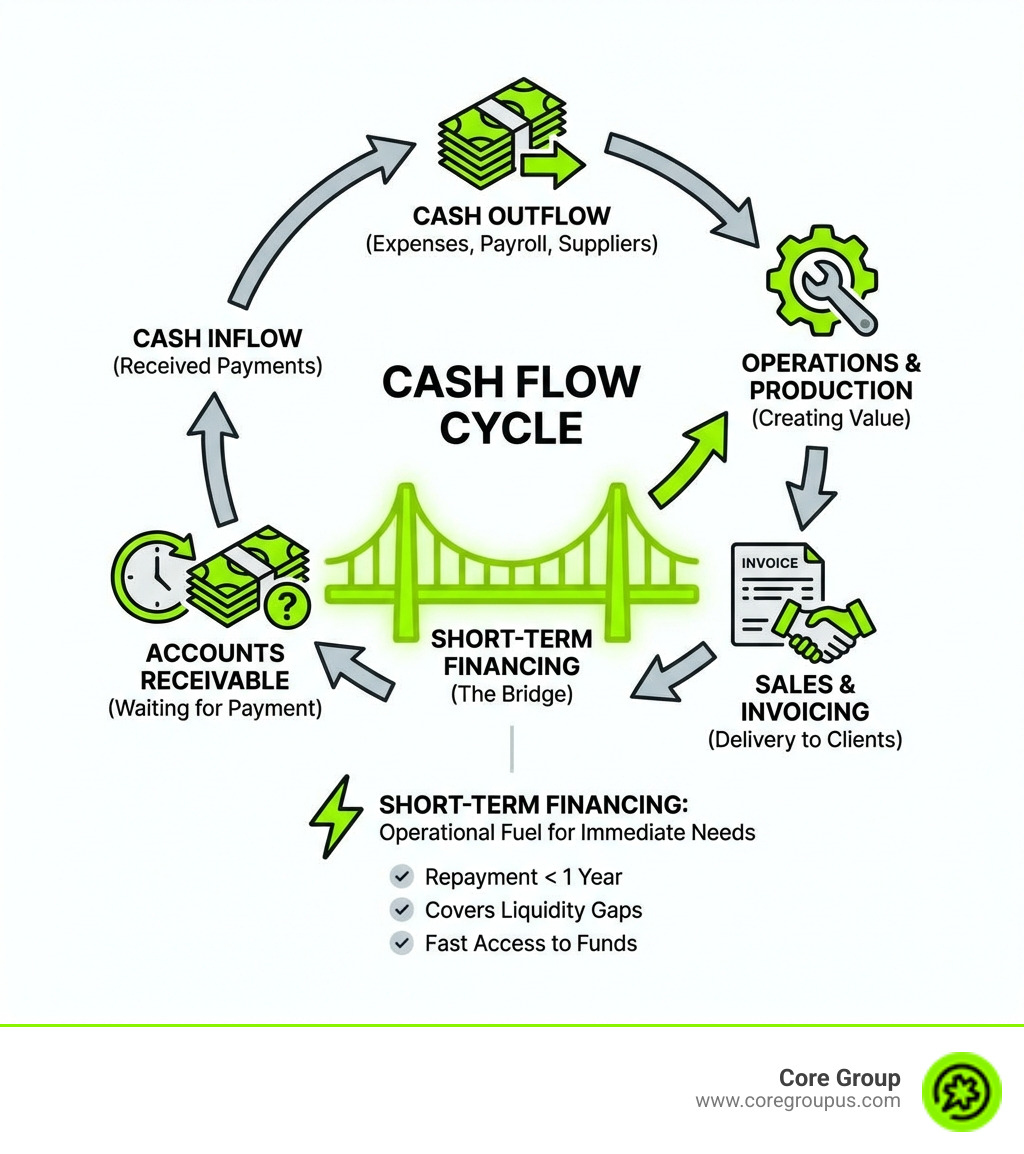
At its core, short term financing is about getting the funds you need now, with the promise to pay them back quickly. We're talking about financial resources with a repayment term of one year or less. On your balance sheet, this means it shows up as a current liability—something you expect to settle in the near future. It’s primarily designed to cover your immediate liquidity needs and operational costs, keeping your day-to-day business humming along.
Think of it this way: short-term financing is your operational fuel. It keeps the lights on, the team paid, and the projects moving. It's ideal for covering routine expenses, managing temporary cash flow fluctuations, or seizing fleeting opportunities. This is a stark contrast to long-term financing, which is the capital you secure for major investments that will yield returns over many years, like buying new studio equipment, expanding your physical space, or funding a multi-year growth strategy. While short-term financing is for the sprint, long-term financing is for the marathon.
Understanding the distinction is crucial for creative entrepreneurs. We often deal with project-based income and unpredictable payment schedules, making short-term cash flow management a daily reality. For a deeper dive into how these two types of debt differ, check out our guide on What is the difference between short-term and long-term debt.

Short-Term vs. Long-Term Financing
To truly grasp the strategic role of short term financing, let's lay out how it stacks up against its long-term counterpart. This isn't about one being "better" than the other; it's about choosing the right tool for the right job in your business.
| Feature | Short-Term Financing | Long-Term Financing |
|---|---|---|
| Purpose | Operational needs, immediate liquidity, bridging cash flow gaps, seasonal expenses, urgent investments. | Capital investments, strategic growth, major equipment purchases, expansion, real estate. |
| Term | One year or less (often 3-6 months, sometimes days). | Greater than one year (typically 2-5 years, sometimes 15+ years). |
| Approval Speed | Faster, often within a day, some providers claim setup in under 27 seconds. | Slower, rigorous approval process, extensive due diligence. |
| Cost/APR | Generally higher Annual Percentage Rates (APRs), higher interest rates, can include fees and discounts. | Generally lower interest rates, but can involve significant upfront costs and collateral requirements. |
| Qualification | Can be less strict, focus on recent cash flow, may be available for lower credit scores. | Stricter, requires strong credit history, comprehensive business plans, often collateral. |
| Examples | Trade credit, lines of credit, invoice factoring, commercial paper, merchant cash advances. | Term loans, mortgages, venture capital (e.g., Series A funding rounds often secure more than $10 million), long-term bonds. |
As you can see, the choice between these two largely depends on your business objectives and the nature of the financial need. For creative entrepreneurs, who often operate with project-based cash flows, short term financing is frequently the go-to for maintaining agility and responsiveness.
The Toolkit: Common Types of Short-Term Financing
Navigating short term financing can feel like opening a financial toolbox. There are various instruments, each designed for specific situations. Generally, these options fall into two main categories: unsecured and secured loans. Unsecured loans are granted based on your business's creditworthiness, meaning your lender trusts you to repay without holding any specific assets as collateral. Secured loans, on the other hand, require you to pledge specific assets—like your accounts receivable or inventory—that the lender can seize if you can't repay the loan.
Understanding these distinctions is key to choosing the right tool for your creative venture. For a comprehensive overview, you can explore resources like 16.3 Obtaining Short-Term Financing - Introduction to Business | OpenStax, which digs into the mechanics of various options.

Unsecured Options: Trade Credit, Bank Loans, and Commercial Paper
These options rely heavily on your business's reputation and credit history, rather than specific assets.
Trade Credit (Accounts Payable): This is probably the most common and often overlooked form of short term financing. It's simply when a supplier extends credit to you for goods or services, allowing you to pay later. For example, if you're a photographer buying new lenses from a supplier who gives you 30 days to pay, that's trade credit. Your supplier carries the inventory, and you get time to use the goods or generate revenue before payment is due. This shows up as an "account payable" on your balance sheet. It's a major source of short-term business financing, and an account payable is essentially a short-term loan from the seller to the buyer.
Bank Loans: When we talk about bank loans in the short-term context, we're typically referring to:
- Lines of Credit: This is an agreement with a bank that allows you to borrow up to a certain maximum amount over a specified period, usually one year. You only pay interest on the amount you actually borrow, and you can draw from it as needed and repay it, making it a flexible option for managing fluctuating cash flow. Many seasonal creative businesses find lines of credit invaluable.
- Revolving Credit Agreements: Similar to lines of credit, but often more formal and can be arranged for longer periods, sometimes two to five years. They typically guarantee the availability of funds up to a certain limit, often for an additional fee beyond the interest on borrowed amounts. Most short-term business loans are unsecured, relying on your business's overall financial health.
Commercial Paper: This is an unsecured short-term debt instrument (think of it as an IOU) issued by financially strong corporations. It's typically sold in large denominations, often in multiples of $100,000, and for periods ranging from 3 to 270 days. For large, well-established creative agencies or production houses, commercial paper can be an attractive way to raise funds because interest rates are usually 1 to 3 percent below traditional bank rates. However, it's generally not an option for smaller businesses or startups due to its nature and the financial strength required.
Secured Options: Invoice Financing, Factoring, and Asset-Based Lending
These options involve pledging specific assets as collateral, which can be particularly useful for creative businesses with tangible assets or predictable revenue streams.
Invoice Financing: This allows your business to receive an advance payment for your outstanding customer invoices while you retain control of collections. You essentially borrow against your receivables. For example, if you have a $10,000 invoice due in 60 days, an invoice financier might advance you $8,000 immediately. Once your client pays the full invoice, you repay the advance plus fees, and receive the remaining balance. This helps reduce "Days Sales Outstanding" and improves cash flow, which is a common pain point for creative entrepreneurs dealing with long client payment cycles.
Invoice Factoring: While similar to invoice financing, factoring involves selling your accounts receivable outright to a third party (a "factor") at a discount. The factor then takes on the responsibility of collecting the payment from your client. This means you get immediate cash, but the factor now owns the invoice and handles the collection process. Factoring can cost anywhere from 0.5% to 5% of the invoice value, plus potential commission and administrative fees. It's often more expensive than a traditional bank loan because the factor takes on the risk of collection. However, for businesses with steady orders but immediate cash flow needs, it can be a lifesaver. For instance, R. Ramirez used Viva Capital’s invoice factoring services to convert outstanding invoices into immediate funds, exemplifying how this solution can provide crucial liquidity.
Asset-Based Lending: This type of financing uses your business's assets—most commonly accounts receivable and inventory—as collateral for a loan. If you have valuable equipment, finished products, or even raw materials, a lender might extend credit based on the value of these assets. The appeal of inventory as collateral depends on how easily it can be sold at a fair price. For a creative business, this might include specialized equipment, art inventory, or even large material purchases for a project.
The Pros and Cons: Weighing Your Options
Like any powerful tool, short term financing comes with both significant advantages and potential pitfalls. Our goal at Core Group is to help you use debt strategically, not just as a last resort, but as a proactive instrument to foster your creative business's financial health. However, it's crucial to perform a thorough risk assessment before diving in.
The Upside: Speed, Flexibility, and Opportunity
When used wisely, short term financing can be a game-changer for creative entrepreneurs.
- Fast Application Process: Unlike the often lengthy and cumbersome process of traditional loans, many short-term financing options boast rapid approval. Some providers can even have you set up in under 27 seconds, with many approvals completed within a day. This speed is invaluable when urgent needs arise.
- Immediate Access to Funds: The quick approval process translates directly into immediate access to cash. This means you can address pressing operational costs, pay your team, or secure materials without delay.
- Improved Cash Flow: For creative businesses, where client payments can be slow and inconsistent, short-term financing helps smooth out those peaks and valleys. By bridging the gap between expenses and incoming revenue, it ensures a more predictable cash flow, allowing you to focus on your art rather than worrying about when the next payment will hit.
- Seizing Market Opportunities: Imagine a sudden opportunity to buy materials at a significant discount, or to launch a limited-time marketing campaign that could dramatically boost your visibility. Short term financing provides the agility to act fast on such opportunities, turning potential into profit.
- Operational Flexibility: It helps you maintain operational flexibility, allowing your business to adapt quickly to changes in demand or unforeseen situations without being constrained by a lack of immediate capital.
The Downside: Costs, Risks, and the Debt Cycle
While the benefits are clear, it's equally important to understand the potential drawbacks.
- Higher APRs and Costs: This is often the biggest trade-off. Short term financing typically comes with higher Annual Percentage Rates (APRs) compared to long-term loans. For instance, while commercial paper interest rates are usually 1 to 3 percent below bank rates for large corporations, other short-term loans, especially those from alternative lenders, can carry significantly higher interest. Payday loans, for example, are notorious for their extremely high interest rates, often over 1000% APR, making them especially expensive loan products.
- Aggressive Repayment Timelines: Because the repayment period is short—often just a few weeks or months—there isn’t much room to spread out the cost. This can lead to aggressive repayment schedules that put a strain on your cash flow if not managed carefully.
- Limited Credit Sizes: The amounts you can borrow through short term financing are generally smaller than with long-term loans. This means it's great for bridging small gaps or covering specific, immediate needs, but not for funding massive expansion projects.
- Risk of the Debt Cycle: This is perhaps the most dangerous pitfall. With high interest rates and tight repayment schedules, businesses can easily fall into a cycle of borrowing to pay off previous debt. Over 80% of payday loans, for example, get rolled over into the next period, trapping borrowers in a continuous cycle of debt. This highlights the importance of using short term financing only for urgent, well-planned needs and having a clear repayment strategy.
- Predatory Lenders: Be wary of lenders who offer "easy" money with little scrutiny, especially if you have a lower credit score. Their terms can be predatory, designed to keep you indebted. Always scrutinize the APR and all associated fees.
Is This the Right Move for Your Creative Business?
Deciding whether short term financing is right for your creative business requires a bit of introspection and careful planning. It's not a one-size-fits-all solution, but a strategic tool that, when used correctly, can significantly bolster your financial stability and growth. Before you commit, we recommend a thorough financial needs analysis, a realistic cash flow projection, and clearly defined goals for how the funds will be used.
Here are some key questions to ask yourself before applying:
- What is the exact purpose of this financing? Is it for an urgent, specific need, or an ongoing operational deficit?
- Can we realistically repay this within the short timeframe? Have you projected your cash inflows and outflows to confirm repayment capacity?
- Have we explored all other options? Could adjusting payment terms with clients or suppliers, or tapping into existing reserves, be a better first step?
- What is the total cost (APR) of this financing? Are we comfortable with the interest rates and fees?
- How will this impact our business's ability to take on future projects or debt?
Key Scenarios for Using short term financing
For creative entrepreneurs, who often juggle multiple projects, seasonal demand, and delayed payments, short term financing can be particularly useful in several situations:
- Seasonal Business Needs: Many creative fields experience peak and off-peak seasons. A marketing agency, for example, might need to ramp up staffing before the holidays, or a production company might need to cover increased costs during a busy filming schedule. Short-term funds can cover seasonal staff or inventory purchases, ensuring you're ready for demand.
- Bridging Cash Flow Gaps: This is a classic use case. If you have a large invoice due from a client in 60-90 days, but payroll is next week, short term financing can bridge that gap. It helps maintain normal operational flow when clients pay late or unexpected delays occur.
- Unexpected Expenses: Life happens, and so do unexpected business expenses. A sudden equipment breakdown, an urgent software upgrade, or an unforeseen travel cost can all be covered quickly with short-term funds, preventing operational disruptions.
- Funding a New Project: Sometimes, a new client project requires upfront investment in materials, contractors, or software before you receive your first payment. Short-term funding allows you to take on these opportunities without straining your existing capital.
- Paying Suppliers: Ensuring your suppliers are paid on time is crucial for maintaining good relationships and securing favorable terms in the future. Short-term loans can help you meet these obligations, especially when your own incoming payments are delayed.
- Tax Planning: Unexpected tax liabilities can sometimes create a temporary cash crunch. Strategic use of short term financing can help manage these obligations without disrupting your core business operations. For more on managing your tax obligations, explore our Tax Planning insights.
How to Manage Your short term financing Effectively
The key to success with short term financing is not just acquiring it, but managing it wisely. Without a solid management plan, even the most beneficial loan can become a burden.
- Create a Realistic Repayment Schedule: Based on your cash flow projections, design a repayment plan that aligns with your anticipated income. Don't borrow more than you can comfortably repay.
- Continuous Monitoring: Your business environment is dynamic, and so should be your financial plan. Periodically review your financing plan and adjust it in response to changes in your business environment or cash flow.
- Avoid Rollovers: Especially with high-interest options like payday loans, avoid rolling over the debt into a new period. This is how the debt cycle begins, and it can quickly spiral out of control. Always prioritize paying off your short term financing as quickly as possible.
- Build a Cash Reserve: While short term financing is for immediate needs, building a healthy cash reserve is a long-term strategy that can reduce your reliance on external borrowing. This "rainy day fund" gives you a buffer for unexpected expenses.
- Seek Professional Financial Guidance: We at Core Group believe in empowering creative entrepreneurs with a "no-fluff, profit-first playbook." Our experts can help you analyze your financial needs, explore the best short term financing options, and build a robust repayment strategy. We’re here to help you make informed decisions and achieve financial peace of mind. For more helpful information, check out our Resources.
Frequently Asked Questions about Short-Term Financing
We know you've got questions, and we're here to answer them! Navigating short term financing can bring up a lot of concerns, especially for busy creative entrepreneurs. Let's tackle some of the most common ones.
How does the application process compare to traditional loans?
One of the biggest advantages of short term financing is its speed and relative simplicity compared to traditional, long-term bank loans.
- Simplified Applications: You'll generally find that applications for short-term options are much less complex. They often require less extensive documentation about your business's long-term history and future projections, focusing more on your current cash flow and immediate financial health. Many processes are now entirely online, making them easy to apply for.
- Faster Approval Times: While traditional loans can take weeks or even months to approve, short term financing approvals are often completed within a day. This immediate access to funds is critical when you have urgent needs.
- Less Strict Qualification: While lenders still assess risk, the qualification criteria for some short term financing options can be less stringent than for long-term loans. This can make them accessible to businesses with less established credit histories or those who might not qualify for conventional bank loans.
- Focus on Cash Flow vs. Long-Term History: Lenders for short term financing often place more emphasis on your current and projected cash flow rather than solely on years of financial statements and extensive collateral. They want to see that you have the immediate capacity to repay the short-term debt.
What are the typical costs I should expect?
The costs associated with short term financing can vary widely, but understand all components to calculate the true cost.
- Annual Percentage Rate (APR): This is the most crucial figure. The APR reflects the real cost of a loan, including the interest rate, fees, and other associated expenses, expressed as an annual percentage. It gives you a clear picture of what you'll actually pay.
- Interest Rates: As we've discussed, short term financing typically carries higher interest rates than long-term loans. These can be fixed or variable, depending on the product and lender.
- Origination Fees: Many lenders charge an upfront fee for processing the loan application. This is usually a percentage of the total loan amount.
- Factoring Discounts: If you opt for invoice factoring, the cost comes in the form of a discount on your invoices. The factor buys your receivables at a percentage of their value, so the "cost" is the difference between the invoice value and the cash you receive. This can range from 0.5% to 5% of the invoice value, plus other administrative fees.
- Late Payment Penalties: If you miss a payment, expect to incur late fees, which can add significantly to the overall cost and damage your credit standing.
Can I get short-term financing with a low credit score?
Yes, it is often possible to obtain short term financing even with a low or less-than-perfect credit score, but there are important considerations.
- Accessibility for Lower Credit Scores: Many alternative lenders specialize in providing short term financing to businesses that might not qualify for traditional bank loans due to credit history. Options like invoice factoring, which is based on the creditworthiness of your clients, can be accessible even with a low business credit score.
- Higher Interest Rates to Mitigate Risk: Lenders take on increased risk when lending to businesses with lower credit scores. To compensate for this, they will typically charge higher interest rates and fees. It's a trade-off: more accessibility often means a higher cost.
- Importance of a Strong Business Case: Even with a low credit score, a clear, compelling business case, strong cash flow projections, and a solid plan for repayment can help you secure financing. Lenders want to see that you have a viable business and the capacity to generate revenue.
- Be Cautious with Alternative Lenders: While they offer accessibility, it's crucial to thoroughly vet alternative lenders. Some can be predatory, offering unfavorable terms. Always compare offers, read the fine print, and understand the full APR before committing. If a deal seems too good to be true, it probably is.
Conclusion
We've sprinted through the essentials of short term financing, uncovering its definition, diverse forms, and the critical role it plays in the agility and resilience of creative businesses. We’ve seen how it differs from long-term capital, acting as a nimble tool for managing immediate needs, bridging cash flow gaps, and seizing fleeting opportunities.
For creative entrepreneurs, who are often at the mercy of project-based payments and seasonal ebbs and flows, strategic use of short term financing isn't just a convenience—it's a necessity. It’s the difference between missing a beat and maintaining your creative momentum, ensuring your team is paid, your suppliers are happy, and your projects stay on track.
At Core Group, our mission is to provide you with the "no-fluff, profit-first playbook" that guarantees peace of mind and saves you time, allowing you to focus on what you do best: creating. Understanding and leveraging short term financing wisely is a crucial part of that playbook. We believe that with the right financial knowledge and support, you can transform potential financial problems into stepping stones for growth.
Don't let cash flow dictate your creative vision. Take control of your finances, make informed decisions, and empower your business to thrive. For expert guidance on accounting, financial management, and tax services custom for creative entrepreneurs, explore our resources at https://www.coregroupus.com/resources/accounting.