The 1099 Lowdown for Your Solo LLC: A Tax Reporting Explainer
Why Single Member LLC 1099 Reporting Matters for Creative Entrepreneurs

Single member LLC 1099 reporting can feel like navigating a maze blindfolded, especially when you'd rather focus on your next film project or creative campaign. But understanding when to issue and receive Form 1099 is crucial for staying compliant with the IRS and avoiding costly penalties.
Quick Answer: Do You Need to Deal with 1099s?
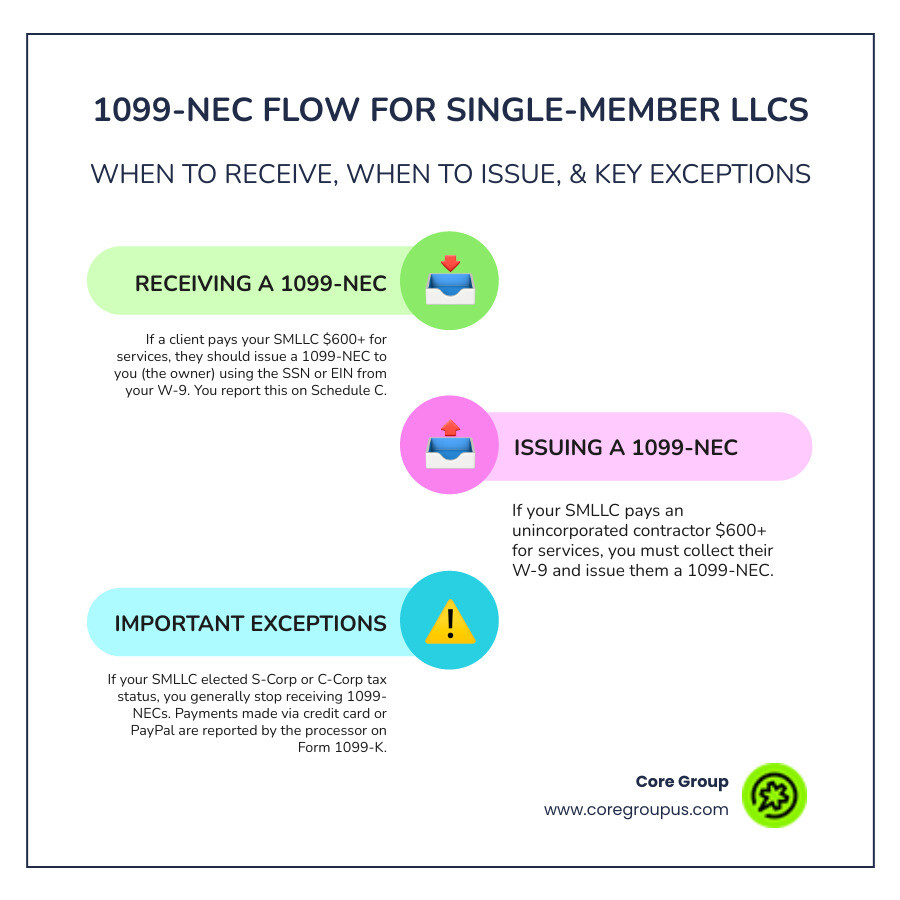
- Receiving 1099s: Your SMLLC should receive a Form 1099-NEC from any client who pays you $600 or more for services during the year (unless your LLC is taxed as a corporation).
- Issuing 1099s: Your SMLLC must issue a Form 1099-NEC to any unincorporated contractor or vendor you pay $600 or more for services.
- Key Exception: If you elect S-Corp or C-Corp tax status for your LLC, you generally stop receiving 1099s (though you still issue them to your contractors).
- Form W-9 is Critical: Always collect a W-9 from clients and contractors—it tells you exactly what tax reporting is required.
Here's the reality: As a creative professional running a single-member LLC, you're operating in a unique tax space. The IRS treats your LLC as a "disregarded entity" by default, meaning it's essentially invisible for tax purposes. You and your business are one and the same in the eyes of the tax code.
This creates a specific set of 1099 reporting obligations—both for the payments you receive and the payments you make to others. Get it wrong, and you could face penalties ranging from $60 to $630 per form. Get it right, and you'll have peace of mind to focus on what you do best.
This guide will walk you through everything you need to know about single member LLC 1099 reporting, from understanding your tax identity to mastering filing deadlines. We'll cover when to issue 1099s, when to expect them, and how tax elections like S-Corp status change the rules entirely. For more financial insights custom to creative entrepreneurs, check out The Planner Blog.
Your SMLLC's Tax Identity: The "Disregarded Entity"

When you form a single-member LLC (SMLLC), you create a legal entity that protects your personal assets from business liabilities. For federal income tax, however, the IRS views your SMLLC as a "disregarded entity," meaning the business is not considered separate from you for tax reporting. This is the default status unless you elect for your LLC to be taxed as a corporation (S-Corp or C-Corp). The IRS states that a disregarded entity reports its activities on the owner's federal tax return.
From a tax perspective, this makes your SMLLC similar to a sole proprietorship. Both use "pass-through taxation," where profits and losses pass directly to your personal tax return. The key difference is the LLC's limited liability protection. For your Taxpayer Identification Number (TIN), a disregarded SMLLC without employees generally uses your Social Security Number (SSN). However, an Employer Identification Number (EIN) is required if you have employees or certain tax liabilities. Many owners get an EIN anyway to keep their SSN private. For help navigating these distinctions, our team offers comprehensive Accounting services.
How to Report Your SMLLC Income
As a creative entrepreneur with an SMLLC, your business income and expenses are reported on your personal tax return via Schedule C, Profit or Loss From Business, attached to your Form 1040. On Schedule C, you list all business income and detail all expenses (software, supplies, marketing, home office deductions, etc.) to calculate your net profit or loss. This net figure carries over to your Form 1040.
Maintaining meticulous records is paramount, as good records are essential for accurately completing Schedule C. For those interested in optimizing their filings, exploring strategies like a Section 105 Plan for Sole Proprietors Filing Schedule C could offer additional benefits.
Understanding Self-Employment Tax
Self-employment tax is your contribution to Social Security and Medicare. Unlike employees, as an SMLLC owner, you're responsible for both halves. This tax is 15.3% of your net earnings (12.4% for Social Security up to an annual limit, and 2.9% for Medicare with no limit). You calculate this tax on Schedule SE, Self-Employment Tax, using the net profit from your Schedule C.
Since these taxes aren't withheld, you must pay estimated taxes quarterly using Form 1040-ES if you expect to owe $1,000 or more. Due dates are typically April 15, June 15, September 15, and January 15. Underpaying can lead to penalties, so we advise clients to set aside about 30% of their income for taxes.
When Your SMLLC Should Receive a Form 1099

Ah, the joy of receiving mail that isn't junk! For your single member LLC 1099 reporting, some of the most important documents you'll receive are Form 1099-NEC or 1099-MISC. These forms are how your clients tell the IRS how much they paid you during the year.
Generally, any business that pays your SMLLC $600 or more for services during the tax year must send you a Form 1099-NEC, Nonemployee Compensation. Think of it as a formal record of your freelance income. If you're paid for things like rent, royalties, or legal services, a Form 1099-MISC, Miscellaneous Income, might be used instead. Single-member LLCs and partnerships typically receive 1099 forms for payments over $600.
The key to all of this is the Form W-9, Request for Taxpayer Identification Number and Certification. When you start working with a new client, they should ask you to fill one out. This form provides them with your Taxpayer Identification Number (TIN) – either your SSN or your SMLLC's EIN – and confirms your tax classification. This ensures they report payments to the correct entity and avoid penalties themselves.
What about payments received through third-party payment networks like PayPal, Stripe, or other electronic payment processors? For these transactions, the payment processor (not your client) is generally responsible for reporting. In 2025, if your SMLLC receives $600 or more via electronic transactions, the payment processor will send you a Form 1099-K, Payment Card and Third Party Network Transactions. This means that if a client pays you $1,000 via PayPal, your client does not issue you a 1099-NEC; PayPal issues you a 1099-K. You still report all that income on your Schedule C, of course, but the reporting mechanism changes.
Filling Out Form W-9 for Your Clients
When a client asks you to complete a Form W-9, it's not a trick question; it's a standard part of doing business. This form is crucial for your clients to correctly fulfill their single member LLC 1099 reporting obligations to you.
Here’s how you, as a single-member LLC owner, should generally fill out a W-9:
- Line 1 (Name): Enter your individual name, as it appears on your income tax return.
- Line 2 (Business name/disregarded entity name): This is where you would enter your SMLLC's legal name.
- Box 3 (Federal tax classification): You will typically check the box for "Individual/sole proprietor or single-member LLC." This clearly communicates your disregarded entity status to your client.
- Part I, Taxpayer Identification Number (TIN): For a disregarded SMLLC, you will generally enter your personal Social Security Number (SSN). If you have an EIN for your SMLLC (perhaps you got one to keep your SSN private or because you have employees), you can use that instead. The IRS advises that if a disregarded entity LLC owned by an individual provides a Form W-9, it should use the owner's SSN or EIN, not the LLC's EIN if it's solely for employment tax purposes.
Accurately filling out your W-9 helps your clients get their reporting right and ensures you receive the correct 1099s. It's a small but mighty step toward financial clarity. For more on taking control of your financial journey, you might find inspiration in From Intimidated to Empowered: A Creative's Guide to Financial Epiphanies.
When Your SMLLC Must Issue a Form 1099
Your SMLLC also has single member LLC 1099 reporting responsibilities when you pay independent contractors or vendors. If you hire a freelance designer, developer, or consultant, you might need to issue them a 1099.
The general rule is: if your SMLLC pays an unincorporated contractor or vendor $600 or more for services in a calendar year, you must issue them a Form 1099-NEC. This applies to individuals, partnerships, and other LLCs taxed as partnerships. The threshold also applies to payments like rents and royalties, reported on Form 1099-MISC ($600 threshold, or $10 for royalties).
The most critical step is to collect a Form W-9 from every contractor before you pay them. This form provides their tax classification and TIN (SSN or EIN), which is essential for determining your filing needs and avoiding penalties.
For foreign contractors, the rules differ. Form 1099 is for U.S.-based entities. If you pay a foreign contractor, collect a Form W-8BEN (for individuals) or W-8BEN-E (for entities). You may then need to file Form 1042-S, Foreign Person's U.S. Source Income Subject to Withholding, which can involve tax withholding. Our Payroll services can help keep you compliant.
How to Use a Vendor's W-9 to Determine Filing Needs
A vendor's W-9 is your guide to accurate single member LLC 1099 reporting. It shows how the IRS views the vendor for tax purposes, which dictates if you must issue a 1099.
Here’s what to look for on a W-9:
- Box 3 - Federal Tax Classification: This box is key.
- Individual/Sole Proprietor or Single-Member LLC: If checked, and you pay them $600 or more for services, you will almost certainly need to issue a Form 1099-NEC.
- Partnership: If the vendor is a partnership and you pay them $600 or more for services, you will also typically need to issue a Form 1099-NEC.
- C Corporation or S Corporation: Generally, you do not need to issue a 1099-NEC to C-Corps or S-Corps, regardless of the payment amount. This is a common exception that saves paperwork.
However, there are important exceptions to the corporate exemption. Payments for legal and medical/healthcare services are always reportable on a 1099 if they total $600 or more, regardless of whether the recipient is a corporation. So, if you pay an incorporated lawyer or medical provider, you'll still issue a 1099. Similarly, payments for fish purchases for resale or services involving federal executive agencies are also exceptions.
Payments made via credit card or third-party payment apps (like Stripe or PayPal) are generally reported by the payment processor on Form 1099-K, not by you on a 1099-NEC. This distinction can simplify your reporting. For more insights, explore resources like The Difference Between Employee & Entrepreneur - Jimmy Owens.
How Tax Elections Affect Single Member LLC 1099 Reporting
An LLC offers tax flexibility. While a disregarded entity by default, you can elect for your SMLLC to be taxed as an S-Corporation (Form 2553) or a C-Corporation (Form 8832). This choice significantly impacts your single member LLC 1099 reporting obligations and how you interact with the 1099 system.
Let's look at how these elections change the game for your 1099s:
| Feature | Disregarded Entity SMLLC (Default) | S-Corp SMLLC |
|---|---|---|
| Tax Reporting | Income/expenses on Owner's Schedule C (Form 1040) | Files Form 1120-S; Owner receives W-2 for salary & K-1 for distributions |
| Receiving 1099-NEC | Generally receives 1099-NEC from clients ($600+ for services) | Generally does not receive 1099-NEC from clients (with exceptions like legal/medical services) |
| Issuing 1099-NEC | Issues 1099-NEC to unincorporated contractors ($600+ for services) | Issues 1099-NEC to unincorporated contractors ($600+ for services) |
| Self-Employment Tax | Pays self-employment tax on all net profit from Schedule C | Pays self-employment tax only on "reasonable salary" paid via W-2 |
| Owner Compensation | Owner's Draws | Reasonable Salary (W-2) + Shareholder Distributions (K-1) |
The S-Corp Election and 1099s
Electing S-Corp status is popular with creative entrepreneurs for potential self-employment tax savings. With this election, your LLC is treated as a corporation for tax purposes, not a disregarded entity. You become an employee of your corporation and draw a "reasonable salary."
The biggest change for single member LLC 1099 reporting as an S-Corp is that clients generally stop issuing you Form 1099-NECs. Your business falls under the corporate exemption for 1099 reporting. Instead of a 1099-NEC, your S-Corp handles its own payroll, and you receive a W-2 for your salary and a K-1 for shareholder distributions.
This shift simplifies receiving 1099s. However, your SMLLC, now taxed as an S-Corp, must still issue 1099-NECs to any unincorporated contractors you pay $600 or more for services. For a deeper dive, see our guide, The Essential Guide to S-Corporations, and read Should Creative Entrepreneurs Become an S-Corp.
Special Rules for C-Corp Elections and Other Exceptions
While less common for solo entrepreneurs, an SMLLC can also elect to be taxed as a C-Corporation. This choice involves different tax treatments, like potential "double taxation." For 1099 purposes, a C-Corp SMLLC also generally falls under the corporate exemption and won't receive 1099-NECs from clients for most services.
However, specific payments are always reported on 1099s, regardless of the recipient's corporate tax status. These exceptions are critical:
- Attorney Payments: Payments to attorneys for legal services totaling $600 or more are always reportable on a 1099-NEC (or 1099-MISC), even if the attorney is incorporated.
- Medical Payments: Payments for medical or healthcare services totaling $600 or more must be reported on a 1099-MISC, regardless of the provider's corporate status.
These exceptions ensure transparency for certain professional service payments. Find more details in the IRS instructions for Exceptions to 1099 reporting. Always double-check these rules to ensure your single member LLC 1099 reporting is compliant.
Deadlines, Penalties, and Best Practices for 1099s
Missing deadlines or making errors in your single member LLC 1099 reporting can lead to penalties from the IRS, which is definitely not part of our "no-fluff, profit-first playbook." Staying organized and informed is your best defense against these unwelcome surprises.
The most critical deadline for Form 1099-NEC is January 31st. This is the date by which you must send copies of the 1099-NEC to your contractors and also file them with the IRS. For Form 1099-MISC, the deadline to recipients is also January 31st, but the filing deadline with the IRS can vary (February 28th for paper filing or March 31st for e-filing).
Penalties for late filing can quickly add up:
- $60 per form if filed within 30 days of the deadline.
- $130 per form if filed more than 30 days late but by August 1st.
- $330 per form if filed after August 1st or not filed at all.
- $660 per form for intentional disregard of filing requirements.
Penalties also apply for incorrect information. If you file a 1099 with missing or incorrect information (like a wrong TIN), penalties start at $50 per form. This highlights why collecting accurate W-9s and verifying information is so important.
The IRS encourages and, in some cases, requires e-filing. If you file 10 or more information returns (like 1099s), you are generally required to e-file them. Even if you have fewer, e-filing is often easier and more efficient. To ensure accuracy, especially with TINs, the IRS offers a TIN Matching System which can be a lifesaver for businesses that file many forms.
Best Practices for Flawless Single Member LLC 1099 Reporting
Staying on top of your single member LLC 1099 reporting doesn't have to be a Herculean task. With a few best practices, you can ensure accuracy, avoid penalties, and keep your financial house in order.
- Separate Business Bank Account: This is non-negotiable for any LLC owner. Mixing personal and business finances (commingling) undermines the liability protection of your LLC and makes bookkeeping a nightmare. A dedicated business bank account keeps all your income and expenses clearly separated, making tax time much simpler.
- Robust Bookkeeping Software: Invest in good accounting software like QuickBooks, Wave, or FreshBooks. These tools allow you to categorize income and expenses, track payments to contractors, and generate reports that make filling out Schedule C and identifying 1099 recipients a breeze. They can also help you track payments for estimated taxes.
- Meticulous Record-Keeping: Keep every receipt, invoice, and bank statement. Whether digital or physical, organized records are your best friend during tax season and in case of an audit. Make a habit of recording transactions promptly.
- Collect W-9s Proactively: As soon as you engage a new contractor or vendor, request a completed W-9. Don't wait until year-end when you're scrambling. This ensures you have their correct TIN and tax classification from the start.
- Regular Financial Reviews: Don't let your finances pile up until tax season. Dedicate time each month or quarter to review your income, expenses, and payments made to contractors. This helps you catch errors early, identify potential 1099 obligations, and stay on track with estimated tax payments. This proactive approach helps you grow beyond just being an individual, changing into a true business owner, as highlighted in The Founders Evolution: Why Your Business Cannot Grow Beyond You.
Conclusion
Navigating single member LLC 1099 reporting might seem daunting at first, but with a clear understanding of the rules, it becomes a manageable part of running your creative business.
Here are the key takeaways to remember:
- Disregarded Entity is Default: By default, your SMLLC is treated as a disregarded entity for federal income tax purposes, meaning your business income and expenses flow through to your personal tax return (Form 1040, Schedule C). You'll pay self-employment taxes on your net profit via Schedule SE.
- W-9 is Your Guide: Whether you're receiving payments or making them, the Form W-9 is your essential tool. Use it to provide your tax info to clients and to collect your contractors' tax info.
- Tax Elections Change the Rules: Electing S-Corp status can significantly alter your 1099 landscape, particularly regarding payments you receive. While you generally won't receive 1099-NECs as an S-Corp, you still must issue them to your contractors.
- Know Your Thresholds and Deadlines: Remember the $600 threshold for most services and the January 31st deadline for 1099-NECs. Penalties for non-compliance are real and avoidable.
- Best Practices for Peace of Mind: Separate bank accounts, good bookkeeping, and proactive W-9 collection are your allies in ensuring accurate and timely reporting.
We know that managing the financial intricacies of your creative business can be time-consuming. Our mission at Core Group is to provide you with the financial clarity and peace of mind to focus on your passion. By understanding and implementing these single member LLC 1099 reporting guidelines, you're not just complying with the IRS; you're building a stronger, more sustainable business.
Ready to take the guesswork out of your business finances? Get started with expert Tax Planning with Core Group today.