The Perfect Partnership: Tax Planning Strategies That Actually Work
Why Tax Planning Strategies for Partnerships Can Make or Break Your Business
Effective tax planning strategies for partnerships can mean the difference between keeping tens of thousands of dollars in your pocket or handing it over to the IRS unnecessarily.
Here are the core strategies that work in 2026.
- Choose distributions over guaranteed payments when possible to avoid self-employment tax (up to $18,500 in savings on a $150,000 payment)
- Maximize the QBI deduction by claiming up to 20% of qualified business income under Section 199A, now permanent under the OBBBA
- Use special allocations to shift depreciation and deductions to higher-bracket partners for bigger collective savings
- Make a Section 754 election when a partner buys in or exits to step up inside basis and unlock future deductions
- Elect pass-through entity (PTE) tax in your state to bypass the federal SALT cap, now $40,000 under the OBBBA
- Track partner basis throughout the year to avoid surprise taxable distributions or suspended losses
- Coordinate across all partners since each person's tax bracket, state, and situation affects the whole group's optimal strategy
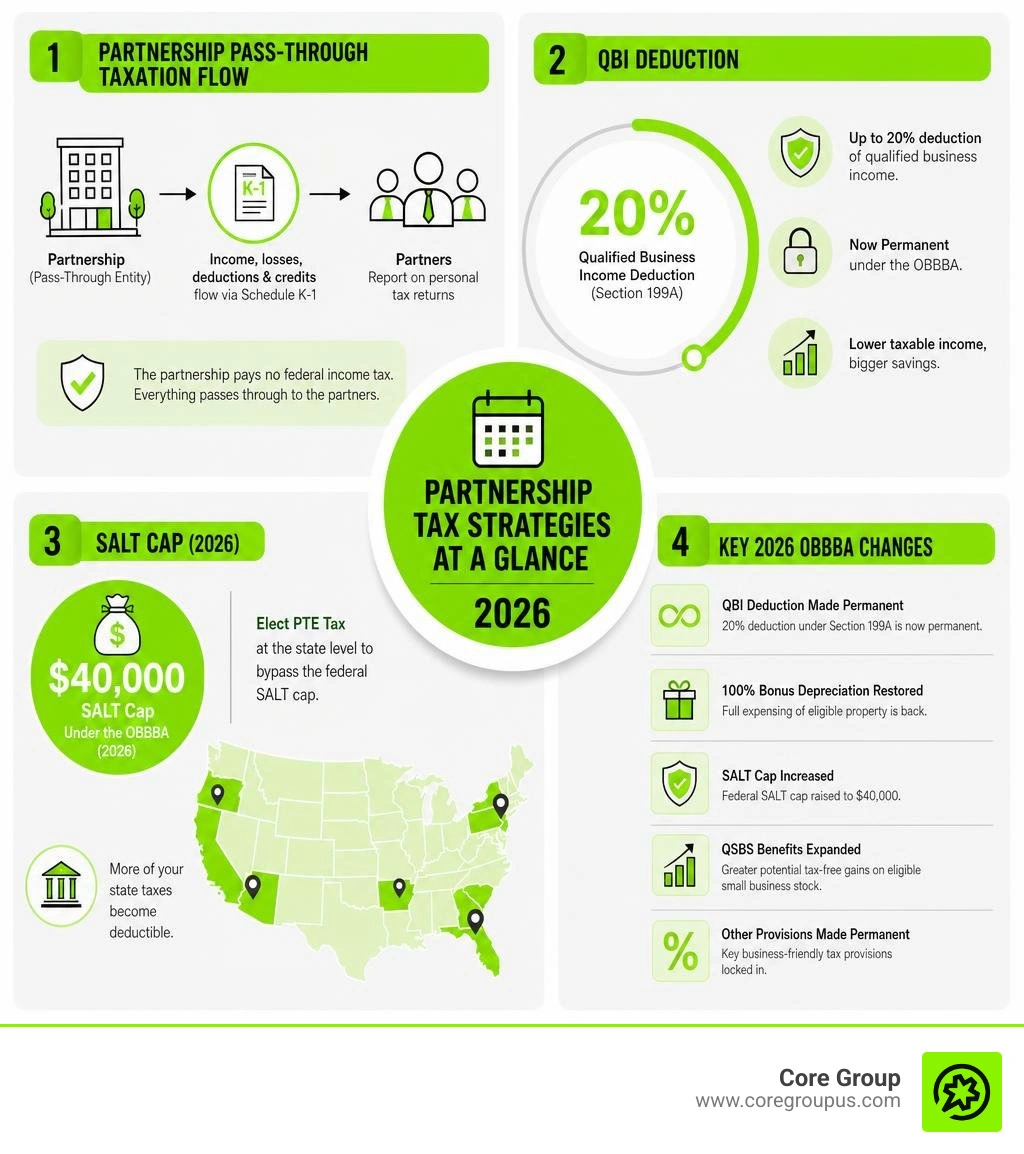
Partnerships are pass-through entities, meaning the business itself pays no federal income tax. Income, losses, deductions, and credits flow directly to each partner's personal return via Schedule K-1. That sounds simple. But with multiple partners comes real complexity.
Unlike an S-Corp (which must split everything proportionally) or a sole proprietor (just one person to optimize for), a partnership lets you customize how income and deductions are shared. That flexibility is powerful. But it also creates more ways to leave money on the table if you are not planning carefully.
The tax landscape shifted significantly in 2026. The One Big Beautiful Bill Act (OBBBA) made several key changes, including permanently extending the QBI deduction, restoring 100% bonus depreciation, raising the SALT cap to $40,000, and expanding QSBS benefits. If your partnership is still running a 2024 playbook, you are likely overpaying.
This guide breaks down every major strategy, from the basics to the advanced moves that high-income creative partnerships use to save thousands each year.
Important tax planning strategies for partnerships terms include the following.
- tax planning strategies
- tax planning for freelancers
- corporate tax planning and strategy
Partnership Taxation Versus Other Business Structures
To truly understand how to optimize your taxes, we must look at how partnerships compare to S-Corporations and sole proprietorships. Each structure has its own set of rules, and what works for one can be a disaster for another.
With a sole proprietorship, you and your business are one and the same. All net income is subject to income tax and self-employment tax. There is no flexibility to shift income or allocate deductions. It is straightforward but leaves very little room for strategic maneuvering.
When we look at S-Corporations, we find strict rules about ownership and allocations. S-Corps must allocate all profits, losses, and distributions strictly pro-rata based on ownership percentages. If you own 60% of the business, you get exactly 60% of the income and 60% of the deductions. There is no room to negotiate a different split, even if one partner did all the heavy lifting this year or sits in a much higher tax bracket.
Partnerships, operating under Subchapter K of the Internal Revenue Code, are the wild west of the tax world in the best way possible. They offer unparalleled flexibility. We can structure the partnership agreement to allocate specific items of income, gain, loss, or deduction disproportionately among the partners. This allows us to customize the tax outcome to fit the real-world economic arrangement of the business.
Another key advantage of the partnership structure is how debt affects your ability to deduct losses. In an S-Corp, shareholders only get tax basis for personal loans they make directly to the corporation. In a partnership, partners can increase their outside basis by their share of partnership liabilities, including bank loans and accounts payable. This extra basis is incredibly valuable when you want to deduct losses or receive tax-free distributions.
For a deeper dive into how different entities are taxed, check out our guide on Federal Income Tax LLC structures. Properly choosing and maintaining your entity classification is the first step to avoid double taxation and keep your cash flow healthy.
Essential Tax Planning Strategies for Partnerships
When we work with creative partnerships, our focus is always on proactive business tax optimization. We do not wait until April to see what happens. We design the business flow throughout the year to legally minimize the collective tax bill of the partners. This requires a deep understanding of how money moves out of the partnership and into your personal bank accounts.
Guaranteed Payments Versus Distributions
One of the most frequent conversations we have with partners is how they should pay themselves. Partnerships generally use two main methods to compensate partners, which are guaranteed payments and profit distributions. Choosing the wrong one can cost you thousands in unnecessary taxes.
Guaranteed payments are payments made to a partner for services or capital without regard to the partnership's income. They function similarly to a salary. The partnership deducts the guaranteed payment as a business expense, and the receiving partner reports it as ordinary income.
However, guaranteed payments come with two major tax drawbacks. First, they are fully subject to self-employment tax, which is roughly 15.3% up to the Social Security wage base of $176,100 in 2026, plus the Medicare tax. Second, guaranteed payments reduce the partnership's qualified business income, which directly shrinks the QBI deduction for all partners.
Profit distributions, on the other hand, are payments made to partners from the accumulated earnings of the business. These distributions are generally not subject to self-employment tax. Instead, the partners pay self-employment tax on their share of the partnership's active ordinary business income, regardless of whether it was distributed.
If we structure payments as distributions rather than guaranteed payments when legally defensible, we can preserve the maximum QBI deduction and keep self-employment taxes in check. For example, structuring a $150,000 payment as a distribution instead of a guaranteed payment can save approximately $18,500 in self-employment tax while keeping the business eligible for a higher QBI deduction. To explore more ways to keep your hard-earned money, review our playbook on how to save on taxes.
Maximizing the QBI Deduction with Tax Planning Strategies for Partnerships
The Qualified Business Income deduction under Section 199A of the Internal Revenue Code is one of the most powerful tax-saving tools available to partners. It allows eligible partners to deduct up to 20% of their share of qualified business income, potentially saving tens of thousands of dollars annually for high-income partners.
With the passage of the OBBBA, the QBI deduction is now permanent. For 2026, the income thresholds before phase-out begins have increased to $203,000 for single filers and $406,000 for joint filers. The phase-out ranges are $203,000 to $272,300 for single filers and $406,000 to $544,600 for joint filers. For partners above these thresholds, the deduction is limited by the partnership's W-2 wages paid and the unadjusted basis of qualified property.
To maximize this deduction, we must carefully manage how we classify partner compensation. Since guaranteed payments do not qualify for the QBI deduction, shifting compensation to profit distributions keeps the qualified business income pool as large as possible.
Additionally, if your partnership has partners with income above the thresholds, we need to ensure the partnership pays sufficient W-2 wages to non-partner employees or holds enough qualified property to unlock the full 20% deduction. If you want to master this calculation, read our detailed guide where the QBI deduction explained steps are laid out clearly.
Advanced Allocation and Basis Management Techniques
Once your partnership has nailed the basics of compensation and QBI, we can step into advanced territory. This is where the true beauty of Subchapter K shines. We can use sophisticated allocation and basis tools to align your tax deductions with the partners who will benefit from them the most.
To learn more about how we integrate these complex strategies with your long-term goals, explore our insights on how firms integrate estate investment tax planning strategies.
Special Allocations and Section 704b Rules
Unlike S-Corporations, partnerships can allocate income, gains, losses, and deductions disproportionately among partners. These are known as special allocations. For instance, if one partner contributed all the startup capital and another contributed the sweat equity, we can allocate 100% of the early depreciation deductions to the funding partner to offset their other high-bracket income.
However, the IRS does not let us shift tax liabilities on a whim. Under Section 704b, all special allocations must have substantial economic effect. This means the tax allocation must reflect the actual economic reality of the business. If the tax return says a partner gets 80% of the depreciation deduction, their capital account must be reduced by that same 80%. If the business liquidates, the cash must be distributed based on those positive capital account balances.
When done correctly, special allocations can generate immense savings. Imagine a partnership with $120,000 in depreciation deductions. If we allocate this depreciation to a partner in a high 37% tax bracket, it generates $44,400 in tax savings. If we had allocated it to a partner in a 15% bracket, it would only save $18,000. That is an extra $26,400 kept within the partnership group simply by being smart with our allocations.
We must also navigate Section 704c rules when a partner contributes appreciated property instead of cash. Section 704c prevents partners from shifting pre-contribution gains or losses to other partners. If you contribute a building worth $100,000 but your tax basis in it is only $40,000, that $60,000 built-in gain must eventually be allocated back to you when the property is sold or depreciated.
Partner Basis Tracking and Section 754 Elections
We cannot stress this enough, tracking your partner basis is absolutely critical. Your outside basis is your tax investment in the partnership. It acts as a gatekeeper for two major events, deducting losses and receiving tax-free distributions.
If the partnership passes through a loss to you on your Schedule K-1, you can only deduct that loss on your personal return if you have sufficient outside basis. If your basis is zero, that loss is suspended and carried forward indefinitely until you rebuild your basis.
Similarly, if the partnership distributes cash to you that exceeds your outside basis, that excess distribution is treated as a taxable capital gain, even if the partnership did not sell any assets. We recommend tracking basis quarterly, especially if your business utilizes heavy depreciation or makes frequent cash distributions.
One of the most powerful tools to resolve basis discrepancies is the Section 754 election. When a new partner buys into the partnership from an existing partner, they often pay a premium that reflects the fair market value of the business assets. Without a Section 754 election, the new partner's outside basis is high, but their share of the partnership's inside basis in its assets remains low.
By making a Section 754 election, the partnership can step up the inside basis of its assets specifically for the incoming partner. This allows the new partner to claim higher depreciation deductions and reduces their taxable gain when the partnership eventually sells those assets.
Be aware that once you make a Section 754 election, it is irrevocable without IRS consent. It requires diligent record-keeping, but the tax savings are usually well worth the effort. For more advanced ideas on structuring your business assets, check out our resource on corporate tax planning and strategy.
Navigating the Pass Through Entity Tax and SALT Cap Workarounds
State and local taxes can take a massive bite out of your profits, especially for partners living in high-tax states. Under the OBBBA, the federal deduction for individual state and local taxes (the SALT cap) has been increased to $40,000 through 2029. While this is a welcome relief from the previous $10,000 limit, many high-earning partners still find themselves exceeding this threshold.
Fortunately, over 30 states offer a brilliant workaround known as the Pass-Through Entity (PTE) tax election. This election allows partnerships to pay state income tax directly at the entity level rather than passing the state tax liability through to the individual partners.
Because the partnership pays the state tax directly, it can deduct those payments as ordinary business expenses on its federal Form 1065. This reduces the partnership's ordinary net income, which in turn reduces the federal taxable income reported on each partner's Schedule K-1.
The partners then receive a state tax credit on their individual state returns to offset the tax already paid by the partnership. This effectively bypasses the individual SALT cap entirely, potentially saving partners $30,000 or more in combined federal and state tax liabilities.
To learn more about implementing these state-level workarounds and other advanced tax strategies, read our core guide on Tax Planning.
Coordinating Multi Partner Tax Situations
A challenge in partnership tax planning is that partners are rarely in the exact same financial position. You might have one partner who is a high-income physician in the 37% tax bracket living in California, and another who is a retired investor in the 12% bracket living in Texas.
What is good for one partner might be detrimental to another. For example, a PTE election is incredibly valuable for the California partner but might offer little to no benefit for the Texas partner who pays no state income tax.
Similarly, making equipment purchases to trigger immediate depreciation benefits the high-bracket partner immensely but might waste deductions for a partner in a lower bracket who would prefer to defer those deductions to future years.
To solve this, we must model scenarios that optimize the total tax savings across all partners. Coordinated planning, including customized special allocations, structured distributions, and targeted PTE elections, can save a multi-partner group an average of $47,000 annually compared to uncoordinated filing.
We also need to plan carefully for partner transitions. When a partner exits or a new partner is admitted, we must review the partnership agreement, update capital accounts, and determine whether a Section 754 election is necessary to protect all parties involved.
Year End Tax Planning Strategies for Partnerships Checklist

The worst time to do tax planning is in March when you are gathering documents for your tax preparer. By then, the concrete has set, and your options are extremely limited. Effective tax planning happens in the final quarter of the year.
To help you stay on track, we have put together this essential year-end checklist. For a broader look at preparing your business for the end of the year, read our guide on business year-end tax planning.
- Verify partner basis by October or November. Do not wait until December 31 to find out a partner has negative basis, which could turn their year-end cash distribution into a surprise taxable gain.
- Model the QBI deduction. Project your net income and review whether any partners are crossing the phase-out thresholds. If they are, evaluate if we need to adjust W-2 wage allocations or make capital purchases to maximize the deduction.
- Utilize permanent bonus depreciation. Under the OBBBA, 100% bonus depreciation is permanent for qualifying property placed in service after January 19, 2025. If you need to buy equipment, machinery, or technology, make those purchases and place them in service before December 31 to claim the full write-off this year.
- Leverage Section 179 expensing. The Section 179 limit has increased to $2.5 million with a $4 million phase-out threshold. Ensure your planned capital acquisitions fit within these limits to maximize your immediate deductions.
- Review retirement contributions. Partnerships can establish and fund powerful retirement plans like SEP IRAs, which allow contributions of up to 25% of net self-employment income, up to a maximum of $69,000 in 2026.
- Review the partnership agreement. Ensure any special allocations or changes to partner compensation are fully documented in writing before the end of the tax year. The IRS heavily scrutinizes oral agreements or retroactive changes made after the year closes.
For a deeper understanding of what to watch out for during this process, review what should be considered in tax planning strategies.
Frequently Asked Questions About Partnership Taxes
Navigating partnership taxes can raise a lot of questions. Here are the answers to some of the most common questions we hear from business owners.
What is the difference between guaranteed payments and distributions
Guaranteed payments are fixed payments made to partners for services or capital, regardless of the partnership's profitability. They are treated as ordinary income to the partner and are fully subject to self-employment tax. They also reduce the partnership's qualified business income, which can lower the QBI deduction for all partners.
Profit distributions are payments made from the partnership's accumulated earnings. They are generally not subject to self-employment tax because partners already pay self-employment tax on their share of the partnership's active ordinary business income. Profit distributions do not reduce qualified business income, making them a much more tax-efficient way to move cash out of the business when legally appropriate.
How does the OBBBA affect partnership tax planning in 2026
The OBBBA introduced several game-changing provisions for partnerships. It made the 20% QBI deduction permanent and increased the phase-out thresholds to $203,000 for single filers and $406,000 for joint filers. It also restored permanent 100% bonus depreciation for qualifying property placed in service after January 19, 2025.
Additionally, the OBBBA increased the individual SALT cap to $40,000 through 2029. While this provides relief on personal returns, making a state-level PTE election remains an incredibly valuable tool for partnerships in high-tax states where partners easily exceed this new limit.
When should a partnership make a Section 754 election
A partnership should consider a Section 754 election when there is a transfer of a partnership interest, such as a partner buyout or the admission of a new partner, or when a significant property distribution occurs.
The election allows the partnership to adjust the inside basis of its assets to match the outside basis of the transferring partner. This provides the incoming partner with a basis step-up, unlocking higher depreciation deductions and reducing their taxable gain when partnership assets are eventually sold.
Conclusion
Partnership tax planning is not a one-size-fits-all game. Because partnerships are incredibly flexible, they require proactive, coordinated strategies to ensure no partner is left overpaying the IRS. From choosing distributions over guaranteed payments to navigating complex Section 754 elections and state PTE taxes, the decisions you make throughout the year will directly impact your bottom line.
At Core Group, we specialize in helping creative entrepreneurs keep more of their hard-earned money. We cut through the noise with our no-fluff, profit-first playbook, giving you the peace of mind to focus on what you do best.
We are so confident in our financial management, bookkeeping, and tax services that we back them with our unique MacBook Pro guarantee. If you are ready to stop guessing and start optimizing, let us build a custom tax strategy for your partnership.
Explore our comprehensive resources on Tax Planning and take control of your financial future today.