A Creator's Guide to Income & Freebies
Why Taxes for Influencers Are More Complex Than You Think

Taxes for influencers aren't just about reporting cash payments—they include gifted products, free trips, platform payouts, and even barter deals. Here's what you need to know:
- All income counts: Sponsored posts, affiliate commissions, ad revenue, and brand deals are taxable
- Gifts are income: Free products, trips, and services received for promotion must be reported at Fair Market Value
- Platform earnings matter: YouTube, TikTok, Twitch, and other platform payments are all taxable
- Registration thresholds exist: You may need to register for GST/HST (Canada) or make estimated tax payments (US)
- Deductions can help: Equipment, software, home office, and travel expenses can reduce your tax bill
The influencer marketing industry hit $21.1 billion in 2023, and tax authorities like the CRA and IRS are paying close attention. What started as a side hustle for many creators has become serious business—and with that comes serious tax obligations.
Here's the challenge: most creators excel at producing amazing content but struggle with the financial side. You might know exactly how to light a shot or craft the perfect caption, but tax forms? That's a different story.
The good news is that understanding your tax obligations doesn't have to be overwhelming. Whether you're earning $500 from a single sponsored post or pulling in six figures from multiple revenue streams, the basic principles are the same. You need to know what counts as income, when to register as a business, what you can deduct, and when taxes are due.
Many influencers find too late that the designer handbag they received for a post, that all-expenses-paid trip to promote a resort, or those monthly platform payouts all create tax obligations. The CRA and IRS are actively targeting digital income, making compliance more important than ever.
This guide breaks down everything you need to know about influencer taxes in plain language—no accounting degree required.
What Counts as Taxable Income for a Creator?
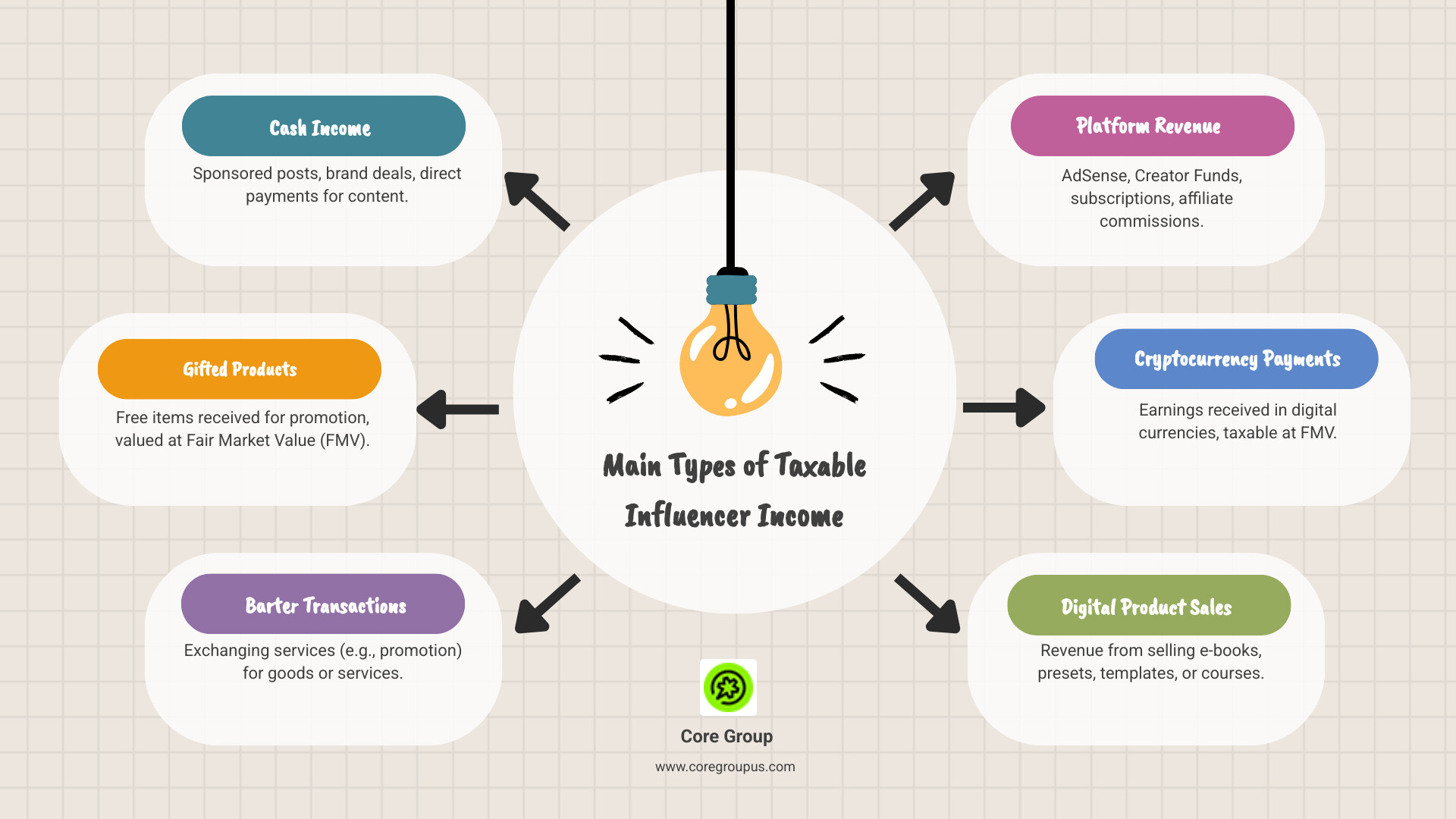
As a content creator, your income isn't always a straightforward paycheck. It can come in many forms, and understanding what's taxable is the first step to staying compliant. The IRS (and CRA in Canada) considers income to be anything that increases your wealth, whether it's money, property, or services. This means that if you receive something of value in exchange for your influence, it's likely taxable.

For US taxpayers, IRS Publication 525, "Taxable and Nontaxable Income," is your go-to resource for understanding these nuances. It clearly states that you can receive income in the form of money, property, or services, and this publication discusses many kinds of income and whether they are taxable or nontaxable.
A key concept here is Fair Market Value (FMV). When you receive non-cash items, their FMV at the time of receipt is what you'll report as income. This is especially true for barter transactions, where you exchange your services for goods or other services without any money changing hands. For example, if you promote a brand in exchange for a new camera, the camera's FMV is your taxable income.
Key Income Sources and the Basics of Taxes for Influencers
Let's break down the common ways influencers earn income and how they're taxed:
- Sponsored Posts and Brand Deals: This is often the bread and butter for many creators. Payments received for creating content that promotes a brand, product, or service are clearly taxable income. This includes direct payments, but also things like referral codes that generate commissions.
- Affiliate Commissions: When you earn a percentage of sales generated through your unique links, that's taxable income.
- Ad Revenue: Platforms like YouTube pay creators based on ad views or clicks on their content. This income, usually received through services like AdSense, is fully taxable.
- Gifts from Followers: Generally, small, unsolicited gifts from followers are not considered taxable income. However, if a "gift" from a brand or company is given in exchange for promotion or a service, it's typically treated as taxable income at its Fair Market Value. We cover this in more detail in our blog post, Is There Tax on Gift Cards.
- Free Products: That new skincare line, gaming console, or designer handbag you received for a review? If you were expected to perform a service (like posting about it) in return, its Fair Market Value is taxable income.
- Free Vacations and Experiences: Dream trips are a perk of the job, but they're not tax-free. If a brand covers your travel, accommodation, and activities in exchange for promotional content, the value of that trip is taxable income.
- Barter Exchanges: As mentioned, exchanging your promotion services for goods or services (like a free stay at a hotel for a review) means you must report the Fair Market Value of what you received as income. This is a common aspect of influencer services, and you can learn more about how we help creators manage this on our influencer services page.
Platform & New-Age Payments
The digital landscape constantly evolves, bringing new ways to earn. Here's how some of these unique income streams are handled:
- YouTube AdSense: Payments from YouTube's advertising program are a direct form of taxable income, reported just like any other business revenue.
- Twitch Subscriptions and Bits: Income from viewer subscriptions, donations (Bits), and other platform monetization features on Twitch is taxable.
- TikTok Creator Fund: While the TikTok Creator Fund was a way for TikTok to pay creators directly, these payments are taxable income. We've written a detailed guide on Clearing Up Confusion on the TikTok Creator Fund Tax.
- Cryptocurrency Payments: If you receive payments in cryptocurrency for your services, the Fair Market Value of that crypto in US dollars (or CAD for Canadian residents) at the time of receipt is considered taxable income. You'll also have capital gains or losses if the value of the crypto changes between when you received it and when you sell or spend it.
- Digital Product Sales: Selling your own presets, e-books, courses, or merchandise directly to your audience generates taxable income.
Structuring Your Influencer Business for Tax Success
How you structure your influencer activities can have significant tax implications. It starts with a fundamental question: Is your content creation a hobby or a business?
Hobby vs. Trade
The IRS (and CRA in Canada) doesn't care if you call yourself a business; they care if you act like one. If your influencer activities are genuinely aimed at making a profit and you carry them out in an organized, commercial manner, it's considered a business. If it's primarily for pleasure with no real expectation of profit, it's a hobby.
For US taxpayers, the IRS looks at several factors, often called "badges of trade" (a term often used in UK tax law but the principles are similar for the IRS), to distinguish between a hobby and a trade. These include:
- Whether you carry on the activity in a businesslike manner.
- The time and effort you put into the activity.
- Whether you depend on the income for your livelihood.
- Whether you have losses due to circumstances beyond your control (or are typical in the startup phase of a business).
- Whether you change your methods to improve profitability.
- Your expertise in the activity.
- Your history of income or losses from the activity.
If the IRS deems your activity a hobby, you generally cannot deduct business expenses beyond the income generated by the hobby, and those deductions are limited. However, if it's a business, you can deduct all ordinary and necessary business expenses, even if they result in a loss. To be considered a legitimate business by the IRS, your activity should show a profit in at least three of the last five tax years, or demonstrate a clear potential for future profits.
GST/HST Registration (for Canadian Influencers)
For our Canadian friends, the Goods and Services Tax (GST) and Harmonized Sales Tax (HST) are consumption taxes you might need to collect. You are generally required to register for a GST/HST account if your total taxable revenues from your influencer activities (and other taxable supplies) exceed $30,000 in a single calendar quarter or over four consecutive calendar quarters. This $30,000 threshold is known as the "small supplier" threshold.
Once registered, you must charge, collect, and remit GST/HST on your taxable supplies. The good news is that you can also claim Input Tax Credits (ITCs) for the GST/HST you pay on your business expenses, helping to reduce your net remittance. Even if you don't meet the threshold, you can voluntarily register, which allows you to claim ITCs immediately.
Sole Proprietor vs. Limited Company
Most influencers start as self-employed individuals, operating as sole proprietors. This is the simplest structure, but as your income grows, you might consider incorporating.
Here's a quick comparison for US-based influencers:
| Feature | Sole Proprietorship | Limited Company (e.g., S Corp, C Corp) |
|---|---|---|
| Setup | Easiest, no formal action needed (just start doing business). | More complex, requires filing with the state. |
| Liability | Unlimited personal liability for business debts and lawsuits. | Limited personal liability (personal assets generally protected). |
| Taxation | "Pass-through" taxation. Income/expenses reported on Schedule C of your personal Form 1040. Subject to self-employment tax. | Separate legal entity. Profits taxed at corporate level (C Corp) or "pass-through" to personal return (S Corp). Potential for tax savings on self-employment tax with S Corp. |
| Administrative | Minimal paperwork, simpler record-keeping. | More complex, requires corporate bylaws, annual meetings, separate banking, and more detailed record-keeping. |
| Credibility | May be perceived as less formal. | Often perceived as more professional and credible by brands and partners. |
| Cost | Low startup and ongoing costs. | Higher startup and ongoing costs (filing fees, legal, accounting). |
| Income Split | No formal income splitting. | Can pay yourself a reasonable salary and take remaining profits as distributions (S Corp) or dividends (C Corp), potentially optimizing taxes. |
For sole proprietors, understanding how to maximize your deductions on Schedule C is crucial. We even have a blog post on The Planner Blog - Section 105 Plan for Sole Proprietors Filing Schedule C that dives into specific strategies.
Deciding between a sole proprietorship and a limited company depends on your income level, risk tolerance, and long-term business goals. It's a key area where professional advice can save you significant money and headaches.
Maximizing Deductions & Keeping Your Books Clean
One of the most exciting parts of being a business owner (yes, even a digital one!) is the ability to deduct ordinary and necessary business expenses. This means reducing your taxable income, which ultimately means paying less in taxes. But to do this effectively, you need meticulous record-keeping.

The IRS emphasizes the importance of good records to support your income, expenses, and credits. This includes invoices for services rendered, payment receipts for expenses, bank statements, and any other documentation related to your business activities. Accounting software can be a lifesaver here, automating many of these tasks and keeping everything organized. You can find more general information on business expense deductions on the IRS website.
Common Deductible Expenses for Creators
Here are some common expenses that influencers and content creators can often deduct:
- Home Office Expenses: If you use a dedicated space in your home exclusively and regularly for your business, you can deduct a portion of your rent/mortgage interest, utilities, insurance, and property taxes.
- Equipment: Cameras, lenses, microphones, lighting, computers, smartphones, and other tech essential for content creation are deductible.
- Software and Subscriptions: Editing software (Adobe Creative Suite), scheduling tools, website hosting, domain fees, stock photo subscriptions, and music licensing are all fair game.
- Marketing & Advertising: Costs for promoting your content or brand, including social media ads, website design, and business cards.
- Travel for Business: If you travel for brand events, conferences, or to create specific content (and it's not a free trip that's already counted as income), expenses like airfare, accommodation, and a portion of meals can be deductible.
- Professional Development: Courses, workshops, and books related to improving your craft or business skills.
- Internet & Phone Bills: A portion of these costs can be deducted if used for business.
- Bank Fees: Fees associated with your business bank accounts.
- Professional Services: Fees paid to accountants, lawyers, or other consultants.
Every expense must be "ordinary and necessary" for your business, and you must have documentation to back it up.
Capital Expenses vs. Current Expenses
Not all expenses are treated the same. Some items, like computers, cameras, and other significant equipment, are considered "capital expenses" because they have a useful life of more than one year. These aren't immediately deductible in full. Instead, their cost is recovered over several years through a process called depreciation (or Capital Cost Allowance, CCA, in Canada).
For US taxpayers, the IRS allows for accelerated depreciation methods like Section 179 deduction or bonus depreciation, which can enable you to deduct a significant portion, or even the full cost, of qualifying assets in the year they are placed in service. This can be a huge tax advantage.
In contrast, "current expenses" are consumed within the year, like software subscriptions, office supplies, or advertising costs, and are fully deductible in the year they are incurred. The canada.ca page on capital expenses provides specific Canadian context for this distinction.
Understanding the difference and applying the correct deduction method is crucial for maximizing your tax savings.
Handling Foreign Currency and Record-Keeping
Many influencers work with international brands or platforms, leading to payments in foreign currencies like USD. For US taxpayers, you'll need to convert any income received in foreign currency into US dollars. The exchange rate to use is generally the rate in effect on the date you received the income. Alternatively, you can use an average exchange rate if you receive payments regularly throughout the year.
For Canadian influencers receiving USD, it's important to convert all your USD income into CAD before completing your income tax return. The Bank of Canada’s conversion table provides annual average exchange rates that can be used for this purpose.
Regardless of your currency, robust record-keeping is non-negotiable. We recommend:
- Separate Business Bank Account: Keep your personal and business finances separate. This makes tracking income and expenses infinitely easier and provides a clear audit trail.
- Digital Record-Keeping Tools: Use accounting software (like QuickBooks, Xero, or FreshBooks) to categorize transactions, generate reports, and store digital copies of receipts.
- Regular Reconciliation: Reconcile your bank statements monthly to catch errors and ensure all transactions are recorded.
- Backup Everything: Store digital records securely in the cloud or on external drives.
Good record-keeping isn't just about tax compliance; it's about understanding the financial health of your business. For more tax planning insights, check out our Resources - Tax Planning page.
Understanding the Essentials of Taxes for Influencers
Beyond knowing what income to report and what expenses to deduct, understanding the rhythm of tax season is paramount. As a self-employed individual, you're responsible for not only filing your tax return but also for paying your taxes throughout the year.
For US-based influencers, this means dealing with self-employment tax (Social Security and Medicare contributions) and making estimated tax payments. Since no employer is withholding taxes from your influencer income, you're expected to pay your income and self-employment taxes quarterly. These estimated payments help you avoid a large tax bill and potential penalties at year-end.
Navigating Deadlines and Special Cases in Taxes for Influencers
US Tax Deadlines for Self-Employed Influencers:
- Estimated Tax Payments: These are typically due on April 15, June 15, September 15, and January 15 of the following year. If these dates fall on a weekend or holiday, the deadline shifts to the next business day.
- Annual Tax Return (Form 1040): Generally due by April 15. If you file an extension, you typically have until October 15, but any taxes owed are still due by April 15.
Canadian Tax Deadlines for Self-Employed Influencers:
- Annual Tax Return: While the deadline for filing your personal income tax return as a self-employed individual is June 15, any taxes owed must still be paid by April 30.
Consequences of Non-Compliance:The IRS takes non-compliance seriously. Not reporting income, underpaying taxes, or missing deadlines can lead to:
- Penalties: These can include penalties for failure to file, failure to pay, and underpayment of estimated tax.
- Interest: Interest accrues on underpaid taxes from the due date until the date of payment.
- Audits: The IRS may select your return for audit, which can be a lengthy and stressful process.
Voluntary Disclosure Program (VDP):If you've realized you haven't reported income or complied with tax obligations in previous years, the IRS (and CRA in Canada) offers a Voluntary Disclosure Program. This program allows taxpayers to come forward and correct their tax affairs, potentially reducing or avoiding penalties. It's a complex process, and seeking professional advice is highly recommended before pursuing it.
Non-Resident Tax Implications:For influencers who are not US residents but earn income from US sources (e.g., US brands, US audience ad revenue), there are specific tax implications. The US generally taxes non-residents on income effectively connected with a US trade or business. This can involve different filing requirements and withholding taxes. Similarly, for Canadian influencers who are not Canadian residents, the CRA has specific rules, including a simplified non-resident regime for sales tax in some cases.
US Market-Based Sourcing Rules:For US market influencers, especially those working across state lines, understanding "market-based sourcing rules" is crucial. Some US states require that income for services be sourced to where the benefit of the service is received (i.e., where the audience is located), rather than where the influencer performs the service. This can lead to state tax obligations in multiple states, requiring careful tracking of your audience demographics and income attribution.
Name, Image, and Likeness (NIL) Income:A special case in the US is Name, Image, and Likeness (NIL) income for student-athletes. Following the NCAA's interim NIL policy, student-athletes can now monetize their NIL without jeopardizing their eligibility. This income is generally considered taxable, and student-athletes are typically treated as independent contractors, meaning they are subject to self-employment tax and estimated tax payments. They must also consider the impact of NIL income on their financial aid eligibility.
Frequently Asked Questions about Influencer Taxes
We know you've got questions, and we're here to answer them clearly.
Are gifted products always taxable?
Yes, generally, if you receive a gifted product, service, or experience (like a free vacation) in exchange for a promotional post, review, or any other service, its Fair Market Value (FMV) at the time of receipt is considered taxable income. This falls under the umbrella of barter transactions. The IRS requires you to report the FMV of property or services received in bartering as income. So, that designer handbag or luxury trip? It's likely income.
What happens if my influencer business loses money?
It's perfectly normal for a business, especially a new one, to incur losses in its early years. The IRS and CRA generally allow you to deduct these business losses against other income. However, if your influencer activity consistently fails to earn a profit over several years (for the IRS, typically showing a profit in three out of five tax years), tax authorities might reclassify it as a "hobby." If deemed a hobby, your ability to deduct expenses is severely limited, often only up to the amount of income the hobby generates, and those deductions might not be allowed at all. This is why demonstrating an "intent to profit" and operating in a businesslike manner is so important.
Do I need to register for GST/HST in Canada?
For our Canadian creators, you are required to register for GST/HST if your total worldwide taxable revenues (including income from sponsorships, ad revenue, digital product sales, and the Fair Market Value of any bartered goods or services) exceed $30,000 in a single calendar quarter or over four consecutive calendar quarters. This is the "small supplier" threshold. If you meet or exceed this threshold, you must register, collect, and remit GST/HST on your taxable supplies. However, even if you don't meet the threshold, you can choose to voluntarily register, which allows you to claim Input Tax Credits (ITCs) on your business expenses.
Conclusion
Navigating taxes for influencers might seem like a daunting task, but it's an essential part of building a sustainable and compliant business. From understanding what counts as taxable income—be it cash, gifted products, or bartered services—to carefully tracking your expenses and meeting crucial deadlines, proactive tax planning is your best strategy.
We've explored the differences between a hobby and a trade, the implications of various business structures, and the importance of diligent record-keeping. Tax authorities like the IRS and CRA are increasingly scrutinizing digital income, making compliance more critical than ever.
When should you consider seeking professional tax advice? We recommend it as soon as your influencer activity moves beyond a casual hobby, when your income becomes significant, or when your tax situation becomes complex (e.g., international collaborations, incorporating, or dealing with capital expenses). A tax professional can help you optimize deductions, ensure compliance, and provide peace of mind, allowing you to focus on what you do best: creating amazing content.
At Core Group, we specialize in financial management for creative entrepreneurs. Our "no-fluff, profit-first playbook" is designed to simplify your finances, save you time, and ensure you're making the most of your earnings. Don't let tax season stress you out; let us help you build a solid financial foundation for your creative business.