How to Soften the Blow of Your Gambling Losses at Tax Time
What You Need to Know About Taxes on Gambling Losses Right Now
Understanding taxes on gambling losses can save you real money, especially now that the rules have changed significantly starting in 2026.
Quick answer for most taxpayers
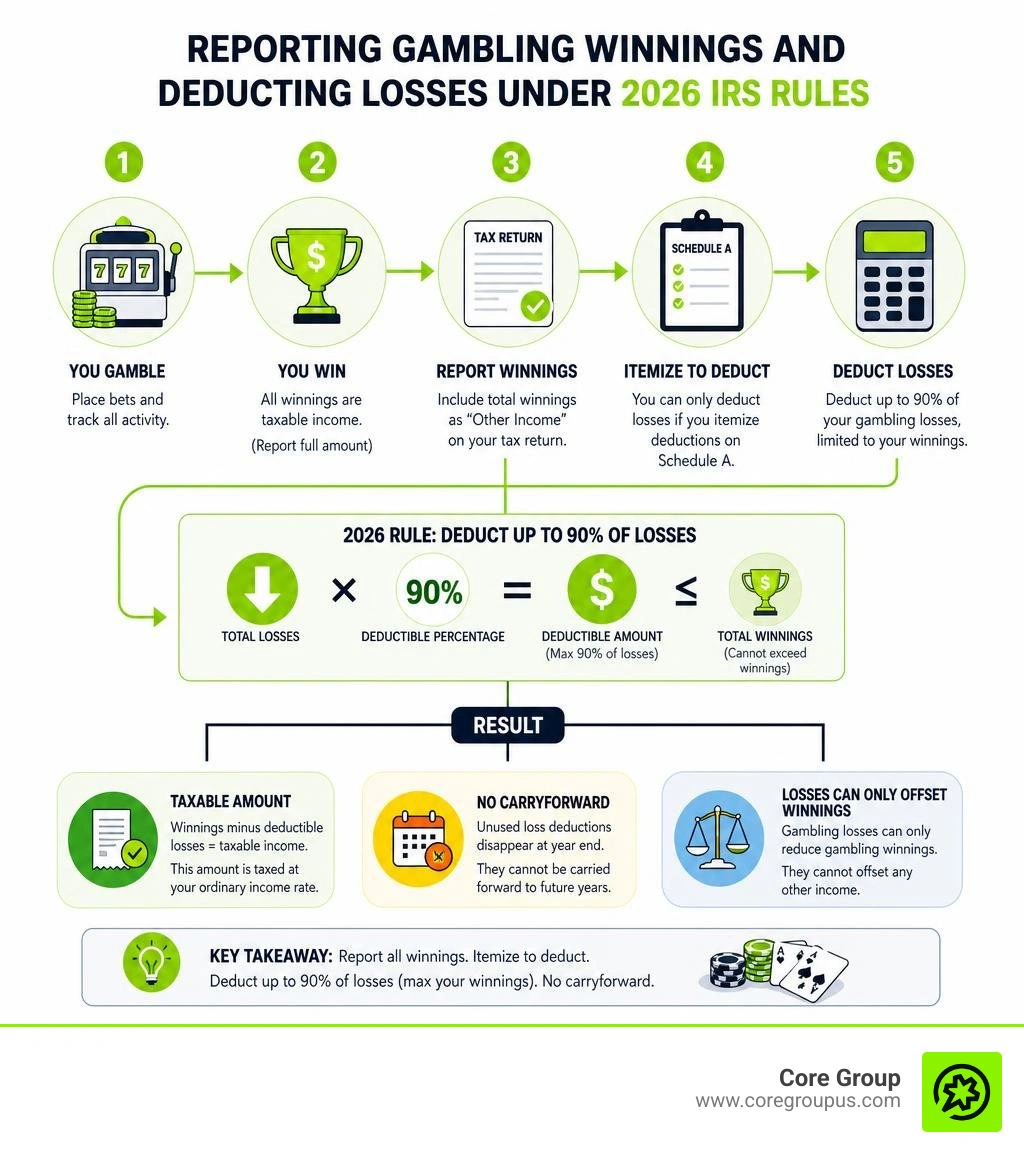
- Gambling winnings are always taxable income, no matter the amount
- You can only deduct losses if you itemize deductions on Schedule A
- Losses can only offset winnings and not other income
- Starting in 2026, you can deduct a maximum of 90% of your gambling losses (down from 100%)
- No carryforward is allowed because unused loss deductions disappear at year end
For creative entrepreneurs who gamble recreationally, this is not a minor bookkeeping footnote. It is a real shift that can create taxable income even when you break even or come out behind.
Here is a simple example. Say you won $10,000 and lost $10,000 in 2026. Under the old rules, those cancel out. Under the new rules, you can only deduct $9,000 of your losses, leaving $1,000 of taxable income on money you never actually kept.
That is not a typo. The IRS can now tax income you did not earn.
This guide breaks down exactly how the rules work, what changed, who is affected most, and what steps you can take to reduce the damage at tax time.
Understanding the Baseline IRS Rules for Taxes on Gambling Losses
To understand how the new laws impact your wallet, we first need to look at how the IRS historically treats wagering activities. The federal government views gambling winnings as fully taxable income. This rule applies to casual players who visit a casino, place a sports bet, or buy a lottery ticket.
When you win, the fair market value of your prize, whether it is cash, a new car, or a vacation, must be reported on your tax return. You cannot simply subtract your losses from your wins at the end of the year and report the net difference as your income. Instead, the IRS requires you to report the entire sum of your winnings first.
For casual gamblers, winnings are reported as other income on Schedule 1 of Form 1040. If you want to claim your losses, you must do so separately. You can find more details on this basic structure in the official IRS Topic 419 Guidance.
The biggest hurdle for most recreational players is that gambling losses can only be claimed if you itemize your deductions. We discuss this in depth in our article on Are Gambling Losses Itemized Deductions. If you take the standard deduction, you cannot deduct any of your losses, meaning you will pay taxes on the full amount of your winnings even if you lost twice that amount over the course of the year.
Casinos and sports betting platforms are required to report certain winnings directly to the IRS using Form W-2G. This form is typically issued when your winnings meet specific thresholds, such as $1,200 or more from a slot machine, $1,500 or more from keno, or $600 or more from sports betting if the payout is at least 300 times your wager. However, even if you do not receive a Form W-2G, you are legally obligated to report every dollar of your winnings on your tax return.
The One Big Beautiful Bill Act and the New Ninety Percent Limit
The landscape of gambling taxation changed dramatically with the passage of the One Big Beautiful Bill Act, also known as the OBBBA. Signed into law in July 2025, this sweeping tax package introduced major structural changes that went into effect on January 1, 2026.
The primary goal of the OBBBA was to implement broad tax reforms while managing the federal deficit. To offset the costs of other tax cuts, the Senate Finance Committee searched for non-controversial revenue sources. They landed on a major adjustment to Internal Revenue Code Section 165(d), which governs how wagering losses are deducted.
Under the OBBBA, the deduction for gambling losses is now capped at 90% of your qualified losses. This 10% reduction is projected to raise approximately $1.1 billion in federal tax revenue over the next eight years. While this change might seem minor on paper, it represents a massive shift in how the government taxes recreational activities. According to the detailed KPMG Analysis of the OBBBA, this new rule effectively taxes a portion of gross gambling activity rather than actual net profits.
How the Ninety Percent Cap Affects Taxes on Gambling Losses
The introduction of the 90% cap has introduced a concept known as phantom income. This occurs when a taxpayer is forced to pay taxes on money they did not actually profit from, or worse, money they lost.

Let us look at how this tax friction plays out for a typical casual sports bettor in 2026. Imagine you use a mobile sports betting app throughout the year. You have a series of wins totaling $50,000, but you also have losses totaling $50,000. In reality, you broke even.
Under the old rules, you would report $50,000 of income and deduct $50,000 in losses, resulting in $0 of net taxable income. Under the 2026 rules, you must still report the $50,000 in winnings. However, your deduction is capped at 90% of your losses, which is $45,000. You are now required to pay income tax on $5,000 of phantom income, despite having $0 in actual profit.
For high-volume bettors with thin margins, the math becomes even more punishing. Consider a player who wins $200,000 and loses $195,000, leaving them with an actual profit of $5,000. Under the new rules, their deductible losses are capped at 90% of $195,000, which is $175,500. This leaves them with a taxable income of $24,500. Depending on their tax bracket, the tax bill on that $24,500 could easily exceed their actual $5,000 profit, resulting in an effective tax rate of over 100% on their real-world earnings. You can explore more scenarios and calculations in the Super Lawyers Guide to the Ninety Percent Limit.
Comparing Prior Rules and Current Rules
To help you visualize these differences, we have outlined the major tax changes before and after the 2026 tax year.
| Tax Provision | Pre-2026 Rules | Post-2025 Rules (2026 Tax Year) |
|---|---|---|
| Maximum Loss Deduction | 100% of losses up to the amount of winnings | 90% of losses up to the amount of winnings |
| Standard Deduction for Single Filers | $15,750 (for 2025) | $16,100 (for 2026) |
| Standard Deduction for Joint Filers | $31,500 (for 2025) | $32,200 (for 2026) |
| Scope of Deductible Expenses | Wagering losses only for casual players | Wagering losses capped at 90% for all players |
| Carryforward of Unused Losses | Not allowed | Not allowed |
As shown in the table, the basic limitation remains that you cannot deduct more than you win. However, the new 90% cap adds an extra layer of tax liability. This table highlights why many taxpayers ask us, Gambling Losses Should Just Offset My Gambling Winnings Right. The reality is that the tax code has never treated gambling wins and losses as a simple offset, and the 2026 rules make that separation even wider.
Requirements for Claiming Your Deductions
If you want to claim your taxes on gambling losses, you must meet strict IRS guidelines. The most basic rule is that you cannot claim a deduction that exceeds your reported winnings. If you win $5,000 and lose $8,000, your deduction is capped based on your winnings, and starting in 2026, it is further reduced by the 90% cap. You can read more about these basic boundaries in the Investopedia Guide on Gambling Losses.
To secure these deductions, you must bypass the standard deduction and itemize your expenses on Schedule A. This requires careful planning, as the standard deduction thresholds have increased for the 2026 tax year to adjust for inflation.
Itemizing Your Deductions on Schedule A
Because the standard deduction is so high, only about 14% of Americans are expected to itemize their deductions in 2026. This means the vast majority of taxpayers will not be able to claim their gambling losses at all.
If you are a single filer in 2026, your standard deduction is $16,100. If you are married filing jointly, it is $32,200. To make itemizing beneficial, your total itemized deductions, including mortgage interest, state and local taxes, charitable donations, and gambling losses, must exceed these thresholds.
If you have $5,000 in gambling winnings and $5,000 in losses, but you have no other itemized deductions, taking the standard deduction of $16,100 is still your best financial move. However, you must still report the $5,000 in winnings as taxable income, meaning you will pay taxes on that money without receiving any offsetting benefit from your losses.
Essential Recordkeeping to Substantiate Taxes on Gambling Losses

To protect yourself, you should maintain a detailed wagering diary. For every gambling session, you should record the following details.
- The date and time of the activity
- The specific type of wager or game
- The name and address of the casino or gaming establishment
- The names of any other people present with you
- The exact amounts you won or lost
You must also save supporting documentation, such as wagering tickets, credit card statements, bank withdrawal receipts, and Form W-2G statements.
For slot players, the IRS provides specific guidance on how to track wins and losses. Under the IRS Chief Counsel Advice on Slot Play, players can determine their gains and losses based on individual sessions of play rather than tracking every single spin. A session is generally defined as a continuous period of play on a single machine or type of game during a single calendar day. When you redeem your tokens or cash out, that transaction marks the end of the session, allowing you to calculate your net gain or loss for that specific period.
Professional Gamblers Versus Casual Bettors Under the New Law
The IRS draws a sharp distinction between casual gamblers and professional gamblers. Professionals are considered to be running a trade or business. Instead of reporting their activity on Schedule A, they file Schedule C as self-employed individuals.
To qualify as a professional gambler, you must prove that you pursue gambling full-time, with continuity and regularity, and with the primary motive of making a profit. If you qualify, you can deduct ordinary and necessary business expenses, such as travel, lodging, data subscriptions, and entry fees.
However, the OBBBA has made life much harder for professional gamblers. The new 90% limitation on deductions applies to any expenses incurred in carrying on wagering transactions. This means that professional gamblers can no longer deduct 100% of their business expenses or wagering losses.
This change has caused massive concern within the gaming industry. Around 10% of sports bettors are responsible for over 80% of the total industry handle. Many of these high-volume, professional bettors operate on razor-thin profit margins. With the 90% cap in place, many professionals are facing massive tax bills on phantom income, which could force them to reduce their betting volume, migrate to offshore platforms, or move to prediction markets that operate outside traditional US tax reporting systems.
Frequently Asked Questions About Gambling Taxes
Navigating the tax code can be confusing, especially with new laws in place. Here are answers to some of the most common questions we receive about gambling taxes.
Can nonresident aliens deduct gambling losses
Generally, nonresident aliens who file Form 1040-NR cannot deduct gambling losses on their US tax returns. The IRS taxes their US-source gambling winnings at a flat rate of 30%, and they are not permitted to offset those winnings with losses.
The primary exception to this rule applies to residents of Canada. Under the US-Canada tax treaty, Canadian residents are allowed to deduct their gambling losses to the extent of their US winnings, similar to US citizens. However, they must still maintain the same rigorous recordkeeping and documentation required of US taxpayers to claim these deductions.
Are there legislative efforts to restore the full deduction
Yes, the gaming industry and various lawmakers are actively working to reverse the 90% cap. Two major bills have been proposed in Congress to address this issue, including the FAIR BET Act, introduced by Representative Dina Titus, and the FULL HOUSE Act, sponsored by Representatives Max Miller and Steven Horsford.
According to a Gambling Insider Report on Legislative Fixes, supporters are urging the House Rules Committee to attach these fixes to upcoming federal spending bills. Industry advocates argue that the 90% cap hurts state tax revenues by driving high-volume players to unregulated offshore markets. While prediction markets show mixed odds on whether a repeal will pass by the end of 2026, the issue remains a top priority for gaming lobbyists.
How does the ninety percent limit create phantom income
The 90% limit creates phantom income by preventing you from deducting the full amount of your losses, even when those losses match or exceed your winnings.
If you win $100,000 and lose $100,000, your net real-world profit is $0. However, because you can only deduct 90% of your losses, your allowable deduction is limited to $90,000. The IRS treats the remaining $10,000 as taxable income. You are forced to pay taxes on $10,000 of income that you do not actually have in your bank account, which is the definition of phantom income.
Conclusion
The 2026 tax changes under the One Big Beautiful Bill Act have made managing your gambling records more important than ever. With the new 90% cap on loss deductions, recreational players and professional bettors alike face a much higher risk of paying taxes on phantom income.
At Core Group, we help creative entrepreneurs navigate these complex tax rules. Our team provides financial management, bookkeeping, and tax services designed to give you complete peace of mind. We use a no-fluff, profit-first playbook that saves you time and protects your hard-earned money, all backed by our MacBook Pro guarantee.
If you want to make sure your records are audit-proof or need help modeling how these new rules impact your personal finances, we are here to help. You can read more about maximizing your deductions in our guide on IRS Gambling Deductions, or reach out to us today to schedule a consultation.