Understanding Gift Card Taxability with the IRS
Why Understanding Gift Card Taxability Matters for Your Business
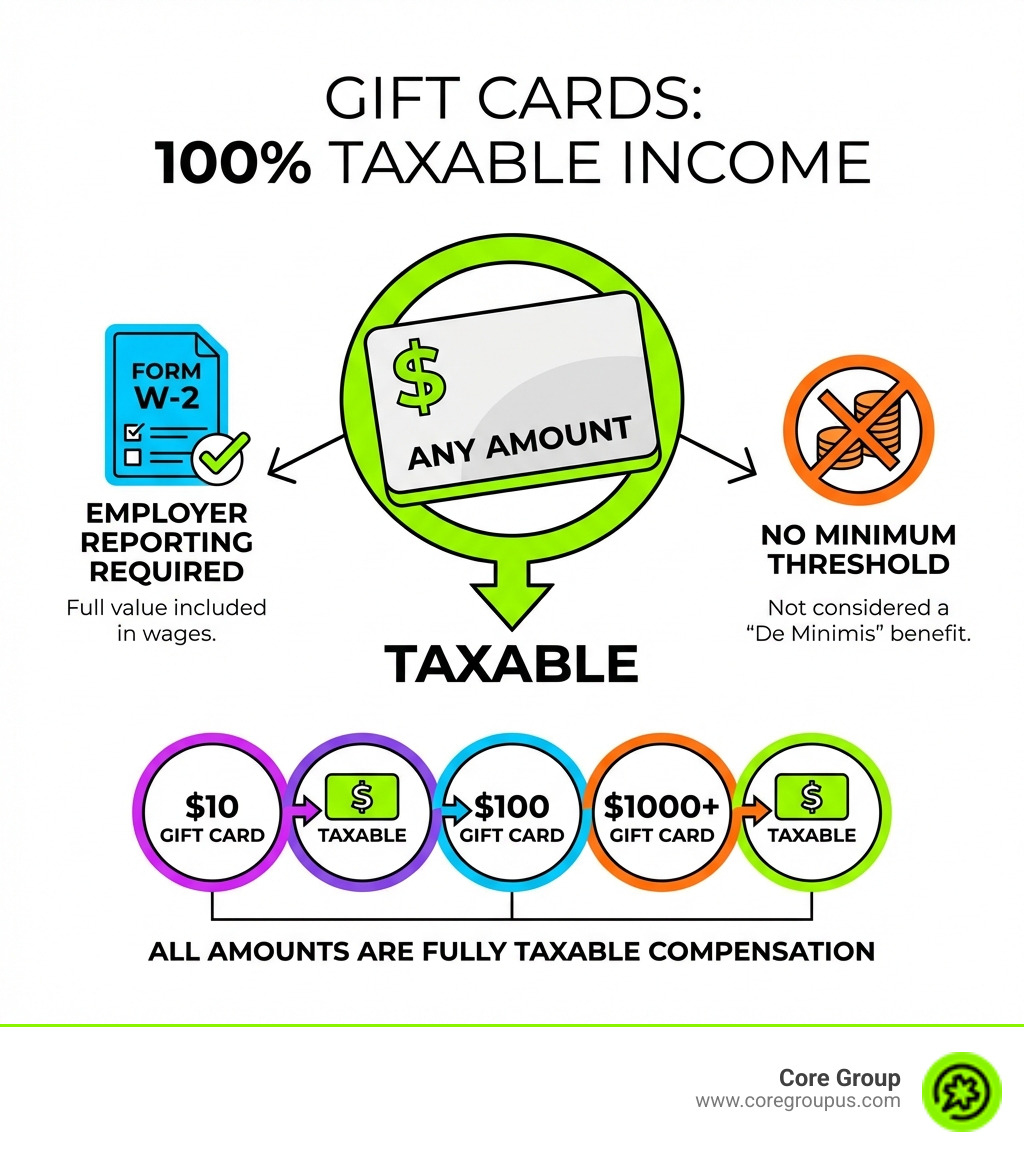
What amount of gift card is taxable? According to IRS rules, all gift cards are taxable as income, regardless of the dollar amount. Whether you give a $25 coffee shop card or a $500 travel voucher to an employee, the full value must be reported as taxable compensation. There is no minimum threshold that makes a gift card tax-free.
Quick Answer:
- For Employees: 100% of the gift card value is taxable income, reported on Form W-2
- No De Minimis Exception: Gift cards are considered "cash equivalents" and never qualify for the small-gift tax exemption
- Amount Doesn't Matter: A $10 gift card is just as taxable as a $1,000 gift card
- Reporting Required: Employers must withhold income tax, Social Security, and Medicare taxes on the full value
As a creative entrepreneur managing your film or media business, you might think giving your crew a $50 gift card is just a nice gesture. But the IRS sees it differently. They classify gift cards as cash, which means they're taxable from the first dollar.
Many business owners get tripped up by this rule. They've heard about "de minimis" benefits—small perks that don't need to be taxed. But gift cards don't qualify, no matter how small. The IRS changed these rules specifically to protect employee wages and prevent companies from replacing taxable salary with tax-free perks.
This gets even more complex when you're juggling multiple roles, paying contractors, thanking clients, or compensating research participants. Each recipient type has different tax rules and reporting thresholds. Getting it wrong can lead to penalties, audit headaches, and stress you don't need when you're trying to focus on your creative work.
The IRS View on Gift Cards: Are They Taxable Income?
When we think of showing appreciation to our employees or partners, gift cards often come to mind. They're convenient, flexible, and generally well-received. However, the IRS has a very specific stance on gift cards: they are considered taxable income. This means that, from the IRS's perspective, a gift card is treated much like cash or additional wages.
Gift cards fall under the category of "cash equivalent fringe benefits." This crucial classification means their value must be included in an employee's wages and is subject to federal income tax withholding, as well as Social Security and Medicare taxes (FICA). This applies whether the gift card is given as a holiday bonus, an employee recognition award, or just a token of appreciation. The tax rules for gift cards do not change based on the amount—a $50 gift card is just as taxable as a $500 one.
The IRS outlines its regulations on fringe benefits in publications like Fringe benefits explained by the IRS. For creative entrepreneurs, understanding these rules is vital for proper Accounting and tax compliance.
Why Gift Cards Are Considered Cash Equivalents
The core reason gift cards are taxable is their nature as "cash equivalents." Unlike a specific non-cash item (like a turkey or a plaque), a gift card can typically be used to purchase a wide variety of goods or services, making it nearly as flexible as cash itself. The IRS deems cash and cash equivalents as easy to account for, making them ineligible for certain tax exclusions.
Historically, there might have been a misconception or even a $25 threshold for gift cards before taxation. However, this is no longer the case. The IRS changed its rules to protect employee pay and prevent companies from structuring compensation to save on taxes by replacing wages with supposedly tax-exempt gifts. This means that if you give a gift card, its value must be included in the recipient's taxable income, regardless of how small it is.
The distinction between a gift card and tangible personal property is key. A gift card, even if it's for a specific store, is seen as giving the recipient control over funds, which is why it's treated like cash.
Are There Any Exceptions?
While the general rule is that gift cards are taxable, there are a few nuances to consider, though true "exceptions" where a gift card might not be taxable are rare and specific.
One primary area of confusion lies in work-related expenses. If a gift card is issued specifically to reimburse an employee for a legitimate business expense they incurred (e.g., a Visa prepaid card for per diem travel expenses, or an Uber Eats gift card for a meal during a remote meeting), and it is properly accounted for as a reimbursement for a business expense, then it generally wouldn't be considered taxable income to the employee. This is because it's not a gift or additional compensation, but rather a repayment for an expense related to their job. Similarly, a gift card for an office supply store to purchase equipment needed for work would typically be treated as a business expense reimbursement, not taxable income.
However, the line can be blurry. If you give an employee a gift card and expect them to use it for a business expense, but there's no clear accountability or it could easily be used for personal purchases, the IRS is likely to view it as taxable income. The intent and the ability to convert it to personal use are critical factors.
Another very narrow "exception" might involve specific-item certificates. If you provide a certificate that allows an employee to receive a specific item of tangible personal property that is minimal in value, provided infrequently, and is administratively impractical to account for, it might be excludable as a de minimis benefit. But remember, this is for a specific item, not a general merchandise gift card. For more insights on this and other financial topics, check out The Planner Blog.
What Amount of Gift Card is Taxable? The 'De Minimis' Benefit Myth
One of the most persistent myths surrounding gift cards and taxes is the idea of a "de minimis" amount that makes them tax-free. Many business owners believe that if a gift card is below a certain value—often cited as $25 or $50—it doesn't need to be reported as taxable income. This is a common misunderstanding that can lead to compliance issues.

The truth is, when it comes to gift cards, there is no de minimis amount that makes them non-taxable. As we've learned, the IRS considers all gift cards as cash equivalents, and cash equivalents are never de minimis. This means that whether you give a $5 gift card for coffee or a $100 gift card for a department store, the full value is taxable income to the recipient.
Understanding the 'De Minimis' Rule
So, what exactly is a "de minimis" fringe benefit? According to the IRS, a de minimis fringe benefit is one for which, considering its value and the frequency with which it is provided, is so small as to make accounting for it unreasonable or impractical. These benefits are excluded from an employee's gross income under Internal Revenue Code §132(e).
For a benefit to qualify as de minimis, it generally must meet these criteria:
- Infrequent and occasional: It shouldn't be a regular occurrence.
- Low value: The benefit itself must have a very small monetary value.
- Impractical to account for: It would be difficult or costly for an employer to track and account for the benefit.
- Non-cash: Crucially, cash or cash equivalents generally do not qualify.
Examples of benefits that can be de minimis include:
- Occasional snacks, coffee, or doughnuts in the office.
- Occasional use of the company photocopier.
- Flowers, fruit, or books provided under special circumstances (e.g., illness, personal crisis, holiday).
- Holiday gifts of tangible personal property with a low value, like a holiday turkey or ham.
- Occasional tickets for entertainment events.
Even for non-cash items, there can be thresholds. For example, if a non-cash gift like flowers or a gift basket exceeds a certain value (e.g., $100 in some university policies), the entire value may become taxable, not just the amount over the threshold. The IRS provides more information on this topic in its guidance on IRS definition of a 'de minimis' fringe benefit.
Why Gift Cards Never Qualify as 'De Minimis'
The reason gift cards don't qualify as de minimis benefits is straightforward: they are considered "cash equivalent." The IRS explicitly states that cash and cash equivalents are never de minimis, no matter how small the amount. A gift card, by its very nature, represents a specific monetary value that can be easily tracked and converted into goods or services. This makes it practical to account for, thus failing the "impractical to account for" test of a de minimis benefit.
This rule applies universally. It doesn't matter if the gift card is worth $5, $50, or $500. It doesn't matter if it's given as part of an employee recognition program, a holiday bonus, or just a spontaneous thank you. In every instance, the full value of the gift card is taxable income to the employee. This is a critical point for creative entrepreneurs to grasp to ensure compliance and avoid unexpected tax liabilities for both their business and their team.
Tax Implications for Givers and Receivers
Understanding what amount of gift card is taxable is only half the battle. We also need to understand the practical tax implications for both the business giving the gift card and the individual receiving it. This includes reporting requirements, withholding obligations, and how it impacts their overall tax picture. For a foundational understanding, we explored this topic in our blog post, Is There Tax on Gift Cards?.
For Employers: Reporting and Withholding
As an employer, when you distribute gift cards to your employees, you have specific responsibilities to the IRS. Since gift cards are considered taxable income, their value must be treated as supplemental wages.
This means:
- Form W-2 Reporting: The value of the gift card must be included in the employee's gross wages on their Form W-2 for the year it was received. It typically goes into Box 1 (Wages, tips, other compensation), Box 3 (Social Security wages), and Box 5 (Medicare wages).
- Income Tax Withholding: You, as the employer, are responsible for withholding federal income tax from the employee's regular paycheck to cover the tax liability on the gift card.
- FICA Taxes: The value is also subject to Social Security and Medicare taxes (FICA), which means both the employer and employee portions of these taxes must be paid.
- Payroll Processing: This typically requires processing the gift card's value through your payroll system, just like any other bonus or additional compensation.
From a business expense perspective, the cost of gift cards given to employees is generally deductible for your business, as it's considered part of employee compensation. However, this is distinct from gifts given to clients. For client gifts, there's a strict limit of $25 per person per year that can be deducted.
For Employees: What to Expect on Your Paycheck
If you're an employee receiving a gift card from your employer, it's important to understand how it impacts your finances.
- Included in Wages: The value of the gift card will be added to your regular wages, increasing your gross income for tax purposes.
- Tax Bracket Impact: This increased gross income could potentially push you into a higher tax bracket, although for most gift card amounts, the impact is usually minimal.
- Taxes Withheld: You will see a reduction in your net pay from your regular paycheck to cover the income tax, Social Security, and Medicare taxes due on the gift card's value. This can sometimes be a surprise if you're not expecting it.
- Understanding your W-2: The total value of all gift cards you received from your employer during the year will be reflected in your Form W-2, combined with your other compensation.
For creative professionals, managing these nuances can be tricky. Our resources, such as The Profitable Creative, often dig into how to manage various income streams and benefits effectively.
What is a 'Tax Gross-Up'?
Sometimes, employers want to give an employee a gift card of a certain value and ensure the employee receives that full amount, without it being reduced by taxes. This is where a "tax gross-up" comes into play.
A tax gross-up is a method where an employer calculates the taxes (federal income tax, FICA, and sometimes state/local taxes) that would be due on the gift card's value and then pays those taxes on behalf of the employee. This ensures the employee receives the full intended net amount.
How does it apply to gift cards?If you want to give an employee a $100 gift card, and want them to actually receive $100 in value, you would perform a gross-up calculation. Instead of simply providing the $100 gift card and letting the employee's paycheck be reduced by the taxes on that $100, you would calculate how much additional payment is needed so that after all taxes are withheld, the employee effectively keeps the $100 value. The gross-up amount is then added to the employee's taxable income, and taxes are withheld on this larger, grossed-up amount.
This method is often used to boost employee morale, as it prevents the "surprise" of a smaller-than-expected paycheck after receiving a gift. However, it means the employer's total cost for the gift card is higher than its face value.
Steps to Calculate a Tax Gross-Up:
- Determine the Net Amount: Decide the desired net value the employee should receive (e.g., $100 gift card).
- Estimate Tax Rates: Identify the employee's applicable federal income tax, Social Security, Medicare, and any state/local tax rates.
- Calculate Gross-Up Percentage: This involves a formula to determine the pre-tax amount needed to yield the desired net amount after all withholdings.
- Add to Taxable Wages: The grossed-up amount is added to the employee's taxable wages, and all required taxes are withheld from this higher figure.
- Pay the Gift Card: The employee receives the gift card, and their paycheck remains unaffected by the taxes on it, as the employer has covered them.
How Tax Rules Differ for Various Recipients
The question of what amount of gift card is taxable becomes even more nuanced when we consider different types of recipients. The IRS categorizes individuals differently, and these classifications dictate distinct tax rules and reporting requirements for gift cards.
Here’s a simplified comparison:
| Recipient Type | Taxable to Recipient? | Reporting Form (Giver) | Tax Threshold for Reporting (Giver) | Deductible by Giver? |
|---|---|---|---|---|
| Full-Time Employees | Yes (100% of value) | W-2 | All amounts | Yes (as compensation) |
| Independent Contractors | Yes (100% of value) | 1099-NEC | $600 or more in a calendar year | Yes (as compensation) |
| Clients/Customers | No | None | None | Yes (up to $25 per person) |
| Research Participants | Yes | 1099-MISC or 1099-NEC | $600 or more in a calendar year | Yes (as business expense) |
What amount of gift card is taxable for Full-Time Employees vs. Independent Contractors?
The distinction between employees and independent contractors is crucial for gift card taxability and reporting.
Full-Time Employees: As discussed, gift cards given to full-time employees are always 100% taxable income, regardless of the amount. The value is added to their regular wages and reported on their Form W-2. Employers must withhold income tax, Social Security, and Medicare taxes from the employee's pay. This is a straightforward process handled through payroll.
Independent Contractors: For independent contractors (freelancers, consultants, etc.), gift cards are also considered 100% taxable income. However, the reporting mechanism differs. If you pay an independent contractor $600 or more (including gift cards and other payments) in a calendar year, you are required to report these payments to the IRS. This is done on Form 1099-NEC (Nonemployee Compensation).
To comply with this, you need to:
- Collect a W-9 Form: Before making payments, you should request a W-9 Form from the independent contractor. This form provides their Taxpayer Identification Number (TIN) needed for 1099 reporting.
- Issue a 1099-NEC: If the total payments (including gift cards) reach $600 or more, you must issue a 1099-NEC to the contractor and file a copy with the IRS by January 31st of the following year.
The independent contractor is then responsible for reporting this income on their tax return and paying self-employment taxes (Social Security and Medicare) in addition to income tax.
What amount of gift card is taxable for Clients, Customers, or Research Participants?
The rules shift again when we consider non-employee recipients like clients, customers, or individuals participating in research.
Client Gifts: Giving gift cards to clients or customers as a thank you or holiday gesture is generally not taxable income to the recipient. The IRS views these as business gifts, not compensation. However, for the business giving the gift, there's a strict deduction limit. You can only deduct up to $25 per person, per year for business gifts. If the gift card's value exceeds $25, you can only deduct $25 of its cost. Incidental costs like engraving, packing, or shipping for client gifts don't count toward the $25 limit if they don't add substantial value.
Research Participants: Gift cards or incentives given to individuals for participating in research, testing products, or similar services are generally considered taxable income to the recipient. If the total value of these incentives (including gift cards) reaches $600 or more for a single individual in a calendar year, you, as the payer, must:
- Collect a W-9 Form: Obtain a W-9 from the participant.
- Issue a 1099 Form: Issue a Form 1099-MISC (Miscellaneous Income) or 1099-NEC (Nonemployee Compensation, depending on the nature of the service) to the participant and file a copy with the IRS.
It's crucial to inform research participants about this $600 threshold, as they are responsible for reporting and paying taxes on this income.
The varying rules highlight why it's so important for creative entrepreneurs to track all gift card distributions carefully and understand the specific tax implications for each recipient type.
Frequently Asked Questions about Gift Card Taxes
We understand that navigating gift card taxability can be complex. Here are some frequently asked questions to help clarify common concerns:
Are gift cards given for personal reasons (e.g., a birthday gift from a friend) taxable?
No, personal gifts are generally not considered income for the recipient. The IRS’s rules regarding gift cards as taxable income primarily apply when they are given by an employer to an employee, or as payment for services. When a gift card is given from one individual to another as a personal gesture (like a birthday or holiday gift), it is typically not considered taxable income to the person who receives it.
However, it's worth noting that gifts can be subject to a separate "gift tax" for the giver if they exceed the annual exclusion limit (which was $18,000 per recipient in 2024, and $19,000 in 2025). But this is a tax on the transfer of wealth, not income tax for the recipient, and it's a completely separate set of rules from the income tax implications discussed in this article.
Can my business deduct the cost of gift cards given to employees?
Yes, the value of the gift card is considered employee compensation. As such, it is a deductible wage expense for your business, just like regular salary or bonuses. This means that while the gift card is taxable income to the employee, your business can typically deduct the full cost of the gift card (and any associated payroll taxes if you gross up) as a legitimate business expense. This helps reduce your business's taxable income.
What are some non-taxable alternatives to gift cards that employers can offer?
If you're looking to show appreciation without triggering additional tax burdens for your employees (or the administrative hassle for yourself), consider these non-taxable alternatives that can qualify as "de minimis" fringe benefits:
- Occasional Snacks and Beverages: Providing coffee, water, soft drinks, or occasional snacks in the office.
- Holiday Hams or Turkeys: Traditional holiday gifts of tangible personal property, like a turkey or ham, are generally non-taxable if they are of modest value.
- Flowers, Fruit, or Books: These can be given for special circumstances (e.g., illness, personal crisis, or even as a modest recognition) and remain non-taxable if their value is low and they are given infrequently. If the value exceeds a certain threshold (e.g., $100), the entire value could become taxable.
- Occasional Entertainment Tickets: Providing tickets to a sporting event, concert, or other entertainment event on an occasional basis can be a de minimis benefit.
- Company Picnic or Holiday Party: The cost of these events is generally not taxable to employees.
- Occasional Personal Use of Office Equipment: Allowing employees occasional personal use of the photocopier or office supplies, provided it's infrequent and difficult to account for.
- Small Achievement Awards (Tangible Property): Non-cash awards for length of service or safety achievement can be non-taxable up to certain limits, provided they are tangible personal property (not cash or gift cards) and meet other specific IRS criteria.
The key for any of these alternatives is that they must be non-cash, of low value, and provided infrequently to qualify as de minimis and remain non-taxable.
Conclusion: Simplify Your Finances and Stay Compliant
Navigating the tax implications of gift cards can feel like a maze, but the core message from the IRS is clear: what amount of gift card is taxable? All of it. Gift cards are treated as cash equivalents, making them 100% taxable income for employees, regardless of their value or the reason they're given. There's no magical minimum threshold that makes a gift card tax-free under the "de minimis" rule.
For creative entrepreneurs like us, understanding these rules is essential for maintaining compliance and avoiding unnecessary headaches. We've seen that the tax and reporting requirements vary significantly depending on whether the recipient is a full-time employee, an independent contractor, a client, or a research participant. From W-2s and 1099s to specific deduction limits for client gifts, the details matter.
While gift cards offer convenience, we also explored non-taxable alternatives that can still show appreciation without adding to anyone's tax burden. Whether you choose a tax gross-up to ensure your employees receive the full intended value, or opt for a thoughtful non-cash gift, proactive planning is key.
At Core Group, we believe in empowering creative entrepreneurs with the knowledge and tools to manage their finances with confidence. Our "no-fluff, profit-first playbook" is designed to give you peace of mind and save you time, so you can focus on your passion. For expert help managing your business finances and ensuring tax compliance, explore our Tax Planning services. You can also find more valuable insights and tools in our Resources section.