The Ins and Outs of Overtime Tax Rates
What the Federal Tax Rate on Overtime Actually Means for Your Paycheck
Understanding what is the federal tax rate on overtime is one of the most common sources of confusion for working Americans, and the answer changed significantly when the One Big Beautiful Bill Act was signed into law on July 4, 2025.
Quick answer: There is no special "overtime tax rate." Overtime pay is taxed at the same marginal federal income tax rates as your regular wages (10%, 12%, 22%, 24%, 32%, 35%, or 37%, depending on your total income). However, starting with the 2025 tax year, a new deduction allows eligible workers to subtract a portion of their overtime pay from taxable income entirely.
Here is what you need to know at a glance:
| Topic | Key Detail |
|---|---|
| Special overtime tax rate | None, same marginal brackets as regular pay |
| New deduction name | No Tax on Overtime (One Big Beautiful Bill Act) |
| What portion is deductible | The "premium" half of time-and-a-half pay only |
| Max deduction, single filer | $12,500 per year |
| Max deduction, joint filers | $25,000 per year |
| Income limit to qualify | Under $150,000 MAGI (single), $300,000 (joint) |
| Active tax years | 2025 through 2028 |
| Payroll taxes (FICA) | Still apply, deduction does not reduce these |
Your paycheck may look like overtime is taxed harder, but that is usually just a withholding quirk, not your real tax rate. And right now, more than 15.5 million Americans have already claimed the new overtime deduction, with average refunds running more than 10% higher than last year as a result.
Whether you are a film crew member logging long production weeks or a freelancer trying to make sense of a complex W-2, this guide breaks down exactly how the rules work and what you can claim.
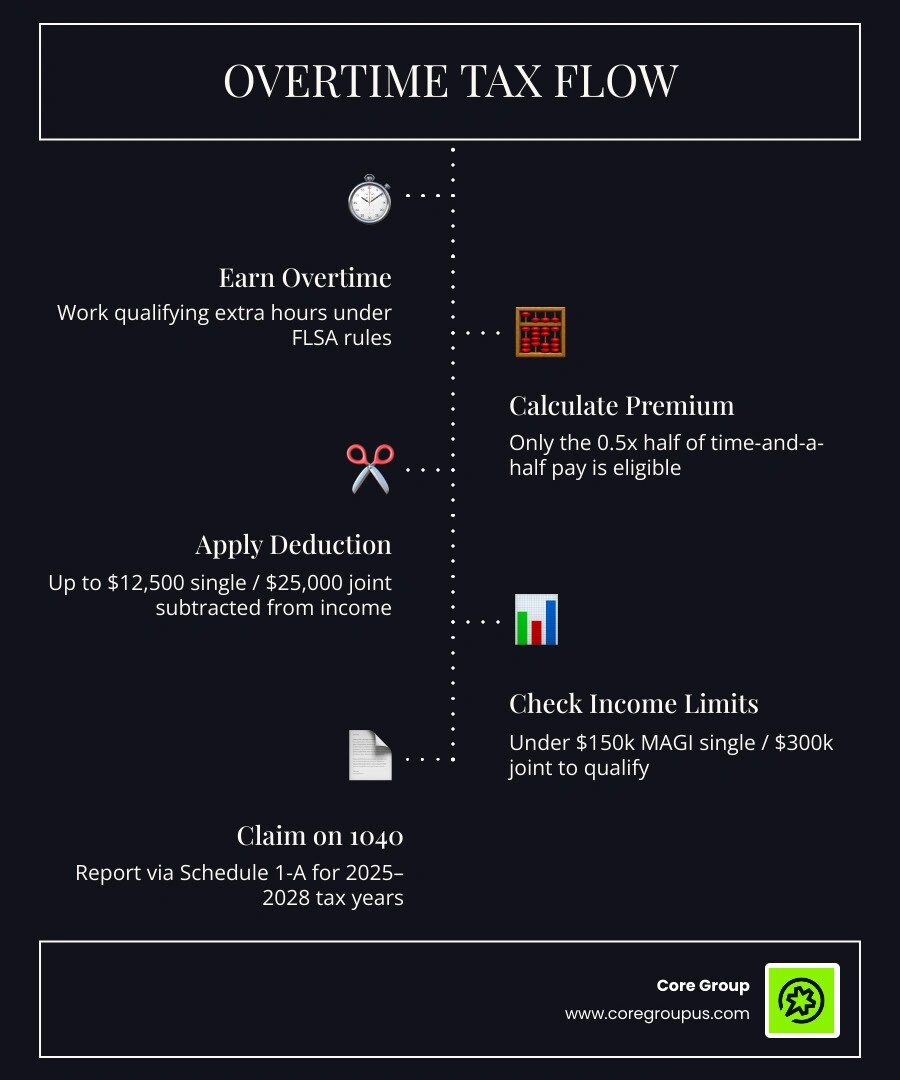
Understanding the Federal Tax Rate on Overtime Pay
When we look at our paychecks after a long week of extra shifts, it often feels like the government takes a bigger bite out of those hard earned overtime hours. We hear from creative entrepreneurs and hourly professionals all the time who worry that working more might actually result in less take home pay. This is a common myth that we want to clear up right away.
The actual federal tax rate on overtime is determined by the same progressive tax brackets that apply to your regular salary. If your total annual income puts you in the 22 percent bracket, every dollar of overtime is also taxed at 22 percent. There is no hidden penalty for working hard. However, how your employer takes that tax out of your check can vary.
Employers generally use two methods for federal withholding on supplemental wages like overtime. Some use the aggregate method, which combines your overtime with your regular wages and calculates withholding as if you earn that high amount every single pay period. This often leads to over-withholding because the payroll system assumes you have moved into a higher annual tax bracket. Others use a flat 22 percent supplemental wage withholding rate. You can learn more about these mechanics in our guide on the Overtime Tax Rate.
While the withholding might be high, the actual amount you owe is settled when you file your tax return. If too much was taken out, you get it back as a refund. To understand the details of these withholding methods, you can review this guide on How Much Tax Is Taken From Overtime Pay?.

What is the federal tax rate on overtime for qualified workers
Starting in 2025 and continuing through 2028, the federal government introduced a massive change for hourly workers. Under the One Big Beautiful Bill Act, the federal income tax rate on a specific portion of your overtime pay is effectively zero. This is because you can now deduct the overtime premium from your taxable income.
In payroll, your overtime pay usually consists of your regular rate plus an extra half. For example, if you earn 30 dollars an hour, your overtime rate is 45 dollars. The 15 dollar difference is the premium. The new law allows you to deduct this 15 dollar premium from your federal income tax. This means that while the base 30 dollars is still taxed at your normal rate, the extra 15 dollars is tax free for federal income tax purposes.
This benefit was made retroactive to January 1, 2025, which has led to significant savings for millions of taxpayers during this 2026 tax season. For a deep dive into these new rules, check out this resource on No Tax on Overtime 2025 Everything You Need to Know.
Why withholding differs from actual tax liability
The reason many people feel frustrated is the gap between withholding and liability. Withholding is just an estimate. When you work 60 hours in one week, the IRS withholding tables look at that one check and act as if you work 60 hours every single week of the year. This makes the system think you are a much higher earner than you actually are, causing it to grab a larger percentage upfront.
This is why we see a 10 percent average increase in tax refunds this year. People are having tax withheld at the old rates on their paychecks, but then they claim the new No Tax on Overtime deduction when they file. The result is a much larger check from the Treasury. You can read about how these withholding quirks affect your bottom line in this article about Does Overtime Get Taxed More? 2026 Truth and H.R.1.
The No Tax on Overtime Deduction and How It Works
The magic behind these savings is found in Section 225 of the Internal Revenue Code, which was added by the One Big Beautiful Bill Act. This is an above the line deduction. In plain English, that means you do not have to itemize your deductions to get it. You can take the standard deduction and still subtract your qualified overtime pay from your total income.
To claim this, you use a new form called Schedule 1-A. This form helps you calculate exactly how much of your overtime pay qualifies for the deduction. The IRS has provided a comprehensive list of Questions and answers about the new deduction for qualified overtime compensation to help taxpayers navigate the process.

Determining what is the federal tax rate on overtime for your return
To figure out your deduction, you must first identify your Qualified Overtime Compensation (QOC). Under the Fair Labor Standards Act (FLSA) Section 7, this is generally any pay you receive for working more than 40 hours in a single workweek.
The deduction specifically targets the premium portion. If you are paid time and a half, the half part is your deduction. If your employer is extra generous and pays you double time, you are still limited to the amount that would have been required by the FLSA, which is usually the 0.5 premium. You can find more details on these specific limits in this No Tax on Overtime Complete Guide.
Eligibility and Limits for Qualified Overtime Compensation
Not everyone can claim this deduction. It is designed specifically for workers who are covered by the overtime provisions of the FLSA. This mostly includes non-exempt hourly employees in industries like healthcare, construction, manufacturing, and production. If you are a salaried exempt employee who does not receive overtime pay, this deduction unfortunately does not apply to you.
You also need a valid Social Security Number to claim the benefit. Furthermore, if you are married, you must file a joint return with your spouse to be eligible. Filing separately will disqualify you from the No Tax on Overtime deduction.
The annual caps are as follows.
- Single or Head of Household Filers. $12,500
- Married Filing Jointly. $25,000
Income thresholds and phase-out rules
The government wanted to ensure this tax break went to middle and lower income families. Because of this, there are phase out rules based on your Modified Adjusted Gross Income (MAGI). If you earn too much, the deduction starts to disappear.
| Filing Status | Full Deduction Threshold | Partial Phase Out Range | Fully Phased Out At |
|---|---|---|---|
| Single / Head of Household | Up to $150,000 | $150,001 to $274,999 | $275,000 |
| Married Filing Jointly | Up to $300,000 | $300,001 to $549,999 | $550,000 |
For every 1,000 dollars you earn over the threshold, your maximum possible deduction is reduced by 100 dollars. Once you hit the hard cutoff of 275,000 dollars for individuals or 550,000 dollars for couples, the deduction is gone. You can find a detailed timeline and more on these limits at When Does No Tax On Overtime Start?.
How to Calculate and Claim Your Overtime Tax Savings
Since we are currently in May 2026, many of you are looking at your records for the 2025 tax year. For 2025, employers were not required to report your overtime premium separately on your W-2. This means you have to do a little bit of homework.
A quick way to estimate your deduction is the 0.33333 multiplier. If you look at your total overtime earnings for the year and multiply that number by 0.33333, you will get the amount of the premium portion. For example, if you earned 9,000 dollars in total overtime pay, your deduction would be 3,000 dollars.
Starting with the 2026 tax year, things get easier. Employers are now updating their systems to report this information directly. You should look for Code TT in Box 12 of your W-2 or voluntary reporting in Box 14. Employers in states like California are already receiving guidance on these new federal standards, as seen in the California Employer Guide to Federal No Tax on Overtime Law.
Reporting requirements for the 2025 and 2026 tax years
If your 2025 W-2 does not show your qualified overtime, do not panic. You can use your final pay stub from 2025 to find your year to date overtime totals. Keep these records safe in case the IRS asks for verification.
For those of you who are independent contractors or freelancers receiving 1099-NEC or 1099-MISC forms, the rules are a bit stricter. The deduction generally applies to W-2 employees. However, if you are a creative entrepreneur with a small team, you need to ensure your payroll system is ready for the One Big Beautiful Bill Act Implementation to help your employees get their rightful savings.
Frequently Asked Questions about Overtime Taxation
We get a lot of specific questions about how this deduction interacts with other parts of the tax code. Here are the most common things we hear.
Does the deduction apply to Social Security and Medicare taxes
This is a very important distinction. The No Tax on Overtime deduction only applies to federal income tax. You and your employer still have to pay FICA taxes on every dollar earned. This includes the 6.2 percent Social Security tax and the 1.45 percent Medicare tax.
For 2025, the Social Security tax only applies to the first 176,100 dollars of your wages. If you earn more than that, you stop paying the 6.2 percent portion, but the Medicare tax continues on all earnings. Even if your income tax rate on overtime is zero, your payroll tax obligations remain. States like Alabama have also issued guidance on how their own Overtime Exemption Alabama Department of Revenue rules interact with these federal changes.
Can I claim the deduction if I do not itemize
Yes. This is one of the best features of the new law. It is an adjustment to income, often called an above the line deduction. You claim it on Form 1040, line 13b. This means you get the full benefit of the standard deduction plus the No Tax on Overtime deduction. This creates massive tax savings for hourly workers who typically do not have enough expenses to itemize. For more on these specific filing rules, you can check What are the rules about tax on overtime pay?.
What is the federal tax rate on overtime for state tax purposes
This is where things get a bit tricky. Just because the federal government gives you a deduction does not mean your state will. Every state has different rules about whether they follow federal changes, which is known as conformity.
Some states have rolling conformity, meaning they automatically adopt federal changes. Others have decoupled from this specific deduction, meaning you might still owe state income tax on your overtime even if your federal rate is zero. For example, Delaware has been busy with House Bill 126 Bill Detail Delaware General Assembly to address how they handle these types of exemptions. We always recommend checking with a professional to see how your specific state handles overtime.
Conclusion
Navigating taxes can be overwhelming, especially when major new laws like the One Big Beautiful Bill Act change the landscape. At Core Group, we specialize in helping creative entrepreneurs and their teams find financial peace of mind. We use a no fluff, profit first playbook to ensure you are keeping as much of your hard earned money as possible.
Whether you are trying to figure out your own overtime deduction or setting up a payroll system for your growing business, we are here to help. Our goal is to save you time and handle the complex math so you can focus on the creative work you love. If you want to make sure you are maximizing your savings, explore our Tax planning services today. We will help you turn those long hours into real, lasting profit.