The 401(k) and Your MAGI: A Smart Tax Move
Why Your 401k and MAGI Number Matters More Than You Think
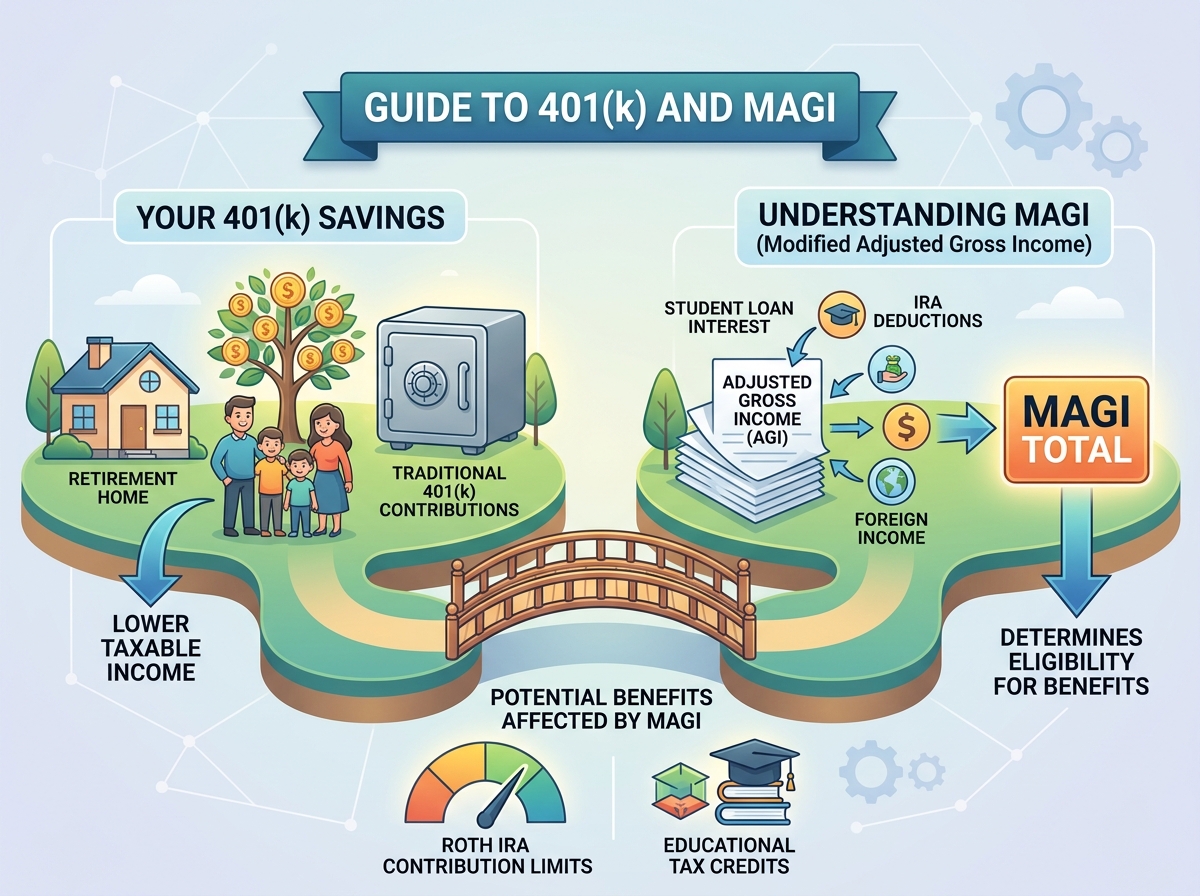
401k and MAGI are directly connected in a way that can save you real money every year. Here is the short answer.
- Traditional 401k contributions reduce your MAGI because they are taken out of your paycheck before taxes, lowering your adjusted gross income (AGI) and since MAGI starts from AGI without adding 401k contributions back, your MAGI drops dollar for dollar
- Roth 401k contributions do not reduce your MAGI because they use after-tax dollars and are already counted in your taxable income
- Employer matching contributions have no effect on your MAGI because they do not appear in your W-2 wages
This matters because your MAGI is the number the IRS uses to decide whether you qualify for tax breaks like Roth IRA contributions, traditional IRA deductions, health insurance subsidies, and education credits.
For creative entrepreneurs juggling project income, freelance payments, and irregular cash flow, this one number can quietly push you out of eligibility for benefits you deserve or pull you back in if you know how to manage it.
Imagine earning $80,000 in a strong production year. Without a 401k strategy, your MAGI stays high and you lose access to several valuable deductions. Contribute $10,000 to a traditional 401k and your MAGI drops to $70,000, potentially unlocking benefits worth hundreds of dollars.
The good news is that the strategy is simpler than it sounds.
Understanding Modified Adjusted Gross Income and How It Works

To master your tax strategy, we first need to look at what Modified Adjusted Gross Income actually is. Think of it as a specialized version of your income that the IRS uses to see if you are too wealthy for certain perks. It starts with your Adjusted Gross Income, which is often called AGI. You can find your AGI on Line 11 of your Form 1040.
According to the IRS adjusted gross income definition, AGI is your total gross income minus specific adjustments. These adjustments include things like educator expenses or student loan interest. Once you have that AGI number, the IRS might ask you to add certain things back to it to find your MAGI.
Common add back items that create your MAGI include the following.
- Any student loan interest you deducted.
- Foreign earned income that you excluded.
- Adoption expenses.
- Tax exempt interest.
- Passive income or losses.
- Half of the self employment tax.
The tricky part is that MAGI can actually change depending on which tax benefit you are trying to claim. The MAGI used for a Roth IRA might be slightly different than the MAGI used for the Premium Tax Credit. However, the most important thing to remember is that traditional 401k contributions are almost never added back. This makes them one of the most powerful tools in our financial toolkit. When we lower our AGI with a traditional 401k, we are effectively lowering our MAGI for almost every single tax program out there.
How Traditional 401k and MAGI Interactions Lower Your Taxes
When you contribute to a traditional 401k, the money comes directly out of your paycheck before the IRS ever sees it. This is known as a salary deferral. Because this money is excluded from your gross income, it never shows up in Box 1 of your W-2 form.
| Feature | Traditional 401k | Roth 401k |
|---|---|---|
| Contribution Type | Pre-tax | After-tax |
| Impact on AGI | Reduces it | No impact |
| Impact on MAGI | Reduces it | No impact |
| W-2 Reporting | Excluded from Box 1 | Included in Box 1 |
| Future Withdrawals | Taxed as ordinary income | Tax-free (qualified) |
We often get asked if this means you are making less money. The answer is no. Your salary remains exactly the same, but you are choosing to receive part of it later in life. In the meantime, you get a significant tax break today.
By reducing your taxable income, you are lowering the base number used for all your tax calculations. If you want to dive deeper into these mechanics, you can read our guide on Do 401k Contributions Reduce MAGI?. For creative professionals in states like California or New York where taxes are high, this reduction in taxable income can mean the difference between moving up into a higher tax bracket or staying in a lower one.
The beauty of the traditional 401k is that it lowers both AGI and MAGI simultaneously. Since MAGI is calculated by taking AGI and adding back specific items, and since 401k contributions are not on that add back list, the benefit carries all the way through. This is a massive advantage over other deductions that might be added back when calculating MAGI for specific credits.
Strategic Benefits of Lowering Your MAGI Through 401k Contributions
Lowering your MAGI is not just about paying less in income tax. It is about unlocking a whole world of other financial benefits. For high earners, MAGI is a gatekeeper. If your income is too high, the gate closes on many popular tax strategies.
One of the biggest benefits is Roth IRA eligibility. Many people want to contribute to a Roth IRA for tax free growth, but they earn too much. In 2024, if you are a single filer and your MAGI hits $161,000, you cannot contribute to a Roth IRA at all. However, if you contribute the maximum amount to a traditional 401k at work, you could bring your MAGI down below that threshold. This effectively lets you use your 401k to "buy" your way back into Roth IRA eligibility.
Another benefit involves the Net Investment Income Tax. This is a 3.8 percent tax that hits people with high investment income. It only applies if your MAGI exceeds $200,000 for individuals or $250,000 for married couples. By maxing out a 401k, you might drop below these levels and avoid this extra tax entirely.
For families, a lower MAGI can help you keep more of the Child Tax Credit. This credit starts to phase out at higher income levels. Similarly, the Saver's Credit is a special tax break for low to moderate income workers who save for retirement. It is based entirely on your MAGI. If you are just over the limit to qualify, a few extra 401k contributions could trigger a tax credit worth up to $2,000 for married couples. You can learn more about how these plans are structured in the 401(k) Plan Overview provided by the IRS.
Using a 401k and MAGI Strategy to Qualify for IRA Deductions
If you are covered by a 401k at work, your ability to deduct contributions to a traditional IRA is limited by your income. This is where the phase out ranges come into play. If your MAGI is too high, you might only get a partial deduction or no deduction at all.
For the 2025 tax year, the limits are as follows.
- Single filers covered by a workplace plan can take a full deduction if their MAGI is $79,000 or less.
- The deduction is partially available up to a MAGI of $89,000.
- For married couples filing jointly, the full deduction limit is $126,000.
- The partial deduction phases out completely at $146,000.
If we look ahead to 2026, these numbers typically adjust for inflation. By increasing your traditional 401k contributions, you are lowering the very MAGI that these limits are based on. This can move you from the "no deduction" zone into the "partial" or "full" deduction zone.
The formula for a partial deduction is often based on how far you are into the phase out range. If you can lower your MAGI by even a few thousand dollars through your 401k, you might save an additional several hundred dollars on your IRA deduction. It is a double win for your retirement savings.
Managing Your 401k and MAGI to Access Health Care Subsidies
For many creative entrepreneurs who buy insurance through the ACA marketplace, MAGI is the most important number on their tax return. Your eligibility for the Premium Tax Credit is based on your household income, which is defined as a specific type of MAGI.
According to the Premium tax credit basics, this credit helps lower the cost of health insurance for families with incomes between 100 percent and 400 percent of the federal poverty level. If your MAGI is just one dollar over the limit, you could lose thousands of dollars in subsidies. This is often called the subsidy cliff, although recent legislation has provided some temporary relief for higher earners.
By contributing to a traditional 401k, you are lowering your household income for ACA purposes. This can lead to two major benefits.
- You might qualify for a larger monthly subsidy to lower your premiums.
- You might become eligible for cost sharing reductions that lower your out of pocket costs like deductibles and copays.
In some states, lowering your MAGI can even make you or your children eligible for Medicaid or the Children's Health Insurance Program, which offers comprehensive coverage at very low costs. For a freelancer earning $50,000, a $5,000 contribution to a 401k could potentially save them $2,000 in health insurance premiums over the course of a year.
Contribution Limits and Rules for 2025 and 2026
To make this strategy work, you need to know how much you are allowed to put away. The IRS sets annual limits on how much you can contribute to a 401k. These limits have been increasing recently to keep up with inflation.
For 2024, the limit for individual employees is $23,000. If you are age 50 or older, you can add a catch up contribution of $7,500, bringing your total to $30,500.
For 2025, the limit rises to $23,500. The catch up contribution remains $7,500 for those 50 and older.
For 2026, we are looking at another increase. The limit is projected to rise to $24,500. The catch up contribution for those 50 and older will increase to $8,000.
Thanks to the SECURE 2.0 Act, there is also a new "super catch up" for people aged 60 to 63. Starting in 2025, individuals in this age bracket can contribute even more to help boost their savings before retirement. If you are a business owner looking to maximize these benefits for yourself and your team, you might want to look into our Safe Harbor 401k Complete Guide to see how these plans can bypass certain IRS testing rules.
It is vital to stay within these limits. If you contribute too much, the IRS can hit you with excess contribution penalties. This often leads to double taxation because you pay tax on the money when it goes in and again when you try to take it out. If you realize you have over-contributed, you must remove the excess funds and any earnings by the April 15 deadline of the following year to avoid these headaches.
Frequently Asked Questions about Retirement Accounts and MAGI
Do Roth 401k contributions reduce my MAGI
The short answer is no. Roth 401k contributions are made with after tax dollars. This means the money is included in your gross income and your AGI. Because it is already part of your AGI, and MAGI starts with that AGI number, a Roth 401k provides no immediate reduction to your MAGI.
While you do not get a tax break today, the benefit of a Roth 401k comes much later. All your qualified withdrawals in retirement, including the growth, are completely tax free. If you are a young creative in a low tax bracket now but you expect to be much more successful and in a higher bracket later, the Roth 401k might still be the better long term move even without the MAGI benefit. However, if your primary goal this year is to qualify for a specific tax credit or lower your current bill, the traditional 401k is the way to go.
Does an employer match affect my MAGI calculation
Employer matching contributions are a fantastic benefit, but they do not affect your MAGI at all. When your employer puts money into your 401k, that money is not considered part of your wages for the current year. It does not show up on your W-2 form and it is not included in your gross income.
Because it is never included in your income in the first place, it does not need to be subtracted or added back. It is essentially invisible to your MAGI calculation. You will only pay taxes on that employer match when you eventually withdraw the money in retirement. Just keep an eye on your vesting schedule. Vesting determines how much of that employer money you actually get to keep if you leave the company.
Are there penalties for exceeding 401k contribution limits
Yes, the IRS is quite strict about the annual caps. If you exceed the limit, the excess amount is essentially taxed twice. First, it is included in your gross income for the year you contributed it. Second, when you withdraw the excess, it is taxed as income again.
To fix this, you need to request a corrective distribution from your plan provider. They will send you the excess funds plus any investment earnings those funds made while in the account. You must report these earnings as income on your Form 1040. As long as you clear this up before the tax filing deadline in April, you can usually avoid the most severe penalties. For creative professionals who might have multiple employers or freelance gigs throughout the year, it is very easy to accidentally over-contribute if you aren't tracking the totals across all your different income streams.
Conclusion
Managing the relationship between your 401k and MAGI is one of the smartest moves you can make for your financial health. By understanding how pre-tax contributions lower your taxable income, you can unlock credits and deductions that would otherwise be out of reach. This is especially true for the creative entrepreneurs we serve at Core Group. Whether you are a filmmaker in Georgia or a graphic designer in Washington, these rules apply to you.
Our "no-fluff, profit-first playbook" is designed to give you peace of mind. We handle the complex financial management and bookkeeping so you can stay focused on your craft. We even back our service with a MacBook Pro guarantee because we know how much your tools matter to your business.
If you want to ensure your retirement strategy is working as hard as you are, we invite you to explore our tax planning resources. Let us help you turn your hard earned income into a secure future while keeping your current tax bill as low as possible. We are here to make sure your wealth is exactly what you think it is.