All About Key Employee Rules for 2026
The Official 401k Key Employee Definition 2026 and IRC Section 416
Under Internal Revenue Code Section 416, the 401k key employee definition 2026 classifies an employee as a key employee if they meet any one of three criteria during the testing period. Specifically, an individual qualifies if they are an officer earning over $235,000, an owner holding more than 5% of company equity regardless of compensation, or an owner holding more than 1% of equity with annual compensation exceeding $150,000. Identifying these individuals ensures qualified retirement plans maintain tax-advantaged status and prevents unexpected top-heavy employer contribution requirements.
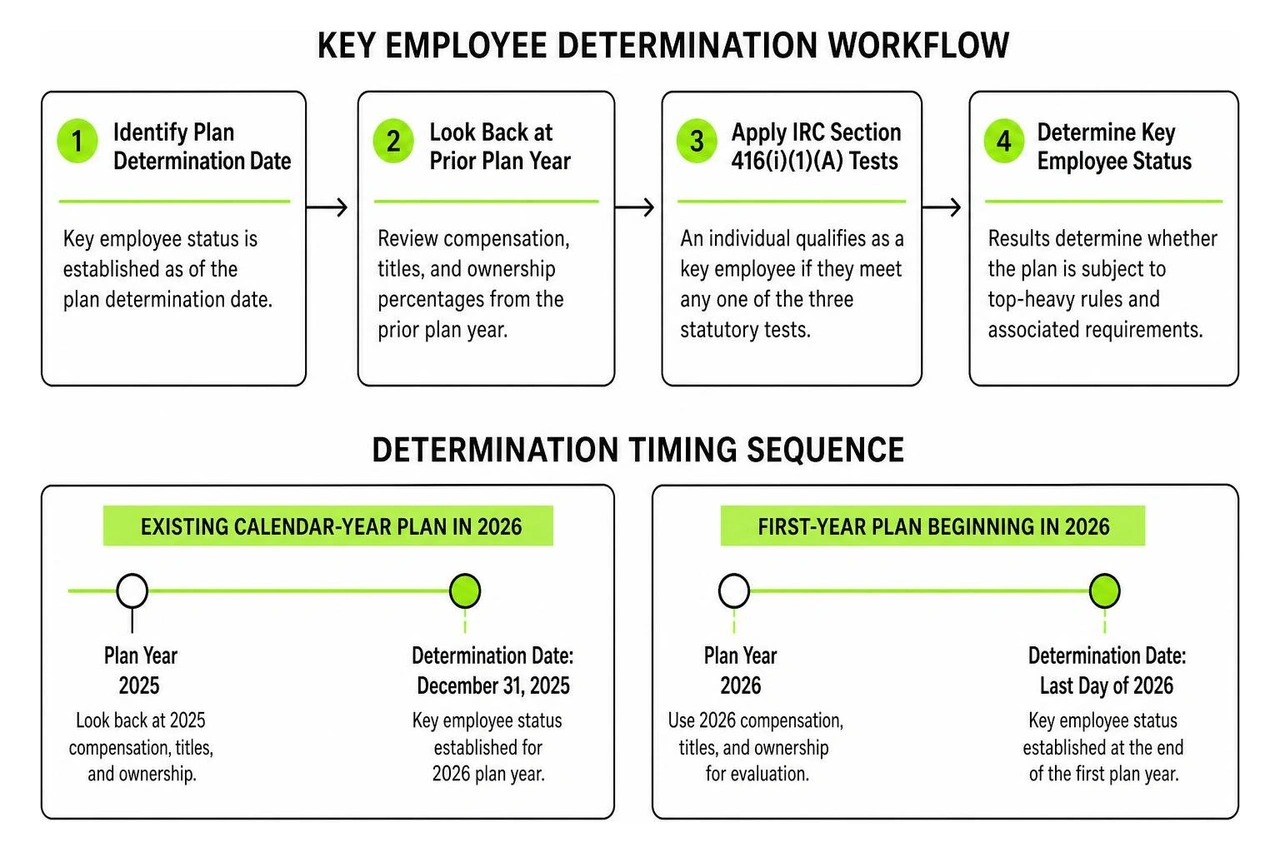
When evaluating key employee classification for any given plan year, timing is critical. Key employee status is established as of the plan determination date. For an existing calendar-year plan operating in 2026, the determination date is December 31, 2025. This means you look back at the prior plan year to review compensation, titles, and ownership percentages. If a retirement plan begins its very first year in 2026, the determination date is instead the final day of the 2026 plan year. Reviewing official IRS guidance on top-heavy plans helps ensure you apply the proper lookback figures when running annual evaluations.
Applying the 401k Key Employee Definition 2026 Across the Three Statutory Tests
Under IRC Section 416(i)(1)(A), an individual qualifies as a key employee if they meet any one of three distinct statutory routes during the determination period.
| Qualification Test | Ownership Requirement | Compensation Threshold | Notes |
|---|---|---|---|
| Test 1 - Officer Test | No ownership required | Over $235,000 for 2026 ($230,000 for 2025 lookback) | Capped at a maximum of 50 officers |
| Test 2 - Greater Than 5% Owner | Greater than 5.0% equity | No compensation requirement ($0 salary qualifies) | Includes direct and family attribution equity |
| Test 3 - Greater Than 1% Owner | Greater than 1.0% equity | Greater than $150,000 | Fixed dollar amount not indexed for inflation |
The first route evaluates company officers. For 2026, the officer compensation limit is set at $235,000, rising from $230,000 in 2025. When evaluating a calendar-year 2026 plan whose determination date fell on December 31, 2025, you look at whether the officer earned over $230,000 in 2025.
The second route examines substantial business ownership. Anyone who owns more than 5% of the company is automatically classified as a key employee. Compensation is completely irrelevant here. An individual holding a 5.1% stake who takes zero dollars in salary is still a key employee. Owning exactly 5.0% does not satisfy this threshold; the statute specifically mandates that ownership must be strictly greater than 5%.
The third route captures owners who hold a smaller stake while drawing substantial pay. An employee who owns more than 1% of the enterprise and receives annual compensation exceeding $150,000 meets the definition. Unlike the officer threshold, this $150,000 limit is a fixed statutory figure and does not adjust for annual inflation.
The 50-Officer Statutory Cap and Functional Authority
Federal tax law prevents large corporations from having an unlimited number of officers labeled as key employees. The tax code imposes a statutory ceiling on the officer test. The maximum number of individuals who can be classified as key employees under the officer route is capped at 50 employees, or the greater of 3 individuals or 10% of the total active workforce rounded up, whichever number is smaller.
For example, a business with 20 employees can have at most 3 key officers. A company with 200 workers caps out at 20 key officers. An enterprise with 1,000 employees hits the statutory maximum of 50 key officers, regardless of how many executives hold corporate titles. When an organization has more qualifying officers than the statutory ceiling permits, the rule selects those with the highest compensation.
Equally important is functional leadership authority. The IRS evaluates what an employee actually does rather than their formal job title. An employee who holds the title of Vice President in name only, without real administrative or executive decision-making power, does not satisfy the officer definition. Conversely, an executive who exercises broad administrative authority cannot avoid officer status simply by holding an informal job title. Evaluating these roles aligns closely with standard common-law employee guidelines used across federal payroll classifications.
Constructive Ownership and Family Attribution Under IRC Section 318
Calculating ownership percentages is rarely as simple as checking a company cap table. Under IRC Section 318, constructive ownership rules attribute equity among related family members and business entities.
If an entrepreneur owns 100% of a business and employs their spouse, child, grandchild, or parent, each of those employed family members is treated as owning 100% of the company for key employee testing purposes. Even if an owner's daughter earns an entry-level wage and holds zero direct shares in the business, she meets the more-than-5% owner test through family attribution.
Attribution also flows through trusts, estates, partnerships, and corporate holdings. If a family trust owns a 20% interest in a firm, beneficiaries of that trust are treated as holding proportional stakes in the operating company. Missing these family and entity relationships is among the most frequent sources of compliance errors for family-owned and closely held businesses.
How Key Employee Classification Triggers the 401(k) Top-Heavy Test
The primary reason businesses must track key employee classifications is top-heavy testing under IRC Section 416. A defined contribution retirement plan becomes top-heavy when the total account balances of key employees exceed 60% of the total assets held by all participants in the plan as of the determination date.
When calculating the top-heavy ratio, plan administrators total the account values of all key employees and divide that figure by the total account values of all participants. Adjusted values include certain distributions made during the lookback period and subtract rollovers from unrelated plans.
Tracking this ratio is critical as executive account values compound alongside updated 2026 IRS dollar limits. In small or fast-growing businesses, founders and early executive hires often accumulate large balances quickly, while newer staff contribute smaller amounts. If those executive balances tip past the 60% line, the retirement plan enters top-heavy territory and triggers mandatory corrective rules. Implementing strategies outlined in our safe harbor 401k complete guide provides a proven path to manage these risks.
Mandatory Employer Minimum Contributions and Accelerated Vesting
When a 401(k) plan is deemed top-heavy for a given plan year, the employer must satisfy two strict statutory requirements to protect non-key participants.
- Mandatory Minimum Contributions - The employer must make a fully vested contribution to non-key employees equal to at least 3% of their annual compensation. If the highest contribution percentage made by any key employee (including elective salary deferrals and employer contributions) is less than 3%, the required non-key contribution rate drops to that lower percentage.
- Accelerated Vesting Schedules - Any employer matching or profit-sharing contributions subject to a standard vesting schedule must immediately shift to an accelerated vesting timeline. The plan must offer either a 3-year cliff schedule (100% vested after 3 years of service) or a 6-year graded schedule (20% per year starting in year two, reaching 100% in year six).
These required minimums represent a direct cash outlay that can strain an unprepared business. Coordinating your contribution structures with our 401k employer match guide 2026 helps keep organizational budgets predictable.
Safe Harbor Exemptions and Legislative Updates Under SECURE 2.0
Fortunately, plan sponsors have reliable methods to shield their plans from top-heavy testing mandates. The most effective strategy is adopting an IRS-approved safe harbor plan design.
A safe harbor 401(k) plan that satisfies statutory notice and contribution requirements is generally exempt from top-heavy testing. This exemption applies as long as the plan receives only employee salary deferrals, required safe harbor matching or nonelective contributions, and safe harbor compensation allocations. However, if a business adds discretionary profit-sharing contributions, reallocates plan forfeitures as profit sharing, or modifies eligibility, the safe harbor plan can lose its automatic exemption and become subject to top-heavy rules.
Plan sponsors should also review legislative adjustments. The SECURE 2.0 Act introduced provisions that allow employers to test otherwise excludable employees separately, preventing newly eligible part-time or younger workers from inadvertently worsening top-heavy percentages. Exploring these and other safe 401k options while referencing the SECURE 2.0 Act cheat sheet ensures your plan structure remains both compliant and cost-effective.
Beyond Retirement - Impact on Section 125 Plans and Group-Term Life Insurance
Key employee status does not stop at your retirement plan. Federal tax law uses the exact same IRC Section 416 key employee definition to govern nondiscrimination testing across other employee benefit structures.
For Section 125 cafeteria plans, key employee status triggers the 25% Concentration Test under Section 125(b)(2). This rule dictates that key employees cannot receive more than 25% of the total aggregate nontaxable benefits provided to all employees through the cafeteria plan.
Consider a 60-employee creative agency where total pre-tax cafeteria plan selections (including health insurance premiums, flexible spending accounts, and health savings accounts) equal $480,000 across the entire company. If three key executives elect benefits totaling $132,000, their share equals 27.5% of the total benefit pool. Because this exceeds the 25% statutory ceiling, the plan fails the concentration test.
When a Section 125 plan fails this test, the tax penalty falls directly on the key employees. All pre-tax cafeteria benefits elected by key employees lose their tax-favored status and must be reclassified as taxable W-2 compensation. Non-key employees remain completely unaffected.
Key employee classification also impacts group-term life insurance governed by IRC Section 79(d). Under standard tax rules, the cost of employer-provided group-term life insurance coverage up to $50,000 is excluded from an employee's gross income. However, if a group-term life plan discriminates in favor of key employees regarding eligibility or benefit amounts, every key employee loses the standard $50,000 income exclusion. Instead, the full value of their employer-provided coverage becomes taxable income calculated under IRS Table I rates.
Compliance Best Practices and Annual Classification Pitfalls
Maintaining an accurate benefits roster requires active management. Small-to-midsize businesses frequently run into compliance hurdles because payroll and HR teams treat key employee classifications as a one-time project during initial plan setup.
Common classification mistakes include the following.
- Confusing Job Titles with True Authority - Giving an executive assistant or senior specialist an officer title on paper without administrative authority can trigger unnecessary officer counts.
- Ignoring Attribution Rules - Overlooking spouses, children, or family trusts that own shares creates blind spots in ownership testing.
- Overlooking Year-End Timing - Applying the current year's compensation limit to a prior-year determination date leads to incorrect testing thresholds.
- Operating Disconnected Benefit Rosters - Running separate key employee lists for retirement, cafeteria, and life insurance plans instead of using a unified compliance master sheet.
To prevent these pitfalls, plan sponsors should review employee compensation, title changes, and cap table adjustments at the close of every quarter. Staying informed about broader statutory changes outlined in our guide on 401k changes 2026 ensures your administrative team stays ahead of IRS requirements.
Key Employee vs. Highly Compensated Employee - 401k Key Employee Definition 2026 Distinctions
A frequent point of confusion among business leaders is the difference between a Key Employee and a Highly Compensated Employee (HCE). While these terms sound similar, they serve entirely different compliance functions in federal tax law.
| Feature | Key Employee (IRC Section 416) | Highly Compensated Employee (IRC Section 414(q)) |
|---|---|---|
| Primary Purpose | Top-Heavy Testing, Section 125, Group Life | ADP / ACP Nondiscrimination Testing |
| 2026 Threshold | Officers earning over $235,000 ($230,000 lookback) | Prior-year compensation over $160,000 |
| Ownership Tests | Greater than 5% owner OR greater than 1% owner earning over $150,000 | Greater than 5% owner at any point in current or prior year |
| Top-Paid Group Rule | Does not apply | Employer can elect top 20% compensation limitation |
| Asset/Testing Impact | Triggered if balances exceed 60% of total plan | Limits employee deferrals relative to non-HCE averages |
Every key employee is almost always an HCE due to pay or equity levels. However, many HCEs are not key employees. An engineering director earning $180,000 who owns zero stock and holds no corporate officer authority is an HCE under Section 414(q), but is not a key employee under Section 416. Plan administrators must track both categories independently to maintain flawless compliance records.
Frequently Asked Questions about 401(k) Key Employees
How much does an officer have to earn to be a key employee in 2026?
For the 2026 plan year, an officer must earn over $235,000 to meet the compensation threshold. Because key employee determinations for calendar-year plans evaluate data from the prior plan year, you look back at 2025 earnings where the applicable officer threshold was $230,000.
Does a more-than-5% owner have to draw a salary to be considered a key employee?
No. Compensation plays no role in the more-than-5% owner test. An individual who owns more than 5.0% of company equity (either directly or through family attribution) is classified as a key employee even if they draw zero salary or take an unpaid sabbatical.
What happens if our 401(k) plan exceeds the 60% top-heavy threshold?
If key employee account balances exceed 60% of total plan assets on the determination date, the plan becomes top-heavy for the coming plan year. The employer must provide a fully vested minimum contribution (typically 3% of pay) to all eligible non-key employees and adopt an accelerated vesting schedule for employer contributions.
Conclusion
Navigating federal benefits compliance does not have to pull you away from leading your business. Key employee classifications carry major financial consequences across your 401(k), Section 125 cafeteria programs, and executive insurance arrangements. Failing to identify these individuals accurately can turn an affordable benefits package into an unexpected financial obligation.
At Core Group, we help creative entrepreneurs establish proactive financial systems through our no-fluff, profit-first playbook. Whether you are scaling an agency, managing executive compensation, or navigating 401k and MAGI planning, our team handles the complex tax and bookkeeping mechanics so you can focus on building your business with total peace of mind.