An Essential Guide to Animator Overtime Tax Deduction Planning
How Animator Overtime Tax Deduction Planning Works in 2026
Good animator overtime tax deduction planning starts with checking how you are paid. If you are a W-2 studio employee who qualifies for overtime under federal law, you may deduct the extra half of your time-and-a-half pay for hours over 40 in a workweek. Your full overtime pay is not deductible, and extra hours billed as an independent contractor do not qualify. Save your weekly timesheets and pay stubs, then compare them with the overtime amount on your 2026 W-2.
The deduction is capped at $12,500, or $25,000 for joint filers, and begins to phase out at higher incomes. I'm Christian Brim, and I'll walk you through how to check your eligibility and keep records that support your claim.

Discover more about animator overtime tax deduction planning.
- overtime tax savings for artists
- overtime tax audit protection artists
- creative overtime tax savings strategies
Qualifying Overtime. Understanding the One Big Beautiful Bill Act for Creatives
Crunch time is practically a rite of passage in the animation world. When release dates loom, render farms run hot, and sequence revisions pile up, animators regularly put in 50, 60, or even 70 hours a week. With the passage of the One Big Beautiful Bill Act, Congress introduced a temporary tax relief provision running through 2028 designed to ease the federal income tax burden on overtime hours.
The law does not make all overtime completely tax-free. Under IRS official guidance on the overtime deduction, only specific non-exempt employees covered under Section 7 of the Fair Labor Standards Act (FLSA) qualify.
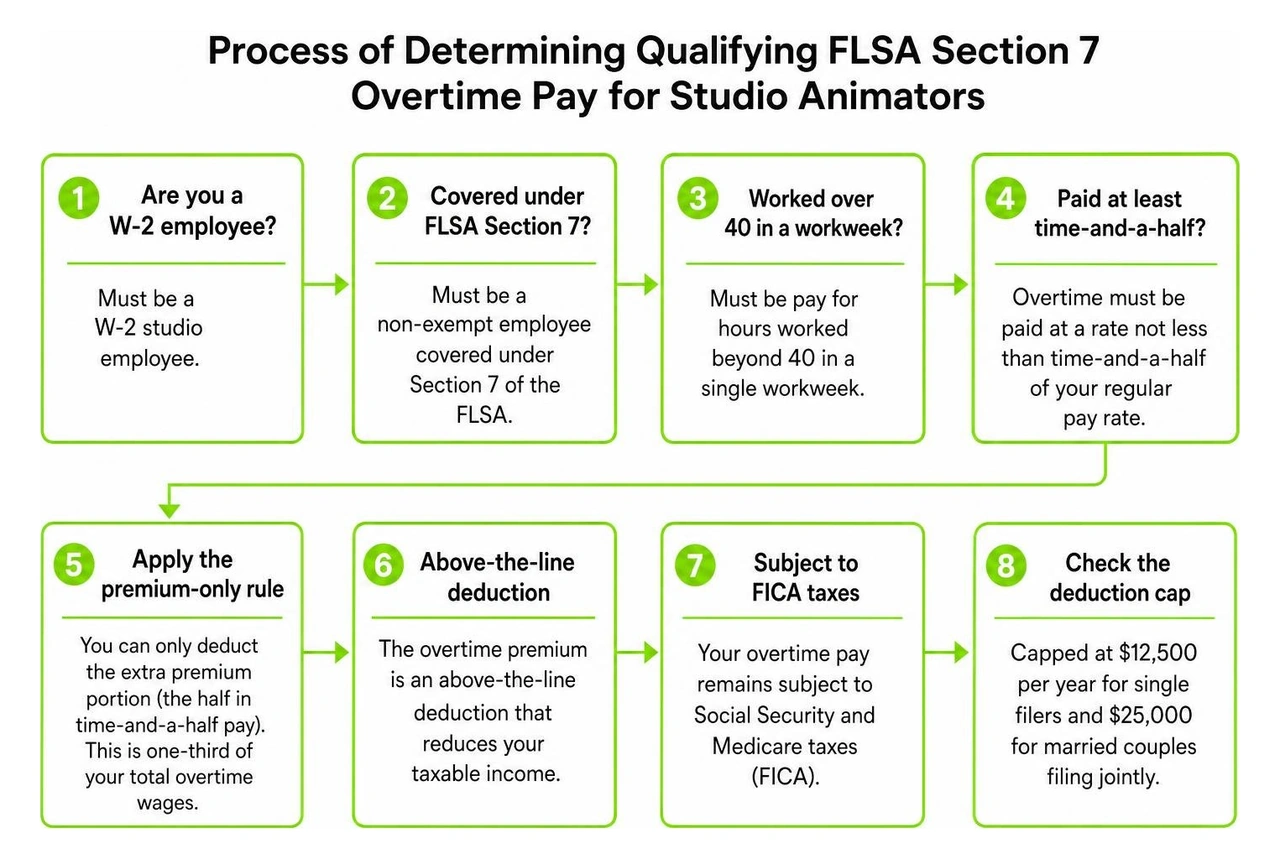
Under FLSA rules, qualified overtime is defined as pay for hours worked beyond 40 in a single workweek at a rate not less than time-and-a-half of your regular pay rate. The crucial detail many creatives miss is the premium-only rule. You cannot deduct your total overtime earnings. You can only deduct the extra premium portion, which represents the half in your time-and-a-half pay. Mathematically, this deductible premium accounts for exactly one-third of your total overtime wages.
Exploring overtime tax savings for artists reveals that this benefit operates as an above-the-line deduction on your federal return. It directly reduces your taxable income without stripping away your eligibility for adjusted gross income dependent credits.
Your overtime pay remains subject to standard Social Security and Medicare taxes (FICA). The statutory deduction caps stand at $12,500 per year for single filers and $25,000 for married couples filing jointly.
| Pay Component | Hourly Rate Calculation | Example for 10 Overtime Hours | Deductible Amount Under OBBBA |
|---|---|---|---|
| Regular Base Pay | $45.00 per hour | $450.00 | $0.00 |
| Overtime Premium (The "Half") | $22.50 per hour | $225.00 | $225.00 |
| Total Overtime Pay (Time-and-a-Half) | $67.50 per hour | $675.00 | $225.00 |
State-mandated daily overtime rules, such as California's daily 8-hour threshold, union meal penalties, and double-time premiums do not automatically qualify for this federal tax deduction unless they fall strictly within federal FLSA Section 7 guidelines for weekly hours exceeding 40.
Core Framework for Animator Overtime Tax Deduction Planning

Proactive planning requires looking closely at your Modified Adjusted Gross Income (MAGI). The law establishes clear income thresholds where the deduction begins to phase out. For single filers, the phase-out starts at $150,000 of MAGI. For married couples filing jointly, the phase-out begins at $300,000.
The phase-out mechanics use a straightforward reduction formula. Your available deduction limit is reduced by $100 for every $1,000 your MAGI exceeds the threshold.
- Single Filer Phase-Out Window. $150,000 to $275,000 MAGI
- Married Filing Jointly Phase-Out Window. $300,000 to $550,000 MAGI
To claim this benefit on your tax return, the IRS utilizes Schedule 1-A. This form aggregates specialized deductions including tip income, car loan interest, and qualified overtime premiums. Managing these income brackets is central to creative studio overtime tax optimization so you do not accidentally phase yourself out of thousands of dollars in legitimate deductions.
Step-by-Step Animator Overtime Tax Deduction Planning for W-2 vs. 1099 Income
Understanding your worker classification is vital when calculating your deductions.
- W-2 Non-Exempt Animators. You receive standard paychecks with statutory withholdings. When you exceed 40 hours in a workweek, your employer pays an overtime premium. You qualify directly for the deduction.
- 1099 Independent Contractors. Freelance animators billing clients via invoices or flat day rates do not fall under FLSA Section 7. Independent contractors are not eligible to claim the overtime premium deduction against their Schedule C net profit.
- S-Corporation Shareholder-Employees. If you operate your animation studio as an S-Corp, paying yourself an hourly W-2 wage with overtime does not qualify you for the deduction under FLSA employer-employee rules.
Freelancers transitioning between temporary studio staff roles and independent client contracts must keep strict separation between these income streams. Meeting overtime tax filing deadlines for artists requires tracking which projects generated true statutory overtime and which represent standard business revenues.
Advanced Animator Overtime Tax Deduction Planning with Retirement and Business Expenses
Combining the overtime deduction with other creative tax strategies maximizes your overall financial position. Independent animators who also maintain side studios can pair their W-2 overtime planning with strategic business write-offs.
A comprehensive tax planning guide for animators and filmmakers highlights the importance of coordinating multiple tax reduction levers.
- Home Studio Deductions. If you maintain dedicated, exclusive space for your freelance work, calculating direct and indirect housing expenses reduces self-employment income.
- Hardware and Software Expensing. Take advantage of Section 179 expensing or bonus depreciation on high-performance workstations, color-accurate displays, and render nodes.
- Retirement Contributions. Funding a Solo 401(k), traditional IRA, or SEP-IRA lowers your overall MAGI, which can pull high-earning animators back below the $150,000 phase-out threshold.
Our creative deduction maximization guide provides deeper strategies for aligning studio gear purchases with your annual production schedule.
Tracking, W-2 Reporting, and Audit Defense for Studio Crunch Hours
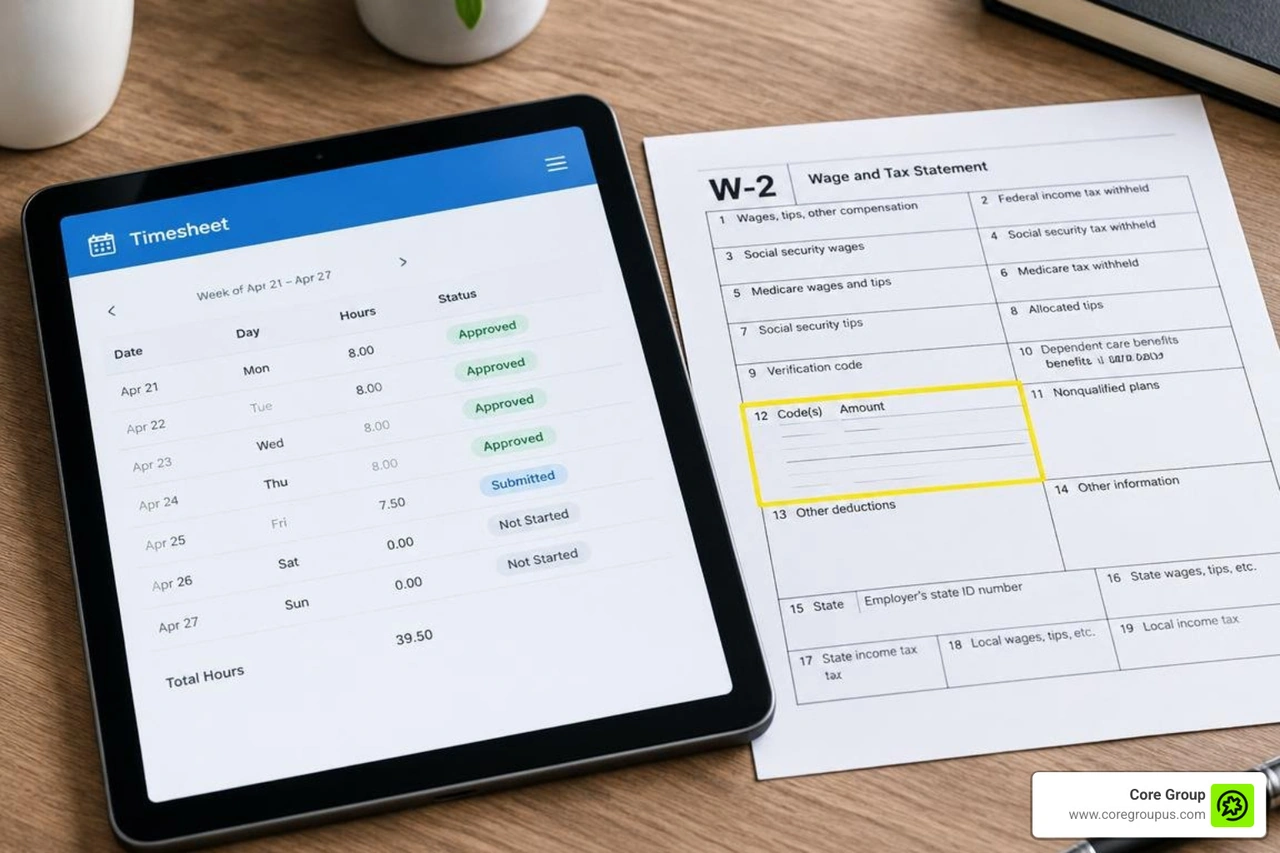
Detailed records are your strongest defense against IRS scrutiny. For the 2026 tax year, the IRS requires employers to report qualifying overtime compensation in Box 12 of Form W-2 using Code TT. This reporting mechanism makes it much easier to match your tax return with payroll records.
You should still actively audit your earnings. You can download our artist overtime tax deduction worksheet to verify that your studio's payroll figures match your actual hours.
To establish comprehensive overtime tax audit protection for artists, keep the following records on file for at least four years.
- Weekly timecards and digital timesheet exports showing exact start and end times
- Final cumulative year-end pay stubs showing separated regular and overtime earnings
- Complete copies of your Form W-2 displaying Box 12 Code TT
- Freelance project contracts showing worker classification distinctions
- Documentation of any employer meal stipends or shift differentials
Be aware of state and municipal tax variations. While federal law permits the deduction, some local jurisdictions disallow it on municipal returns. Always check your local tax rules before filing.
Frequently Asked Questions About Overtime Deductions for Creatives
Can salaried animators claim the overtime tax deduction under FLSA rules?
Generally, no. Animators categorized as exempt salaried employees under the FLSA creative professional exemption do not qualify for statutory overtime and cannot claim this deduction. However, if your studio classifies you as an hourly non-exempt employee, you are eligible for the deduction on all qualifying hours over 40 per week.
Can animators claim both the overtime deduction and the tip deduction?
Yes. Under Schedule 1-A guidelines, taxpayers can claim both deductions simultaneously if they legitimately earn both types of income. While animation work rarely includes tips, creatives who teach workshops, perform live illustration at events, or work in secondary hospitality roles can claim qualifying tips up to the $25,000 cap alongside their studio overtime deduction.
How does the deduction apply if I work across multiple animation studios in 2026?
If you work for multiple studios throughout the year on a W-2 non-exempt basis, you combine the qualified overtime premiums from each Form W-2 Box 12 Code TT. Your total combined deduction across all employers cannot exceed the statutory limit of $12,500 for single filers or $25,000 for married couples filing jointly.
Conclusion
Maximizing your creative earnings requires proactive financial management. At Core Group, we deliver financial management, bookkeeping, and tax services designed specifically for creative entrepreneurs. Our no-fluff, profit-first playbook provides complete peace of mind, backed by our MacBook Pro guarantee. Take charge of your studio earnings today by optimizing your overtime tax rate and building an audit-proof financial foundation for your career.