The Ultimate Guide to Bookkeeping and Financial Accounting
What Is the Difference Between Bookkeeping and Financial Accounting
Bookkeeping and financial accounting are two distinct but deeply connected functions that every business relies on to stay financially healthy.
Here is a quick breakdown of how they differ
| Bookkeeping | Financial Accounting | |
|---|---|---|
| Focus | Recording daily transactions | Analyzing and interpreting financial data |
| Goal | Accurate, organized records | Strategic insights and reporting |
| Tasks | Data entry, reconciliation, invoicing | Tax prep, audits, financial statements |
| Education | Certificate or associate degree | Bachelor's degree, often CPA |
| Median Salary | $47,440/year | $79,880/year |
Think of it this way. Bookkeeping captures the raw financial story of your business, transaction by transaction. Accounting then reads that story and turns it into decisions, forecasts, and plans.
For creative entrepreneurs, this distinction matters more than most people realize. When you are busy producing work, managing clients, and running projects, the financial side of the business can feel overwhelming. Knowing which function you need, and when, can save you time, money, and a lot of stress.
This guide breaks down both roles clearly so you can make smarter decisions about your finances, whether you handle them yourself or bring in professional support.

Defining Bookkeeping and Financial Accounting
As we look at the landscape of business finance in April 2026, it is clear that the relationship between bookkeeping and financial accounting has never been more vital. While people often use these terms interchangeably, they represent different stages of the financial lifecycle. Bookkeeping is the foundational backbone of your business. It involves the systematic recording of every single financial transaction that occurs. From the coffee you bought for a client meeting to the large invoice paid by a major brand, the bookkeeper ensures every cent is tracked.
This process provides the raw data that makes everything else possible. Without clean books, an accountant cannot do their job effectively. You can think of a bookkeeper as the person who gathers the ingredients and an accountant as the chef who creates a gourmet meal. The accountant takes those raw numbers and engages in financial storytelling. They look at the data to tell you where your money went, why your profit margins are shifting, and how you can save on taxes.
For many small business owners, especially those in the creative space, understanding this distinction is the first step toward financial freedom. If you want to dive deeper into what these services entail, you can check out our Bookkeeping Services Complete Guide for a full breakdown. We believe that every creative deserves to understand their numbers without getting lost in the jargon.
In states like Arizona or Colorado, many businesses rely on specialized local support to keep their records straight. Whether you are a solopreneur or running a large agency, the goal remains the same. You need a solid foundation of data to drive your future success.
Core Responsibilities and Strategic Business Growth
Understanding when to shift from basic record keeping to strategic financial management is a major milestone for any entrepreneur. We often see business owners hitting a wall when they reach certain revenue thresholds. A common rule of thumb is that once your annual revenue exceeds $500,000, you almost certainly need the advanced insights that an accountant provides. However, the need for professional bookkeeping starts much earlier.
The statistics regarding business survival are eye opening. Research shows that businesses that only perform annual financial reviews have a survival rate of about 36 percent. In contrast, businesses that commit to weekly bookkeeping see their survival rate jump to over 80 percent. This massive difference exists because weekly tracking allows you to spot cash flow issues before they become disasters. When you know exactly how much money is in your account every Friday, you make better decisions on Monday.
Outsourcing these tasks can provide an even greater advantage. Some data suggests that outsourced bookkeeping can boost a business survival rate by as much as 313 percent. This is because professionals bring a level of objectivity and expertise that is hard to maintain when you are also trying to record a podcast or design a new brand identity. For those running specialized firms, our Bookkeeping for Agencies Ultimate Guide offers tailored advice for managing high volume client work.

Essential Bookkeeping and Financial Accounting Tasks
To keep the gears of your business turning, several tactical tasks must happen on a regular basis. These are the bread and butter of the bookkeeping world.
- Transaction Recording. This is the daily or weekly entry of every sale and expense into your software.
- Bank Reconciliation. We compare your internal records against your bank statements to ensure every penny is accounted for and no errors have occurred.
- Invoicing. Sending out bills to clients and following up on late payments is crucial for maintaining cash flow.
- Payroll. Ensuring your team gets paid accurately and on time while staying compliant with tax withholdings.
- General Ledger Maintenance. This is the master record of all your business accounts, serving as the ultimate source of truth for your finances.
Many businesses find that they need help with these specific tasks as they grow. Professional providers help companies manage these essential functions so owners can stay focused on their craft.
Advanced Accounting Functions for Business Health
Once the bookkeeping foundation is set, the accounting side takes over to provide high level strategy. This is where the real magic happens for your bottom line. An accountant does not just look at what happened in the past. They use that data to predict the future.
Financial analysis is a core part of this role. An accountant will calculate financial ratios and compare them to industry benchmarks to see how you stack up against your peers. They also handle tax compliance, ensuring you are not just filing your returns but also taking advantage of every legal deduction available. This is where Tax Planning becomes a game changer. By looking ahead, we can help you structure your business and your spending to minimize what you owe the IRS.
Auditing and risk assessment are also vital. An accountant can spot inconsistencies that might suggest fraud or simple human error. They provide the strategic advice you need when you are considering a major purchase, hiring a new executive, or expanding into a new market. Specialized firms combine these analytical skills with traditional record keeping to support business health.
Education and Career Paths in Finance
The paths to becoming a bookkeeper versus an accountant are quite different, though they often overlap. If you are looking to hire a professional or considering a career in this field, it is important to know what qualifications to look for.
| Qualification | Bookkeeper | Accountant |
|---|---|---|
| Typical Degree | Associate Degree or Certificate | Bachelor's Degree in Accounting |
| Advanced License | Certified Bookkeeper (CB) | Certified Public Accountant (CPA) |
| Focus Area | Accuracy and Organization | Analysis and Strategy |
| Software Skill | High (QuickBooks, Xero) | High (ERP Systems, Analysis Tools) |
An associate degree in accounting is often a fantastic starting point. It provides the practical skills needed to handle daily books while serving as a stepping stone to a four year degree. Many people start as bookkeepers and then pursue further education to become accountants. This career transition is common and allows a professional to understand the how of the numbers before they tackle the why.
Education programs like the Bookkeeping and Financial Accounting 14 Day Intensive offer quick, focused training for those wanting to enter the field. However, for those aiming for the highest levels of the profession, a bachelor's degree and a CPA license are the gold standard.
Qualifications for Bookkeeping and Financial Accounting Roles
Beyond formal degrees, certifications play a huge role in the industry. A Certified Bookkeeper (CB) designation from the American Institute of Professional Bookkeepers shows a high level of commitment and knowledge. Software certifications, such as becoming a QuickBooks ProAdvisor or a Xero Certified Advisor, are also essential in the modern market.
Accountants must also be well versed in GAAP standards, which are the Generally Accepted Accounting Principles used in the United States. If a company operates internationally, they may also need to understand IFRS compliance. These standards ensure that financial reporting is consistent, transparent, and comparable across different companies. For those operating in the Lone Star State, our Bookkeeping Services Texas Guide provides more context on local business requirements.
Salary and Job Growth Projections
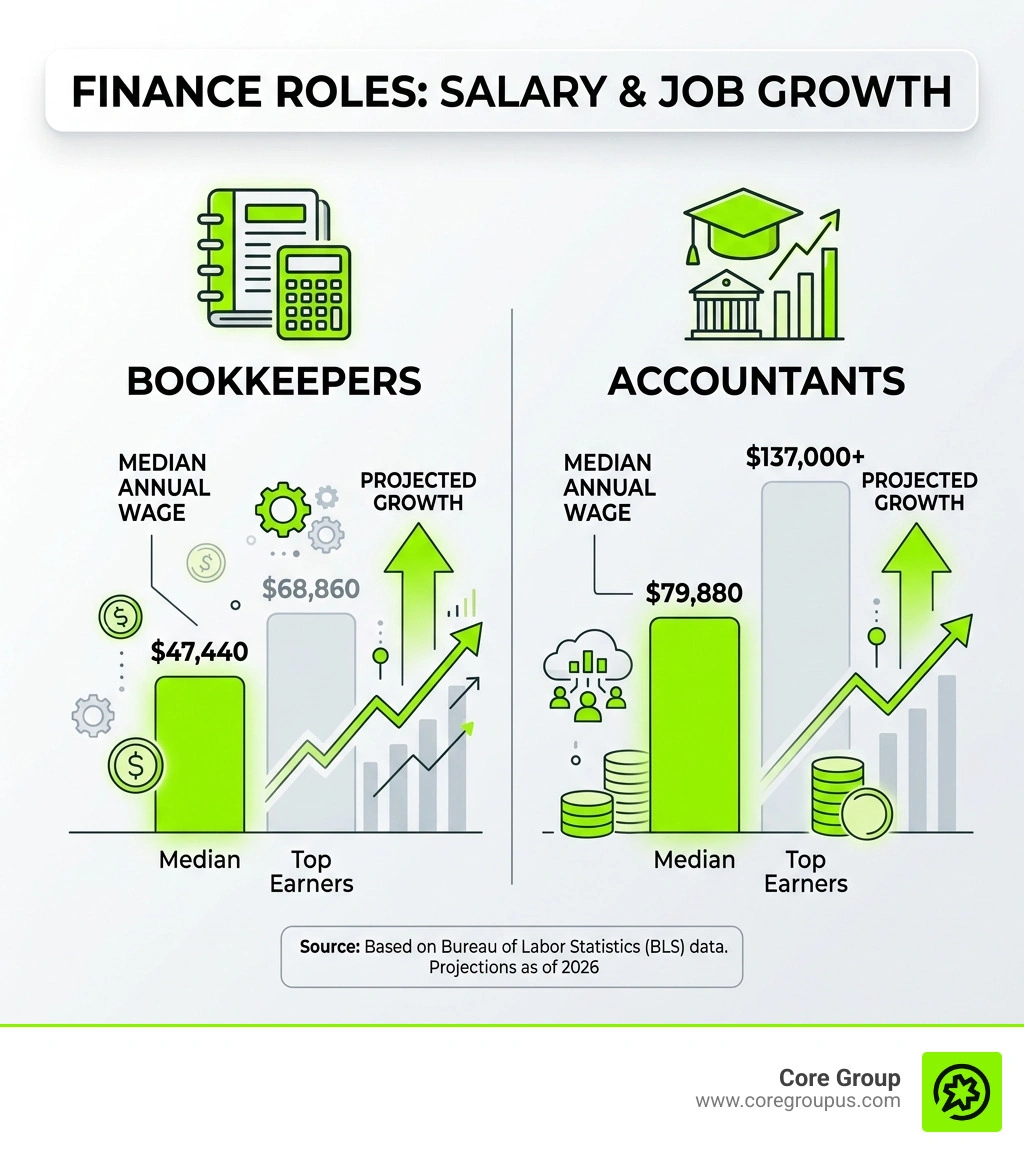
The financial rewards for these roles reflect the level of education and responsibility required. According to the Bureau of Labor Statistics, the median annual wage for bookkeepers is approximately $47,440. Those in the top tier of the profession can earn up to $68,860. Accountants, with their higher education requirements, see a median wage of $79,880, with top earners making over $137,000 annually.
While automation and AI are changing the industry, the demand for human expertise is not going away. In fact, 88 percent of finance leaders say that fostering a data driven culture is crucial to their future performance. However, there is a significant trust gap. Only 14 percent of these leaders say they are fully confident in the integrity of their financial data. This means there is a massive opportunity for bookkeepers and accountants who can provide clean, reliable, and human verified data.
As we move deeper into 2026, the focus is shifting toward data integrity. Technology handles the repetitive data entry, but professionals are needed to interpret that data and ensure it is accurate. This is why specialized boutique firms continue to thrive. They offer a level of personal attention that software alone cannot match.
Frequently Asked Questions about Financial Management
We hear many of the same questions from creative entrepreneurs who are trying to navigate their financial journey. Here are some of the most common queries we encounter.
What is the primary difference between bookkeeping and accounting
The primary difference lies in the focus of the work. Bookkeeping has an administrative focus. It is about the what and the when of your money. It is the process of entering data, filing receipts, and making sure the bank balance matches the software balance.
Accounting has an analytical focus. It is about the so what of your money. An accountant looks at the records created by the bookkeeper and interprets them. They look for trends, identify areas where you are wasting money, and help you plan for your tax bill. One is about data entry, while the other is about data interpretation.
When should a small business hire an accountant
You should consider hiring an accountant when your business reaches a level of complexity that you can no longer manage on your own. This often happens when you hit specific revenue milestones, like the $500,000 mark we mentioned earlier.
Other triggers include complex tax situations, such as having employees in multiple states or dealing with international sales. If you are planning to seek investment or sell your business, you will need an accountant to prepare investor ready financial statements. Scaling operations usually requires a more sophisticated level of financial modeling that only an accountant can provide. Professional firms can provide quotes to give you an idea of what to expect in the current market.
Can a bookkeeper transition into an accounting role
Yes, a bookkeeper can certainly transition into an accounting role. In fact, many of the best accountants started in bookkeeping because they have a deep understanding of how transactions flow through a business.
The transition usually requires additional education. Most accounting roles require at least a bachelor's degree. If the bookkeeper already has an associate degree, they can often transfer those credits toward a four year program. After obtaining a degree, the next step is often pursuing a CPA license, which requires passing a rigorous exam and meeting specific work experience requirements. Professional development and staying current with the latest software are also key parts of this journey.
Conclusion
At Core Group, we understand that you did not start your business to spend your weekends staring at spreadsheets. You started it to create, to innovate, and to build something meaningful. That is why we offer a no fluff, profit first playbook designed specifically for creative entrepreneurs.
Our goal is to give you total peace of mind. We handle the complexities of bookkeeping and financial accounting so you can focus on your craft. We are so confident in our ability to save you time and help you grow that we even back our services with a MacBook Pro guarantee. Whether you are a solopreneur or a growing agency, we provide the financial management and tax services you need to thrive in today's competitive market.
If you are ready to stop worrying about your books and start focusing on your profit, we invite you to explore our Accounting services. Let us help you turn your financial data into a roadmap for your future success. We serve clients across the United States, from the bustling streets of New York to the creative hubs of California and everywhere in between, ensuring your business stays compliant and profitable no matter where you call home.