Don't Get DIRty: How to Master Certified Payroll Services in California
Understanding Public Works Compliance in the Golden State
Certified payroll services california contractors rely on are a legal requirement for any business working on publicly funded construction projects in the state. If you work on public works jobs in California, here is what you need to know right away.
Quick Answer: What Are Certified Payroll Services in California?
- Contractors and subcontractors on California public works projects must submit Certified Payroll Reports (CPRs) weekly to the Labor Commissioner
- Reports are submitted electronically through the DIR's Public Works Website Services
- Workers must be paid prevailing wages, with daily overtime kicking in after 8 hours (not just after 40 hours per week like federal rules)
- Records must be kept for at least three years
- Non-compliance can mean fines, withheld payments, and even debarment from future projects
California does not make this easy. The state has stricter rules, higher wage rates, and more detailed reporting requirements than almost anywhere else in the country. What slides by in other states can trigger a full enforcement action here.
And for creative entrepreneurs in film, media, and production who occasionally work on publicly funded projects, the paperwork alone can feel like a second job. Accounting teams report spending close to an hour per project just managing certified payroll reports manually.
This guide breaks down exactly what California requires, what mistakes to avoid, and how the right support can take this off your plate entirely.

As of April 2026, the landscape for public works in California remains one of the most regulated in the United States. When we talk about public works, we are referring to construction, alteration, demolition, installation, or repair work done under contract and paid for in whole or in part out of public funds. This includes everything from massive freeway expansions to small renovations on local library branches.
The Department of Industrial Relations, commonly known as the DIR, is the primary governing body that oversees these projects. Specifically, the Labor Commissioner's Office ensures that workers on these projects receive the fair compensation they are entitled to under the law. This is where the concept of certified payroll comes into play. It is not just a standard pay run. It is a sworn statement that the wages paid are correct and that the employer has complied with all labor laws.
Weekly reporting is a non negotiable part of the process. Every contractor and subcontractor involved in a project must submit their records to the DIR. This ensures transparency and allows the state to monitor whether workers are being paid the correct prevailing wage for their specific trade. The process can be incredibly taxing for business owners who are already juggling site management and project deadlines.
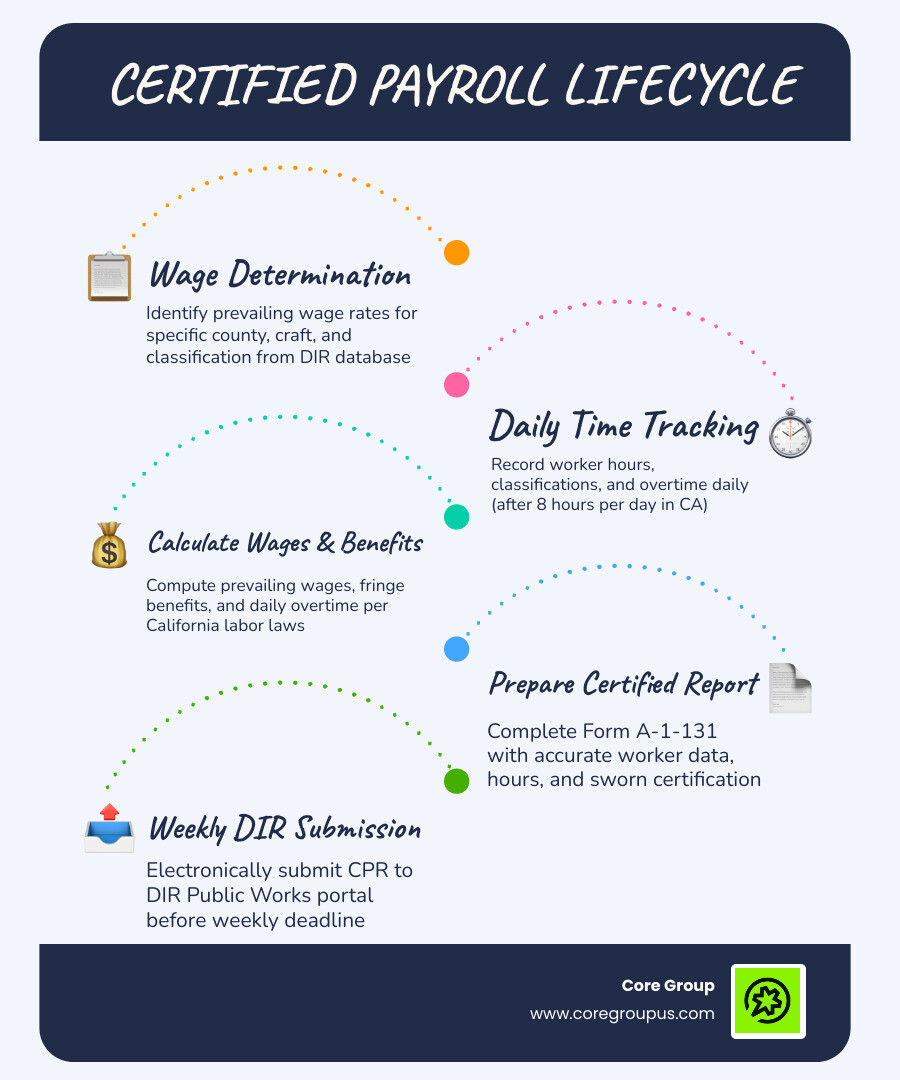
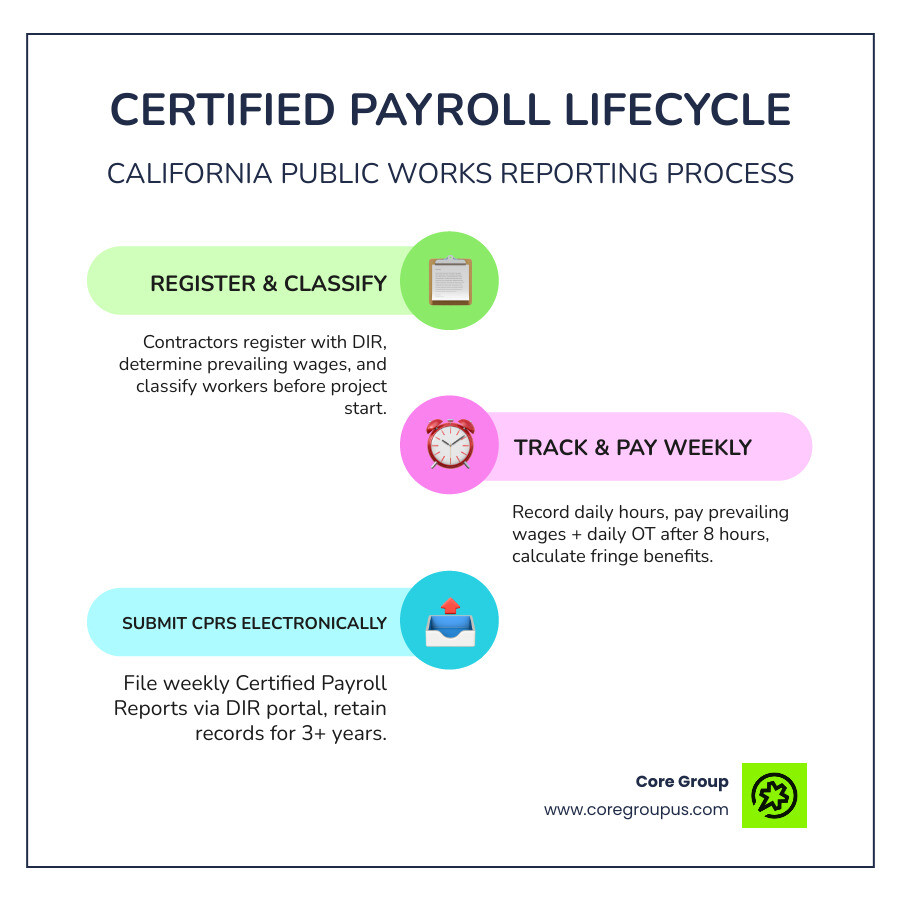
The lifecycle of a certified payroll report begins before the first shovel hits the dirt. It starts with identifying the correct wage determination for the specific county and craft. From there, we must track hours daily, calculate complex fringe benefits, and finally upload the data to the DIR portal. It is a continuous loop that repeats every single week until the project is officially completed and accepted.
Essential Requirements for California Prevailing Wage Projects
The core of California's system is the prevailing wage. This is a minimum wage rate set by the DIR for specific types of work in specific geographic areas. Unlike the standard minimum wage, prevailing wages are often significantly higher and are based on collective bargaining agreements in the region.
One of the biggest hurdles we see contractors face is worker classification. You cannot simply label everyone as a general laborer to save on costs. If a worker is performing the duties of an electrician for four hours and a carpenter for four hours, they must be paid the respective rates for each craft. Misclassification is a primary target for state audits.
Fringe benefits add another layer of complexity. Prevailing wage is usually expressed as a total hourly rate which includes a base wage plus a fringe benefit amount. We can satisfy the fringe portion by paying into approved plans like health insurance or retirement accounts, or by paying the difference as cash to the employee. However, California has very specific rules about which benefits count and how they must be documented.
Perhaps the most distinct rule in California is the daily overtime requirement. While federal Davis Bacon rules generally focus on a 40 hour work week, California requires overtime pay after 8 hours worked in a single day. There are also requirements for double time after 12 hours. This means that even if a worker only logs 30 hours in a week, they might still be owed overtime if one of those days was a 10 hour shift.
To stay compliant, you must constantly refer to the official Certified Payroll Reports guidelines provided by the state. These documents outline the exact expectations for every project participant.
Navigating the DIR Electronic Reporting System and Forms
Gone are the days of mailing stacks of paper to a state office. California now requires electronic submission for almost all public works projects. The primary tool for this is the DIR's Public Works Website Services.
Contractors often find themselves dealing with two main types of forms. Form WH 347 is the federal standard often used for Davis Bacon projects. However, for California state projects, Form A 1 131 is the standard. While they ask for similar information, the California version is tailored to the state's specific daily overtime and fringe benefit tracking requirements.
For businesses with more than a few employees, manual data entry into the DIR portal is a recipe for burnout. This is why many use XML V1.3 files. These files allow payroll software to communicate directly with the DIR system, uploading all employee data in one go. Some awarding bodies or prime contractors may also require the use of third party systems like LCP Tracker to manage compliance across the entire project.
| Feature | California Form A 1 131 | Federal Form WH 347 |
|---|---|---|
| Overtime Basis | Daily (after 8 hours) | Weekly (after 40 hours) |
| Submission Portal | DIR Online System | Agency Specific (often paper or eARS) |
| Fringe Reporting | Detailed breakdown required | Lump sum or check box |
| Apprentice Info | Mandatory tracking | Required if applicable |
| Statement of Employer | California specific language | Federal compliance language |
Using the correct XML schema is vital. If the file format is even slightly off, the DIR system will reject the entire upload, leaving you to hunt for errors while the submission deadline looms.
Avoiding Penalties and Common Mistakes in Reporting
The stakes for messing up your certified payroll services california obligations are high. The DIR does not take a light touch when it comes to enforcement. Non compliance can lead to significant financial penalties that can quickly turn a profitable project into a loss.
Late submission is one of the most common pitfalls. Reports are generally due within a week of the payroll period ending. If you fall behind, the awarding body has the right to withhold your progress payments. This can create a massive cash flow squeeze for your business.
Misclassification remains a top error. We often see contractors struggle with the nuances between a craft worker and an apprentice. To pay a worker the lower apprentice rate, they must be officially registered in a state approved apprenticeship program. If they aren't, you must pay them the full journeyman rate.
Record retention is another area where businesses get caught off guard. Under California law, you must keep all certified payroll records for at least three years. However, some legal actions or audits can extend this period. We recommend keeping these records digitally and securely to ensure they are available at a moment's notice. For more on staying on the right side of the law, check out our guide on Payroll Tax Compliance.
Common mistakes to watch out for include
- Averaging hours over a week instead of reporting daily
- Failing to include the statement of employer compliance
- Using outdated wage determinations
- Incorrectly calculating the credit for fringe benefits paid
The Benefits of Outsourcing Certified Payroll Services in California

If reading about XML schemas and daily overtime rules makes your head spin, you are not alone. Many contractors realize that their time is better spent on the job site or growing their business rather than acting as a part time compliance officer. This is where professional certified payroll services california come in.
Outsourcing offers a level of automation that is nearly impossible to achieve manually. A specialized service can integrate your time tracking data directly with your payroll and accounting software. This eliminates the need for double entry and drastically reduces the chance of human error.
Managed reporting means that an expert is looking over your data before it ever reaches the DIR. They can spot misclassifications or missing fringe benefit information early. This proactive approach is much cheaper than paying a fine later. Furthermore, a good service will handle the electronic upload for you, ensuring that the XML files are formatted perfectly every time.
For creative businesses and small contractors, having a partner who understands hr and payroll for small business is a game changer. It provides the peace of mind that your public works contracts are safe and that your business is protected from unnecessary state scrutiny.
Frequently Asked Questions
How Often Must Contractors Submit Certified Payroll Services in California Reports
In California, certified payroll reports must be submitted weekly. This applies to every week work is performed on the project. If there is a week where no work was performed, most systems require you to submit a "No Work" report to maintain a continuous record for the duration of the project.
The Labor Commissioner is strict about these deadlines. Consistently missing your weekly filings can lead to your business being flagged for an audit. It is also important to remember that different states have different rules, so if you work across state lines, you should consult a resource like the Certified Payroll Requirements by State list to stay compliant.
What Records Are Required for Certified Payroll Services in California Compliance
To stay compliant, you need to maintain a detailed set of records for every worker on the project. This includes
- Legal name and social security number (redacted on public versions)
- Correct work classification (e.g., Carpenter, Electrician)
- Daily and weekly hours worked in each classification
- Daily straight time and overtime hours
- Total wages paid and all deductions
- Fringe benefit statements showing where contributions were made
- Apprentice registration papers and proof of training fund contributions
How to Confirm if a Project Qualifies as Public Works
Confirming if a project is public works is a critical first step. Generally, if the project is being funded by a city, county, state agency, or school district, it is a public works project. However, some private projects that receive public subsidies or tax breaks may also fall under these rules.
You should always check the bid documents or the contract. The awarding body is required to identify the project as a public works job and provide the DIR project registration number. If you are unsure, you can search the DIR database using the awarding body's name or the project location.
Conclusion and Next Steps for Your Business
Mastering certified payroll services california is not about becoming a legal expert. It is about building a system that ensures accuracy and consistency. At Core Group, we understand that your passion is your craft, not your paperwork. We provide financial management, bookkeeping, and tax services specifically designed for entrepreneurs who want to grow without the weight of compliance dragging them down.
Our "no fluff, profit first playbook" is designed to give you back your time and provide total peace of mind. We are so confident in our ability to streamline your operations that we back our service with a MacBook Pro guarantee. We handle the complex math and the DIR dirty work so you can focus on the creative and strategic parts of your business.
Don't let a payroll error derail your next big public works contract. If you are ready to stop stressing over daily overtime and XML uploads, let's talk about how we can support your journey. You can learn more about our philosophy and How we do it by visiting our website. Let us help you keep your business clean and your profits growing.