How to Never Worry About S-Corp 1099 Rules Again
Do S-Corps Get 1099s?
Usually, no. If you pay an S corporation for ordinary services, you generally do not need to send it Form 1099-NEC or 1099-MISC. But some payments, including attorney fees and medical services, are reportable even when the vendor is an S corporation.
Before you file, get the vendor's Form W-9. Check its tax classification, then check what you paid for. That simple habit can save you from both missed forms and forms you did not need to send.
I'm Christian Brim, and I'll walk you through that check so 1099 season takes less time away from your creative work. Understanding whether and when do S-corps get 1099 forms is essential for running a clean, compliant back office.

To keep your business protected during tax season, review our LLC 1099 compliance guide, learn how to issue a 1099 to a contractor, and consult our LLC 1099 income guide.
Do S-Corp Get 1099 Forms? The General Exemption Explained
Under standard Internal Revenue Service regulations, corporations benefit from what is known as the corporate exemption. When you hire an independent contractor who operates as a sole proprietorship or a single-member LLC, you must issue an information return if you pay them $600 or more during the calendar year. However, when a vendor operates under a corporate framework, that general obligation disappears for standard services.
To understand why this exemption exists, it helps to review how an S corporation functions. An S corporation is a pass-through entity that elects to pass corporate income, losses, deductions, and credits through to its shareholders for federal tax purposes. The business files Form 1120-S annually, and each shareholder receives a Schedule K-1 reflecting their portion of the profits. Because corporations maintain formal balance sheets, strict corporate governance, and rigorous federal reporting, the IRS already has substantial visibility into their revenue streams.
Every state recognizes different business entities, and state departments of revenue outline specific rules for corporate entities, as seen in state guidelines on business organizational structure. Despite these local filings, federal 1099 reporting follows uniform guidelines across the country.
| Entity Type | Standard Services (over $600) | Legal Services | Medical Payments | Rent and Royalties |
|---|---|---|---|---|
| Sole Proprietorship | Form 1099-NEC | Form 1099-NEC | Form 1099-MISC | Form 1099-MISC |
| Partnership | Form 1099-NEC | Form 1099-NEC | Form 1099-MISC | Form 1099-MISC |
| Single-Member LLC | Form 1099-NEC | Form 1099-NEC | Form 1099-MISC | Form 1099-MISC |
| C Corporation | Exempt | Form 1099-NEC or MISC | Form 1099-MISC | Exempt |
| S Corporation | Exempt | Form 1099-NEC or MISC | Form 1099-MISC | Exempt |
When Do S-Corp Get 1099-NEC or 1099-MISC Forms?
Form 1099-NEC is dedicated strictly to non-employee compensation, while Form 1099-MISC captures miscellaneous payments such as rents, prizes, and healthcare payments. Our detailed breakdown of Form 1099-NEC covers how the separation between these two forms impacts annual reporting.
If your creative agency hires an outside design firm operating as an S corporation to overhaul your brand identity for $8,000, you do not issue a 1099-NEC. The corporate exemption applies. Conversely, if that exact same design work was performed by an individual freelancer operating under their Social Security number, you must file a 1099-NEC.
S-Corporation vs. C-Corporation 1099 Reporting Rules
From a 1099 compliance standpoint, S corporations and C corporations are treated virtually identically. The IRS treats both as corporate bodies under Treasury Regulation section 1.6041-3.
The differences between the two lie primarily in their internal tax calculations and pass-through status. A C corporation faces entity-level taxation, while an S corporation relies on Form 2553 to pass profits directly to shareholders. For business owners seeking advanced tax efficiency, implementing a proactive S-corp tax planning framework provides substantial savings on self-employment taxes without altering external vendor 1099 obligations.
Key Exceptions When You Must Issue a 1099 to an S-Corporation

While the general corporate exemption covers most routine B2B service contracts, Congress created statutory carve-outs. If your payment falls into one of these specific buckets, the corporate shield vanishes, and you must prepare an information return regardless of whether the recipient is an S corporation, a C corporation, or an individual.
Legal Services and Attorney Fee Payments
Payments to legal professionals represent the most common exception. If you pay an attorney or law firm $600 or more in the course of your trade or business, you must report those payments even if the firm operates as a professional corporation or S corporation.
The reporting method depends on the character of the legal payment.
- Direct legal fees for services rendered are reported in Box 1 of Form 1099-NEC.
- Gross proceeds paid to an attorney in connection with legal settlements are reported in Box 10 of Form 1099-MISC.
For example, if your company pays $5,000 to an incorporated law firm to draft commercial licensing contracts, you must issue a Form 1099-NEC showing $5,000 in Box 1.
Medical and Healthcare Payments
Payments made in the course of your business to physicians, medical practices, and healthcare providers require Form 1099-MISC reporting. Under IRS rules, payments of $600 or more made to individuals or corporations providing healthcare services must appear in Box 6 of Form 1099-MISC.
This requirement frequently touches companies offering self-insured medical plans or businesses that hire specialized medical consultants. Many medical professionals establish entities like PLLCs or PCs with an S corporation election to manage their self-employment liabilities. Staying fully aligned with S-corp payroll rules ensures that healthcare shareholder-employees draw compliant wages while third-party payers maintain accurate Form 1099-MISC records.
Substitute Payments and Gross Proceeds
Financial service transactions carry their own unique reporting rules. If an S corporation receives substitute payments in lieu of dividends or tax-exempt interest during broker-directed loan arrangements, the payer must report these amounts on Form 1099-MISC in Box 8. While less common for everyday creative businesses, these transactions remain fully reportable under federal securities and tax statutes.
How to Verify Vendor Tax Status and Handle Form W-9
You should never guess a vendor's tax structure. The only reliable way to know whether a company is exempt from 1099 reporting is to collect a signed Form W-9 before you disburse any funds.
Line 3 of Form W-9 requires the vendor to check a box indicating their federal tax classification.
- Individual or sole proprietor
- C Corporation
- S Corporation
- Partnership
- Trust or estate
- Limited Liability Company (with tax classification designated as C, S, or P)
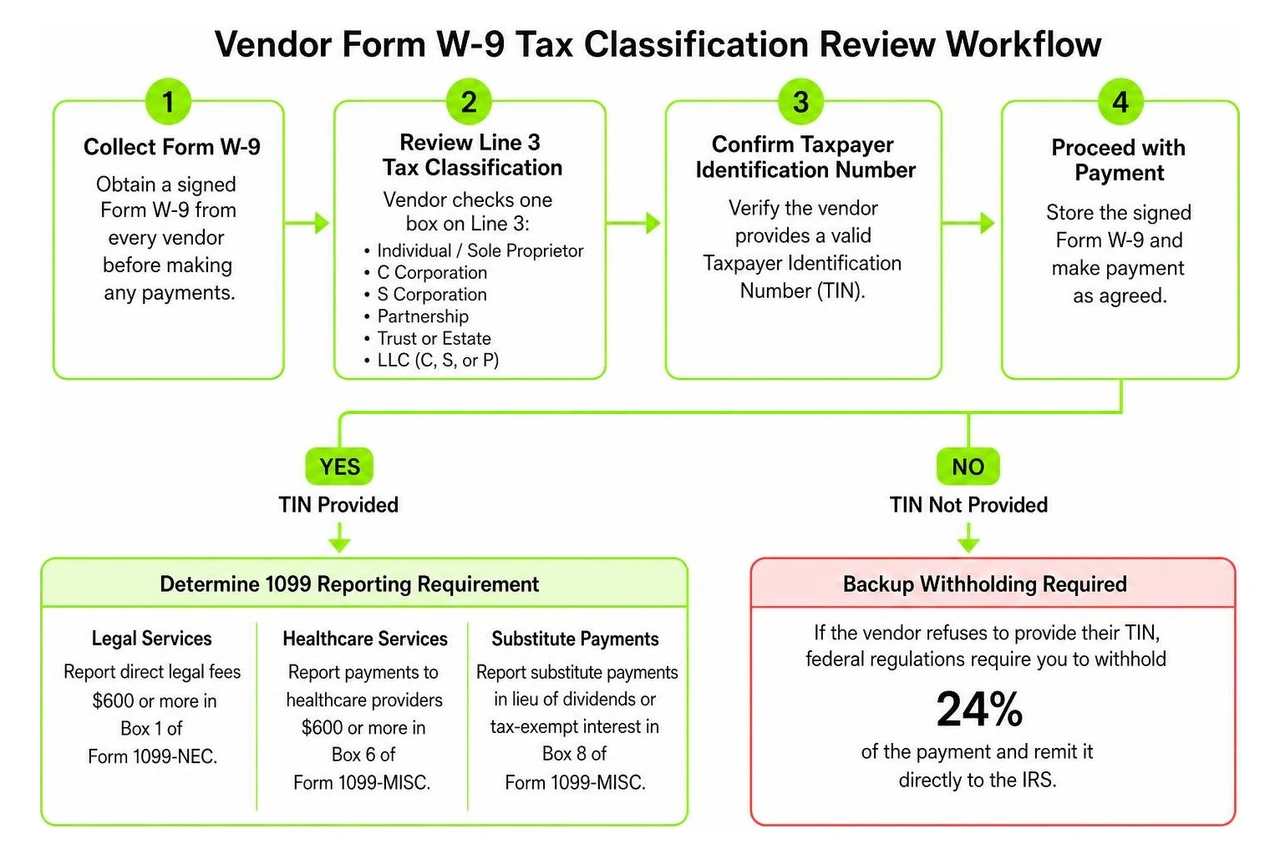
Collecting this form during vendor onboarding protects your company from backup withholding mandates. If a vendor refuses to provide their Taxpayer Identification Number, federal regulations require you to withhold 24 percent of the payment and remit it directly to the IRS.
Evaluating LLCs Taxed as S-Corporations
A source of confusion for many business owners is the Limited Liability Company that elects corporate tax status. An LLC is a legal structure created at the state level, not a federal tax classification.
On Form W-9, an LLC owner will check the LLC box on Line 3 and write the letter "S" in the adjacent box to denote an S corporation election. When you see this designation, treat the vendor as an exempt corporate entity for ordinary service payments. You do not need to issue a 1099-NEC unless the transaction involves legal or medical services.
What to Do If You Mistakenly Issue a 1099 to an S-Corp
If you accidentally issue a Form 1099-NEC to an exempt S corporation, do not panic. The IRS will not penalize you simply for filing an unnecessary informational return. However, it can cause minor bookkeeping administrative friction for the recipient, as their tax preparer will need to reconcile the reported revenue with their corporate general ledger.
If the recipient requests a formal correction, you can file a corrected 1099. Check the "CORRECTED" box at the top of the form, enter the recipient and payer details exactly as they appeared on the original return, enter $0 in Box 1, and transmit the corrected form to both the vendor and the IRS.
Step-by-Step 1099 Compliance and Filing Deadlines for 2026

Tax compliance runs on strict deadlines. To keep your creative business organized and stress-free, follow our structured timeline for annual information returns. You can review our full guide on when 1099s are due to ensure you never miss an IRS cut-off date.
For state-level compliance, state tax authorities also monitor information returns. Certain states maintain distinct reporting portals or direct feed integrations, as detailed in resources like the Alaska tax information portal.
Collecting W-9s and Tracking Reporting Thresholds
Establish a standard operating procedure in your accounts payable department. No vendor invoice gets paid until a completed Form W-9 is uploaded to your system. Modern accounting software platforms allow you to set flags on vendor profiles, automatically tracking cumulative annual payments against the standard $600 threshold.
E-Filing via IRIS and Avoiding Penalties
The IRS requires businesses filing 10 or more information returns across all form types to file electronically. Returns can be submitted using the Information Returns Intake System (IRIS) or the Filing Information Returns Electronically (FIRE) system.
Failing to submit required returns on time leads to tiered IRS penalties under Section 6721.
- Up to 30 days late, $60 per form
- 31 days late through August 1, $130 per form
- After August 1 or not filed, $330 per form
- Intentional disregard of filing requirements, $660 or more per form with no maximum penalty cap
Frequently Asked Questions About S-Corporation 1099 Rules
Why do S-corp get 1099 forms from some clients by mistake?
Many businesses follow an oversimplified policy of sending 1099 forms to every external vendor paid more than $600, regardless of entity type. Other times, automated bookkeeping systems generate forms automatically without filtering out corporate classifications. If your S corporation receives an unnecessary 1099, simply ensure the total gross receipts match your books; there is no need to reject the form.
What are the IRS penalties for failing to file a required 1099?
If you fail to file a mandatory 1099 (such as a 1099-NEC for attorney fees paid to an S corporation law firm), the IRS assesses penalties ranging from $60 to $660 per return based on when the error is corrected.
How do S-corp owners report business income without a 1099?
S corporation owners report all business revenue on Form 1120-S based on their internal accounting records, general ledgers, and bank statements. The IRS does not require 1099 forms to verify corporate income, as corporations are required to maintain independent financial accounting records.
Conclusion
Understanding 1099 reporting does not have to drain your creative energy. By maintaining updated W-9 forms for every vendor and identifying reportable exceptions like legal and medical payments, you can navigate filing season with absolute confidence. If you manage multiple entities or work with independent contractors, exploring our guide on single-member LLC 1099 reporting will give you a complete picture of your annual compliance obligations.
At Core Group, we provide no-fluff, profit-first financial management, bookkeeping, and tax services for creative entrepreneurs. We help you stay compliant, keep more of what you make, and eliminate tax stress so you can focus on building a thriving business.