Financial Planning for Creatives and Artists Made Simple
Why Artists Need a Financial Advisor in Their Corner
Finding a financial advisor for artists is one of the smartest moves a creative professional can make, but it is also one of the most overlooked.
Quick answer on what a financial advisor for artists does
- Helps you budget around unpredictable, project-based income
- Sets up an emergency fund (aim for at least 6 months of living expenses)
- Guides tax planning, including self-employment taxes and quarterly payments
- Builds retirement and investment strategies without employer-sponsored plans
- Protects and values intellectual property as a long-term financial asset
- Helps diversify income through licensing, royalties, and passive streams
- Assembles a full advisory team including a CPA, entertainment lawyer, and business manager
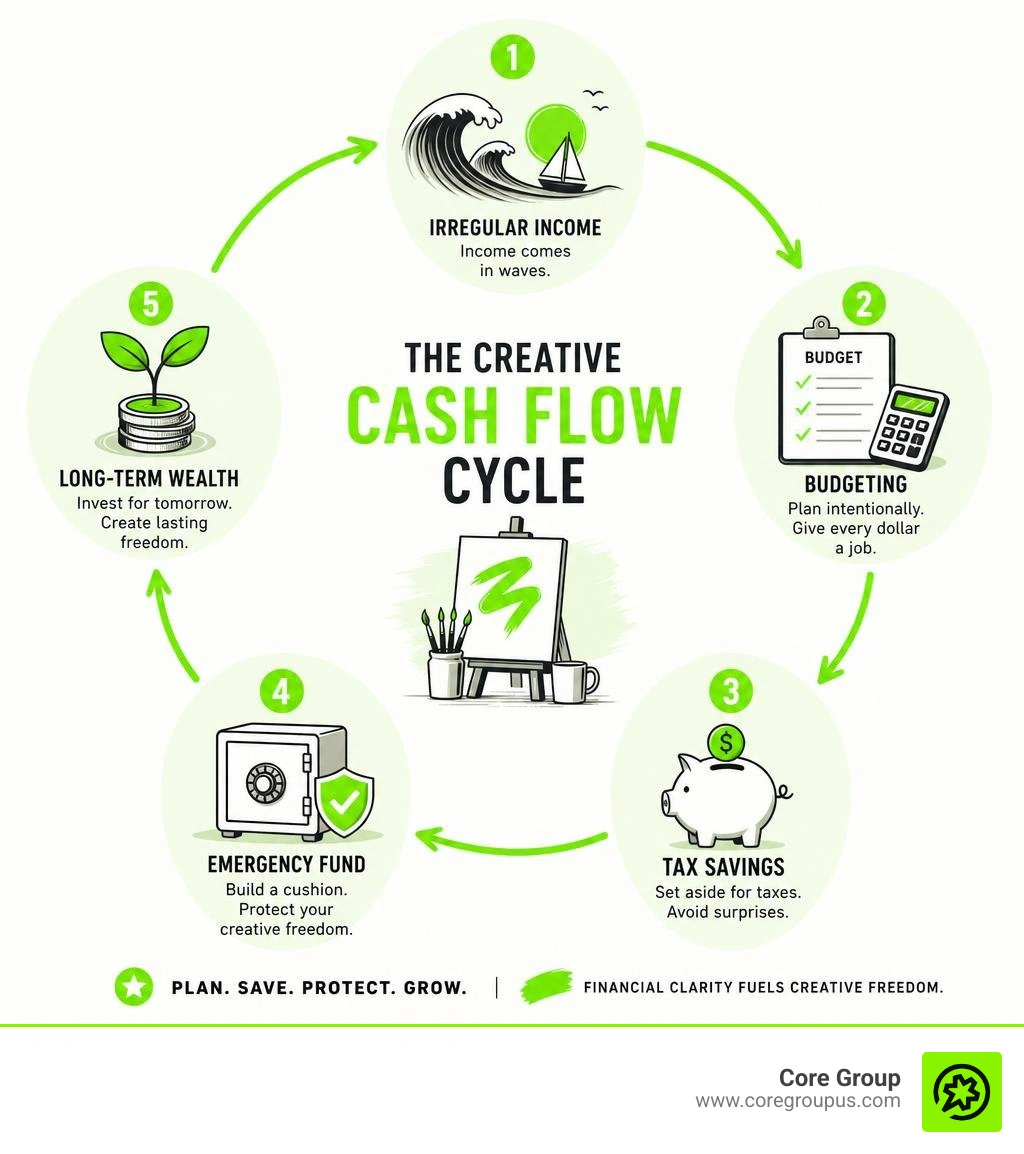
If you work in film, music, design, or any creative field, your financial life looks nothing like a traditional 9-to-5. Income arrives in waves. Projects stall. A single great month can be followed by three quiet ones. Meanwhile, taxes, health insurance, and retirement planning all land squarely on your shoulders.
Many talented creatives are forced to leave their careers not because they lacked skill, but because the financial pressure became unsustainable. The stress of bookkeeping, irregular cash flow, and unexpected tax bills chips away at the creative energy that made the career worth pursuing in the first place.
The good news is that this is a solvable problem. The right financial guidance, built specifically around how creatives actually earn, can turn financial chaos into clarity.
Why Financial Planning is Uniquely Challenging for Creatives

Traditional financial planning is built on the assumption of a steady paycheck. Most financial software, banking tools, and retirement products assume that you get paid a fixed amount on the first and fifteenth of every month. For creatives, this assumption is completely divorced from reality.
We often see artists experience extreme cycles of feast and famine. You might sign a major gallery contract, book a touring gig, or land a massive design client that pays you tens of thousands of dollars all at once. Then, you might go several months without a single dollar of incoming revenue. This unpredictability makes basic tasks like paying rent, buying supplies, and saving for the future feel like a constant balancing act.
On top of irregular income, self-employment taxes present a massive hurdle. In the United States, traditional employees have their taxes automatically withheld from their paychecks. As a self-employed creative, you are responsible for tracking your own earnings and paying both income tax and self-employment tax. This double tax hit often catches creatives off guard at the end of the year, leading to stressful tax debt.
Furthermore, creative professionals lack traditional employer benefits. There is no human resources department setting up your health insurance, matching your 401k contributions, or offering paid sick leave. You have to build your own safety net from scratch while simultaneously trying to protect your intellectual property, plan for your legacy, and maintain your creative focus. It is incredibly easy to feel overwhelmed, but moving From Intimidated to Empowered with a Creative Guide to Financial Epiphanies is entirely possible once you have the right systems in place.
Mastering the Feast and Famine Cycle with Smart Budgeting and Pricing
To survive and thrive as an artist, you must abandon traditional budgeting methods and adopt a system designed for fluctuating cash flows. Instead of budgeting based on what you hope to make, you must budget based on your baseline survival numbers.
We recommend building an emergency fund that covers at least six months of living expenses. This is not a luxury, it is a business necessity. When you have a solid cash cushion, a slow season is no longer a career-threatening emergency; it is simply a quiet period where you can focus on developing new work.
Additionally, you must proactively save for taxes. If you make more than $400 a year as a self-employed creative, you will likely have to pay self-employment tax alongside your standard income tax. We advise setting aside 10 to 30 percent of every single dollar you receive in a separate account specifically for tax season.
| Traditional Budgeting | Irregular Income Budgeting |
|---|---|
| Assumes a fixed monthly income | Assumes income will fluctuate constantly |
| Expenses are paid as they arrive | Expenses are paid from a pre-funded cash reserve |
| Emergency fund of 3 months is typical | Emergency fund of 6 to 12 months is recommended |
| Taxes are automatically withheld | Taxes must be manually saved and paid quarterly |
| Savings are often a fixed monthly amount | Savings are swept during high-earning months |
Managing this cash flow requires a reliable system. If you want to keep your sanity, implementing a structured approach to your daily transactions is vital. You can learn exactly how to set this up by reading our Bookkeeping for Creatives Complete Guide.
Separating Personal and Business Accounts for Tax Peace of Mind
One of the most common mistakes we see creative entrepreneurs make is mixing their personal and business finances. When you use the same checking account to buy groceries and paintbrushes, your financial records become a tangled mess. This makes it nearly impossible to accurately track your business performance or claim rightful tax deductions.
To fix this, you must open separate checking and savings accounts dedicated solely to your creative business. Every payment from a client, gallery, or streaming platform should go directly into your business account. From there, you can pay yourself a consistent monthly personal salary to cover your personal rent, food, and lifestyle.
This clear boundary makes tax preparation incredibly simple. It allows you or your accountant to easily identify write-offs and business deductions. For a deeper dive into organizing these records, check out our Accounting for Artists Complete Guide. Keeping these accounts separate ensures you never miss out on valuable deductions. You can read more about what counts as a legitimate write-off in our resource on Creative Business Expenses.
Pricing Strategies and Knowing When to Raise Your Rates
Pricing creative work is notoriously difficult. Many artists fall into the trap of pricing their work based on an hourly rate, but this often penalizes you as you become faster and more skilled. Instead, we advocate for value-based pricing, which focuses on the impact and value of the finished product to the client.
To price your work effectively, you must combine concrete costs, such as materials, studio rent, and software, with abstract costs, such as your expertise, unique style, and the market demand. Research what other professionals in your niche and geographic region are charging, and position yourself accordingly.
Knowing when to raise your rates is equally important. If your schedule is consistently booked out several months in advance, or if you find yourself feeling burnt out by the sheer volume of work, it is time to increase your prices. This allows you to work with fewer, higher-paying clients while dedicating more time to quality. Building these strong, sustainable relationships is the key to long-term success. You can explore this concept further in our discussion on The Profitable Creative and Why Client Retention is Your Real Competitive Advantage with Francis Flair.
Managing Debt and Diversifying Income Streams
Relying on high-interest credit cards to fund your creative projects during lean months is a recipe for financial disaster. High-interest debt compounds quickly, eating away at your future profits and creating immense psychological stress.
Instead of turning to credit cards, look for alternative ways to manage costs. Within the creative community, skill trading can be an exceptionally effective way to obtain services like web design, photography, or copywriting without spending cash.
To reduce your overall financial risk, you must also diversify your income streams. Relying solely on one-off client projects or physical art sales leaves you highly vulnerable. Consider creating passive income opportunities, such as licensing your designs, selling merchandise, offering digital downloads, or teaching online workshops. If you are a digital creator or influencer, you should also learn how to optimize your business expenses to keep more of your hard-earned cash. You can find excellent tips in our guide on Tax Deductible Expenses for Influencers.
Building Long Term Wealth and Protecting Your Intellectual Property

For artists, wealth is not just about the money in your bank account; it is also about the intellectual property you own. Your copyrights, trademarks, and licensing agreements are valuable business assets that can generate revenue for decades. Protecting these assets is a fundamental part of building long-term financial security.
Always ensure you have clear, written contracts for every project, collaboration, or sale. Never rely on verbal agreements, especially when it comes to ownership rights and royalty distributions. If you are unsure where to start with the legal side of your creative business, there are excellent free and low-cost legal clinics available to help. You can access valuable tools and guidance through the Legal and Financial Management Resources for Artists from NYFA.
Additionally, you must protect your ability to earn an income. If an illness or injury prevents you from performing, painting, or designing, your income could completely vanish. Investing in income loss insurance or disability insurance tailored for self-employed individuals ensures that your financial plan remains secure even if you face unexpected health challenges.
Retirement and Investment Strategies Tailored for Freelancers
Many self-employed creatives assume that retirement planning is not for them because they do not have a traditional corporate pension or 401k plan. However, the IRS offers several highly advantageous retirement accounts specifically designed for self-employed individuals and small business owners.
Options like a Simplified Employee Pension IRA (SEP IRA), a Solo 401k, or a Savings Incentive Match Plan for Employees (SIMPLE IRA) allow you to contribute pre-tax dollars, reducing your current tax bill while building a wealth-generating investment portfolio. You can explore the official rules and contribution limits directly on the IRS page for Retirement Plans for Self Employed Individuals.
When investing, we recommend using tax-efficient strategies such as smart asset location. This involves placing tax-heavy investments in tax-advantaged retirement accounts, while keeping tax-efficient investments, like broad-market index funds, in standard brokerage accounts. Additionally, the traditional model of a hard-stop retirement at age 65 is increasingly being replaced by flex retirement. This model allows creatives to scale back their workload gradually over time, preserving their professional identity and artistic purpose while maintaining financial freedom.
Securing Grants and Non Traditional Funding Opportunities
Grants, residencies, fellowships, and arts council awards are phenomenal ways to fund your creative projects without taking on debt or diluting your ownership rights. These non-traditional funding sources provide you with the financial breathing room to experiment, take creative risks, and elevate your career.
Finding these opportunities requires consistent research. Look for local, state, and national arts organizations that align with your specific discipline. When applying, treat the application process like a professional business pitch. Clearly articulate your creative vision, provide a detailed budget, and demonstrate how the funding will impact your career and community. If you need help structuring your business financials to look attractive to grant committees, we can help you build a professional roadmap through our Financial Consulting for Artists.
How to Choose the Right Financial Advisor for Artists
Not all financial advisors are equipped to handle the unique realities of a creative career. A traditional advisor who primarily manages retirement portfolios for corporate executives may not understand why your income drops to zero for three months while you write a book, or how to value a music catalog.
When looking for a financial advisor for artists, you must seek out professionals who have deep experience working within the arts and entertainment sectors. They should understand the nuances of mixed W-2 and 1099 income, royalty streams, and union benefits. Most importantly, they must owe you a fiduciary duty, meaning they are legally obligated to act in your absolute best financial interest at all times.
What to Look For in a Financial Advisor for Artists
When evaluating potential advisors, look for absolute fee transparency. We strongly recommend working with fee-only or flat-fee advisors rather than those who earn commissions on financial products. Commission-based models can create conflicts of interest, as the advisor may be incentivized to sell you products you do not actually need.
You should also look for credentials like the Certified Financial Planner (CFP) designation, which indicates a high level of training and ethical standards. Pay close attention to their communication style. A great advisor will never use complex financial jargon to confuse you. Instead, they should welcome your questions, explain concepts clearly, and empower you to make informed decisions. If you have ever felt intimidated by money conversations, you are not alone. You can find comforting, practical guidance on overcoming this anxiety in the Financial advice for artists who think they are bad with money from NPR.
Preparing for Your First Meeting with a Financial Advisor for Artists
To get the absolute most value out of your first advisory meeting, you should come prepared with a clear snapshot of your current financial life. This does not mean your finances need to be perfect; it simply means you need to be honest and organized.
Before your meeting, gather the following documents and information
- Your tax returns from the past two years
- A list of all bank accounts, credit cards, and outstanding debts
- A basic balance sheet showing your current assets and liabilities
- A rough cash flow projection showing your expected income and expenses for the next six months
- A list of your short-term and long-term creative and personal goals
Be prepared to discuss your personal relationship with money and your risk tolerance. An experienced advisor will use this information to build a customized plan that respects your values and supports your creative lifestyle.
Understanding Advisor Fee Structures and Compensation Models
Financial advisors charge for their services in several different ways. Understanding these models will help you choose the option that best fits your budget and business structure.
- Flat-fee or Advice-only, You pay a set, transparent fee for a specific financial plan or ongoing coaching. This is often the best model for creatives who want unbiased advice without product sales.
- Assets Under Management (AUM), The advisor takes a small percentage, typically around 1 percent, of the investment assets they manage for you. This model is common but may require you to meet high investment minimums.
- Hourly Rate, You pay the advisor only for the hours you spend meeting and working together. This is a great, low-commitment way to get answers to specific financial questions.
- Commission-based, The advisor earns money by selling you specific insurance policies, mutual funds, or investment products. We generally recommend avoiding this model due to potential conflicts of interest.
Assembling Your Creative Advisory Board and Navigating Family Dynamics
As your creative business grows, you cannot manage everything alone. Trying to act as your own accountant, lawyer, publicist, and business manager will quickly lead to burnout and costly mistakes. Instead, you should aim to build an "advisory board" of trusted professionals who can support your career.
Your core team should eventually include a CPA who specializes in self-employment taxes, an entertainment lawyer to review contracts and protect your intellectual property, and a specialized financial advisor to guide your long-term wealth strategy. By delegating these complex tasks to experts, you free up your mental energy to focus entirely on what you do best, creating art.
Managing Financial Conversations with Family and Peers
Money can be a highly sensitive topic, especially within creative families and artistic communities. If you achieve sudden financial success, you may face requests for financial support from family members or peers.
It is vital to establish clear boundaries early. Involving your financial advisor in these situations can be incredibly helpful, as they can act as a neutral third party to help you set realistic limits on financial gifts. Additionally, if you have children, start teaching them basic money management and self-employment principles early. Demystifying money conversations within your household prevents future misunderstandings and builds a healthy, generational respect for wealth.
Frequently Asked Questions about Creative Wealth Management
How do artists manage highly irregular income streams
Managing irregular income requires a system of cash reserves. We recommend setting up a business savings account to act as your personal "holding tank." When a large payment arrives, deposit it into this account. Then, pay yourself a consistent, pre-determined monthly salary from this tank to cover your living expenses. This stabilizes your personal budget and ensures you always have cash during quiet months.
What percentage of creative income should be saved for taxes
If you are self-employed, you should set aside 10 to 30 percent of your gross earnings for taxes. This covers both your federal and state income taxes as well as your 15.3 percent self-employment tax. We highly recommend making quarterly estimated tax payments to the IRS to avoid penalties and a massive, unexpected bill in April.
Why is intellectual property protection considered a financial strategy
Intellectual property is a wealth-generating asset. By securing copyrights, trademarks, and licensing agreements, you create opportunities for passive royalty income that can support you during retirement or be passed down to your heirs. Without proper legal protection, you risk losing control of your work and the future revenue it generates.
Conclusion
At Core Group, we believe that financial security should never come at the expense of your creative passion. Our specialized team is dedicated to helping creative entrepreneurs take control of their money, simplify their bookkeeping, and build lasting wealth.
We offer a no-fluff, profit-first playbook designed specifically for the unique needs of artists and creatives. Our services guarantee total peace of mind and save you hours of administrative headache, allowing you to focus completely on your craft. In fact, we back our services with our unique MacBook Pro guarantee.
Do not let financial stress hold your creativity hostage. Let us handle the numbers so you can focus on building your legacy. To take the first step toward financial freedom, Get expert tax planning help with us today.