How to Start an S-Corp in 7 Simple Steps
Introduction
To set up an S-corp, first form an LLC or corporation with your state, get an EIN, and file IRS Form 2553 to elect S-corporation tax status. Then set up payroll for any owner who works in the business, keep business finances separate, and meet annual federal and state filing requirements.
An S-corp is not a separate business entity. It is a federal tax election that can let qualifying business owners take part of their earnings as distributions rather than wages. Those distributions are generally not subject to self-employment tax, though owners must still pay themselves a reasonable salary for the work they do.
For many creative businesses, this can be worthwhile once net profit is consistently above roughly $50,000 to $60,000 per year. But the savings come with real responsibilities, including payroll, bookkeeping, Form 1120-S, and shareholder records.
I am Christian Brim, and the next sections walk through each step so you can build the right foundation before tax deadlines and paperwork create a costly distraction.
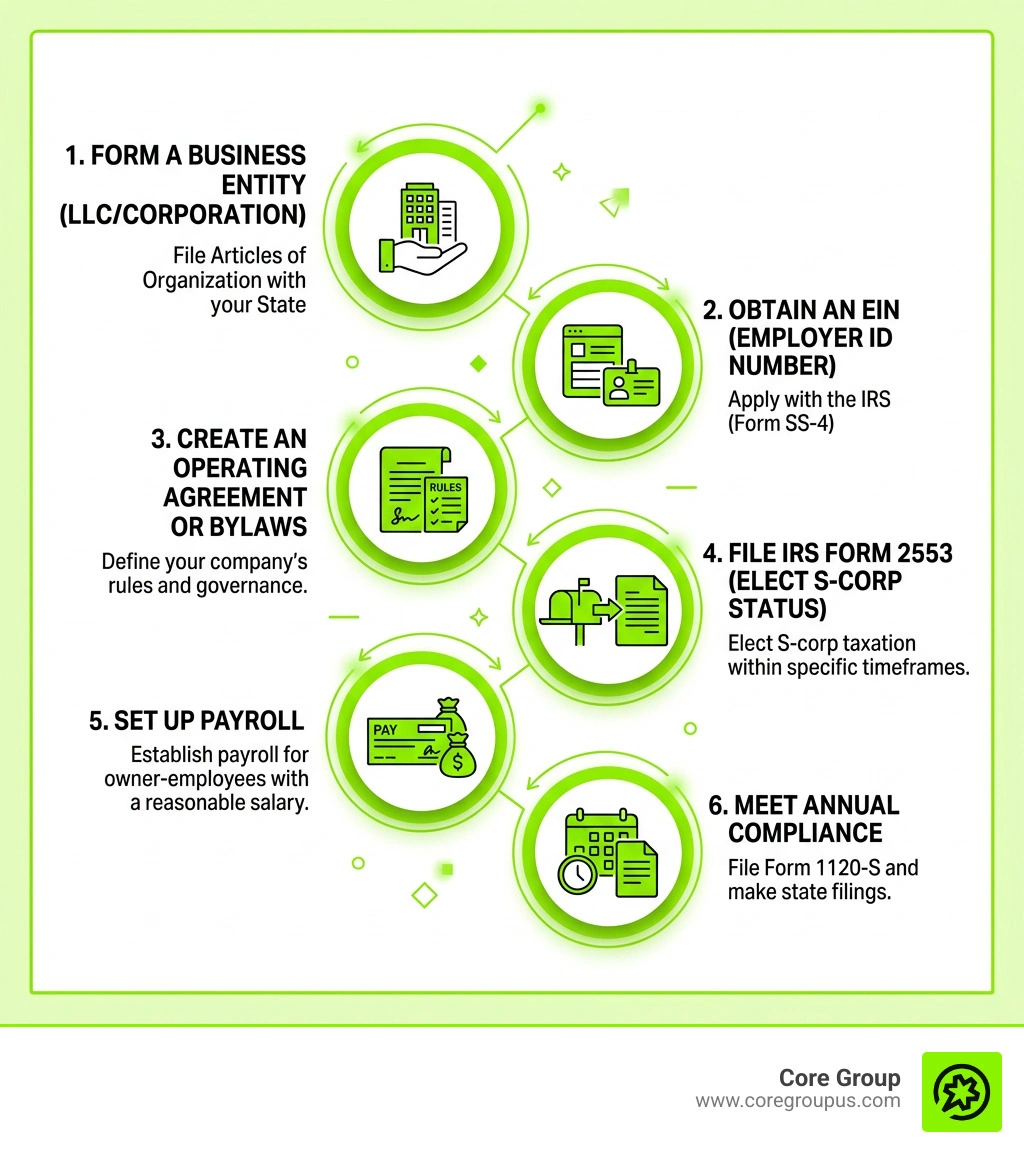
Easy how to setup an s-corp word list
What to Know Before Electing S-Corporation Status

More than 5 million businesses across the United States operate under Subchapter S of the Internal Revenue Code. Before jumping into the mechanics, it helps to understand what is an s-corporation at its core.
An S-corporation is not a standalone legal entity that you create from thin air. Instead, it is a special federal tax status granted by the IRS. You first organize a legal business structure at the state level, usually a limited liability company (LLC) or a traditional C-corporation. Once that entity exists, you request that the IRS tax it under Subchapter S rules.
Choosing an s-corp business structure unlocks pass-through taxation. In a standard C-corporation, business profits face corporate income tax, and shareholders pay personal income tax again when those profits are paid out as dividends. Under S-corp status, profits, losses, tax credits, and deductions flow straight through to shareholder tax returns, bypassing federal entity-level income tax.
To keep this tax status, the company must issue only one class of stock. You can have voting and non-voting shares, but every share must carry identical economic rights to profits and liquidations.
S-Corp Eligibility Requirements and Ownership Limits
The IRS sets clear boundaries for businesses seeking this classification. Meeting every point in the s-corp eligibility requirements is mandatory from your first day of operation.
- The company must be a domestic entity organized under the laws of a US state or territory.
- Ownership is capped at a maximum of 100 shareholders.
- All shareholders must be individuals, certain qualifying trusts, or estates. Partnerships, other corporations, and non-resident aliens cannot hold shares.
- Every shareholder must be a US citizen or permanent resident green card holder.
- Certain financial institutions, insurance companies, and international sales corporations are ineligible.
Evaluating Profit Thresholds and Tax Savings
We often discuss entity transitions on the essential guide to s-corporations because timing matters. S-corp status requires running payroll, filing Form 1120-S, and tracking shareholder equity, which adds operational expenses.
The tax advantage centers on the 15.3% self-employment tax (Social Security and Medicare). In a standard sole proprietorship or single-member LLC, your entire net profit is hit with self-employment tax up to the annual wage caps. With an S-corp, you split earnings between a reasonable W-2 salary and shareholder distributions. Only the W-2 salary faces payroll taxes, while distributions are exempt from self-employment taxes.
| Metric | Sole Proprietorship or LLC | S-Corporation ($120k Profit) | S-Corporation ($200k Profit) |
|---|---|---|---|
| Net Business Profit | $120,000 | $120,000 | $200,000 |
| Owner W-2 Salary | $0 | $60,000 | $80,000 |
| Owner Distribution | $120,000 | $60,000 | $120,000 |
| Income Subject to FICA / SE Tax | $120,000 | $60,000 | $80,000 |
| FICA / SE Tax (approximate) | $18,360 | $9,180 | $12,240 |
| Annual Tax Savings Before Fees | $0 | $9,180 | $18,000+ |
| Estimated Accounting and Payroll Costs | $0 | $3,000 to $4,000 | $3,000 to $4,000 |
| Net Annual Cash Saved | $0 | $5,200 to $6,200 | $14,000 to $15,000 |
When your business generates reliable net earnings above $50,000 to $60,000 annually, the payroll tax savings usually outpace the extra bookkeeping and compliance costs.
How to Setup an S-Corp in 7 Steps

Navigating the s-corp setup process requires working across both state and federal agencies. Following this sequence prevents delays and keeps your liability protections intact.
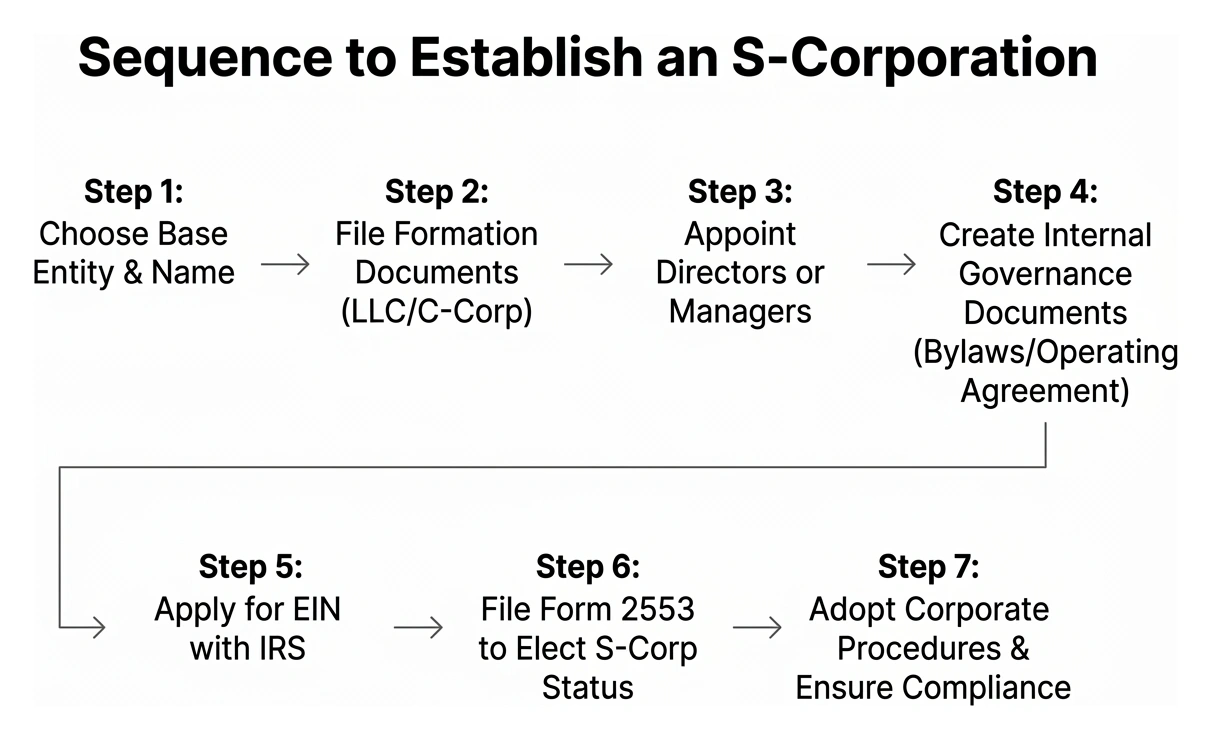
Step 1. Choose Your Business Structure and Entity Name
Start by selecting whether an LLC or a C-corporation serves as your base entity. For most creative entrepreneurs and small service businesses, forming an LLC first offers the smoothest path because LLCs avoid rigid corporate board requirements while still allowing S-corp taxation.
Pick a business name that is available in your home state. Check your Secretary of State online database to confirm no other company uses your chosen name. Ensure the name contains proper entity identifiers such as "LLC", "Inc.", or "Corporation", and file an assumed name or DBA registration if you plan to market under a brand name.
Step 2. Appoint a Registered Agent and File Formation Paperwork
Every state requires you to name a registered agent who maintains a physical address in the state to receive legal notices and official government correspondence during regular business hours.
Next, submit your organizational documents to your state filing office, such as the Division of Corporations - State of Delaware or your local Secretary of State. You will submit Articles of Organization for an LLC or Articles of Incorporation for a corporation. State filing fees range from under $50 to several hundred dollars depending on your location.
Step 3. How to Setup an S-Corp Operating Structure with Bylaws
Before taking on clients or issuing shares, put your internal rules in writing. If you formed a corporation, adopt corporate bylaws. If you formed an LLC, consult an s-corp operating agreement ultimate guide to draft an operating agreement suited for S-corp taxation.
Your agreement must document ownership percentages, voting rules, capital contributions, and procedures for allocating profits. Most importantly, ensure the operating agreement explicitly forbids actions that would violate S-corp rules, such as transferring equity to non-qualifying foreign owners or creating multiple equity classes. Store these signed records in a secure corporate records book.
Step 4. Obtain an Employer Identification Number
An Employer Identification Number (EIN) acts as the federal tax identification number for your business. You need this number before opening a business bank account, running payroll, or filing tax elections.
Apply for an EIN directly on the IRS website at no cost. Once approved, use your official EIN confirmation letter to open dedicated business checking and savings accounts. Keeping your business money completely separate from personal funds is essential for maintaining liability protection.
Step 5. File Form 2553 for Federal S-Corporation Election
To turn your standard state entity into an S-corporation for tax purposes, complete IRS Form 2553 (Election by a Small Business Corporation). Review your documents against an s-corp formation checklist before submission.
All shareholders must sign the form. For existing calendar-year companies, you must file Form 2553 no later than 2 months and 15 days after the start of the tax year (March 15 for a calendar year). If you are launching a brand-new business, you have 75 days from the date of formation to file. If you miss this window, the IRS provides late-election relief under Revenue Procedure 2013-30 if you can show reasonable cause for the delay.
Step 6. How to Setup an S-Corp Payroll System for Shareholder Wages
Operating as an S-corp requires any shareholder who provides services to the business to be treated as a W-2 employee. You cannot simply take owner draws and skip payroll.
Establish a regular payroll schedule using reliable software. You must follow strict s-corp payroll rules by withholding federal income tax, Social Security, Medicare, and applicable state payroll taxes. Report these figures quarterly using IRS Form 941 and provide annual Form W-2 statements by January 31.
Step 7. Establish Ongoing Corporate Compliance and State Tax Filings
Federal S-corp status does not exempt you from state-specific corporate rules. Some states require separate state-level S-corp election forms, and others impose franchise taxes on pass-through entities. For instance, the S Corporations - California Tax Service Center notes that California charges an annual tax of 1.5% on net income or an $800 minimum franchise tax.
Each year, your business must file IRS Form 1120-S by March 15. Your company issues a Schedule K-1 to each shareholder reporting their share of profits and deductions. Maintain annual shareholder minutes, document major corporate resolutions, and submit required annual state reports to preserve your corporate standing.
Critical Compliance Rules for S-Corp Owners
Setting up the entity is only the beginning. Many founders ask can I set up an s-corp myself, and while the initial filings are straightforward, ongoing tax compliance requires disciplined execution.
Never commingle personal and business funds. Paying personal living expenses straight from your business checking account invites the IRS to pierce your corporate veil, voiding your liability shield and putting your personal assets at risk.
Maintaining Reasonable Compensation Standards
The IRS pays close attention to S-corp owner compensation. If you pay yourself an artificially low wage to minimize payroll taxes while taking large distributions, the IRS can audit the business and reclassify those distributions as wages, charging back taxes, penalties, and interest.
To set a defensible salary, evaluate your actual role using three common approaches.
- Market comparison. What would an outside business pay an unrelated employee to perform your daily tasks in your geographic market?
- Cost-to-replace method. Break down the percentage of time spent on executive duties versus administrative work, and calculate a blended market rate.
- Industry benchmarks. Review published wage data for your specific trade or industry sector.
Document your salary evaluation each year in your corporate minutes.
Managing Annual Tax Reporting and Shareholder Distributions
Because S-corps do not pay entity-level federal income taxes, shareholders are responsible for paying quarterly estimated taxes on their personal returns. This covers both their wage income and pass-through distribution income.
You must also track your shareholder basis. Distributions are tax-free only to the extent that you have sufficient stock and debt basis in the business. If distributions exceed your basis, that excess is taxed as capital gains.
Frequently Asked Questions About S-Corp Setup
Can a single-member LLC elect S-Corp status?
Yes. A single-member LLC can file IRS Form 2553 to change its default tax status from a disregarded entity (sole proprietorship) to an S-corporation. The underlying legal structure remains an LLC under state law, providing asset protection while unlocking pass-through corporate taxation.
When is the deadline to file Form 2553 with the IRS?
For an existing calendar-year entity, Form 2553 must be filed by March 15 (2 months and 15 days into the tax year) for S-corp status to take effect that year. Newly formed businesses have 75 days from their official registration date. If you miss the deadline, you can request late-filing relief under IRS Revenue Procedure 2013-30.
What is the minimum profit needed for an S-Corp to make financial sense?
An S-corp election generally makes financial sense once your business reliably produces at least $50,000 to $60,000 in net profit each year after ordinary business expenses. Below this level, the tax savings rarely cover the administrative costs of payroll processing, separate corporate tax return preparation, and state franchise fees.
Conclusion
Setting up an S-corporation gives your business limited liability protection alongside meaningful tax savings. By following the proper formation steps, filing Form 2553 on time, and establishing a compliant payroll system, you create a solid financial engine for your creative enterprise.
At Core Group, we help creative entrepreneurs implement a no-fluff, profit-first playbook. We manage your bookkeeping, handle payroll compliance, and structure your corporate tax filings so you have total peace of mind to focus on your craft, backed by our MacBook Pro guarantee. Explore our step-by-step roadmap on how to form an s-corp or reach out to our team to build your financial foundation today.