What Does It Mean When IRS Codes 150, 806, and 570 Show Up Together?
What IRS Code 150, 806, and 570 Together Actually Mean for Your Refund
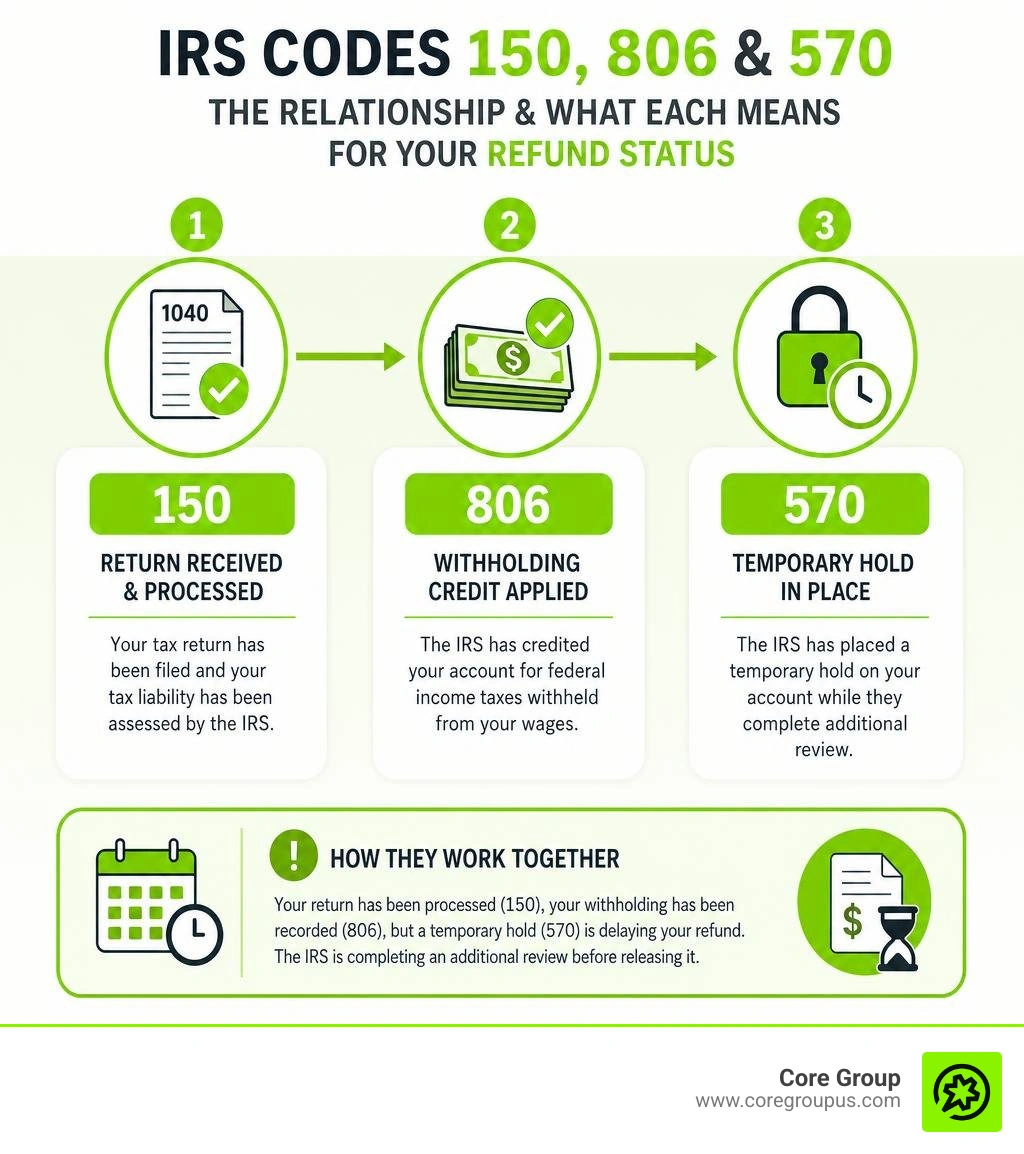
Seeing IRS code 150, 806, and 570 on your account transcript is confusing, especially when you were expecting a refund date instead of a string of numbers. Here is a quick breakdown before we go deeper
- Code 150 means your tax return has been filed and your tax liability has been assessed by the IRS.
- Code 806 means the IRS has credited your account for federal income taxes withheld from your wages (from your W-2 or similar forms).
- Code 570 means the IRS has placed a temporary hold on your account. Your refund is paused while they complete an additional review.
Together, this combination typically means your return has posted and your withholding has been recorded, but something is preventing the IRS from releasing your refund right now.
This is one of the more common patterns tax professionals see. Code 570 appears on roughly 15 to 20% of transcripts reviewed for delayed refunds, so you are not alone, and it does not automatically mean something is seriously wrong.
The key question is why the hold is there and how long it will last. That is exactly what this guide covers.
Understanding the Individual IRS Transcript Codes
To understand why these three codes are appearing together on your tax transcript, we first need to unpack what each of them represents on its own. The IRS uses a system called the Master File to process all tax returns. Each action taken by the IRS computer system or a manual examiner generates a three-digit transaction code on your account transcript.
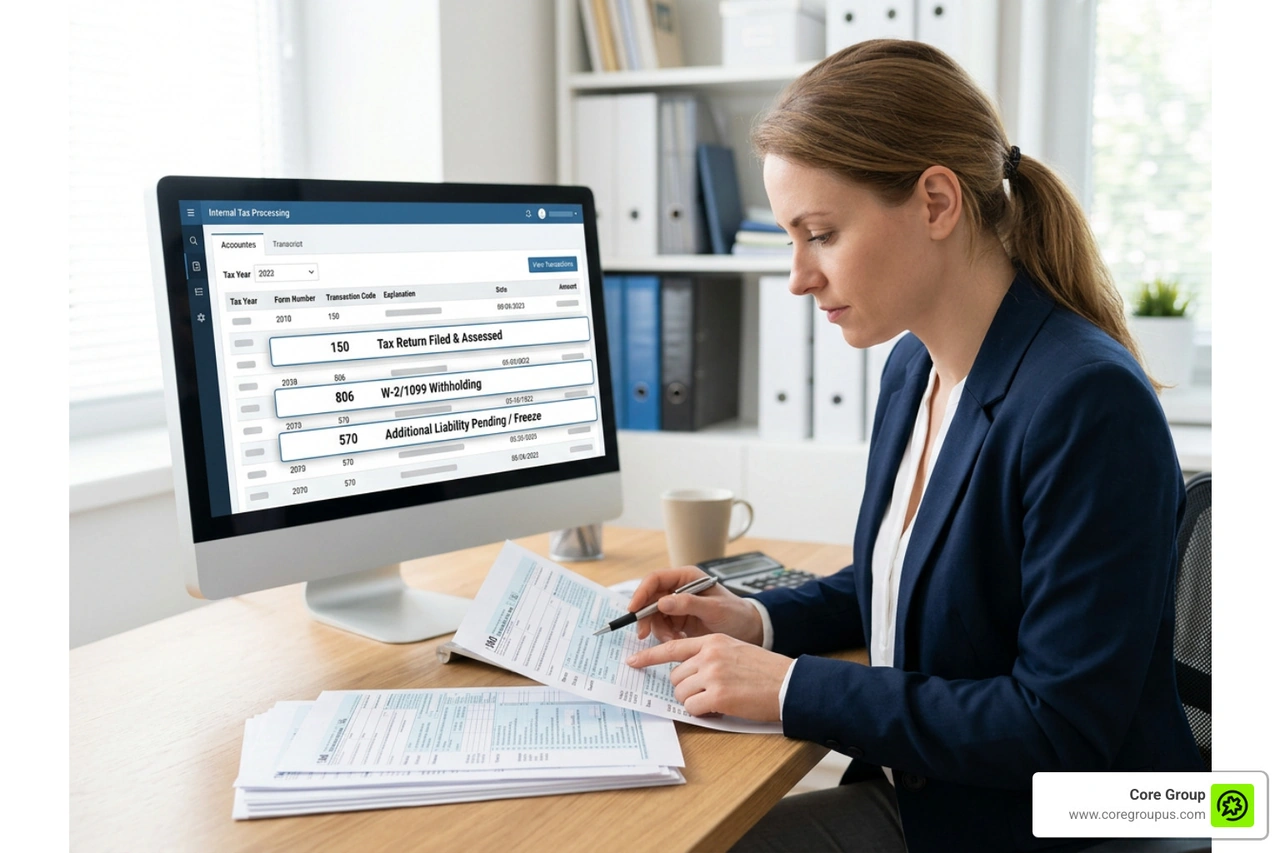
When you log into your IRS online account and pull up your transcript, you are looking at a chronological diary of how your tax return is moving through the system. Let us break down the specific components of the irs code 150 806 and 570 trio.
Transaction Code 150 Tax Return Filed
Transaction Code 150 is the foundational code for any tax year. It indicates that your tax return has officially been entered into the IRS Master File and a tax module has been established.
When you see Code 150, it means the IRS has calculated your tax liability based on the return you submitted. If you look at the dollar amount next to Code 150, you might see a specific number or you might see $0.00. If it shows $0.00, it simply means that you had no net tax liability before credits were applied, which is very common for lower-income taxpayers or those with significant deductions.
It is helpful to know that tax return filing and consolidated returns are governed by specific parts of the tax law, including 26 U.S. Code § 150 - Definitions and special rules. Code 150 on your transcript is the administrative proof that your original return has been received and processed.
Transaction Code 806 Federal Tax Withholding Credit
Transaction Code 806 is generally a welcome sight on a transcript. This code represents the credit applied to your account for the federal income taxes that were withheld from your paychecks throughout the year.
This withholding is typically reported on your W-2 wages or 1099 forms. The IRS treats withholding as paid on April 15 of the filing year, regardless of when your employer actually deducted it from your pay.
When Code 806 appears with a dollar amount, it means the IRS has officially recorded your tax credits. To learn more about how the IRS processes this specific withholding credit, you can read our detailed guide on the IRS Code 806 Meaning. This code confirms that the system recognizes the tax payments you already made through withholding.
Transaction Code 570 Additional Account Action Pending
Transaction Code 570 is the speed bump on your road to a refund. This code represents a processing hold or a temporary delay.
When Code 570 posts to your transcript, it means the IRS has frozen your refund to perform an additional review of your account. It acts as a stop sign for the automated system, preventing any refund from being issued until the underlying issue is resolved.
If you see $0.00 next to Code 570, do not worry. This is standard because Code 570 is a status indicator rather than a financial transaction. To understand how this freeze operates and how to begin resolving it, you can consult the Solving Code 570 on Your Account Transcript - FAQ.
How the IRS Code 150 806 and 570 Sequence Works Together
When these three codes appear on the same tax module, they tell a very specific story about the timeline of your tax return. The order in which they appear and their dates can help us understand exactly where the process has paused.
Decoding the IRS Code 150 806 and 570 Transaction Flow
In a normal tax processing cycle, your withholding recorded under Code 806 offset your tax liability recorded under Code 150. If your withholding is greater than your tax liability, you have a credit balance, which is your refund.
When everything is correct, the system automatically calculates this refund and schedules it for release. However, when Code 570 enters the mix, the transaction flow is interrupted. The IRS system has processed the return under Code 150 and credited the withholding under Code 806, but then immediately applied the Code 570 hold.
This means the IRS has identified a discrepancy or a flag that requires a closer look before that credit balance can be sent to your bank account.
| Transaction Code | Title | Common Meaning | Impact on Refund |
|---|---|---|---|
| 150 | Tax Return Filed | Establishes the tax liability | Neutral, starts the process |
| 806 | W-2/1099 Withholding | Records tax payments made | Positive, increases credit balance |
| 570 | Account Action Pending | Pauses refund processing | Negative, delays refund release |
The Role of Cycle Codes in Processing Timelines
Every transaction on your transcript is associated with an IRS cycle code, which is an eight-digit number representing the exact week and day the transaction was processed.
Understanding these cycle codes helps you track when the IRS updates your account. For example, some accounts are processed weekly, while others are processed daily.
If your account is on a weekly cycle, your transcript will typically only update once a week, usually on Thursday night or Friday morning. For a complete breakdown of how to read these processing cycles, you can check our IRS Cycle Code Complete Guide.
Knowing your cycle type can save you from the stress of checking your transcript multiple times a day. If you want to dive deeper into what these numbers mean, read our articles on What is an IRS Cycle Code and how to track your progress using the Cycle Code IRS tracking method.
Common Triggers for a Code 570 Hold After Your Return Posts
Why does the IRS place a Code 570 hold on an account after posting the return and withholding? There are several common triggers that cause the automated system to pull a return for manual review.
Income Discrepancies and Missing W2 Forms
One of the most frequent reasons for a Code 570 hold is a wage verification issue. When you file your tax return, you report your withholding and income. The IRS computer system then attempts to match your reported numbers with the information sent directly to the IRS by your employer.
If you file early in the year, your employer might not have submitted your W-2 to the Social Security Administration or the IRS yet. When the IRS system sees a large withholding credit under Code 806 but cannot find the matching W-2 from your employer, it automatically triggers a Code 570 hold.
This matching process is part of the strict administrative controls outlined in 26 USC Subtitle A, CHAPTER 6, Subchapter A: Returns and Payment of Tax, which governs how returns are processed and verified.
Identity Verification and Fraud Prevention Flags
In recent years, the IRS has significantly increased its security filters to prevent identity theft and tax fraud. If your return triggers any fraud prevention flags, the IRS will place a Code 570 hold on your account.
This often happens if you have moved to a new address, changed your bank account for direct deposit, or if your income fluctuated dramatically compared to prior years. The hold gives the IRS time to verify that you are actually the person who filed the return before they release any funds.
How to Resolve a Code 570 Hold and Get Your Refund
If you see this combination of codes on your transcript, do not panic. There are clear, structured steps you can take to resolve the hold and get your processing back on track.
Next Steps When Seeing IRS Code 150 806 and 570 on Your Transcript
Your first step should be to look closely at the dates next to Code 570 and Code 150. If the date next to Code 570 is in the future, it is a processing date used by the IRS system and does not mean you are late for anything.
We recommend waiting three to six weeks from the date the Code 570 first appeared. In many cases, the IRS resolves these holds automatically. This happens when the employer's W-2 finally posts to the system, or when the automated review finishes without finding any errors.
If the hold is resolved automatically, you will see a Code 571 (Resolved Additional Account Action) appear on your transcript, followed by a Code 846, which indicates your refund has been approved. You can read more about how this approval works in our guide on the 846 Refund Issued status.
If the hold is not resolved automatically, the IRS may make an adjustment to your return, which might show up as a 290 Additional Tax Assessed code if they need to correct a minor error.
Comparing Code 570 Holds with Code 810 and 971 Actions
It is important to distinguish Code 570 from other common IRS transcript codes because they require different actions.
- Code 570 is a general processing hold. It means the IRS is reviewing your return internally, and you may not need to take any action unless they contact you.
- Code 810 is a refund freeze. This is a much stronger stop than a Code 570 hold. It is often placed by the IRS Frivolous Return Program or the integrity verification department, and it completely blocks any refund or offset until a thorough investigation is completed.
- Code 971 means the IRS has generated a formal notice and sent it to you in the mail. If you see Code 971 appear after Code 570, it means the IRS is mailing you a letter explaining what they need. This could be a request to verify your identity, submit missing W-2 forms, or clarify a deduction.
Frequently Asked Questions About IRS Transcript Codes
What is the difference between code 570 and code 971
Code 570 is the actual hold on your account that stops your refund from being issued. Code 971 is an administrative indicator showing that the IRS has sent you a letter or notice regarding your account.
If you see Code 570 without a Code 971, the IRS is still reviewing your return internally and has not yet decided if they need to contact you. If you see Code 971 post after Code 570, you should expect a letter in the mail within a week or two detailing the exact steps you need to take.
How long does a code 570 hold typically last
For most taxpayers, a Code 570 hold lasts between three and eight weeks. If the hold is due to a simple wage verification issue and your employer submits the missing W-2, the system will often release the hold automatically.
However, if the IRS requires you to verify your identity or send in physical documents, the hold will remain in place until you complete those steps and the IRS processes your response, which can take up to nine weeks from the date they receive your information.
Does code 806 mean my refund is approved
No, Code 806 does not mean your refund is approved. It simply means the IRS has credited your account for the federal income taxes withheld from your paychecks.
Your refund is only officially approved when you see Transaction Code 846 (Refund Issued) appear at the bottom of your transcript with a future date.
Conclusion
Navigating IRS transcript codes like irs code 150 806 and 570 can feel overwhelming, especially when you are trying to run a business or manage your personal finances. For creative entrepreneurs, dealing with tax delays and accounting jargon is a major distraction from doing what you love.
At Core Group, we offer financial management, bookkeeping, and tax services designed specifically for creative entrepreneurs. We operate in the financial services industry across the United States, helping business owners in states from California to New York make sense of their money.
Our unique profit-first playbook guarantees peace of mind and saves you valuable time, allowing you to focus entirely on growing your business. We even back our services with our signature MacBook Pro guarantee.
If you are tired of staring at confusing transcript codes and want to make sure your business taxes are handled perfectly from the start, we are here to help. You can learn more about how we handle these complex tax situations by reviewing our guide on the IRS Code 806 Meaning, or reach out to us today to get your professional financial strategy on track.