The Savvy LLC Owner's Guide to Deductions: 14 Ways to Slash Your Tax Bill
Why LLC Tax Deductions Matter for Your Bottom Line

LLC tax deductions are business expenses you subtract from your income to lower your tax bill. For the 33.2 million small businesses in the U.S., maximizing these deductions is key to profitability.
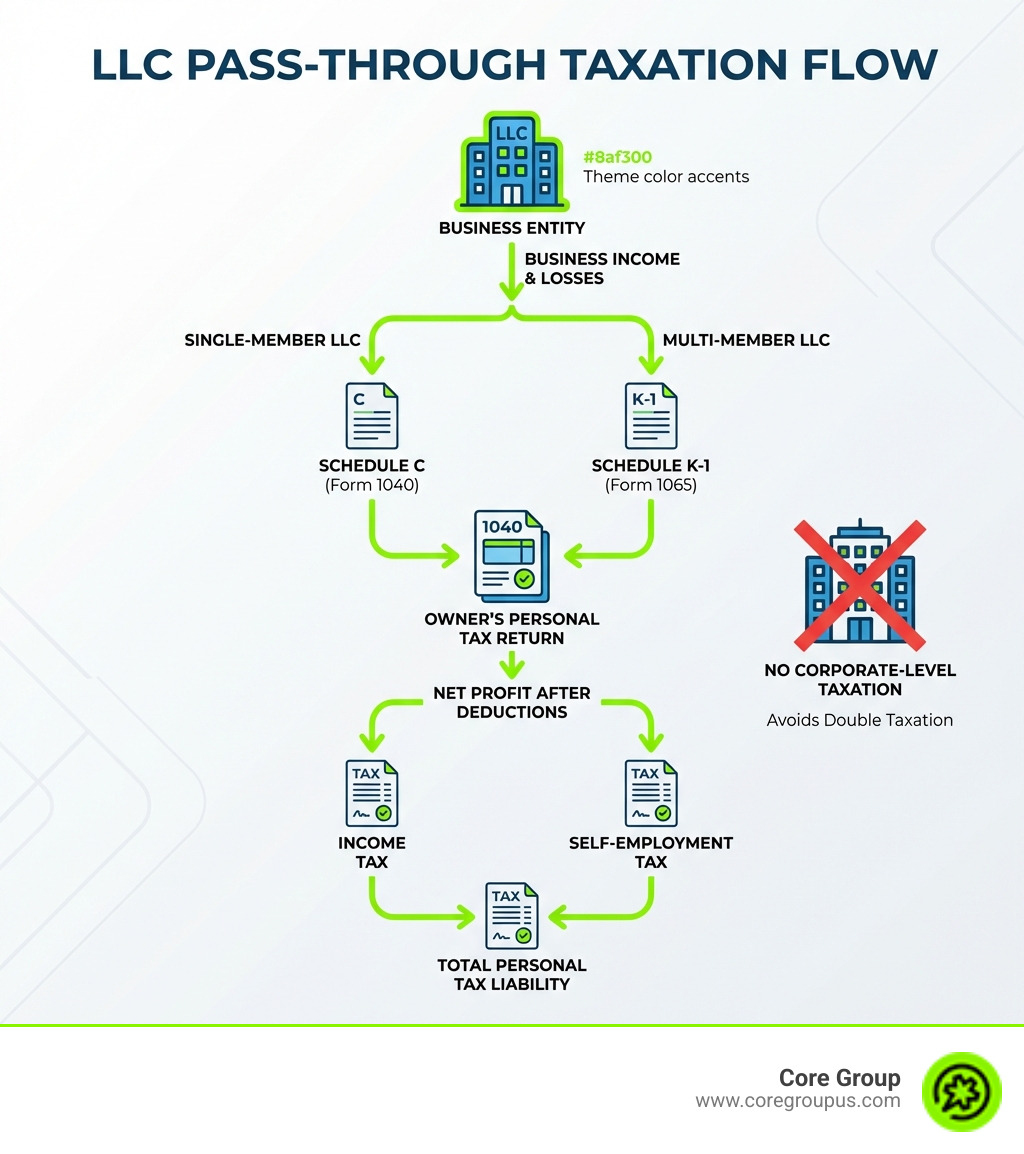
As an LLC owner, you benefit from pass-through taxation, where business profits flow to your personal tax return, avoiding corporate double taxation. This makes tracking and claiming every legitimate deduction essential. Key categories include:
- Startup Costs: Up to $5,000 in first-year deductions.
- Home Office: A portion of rent and utilities.
- Business Vehicles: 72.5 cents per mile (2026 rate) or actual costs.
- Professional Services: Legal, accounting, and consulting fees.
- Marketing & Advertising: Website hosting, ads, and promotional materials.
- Travel & Meals: Business travel and 50% of business meals.
- Equipment & Supplies: Computers, software, and office supplies.
- Employee Costs: Salaries, benefits, and retirement contributions.
- Insurance: Business liability, professional, and property insurance.
- Self-Employment Tax: Half of your 15.3% SE tax.
Many LLC owners miss out on deductions simply by not knowing what qualifies. From a new laptop to a client coffee, these costs add up and can significantly reduce your taxable income. A clear system for capturing deductions year-round is the difference between tax-time stress and financial confidence.
This guide breaks down the 14 most valuable deductions for LLC owners, explains how to claim them, and covers advanced strategies that can save you thousands.
Understanding Your LLC's Tax Foundation
This section explains the essential tax concepts every LLC owner needs to know before diving into specific deductions, ensuring you're set up for success from day one.
How LLCs Are Taxed: The Pass-Through Advantage
An LLC is a "pass-through entity," meaning the business itself doesn't pay federal income tax. Instead, profits and losses "pass through" to the owners' personal tax returns, avoiding the "double taxation" faced by C corporations. The IRS classifies LLCs in one of three ways for tax purposes:
- Disregarded Entity (Default for Single-Member LLCs): A single-owner LLC is treated like a sole proprietorship. You report business income and expenses on Schedule C of your personal Form 1040. For more on this, see our article on Single Member LLC 1099 Reporting.
- Partnership (Default for Multi-Member LLCs): An LLC with two or more members files an informational return, Form 1065. Each member receives a Schedule K-1 detailing their share of profits and losses to report on their personal returns.
- Corporation (C Corp or S Corp Election): An LLC can elect to be taxed as a C corporation or an S corporation, offering different tax structures that may be more beneficial depending on your financial goals.
For more, refer to the IRS overview of LLCs.
Paying Yourself: Owner's Draws vs. a Reasonable Salary
How you pay yourself has major tax implications.
If your LLC is taxed as a disregarded entity or partnership, you take an owner's draw. This is not a deductible business expense, and no taxes are withheld. You are responsible for paying quarterly estimated income and self-employment taxes to avoid penalties.
If your LLC elects to be taxed as an S Corporation, you become an employee and must pay yourself a "reasonable salary." This salary is subject to payroll taxes. Any remaining profits can be distributed as dividends, which are not subject to self-employment taxes, potentially leading to significant tax savings. The IRS requires your salary to be reasonable for your work. Our article Should Creative Entrepreneurs Become an S Corp? offers more insight.
The Self-Employment Tax Deduction
As a self-employed individual, you pay both the employer and employee portions of Social Security and Medicare taxes, known as the self-employment (SE) tax. The rate is 15.3% on your net earnings (12.4% for Social Security up to an annual limit—$168,600 in 2024 and $176,100 in 2025—and 2.9% for Medicare on all earnings).
The good news: the IRS lets you deduct one-half of your self-employment tax. This 7.65% deduction is taken on Schedule SE (Form 1040) and reduces your overall taxable income. It's a crucial LLC tax deduction many new entrepreneurs miss. For details, see the IRS guide to self-employment tax.
The Ultimate Checklist of 14 Common LLC Tax Deductions
Now that we've covered the foundational tax concepts, let's dive into the practical deductions that can directly lower your LLC tax deductions and keep more money in your pocket. Here are 14 of the most common and impactful business expenses you can deduct to lower your taxable income and keep more money in your pocket.
1. Startup and Organizational Costs
Costs incurred before your business opens are deductible. This includes market research (startup costs) and state filing fees for your Articles of Organization (organizational costs). The IRS lets you deduct up to $5,000 of each in your first year. If your costs exceed $50,000, the deduction is reduced. Any remaining costs are amortized over 15 years.

2. Home Office Expenses
If you use a part of your home exclusively and regularly for business, you can claim the home office deduction.
- Simplified Method: Deduct $5 per square foot of business space, up to 300 sq. ft. (a $1,500 maximum deduction).
- Actual Expense Method: Deduct a percentage of your actual home expenses (rent, mortgage interest, utilities, insurance) based on the portion of your home used for business. This requires detailed records but can yield a larger deduction.
The IRS scrutinizes this deduction, so keep good records. Learn more from the IRS rules for home office deductions and the Tax Implications When You Sell Your House With a Home Office.
3. Office Supplies & Software
Everyday items that are "ordinary and necessary" for your business are fully deductible. This includes:
- Equipment: Computers, printers, cameras, and office furniture (large purchases may need to be depreciated, see #13).
- Consumables: Paper, pens, ink, and art supplies.
- Software & Subscriptions: Adobe Creative Suite, project management tools, cloud storage, and accounting software.
4. Business Vehicle Use
If you use your car for business, you can deduct the costs using one of two methods:
- Standard Mileage Rate: For 2026, the rate is 72.5 cents per mile (up from 67 cents in 2024 and 70 cents in 2025). Simply track your business miles and multiply by the rate.
- Actual Expense Method: Deduct the business portion of your actual vehicle costs, including gas, repairs, insurance, and depreciation.
A detailed mileage log is non-negotiable for either method.
5. Marketing and Advertising
Costs to promote your business are fully deductible. This includes website hosting, online ads, business cards, print materials, and professional photography for your brand.
6. Professional Services & Education
Fees paid for professional advice are fully deductible. This covers legal, bookkeeping, tax preparation, and consulting services. More on our Accounting services. Additionally, you can deduct education expenses (workshops, courses, conferences) that maintain or improve skills for your current business. See the IRS rules on business education.
7. Business Travel and Meals
When you travel overnight for business, you can deduct costs like airfare, lodging, and rental cars. For business meals, you can generally deduct 50% of the cost, provided the meal isn't lavish and has a clear business purpose. Always document the date, location, attendees, and purpose. The IRS guide to travel expenses has more details.
8. Employee & Contractor Payroll
Compensation paid to others is a deductible expense. This includes employee salaries and wages, bonuses, payments to 1099 contractors, and your share of payroll taxes. If your LLC is an S Corp, your own "reasonable salary" is also deducted here.
9. Employee Benefits & Retirement Plans
Providing benefits is a great LLC tax deduction. This includes health insurance premiums for employees and contributions to employee retirement plans like a SEP-IRA, Solo 401k, or SIMPLE IRA. For 2026, 401(k) employee contributions are limited to $24,500 (plus an $8,000 catch-up for those 50+).
10. Rent and Utilities
Rent paid for a commercial office, studio, or workshop is fully deductible. The same goes for utilities like electricity, water, and business internet for your commercial space.
11. Business Insurance
Premiums for necessary business insurance are deductible. This includes general liability, professional liability (errors & omissions), property insurance, and workers' compensation.
12. Bank Fees and Loan Interest
Monthly service fees on your business bank accounts are deductible. You can also deduct the interest paid on business loans, lines of credit, and business credit cards.
13. Depreciation of Assets (Section 179)
For large purchases that last more than a year (equipment, furniture, vehicles), you typically recover the cost over time through depreciation. However, Section 179 allows you to deduct the full purchase price of qualifying assets in the year of purchase. For 2026, the limit is $1,310,000. This provides a significant immediate tax benefit. Bonus depreciation is another option, though it is being phased out. See the Section 179 deduction rules for details.

14. Business Gifts
You can deduct the cost of business gifts, but only up to $25 per recipient per year. An exception exists for branded promotional items costing $4 or less (like pens or keychains), which are not subject to this limit.
Advanced Tax-Saving Strategies for Your LLC
Once you've mastered the basics, these advanced strategies can provide even greater tax savings and help your business grow.
The Qualified Business Income (QBI) Deduction
The Qualified Business Income (QBI) deduction (or Section 199A deduction) is a powerful LLC tax deduction allowing eligible business owners to deduct up to 20% of their qualified business income on their personal tax returns. It's a tax break for pass-through entities like most LLCs.
The deduction has income limitations, especially for "specified service trade or businesses" (SSTBs) like health, law, and consulting. For 2026, you generally get the full 20% deduction if your taxable income is below $203,000 (single) or $406,000 (married filing jointly). Above these thresholds, the deduction may be limited. For comparison, the 2024 thresholds were $191,950 and $383,900, respectively.
Navigating the QBI rules is complex, so consulting a tax professional is wise. You'll use IRS Form 8995 for QBI to claim it.
Electing S Corp or C Corp Status
An LLC can elect to be taxed as an S Corporation or a C Corporation, which can significantly alter your tax situation.
| Feature | Default LLC (Disregarded/Partnership) | S Corporation | C Corporation |
|---|---|---|---|
| Taxation | Pass-through (income on owner's return) | Pass-through (income on owner's return) | Entity taxed separately (corporate tax rate) |
| Self-Employment Tax | All net profit subject to SE tax | Only "reasonable salary" subject to SE tax; distributions are not | No SE tax; owner is employee and/or shareholder |
| Owner Compensation | Owner's draws | Salary (W-2) + Distributions | Salary (W-2) + Dividends |
| Double Taxation | No | No | Yes (corporate profits taxed, then dividends taxed again to shareholders) |
| Ideal For | Simplicity, lower profits | Reducing SE tax for profitable businesses | Reinvesting significant profits back into the business; attracting investors |
- S Corporation Election: This is popular for profitable LLCs to reduce self-employment taxes. You pay yourself a "reasonable salary" (subject to FICA taxes), and take remaining profits as distributions (not subject to FICA). This adds administrative work but can offer big savings. Learn more in The Essential Guide to S Corporations.
- C Corporation Election: This is less common for small businesses due to double taxation but can be useful if you plan to reinvest most profits back into the company or seek venture capital.
What Not to Deduct: Common Pitfalls for LLC Tax Deductions
To avoid IRS issues, know what you cannot deduct. The rule is that expenses must be "ordinary and necessary." Common non-deductible items include:
- Personal Expenses: Groceries, family vacations, or your personal cell phone bill. Mixing personal and business funds is a major red flag.
- Commuting Costs: The drive from your home to your primary workplace is not deductible.
- Political Contributions: Donations to political campaigns are not deductible.
- Penalties and Fines: Parking tickets and tax penalties are not deductible.
- Capital Expenses: Major purchases that improve an asset must be depreciated, not expensed at once (unless Section 179 applies).
- Entertainment Costs: These are generally no longer deductible, though business meals (at 50%) still are.
Meticulous record-keeping is your best defense against an audit.
Frequently Asked Questions about LLC Tax Deductions
What's the difference in tax deductions for a single-member vs. a multi-member LLC?
The types of deductible expenses are the same for both. The key difference is in the reporting:
- Single-Member LLCs (SMLLCs): As a disregarded entity, you report all income and deductions on Schedule C (Form 1040) of your personal tax return.
- Multi-Member LLCs: Taxed as a partnership, the LLC files an informational return. Each member then receives a Schedule K-1 detailing their share of the deductions to report on their personal returns.
The list of what you can deduct is consistent; only the paperwork changes.
What documentation do I need to prove my business expenses?
The IRS requires proof for all deductions. Without it, a legitimate expense can be disallowed in an audit. Keep meticulous records of the following:
- Receipts and Invoices: Showing vendor, date, amount, and item purchased.
- Bank and Credit Card Statements: To prove payment.
- Canceled Checks.
- Mileage Logs: For vehicle use, detailing date, purpose, and miles.
- Calendars and Written Records: To document the business purpose of meetings, travel, and meals.
A consistent bookkeeping system—whether a spreadsheet, software, or professional service—is essential.
Can I deduct health insurance premiums as an LLC owner?
Yes, in many cases. Self-employed LLC owners can often deduct health insurance premiums as an "above-the-line" deduction on their personal tax return, which reduces your adjusted gross income (AGI).
There are two main conditions:
- Your business must have a net profit for the year.
- You (and your spouse) cannot be eligible to participate in an employer-sponsored health plan.
This deduction helps level the playing field between self-employed individuals and employees.
Conclusion: Maximize Your Deductions and Focus on Your Craft
Understanding and using LLC tax deductions is a fundamental part of running a profitable creative business. Every dollar saved in taxes is a dollar you can reinvest into your craft and growth.
We advocate for a proactive, year-round approach to tax planning—our "profit-first playbook"—to ensure you're not leaving money on the table. By systematically tracking expenses and knowing what qualifies as a deduction, you gain peace of mind and free up valuable mental energy to focus on what you do best.
Imagine a tax season where you feel confident and in control. That's the reality we help our clients achieve.
Ready to take control of your taxes and build a solid financial foundation? Learn more about our Tax Planning services and build your profit-first plan today.