A Quick Start Guide to Overtime Tax Savings for Artists
Overtime Tax Savings for Artists Can Lower Federal Taxable Income
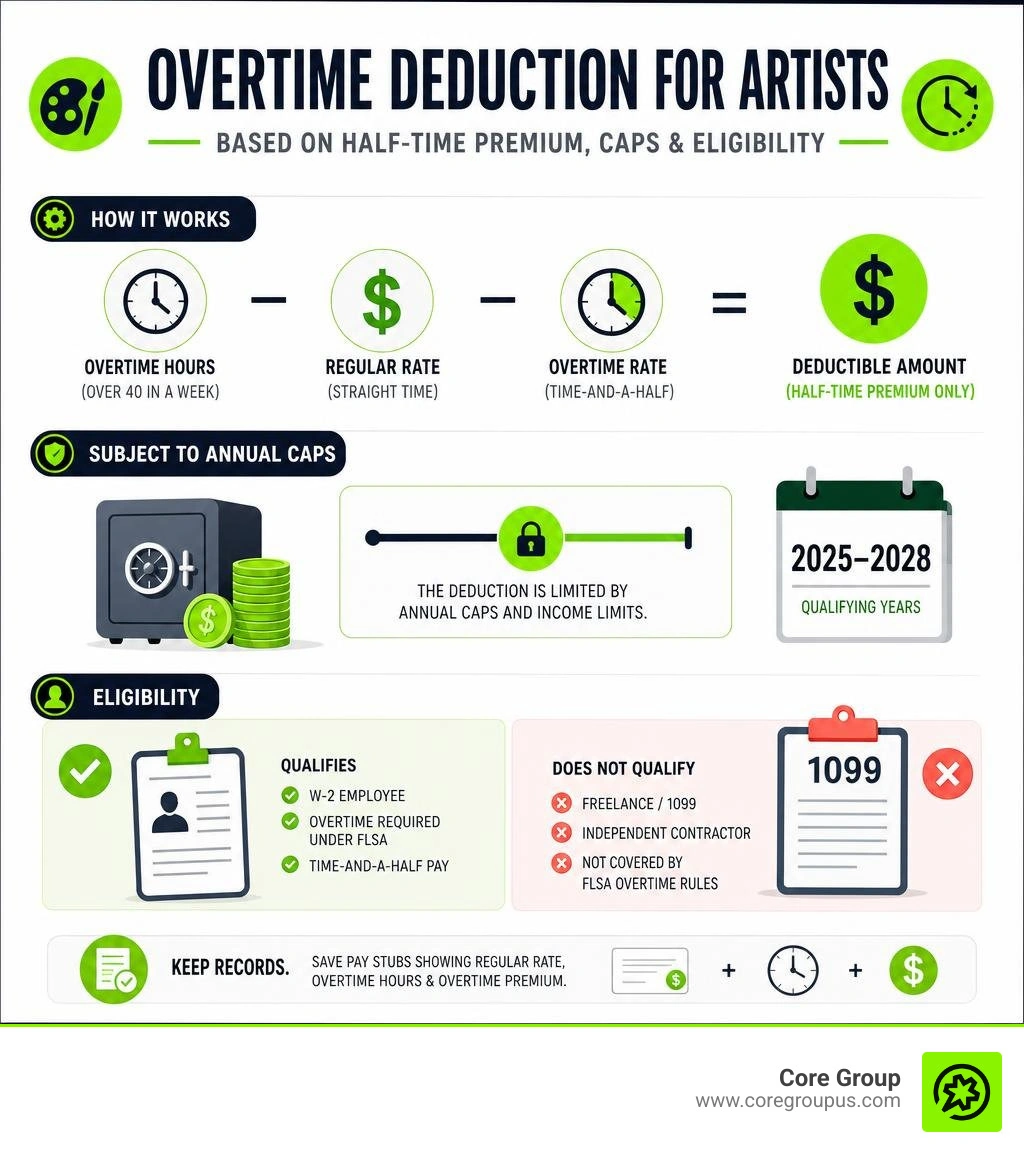
Artists can claim overtime tax savings only if they are W-2 employees who receive overtime required under the Fair Labor Standards Act. For qualifying work performed from 2025 through 2028, the federal deduction covers only the extra half-time premium in time-and-a-half pay, not the entire overtime paycheck.
For example, if a nonexempt studio employee earns $20 per hour and works 10 overtime hours, they receive $30 per hour for those hours. The potential deduction is the $10 premium per hour, or $100, subject to annual caps and income limits.
To protect the deduction, keep pay stubs that show your regular rate, overtime hours, and overtime premium. Freelance artists paid on a 1099 generally do not qualify because independent contractors are not covered by FLSA overtime rules.
I am Christian Brim, and next we will break down which creative roles qualify and how to calculate the deductible portion correctly.
Quick look at overtime tax savings for artists
Understanding Overtime Tax Savings for Artists

Under the federal tax framework enacted in the 2025 reconciliation legislation, qualifying creative workers can deduct a portion of their overtime wages from federal taxable income. Navigating creative overtime tax savings strategies requires understanding that this tax benefit does not make all overtime income tax-free.
The deduction applies strictly to qualified overtime compensation mandated under Section 7 of the Fair Labor Standards Act. It is available for tax years 2025 through 2028. According to official IRS guidance on tip and overtime deductions, the relief targets nonexempt W-2 employees who log extra hours beyond standard full-time schedules.
Treasury and congressional reports indicate that roughly 9 percent of tax returns claim the overtime deduction, cutting federal taxes by an average of $1,440. More than 29 million individual tax filers claimed this benefit in tax year 2025 alone, representing nearly 20 percent of all returns filed that season, with an average deduction exceeding $3,100.
How the Fair Labor Standards Act Defines Qualified Overtime
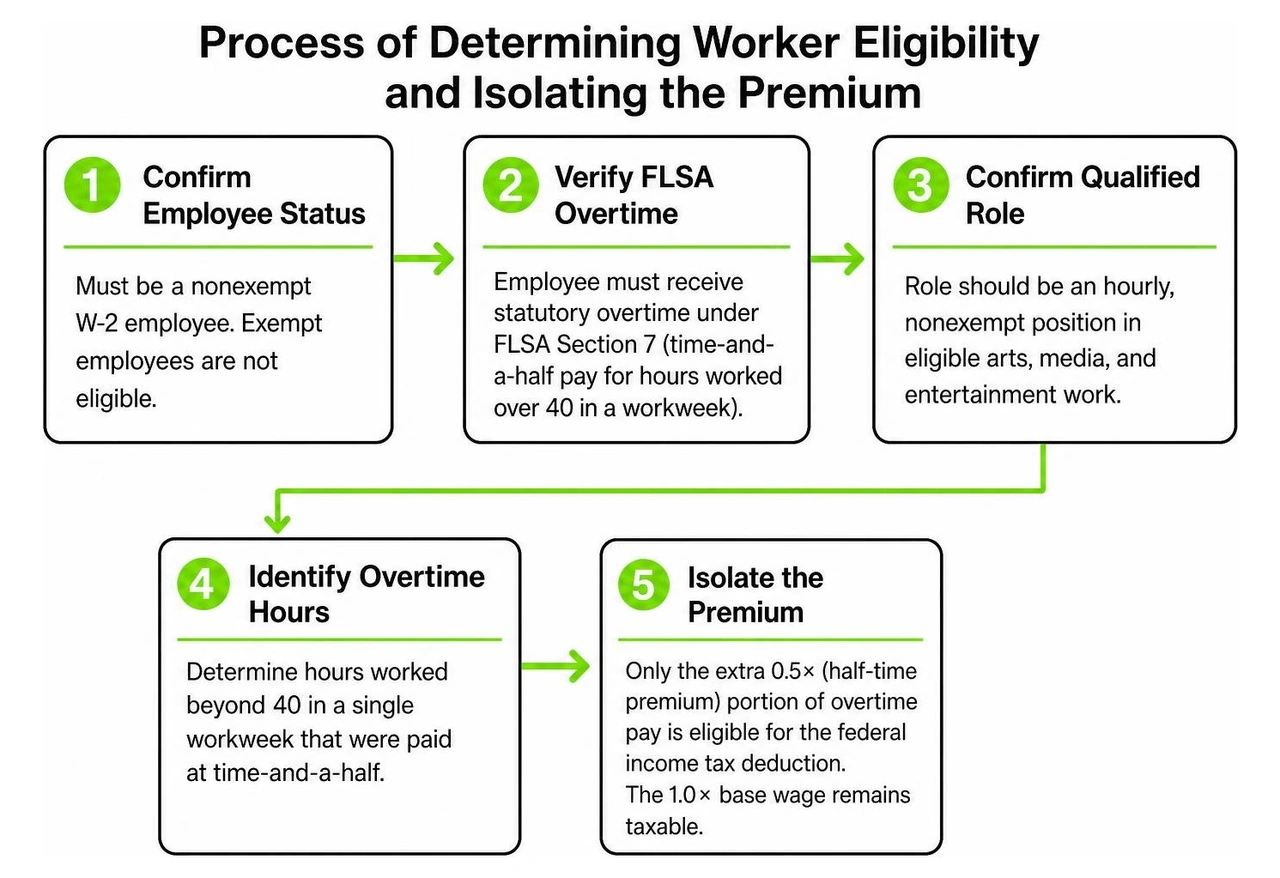
To qualify for this tax break, an artist must receive statutory overtime mandated by FLSA Section 7. This statute requires employers to pay nonexempt employees at least 1.5 times their regular hourly rate for all hours worked beyond 40 hours in a single workweek.
Employees who are exempt under administrative, executive, or professional classifications do not qualify for statutory FLSA overtime. Salaried creative professionals earning above statutory thresholds who perform exempt creative duties do not receive FLSA-mandated overtime, making them ineligible for the deduction.
Qualifying nonexempt roles in the arts, media, and entertainment industries often include
- Production assistants and studio runners
- Junior graphic designers and digital production technicians
- Sound engineering technicians and boom operators
- Grip, electric, and stagecraft crew members
- Hourly model builders, prop makers, and set carpenters
- In-between animators and digital clean-up artists paid on an hourly basis
Calculating Overtime Tax Savings for Artists on W2 Payroll
The core mechanism of the deduction is the half-time premium rule. When you work overtime at time-and-a-half (1.5x your regular hourly rate), only the extra 0.5x premium portion qualifies for the federal income tax deduction. The 1.0x base wage earned during those extra hours remains fully subject to ordinary federal income tax.
Understanding how to calculate overtime tax rate makes planning simple. Consider an hourly animator earning $30 per hour who works 50 hours in a week.
- The first 40 hours are paid at the base rate of $30 per hour ($1,200).
- The 10 overtime hours are paid at 1.5 times the base rate, which is $45 per hour ($450 total overtime pay).
- The $450 overtime pay breaks into base pay ($300) and the overtime premium ($150).
- Only the $150 premium qualifies for the deduction.
If that animator works 10 overtime hours every week for 40 weeks, their qualifying overtime premium equals $6,000. For an artist in the 22 percent federal income tax bracket, a $6,000 deduction saves $1,320 in federal income taxes.
The deduction applies solely to federal income tax. Overtime earnings remain fully subject to standard FICA payroll taxes, including 6.2 percent for Social Security and 1.45 percent for Medicare.
Rules on Deduction Limits and Income Phaseouts

The tax law establishes specific caps and phaseout rules to ensure deduction limits stay within legislative boundaries. The qualified overtime deduction is reported on Schedule 1-A and reduces taxable income. Taxpayers can claim it regardless of whether they choose the standard deduction or itemize on Schedule A.
Single and Joint Filing Caps
The statutory annual limit on qualified overtime deductions includes
- $12,500 per year for Single and Head of Household filers
- $25,000 per year for Married Filing Jointly filers
For married couples filing jointly, the $25,000 cap is a combined household limit on the tax return rather than a per-spouse cap. Married individuals who choose the Married Filing Separately status are completely excluded from claiming the deduction under IRC Section 225.
For detailed scenarios on navigating annual limits, check our no tax overtime guide 2026.
Modified Adjusted Gross Income Thresholds
The deduction begins phasing out once your Modified Adjusted Gross Income (MAGI) reaches specific benchmarks
- $150,000 for Single and Head of Household filers
- $300,000 for Married Filing Jointly filers
The phaseout reduces your maximum deduction cap by $100 for every $1,000 of MAGI above the threshold (a 10 percent phaseout rate).
Because of this reduction rate
- The deduction completely disappears for single filers at $275,000 MAGI.
- The deduction completely disappears for joint filers at $550,000 MAGI.
For example, a single visual artist with a MAGI of $170,000 is $20,000 over the threshold. Their cap is reduced by $2,000 ($100 x 20), lowering their maximum allowable overtime deduction from $12,500 to $10,500.
Eligibility Nuances for Freelance Contractors and Performing Artists
Worker classification plays a decisive role in whether an artist can utilize this tax break. Many creative professionals work as freelancers or independent contractors.
| Worker Type | Tax Classification | FLSA Overtime Protection | Eligible for Overtime Deduction |
|---|---|---|---|
| Studio Staff Artist | W-2 Nonexempt Employee | Yes | Yes (0.5x premium up to caps) |
| Freelance Illustrator | 1099 Independent Contractor | No | No |
| Production Tech | W-2 Nonexempt Employee | Yes | Yes (0.5x premium up to caps) |
| Fine Artist (Sole Prop) | Schedule C / Self-Employed | No | No |
| Performing Artist (Staff) | W-2 Nonexempt Employee | Yes | Yes (Overtime only, tip rules vary) |
Navigating these differences is easier with our accounting for artists complete guide.
The 1099 Independent Contractor Exclusion
Freelance artists receiving Forms 1099-NEC or 1099-MISC are not covered by FLSA Section 7. Because independent contractors set their own project rates and do not receive statutory overtime, they cannot claim the federal overtime tax deduction.
Self-employed creatives can optimize their tax liability through ordinary and necessary business expense write-offs on Schedule C. Deductible items include art supplies, studio rent, software subscriptions, equipment depreciation, and health insurance premiums.
Specified Service Trade Business Rules and Tip Deductions
The 2025 tax law also introduced a deduction for qualified tips up to $25,000 annually. Treasury guidance explicitly added certain personal service arts such as floral design and decorative crafts to the eligible tip occupation lists.
Performing arts businesses face strict restrictions under IRC Section 199A Specified Service Trade or Business (SSTB) rules. While hourly stagehands or crew members receive the overtime deduction on W-2 wages, performing artists who receive voluntary gratuities or service charges must verify whether SSTB limitations or mandatory charge classifications affect tip deduction claims.
Claiming the Deduction on Federal and State Tax Returns
Claiming your deduction accurately requires verifying payroll documentation before submitting your return.
Schedule 1A and Form 1040 Reporting Steps
The deduction is reported on IRS Schedule 1-A (Part III) and transferred directly to Form 1040 line 13b.
- Gather all year-end Forms W-2 and final pay stubs.
- Confirm your eligible overtime premium pay from Box 14 or calculate the 0.5x premium from detailed pay stubs.
- If pay stubs only show total time-and-a-half overtime earnings, determine the premium by dividing the overtime total by 3 per IRS Notice 2025-69.
- Enter your qualified overtime compensation on Schedule 1-A.
- Apply the statutory caps ($12,500 single or $25,000 joint) and compute any MAGI phaseout clawback.
- Transfer the allowable deduction from Schedule 1-A to Form 1040 line 13b.
Implementing proactive tax planning strategies helps ensure you document all eligible earnings cleanly.
Navigating State Tax Decoupling and Local Rules
State income tax laws treat the federal overtime deduction differently across jurisdictions.
- Certain states conform automatically to federal tax changes, passing the deduction through to state returns.
- States such as Colorado have enacted specific decoupling legislation, requiring taxpayers to add back the federal overtime deduction on state returns.
- California calculates daily overtime after 8 hours under state rules rather than weekly FLSA standards, and California does not provide a state-level deduction for overtime pay.
Creative professionals working on traveling theater tours or multi-state film shoots must track state-specific withholding and adjust for local add-backs as outlined in state tax decoupling guidelines.
Maximizing Overtime Tax Savings for Artists Before the 2028 Sunset
The federal overtime tax deduction is temporary and scheduled to expire on December 31, 2028. To maximize this tax benefit while it remains in effect
- Keep MAGI below the $150,000 single or $300,000 joint phaseout ceilings by funding pre-tax retirement accounts such as traditional 401(k) plans or IRAs.
- Ensure your employer tracks FLSA-qualifying premium hours separately in payroll systems.
- Double-check that your marital tax filing status is Married Filing Jointly rather than Married Filing Separately.
Frequently Asked Questions About Artist Overtime Taxes
Does the overtime deduction apply to the entire overtime wage
No. The federal deduction applies only to the extra half-time premium above your regular hourly rate (the 0.5x portion of 1.5x pay). The straight-time base pay earned during overtime hours remains subject to regular federal income tax.
Can freelance 1099 artists claim the federal overtime deduction
No. The deduction requires compensation governed by FLSA Section 7, which applies exclusively to nonexempt employees. Independent contractors and self-employed artists cannot claim the overtime deduction, but they can reduce taxable net income using valid business expense deductions on Schedule C.
Do overtime earnings remain subject to payroll taxes
Yes. The deduction provides relief from federal income taxes only. All overtime wages and premiums remain subject to standard FICA payroll taxes, including 6.2 percent for Social Security and 1.45 percent for Medicare.
Conclusion
Understanding the overtime tax rules helps creative professionals keep more of their hard-earned compensation. At Core Group, our financial management and bookkeeping services give creative entrepreneurs clarity through our profit-first playbook, backed by our MacBook Pro guarantee.
To explore more ways to evaluate your earnings, review our complete breakdown of your overtime tax rate and keep your creative business financially organized.