Creative Tax Loopholes 101: Overtime Savings Strategies
Creative Overtime Tax Savings Strategies for 2026
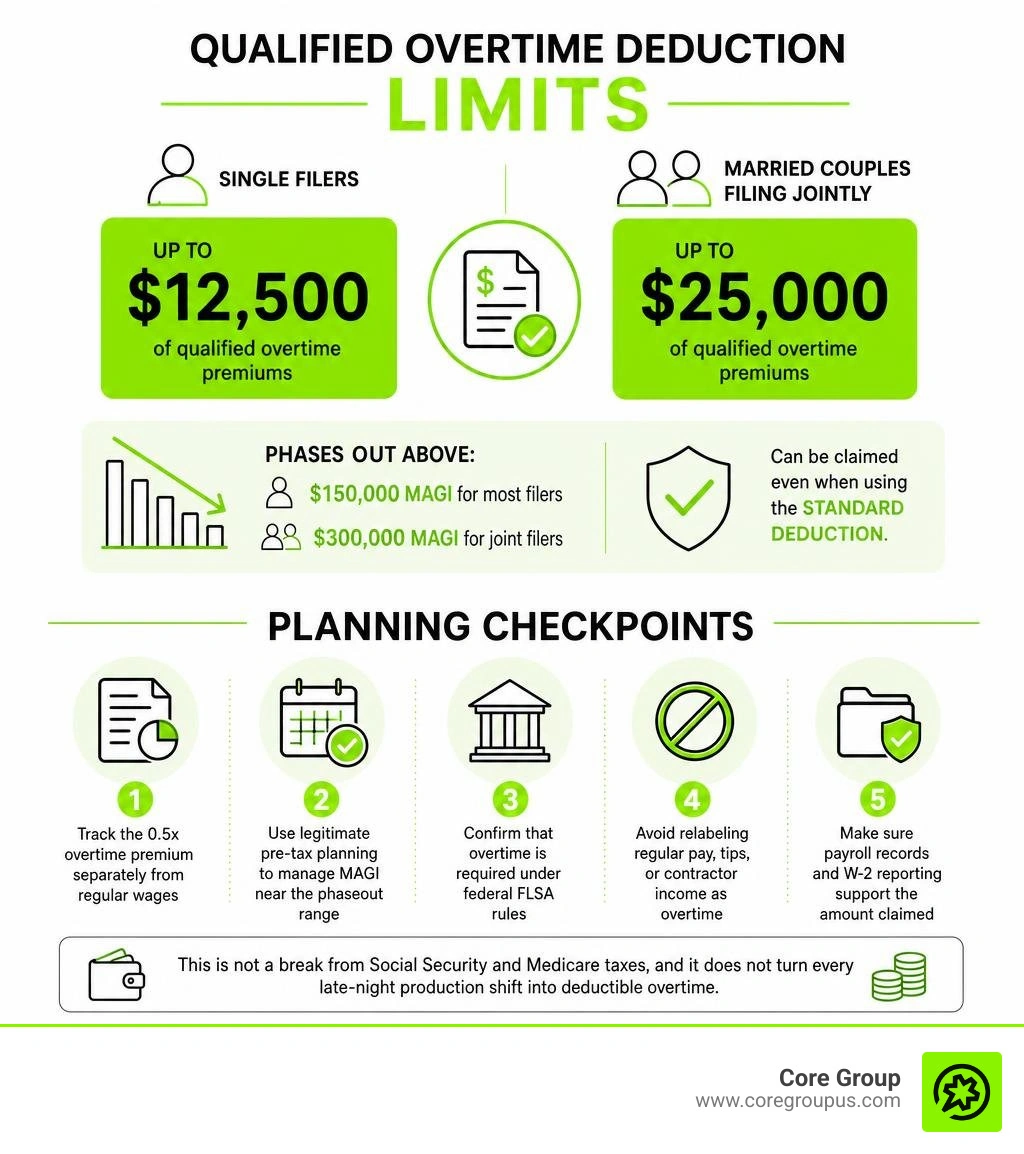
Creative overtime tax savings strategies start with one key fact. The federal overtime deduction applies only to the extra premium portion of FLSA-required overtime pay, not your whole overtime check.
For 2026, eligible workers can deduct up to $12,500 of qualified overtime premiums, or up to $25,000 for married couples filing jointly. The deduction can be claimed even when using the standard deduction, but it begins to phase out above $150,000 in MAGI for most filers and $300,000 for joint filers.
The smart opportunities are real, but so are the limits.
- Track the 0.5x overtime premium separately from regular wages
- Use legitimate pre-tax planning to manage MAGI near the phaseout range
- Confirm that overtime is required under federal FLSA rules
- Avoid relabeling regular pay, tips, or contractor income as overtime
- Make sure payroll records and W-2 reporting support the amount claimed
This is not a break from Social Security and Medicare taxes, and it does not turn every late-night production shift into deductible overtime. But for eligible W-2 workers and businesses with accurate payroll systems, it can reduce federal income tax through 2028.
I am Christian Brim, and the next sections will help you separate worthwhile planning from costly payroll shortcuts.
Creative overtime tax savings strategies terms explained
Understanding Qualified Overtime and the OBBBA Framework

Under the One Big Beautiful Bill Act passed in 2025, federal tax rules allow an above the line deduction on Schedule 1-A for qualified overtime compensation through tax year 2028. Many people initially believed that their entire overtime paycheck would suddenly be tax free. However, the law focuses specifically on the premium portion required under Section 7 of the Fair Labor Standards Act.
Only nonexempt employees covered by the FLSA qualify for this federal tax relief. Roughly 98 million American workers are eligible for FLSA overtime under federal guidelines, yet data shows that only about 8 percent of hourly workers and 4 percent of salaried workers regularly work FLSA-qualified overtime. When qualified workers claim this benefit, the tax savings average around $1,440 per return.
To evaluate how your wages split between base pay and tax-deductible premiums, you can check our guide on How To Calculate Qualified Overtime. Understanding this distinction helps avoid common misunderstandings when calculating total annual savings.
| Pay Type | FLSA Rate Component | Federal Income Tax Treatment | Social Security and Medicare Tax |
|---|---|---|---|
| Regular Hourly Wage | 1.0x regular pay rate | Fully taxable ordinary income | Standard 7.65 percent FICA tax |
| FLSA Overtime Base Portion | 1.0x regular pay rate | Fully taxable ordinary income | Standard 7.65 percent FICA tax |
| Qualified Overtime Premium | 0.5x premium portion | Deductible up to annual caps | Standard 7.65 percent FICA tax |
| State-Only Daily Overtime | Non-FLSA overtime pay | Fully taxable ordinary income | Standard 7.65 percent FICA tax |
State daily overtime rules, such as those in California for hours worked beyond eight in a single day, do not qualify for this federal deduction unless those hours also exceed the weekly 40 hour FLSA threshold. You can read more about state specific nuances in our article Is Overtime Taxed At A Higher Rate In California.
Calculating the 50 Percent FLSA Overtime Premium
Calculating the deductible portion of overtime pay requires isolating the extra half-time bonus from your regular wage rate. When a nonexempt employee earns time and a half pay, two-thirds of that payment represents regular wages and one-third represents the qualified overtime premium.
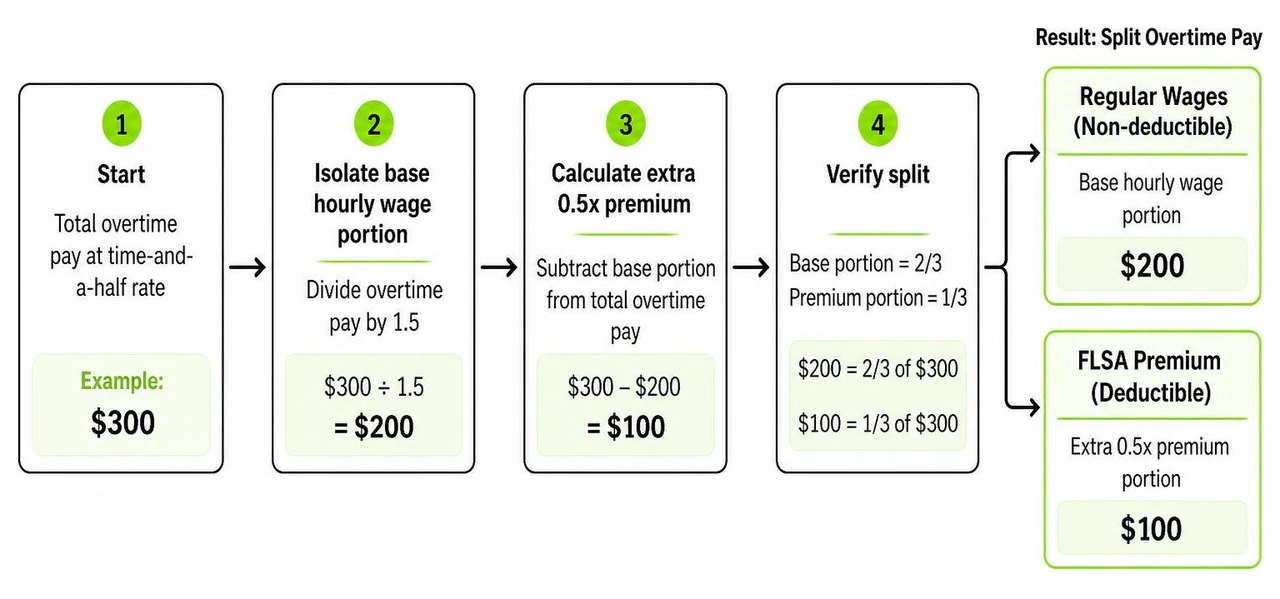
For example, if an employee with a base rate of $20 per hour works 50 hours in a workweek, they earn 40 hours of straight time at $20 ($800) and 10 hours of overtime at $30 per hour ($300). The total gross pay is $1,100. Out of the $300 overtime pay, $200 corresponds to the base hourly wage, while $100 represents the extra 0.5x premium. That $100 is the exact figure that qualifies for the federal tax deduction.
If an employee receives double-time pay under a collective bargaining agreement or employer policy, the federal deduction remains strictly capped at the 0.5x FLSA baseline. In double-time scenarios, dividing the total overtime pay by four isolates the eligible 50 percent premium. To simplify your math across varying shift rates, utilize our interactive Qualified Overtime Calculator or review the policy breakdown from the New Income Tax Deductions for Tax-Free Tips and Overtime briefing paper. You can also explore Does Overtime Get Taxed At A Higher Rate to see how withholding rules function during high-earning pay periods.
MAGI Phaseouts and Annual Deduction Limits
The maximum annual overtime tax deduction is $12,500 for single filers, Head of Household, and Married Filing Separately taxpayers. For Married Filing Jointly couples, the cap increases to $25,000.
The deduction begins to phase out at specific Modified Adjusted Gross Income thresholds. For single filers, the phaseout range starts at $150,000 MAGI and eliminates the benefit completely at $275,000. For married couples filing jointly, the phaseout range starts at $300,000 MAGI and fully eliminates the benefit at $550,000.
The phaseout reduces the allowable deduction by $100 for every $1,000 of MAGI earned above the lower threshold. For instance, a single filer with a MAGI of $170,000 sits $20,000 above the starting phaseout point. Their allowable overtime deduction shrinks by $2,000 ($100 x 20). If they earned $10,000 in qualified overtime premiums, their maximum allowed deduction for the year becomes $8,000. For an in-depth breakdown of phaseout mechanics, review Workers who log overtime can deduct up to $12,500, or $25,000 for a couple, on their 2026 return under the new tax law - The Financial Wire.
Creative Overtime Tax Savings Strategies for Employees and High Earners

Maximizing the overtime deduction requires high earners to stay below the phaseout cliffs. Because the phaseout reduces your available deduction rate as MAGI climbs, keeping your income under the $150,000 or $300,000 threshold preserves every dollar of your qualified overtime write-off.
A worker in the 22 percent federal tax bracket with $12,500 in qualified overtime premiums can save up to $2,750 in federal income taxes. If that worker hits maximum joint caps in the 22 percent bracket, savings reach $5,500. Knowing What Is The Federal Tax Rate On Overtime allows you to model your exact tax savings based on your current marginal bracket.
Creative Overtime Tax Savings Strategies Using Pre-Tax Retirement Contributions
One of the most effective creative overtime tax savings strategies for employees nearing phaseout limits is aggressive pre-tax retirement planning. Contributions to traditional 401k plans, 403b accounts, traditional IRAs, and Health Savings Accounts directly lower your MAGI.
For 2026, the elective deferral limit for a 401k is $24,500, with an additional $11,250 catch-up contribution permitted for taxpayers aged 60 through 63. If a single creative director or senior technician earns $165,000 in gross income, including $12,500 in qualified overtime premiums, their raw MAGI puts them right in the middle of the phaseout zone, cutting their deduction.
By contributing $18,000 to a pre-tax 401k, the employee reduces their MAGI from $165,000 down to $147,000. This brings their MAGI below the $150,000 phaseout trigger. As a result, they protect their full $12,500 overtime premium deduction while simultaneously deferring income tax on their retirement savings. For step-by-step guidance on implementing pre-tax adjustments, check out our complete No Tax Overtime Guide 2026.
Taxpayers can also stack this above the line overtime deduction on Schedule 1-A directly on top of the standard deduction, which for 2026 is $15,750 for single filers and $31,500 for married couples filing jointly. This stacking effect delivers compound tax reductions without requiring itemized deductions on Schedule A. You can explore further calculations in 5 Brilliant Secrets to Master Your Overtime Pay Tax Deduction Calculation 2026 [Ultimate Guide] | mithvibe.
Concentrating Work Cycles and Alternative FLSA Periods
For creative professionals working in video production, event management, electrical infrastructure, or seasonal design, concentrating work hours into targeted weeks provides another smart opportunity.
Because FLSA overtime is calculated on a workweek basis, working 80 hours spread evenly over two weeks (40 hours per week) yields zero overtime pay. However, working 60 hours in week one and 20 hours in week two yields 20 hours of FLSA overtime in week one. The total regular hours worked remain identical, but the concentrated structure generates 20 hours of 0.5x premium pay that qualifies for the federal tax deduction.
In specialized fields like public safety, healthcare, and specialized production units, employers can utilize alternative FLSA work periods under Section 207k. A 28-day work cycle allows overtime to be computed over a longer duration, providing flexibility for shifts while maintaining clear FLSA overtime qualification.
- Group production sprints into high-hour weekly blocks
- Align project deadlines with formal FLSA workweek schedules
- Ensure non-discretionary performance bonuses are factored into the regular pay rate calculation, which naturally increases the resulting 0.5x overtime premium value
When non-discretionary project completion bonuses are paid, employers must legally retroactively recalculate the regular rate of pay across the project period. This recalculation increases the baseline regular rate, which in turn inflates the tax-deductible 0.5x overtime premium.
Business Owner Compensation and Corporate Entity Planning
Business owners who operate creative agencies, production studios, or trade firms can structure employee compensation and corporate entities to benefit on both sides of the ledger. Employers receive a full corporate income tax deduction for all overtime wages paid as ordinary and necessary business expenses under Section 162, while eligible employees claim the 0.5x premium deduction on their personal returns.
Understanding corporate wage planning requires knowing When Does The No Tax On Overtime Start and keeping up with evolving payroll guidelines.
Creative Overtime Tax Savings Strategies for S Corp Owner-Operators
For S Corporation owner-operators who perform hands-on operational work, implementing creative overtime tax savings strategies involves optimizing the balance between standard W-2 salary and FLSA nonexempt wage classification.
To qualify for the personal overtime deduction, an S Corp shareholder-employee must hold a nonexempt position under FLSA rules. If an owner legitimately qualifies as a nonexempt operational employee (such as a lead technician or hands-on designer), paying themselves FLSA-compliant overtime for hours logged over 40 per week creates a valuable tax strategy.
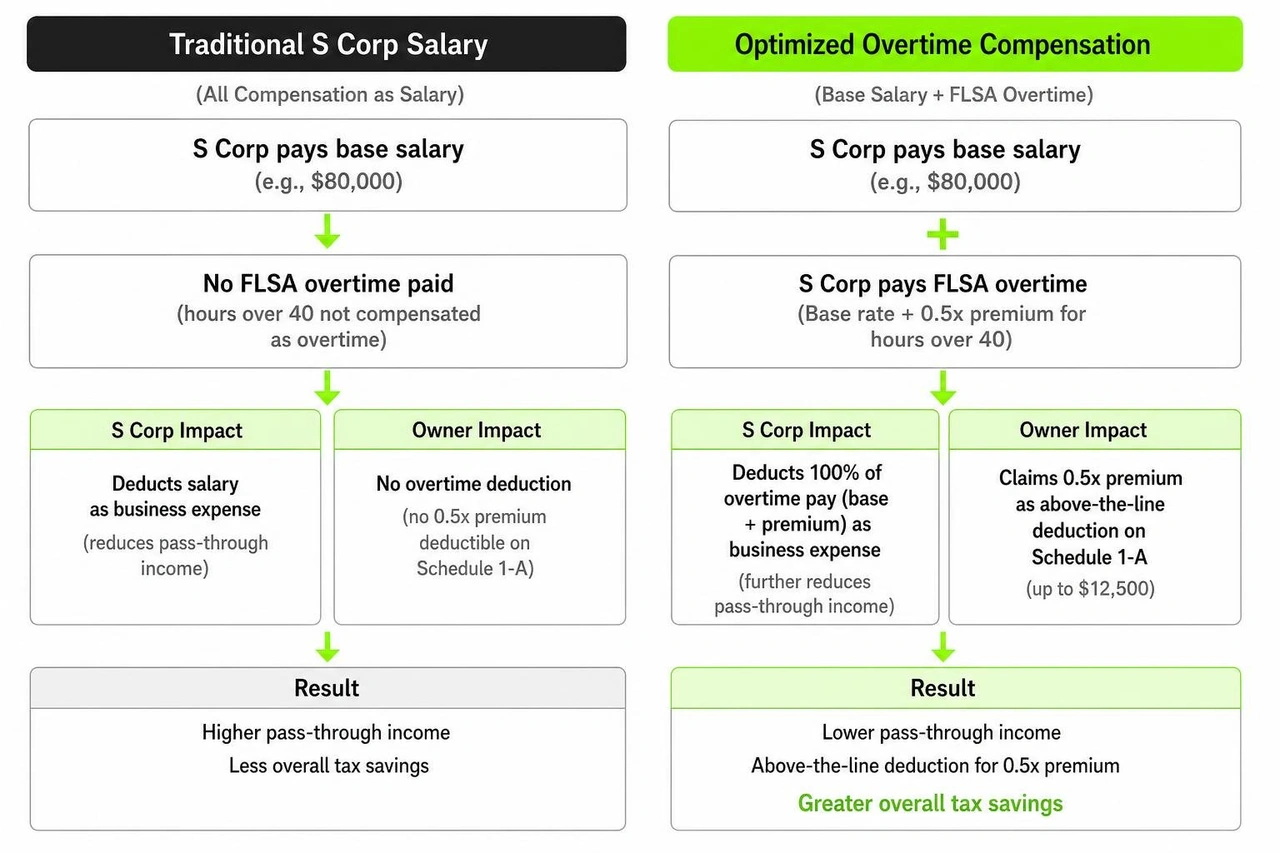
For example, consider an S Corp owner drawing a reasonable base salary of $80,000 per year who logs significant operational overtime hours on client projects.
- The S Corporation deducts 100 percent of the gross overtime pay (base rate plus premium rate) as an ordinary business expense on Form 1120-S, reducing corporate net pass-through income.
- The owner receives the overtime pay as W-2 wages and claims the 0.5x premium portion as an above the line deduction on Schedule 1-A of their personal Form 1040, sheltering up to $12,500 from federal income tax.
- The lowered corporate pass-through income interacts cleanly with the Qualified Business Income (QBI) deduction under Section 199A, creating compounding tax savings across both filings.
To review an owner-operator case study, consult the Is Overtime Pay Tax Deductible Guide. Contractors can also look at specific industry examples in the Overtime Tax Deduction for Electricians | Contractor Guide | Steph's Books.
Reclassifying Salaried Staff to Hourly Nonexempt Status
Some employers consider converting salaried exempt employees to hourly nonexempt status to unlock overtime tax deductions for their team. While this can increase worker satisfaction by delivering higher take-home pay via tax savings, business owners must navigate FLSA duties tests carefully.
Exempt status under the FLSA depends strictly on three criteria, including salary level, salary basis, and actual job duties.
The Department of Labor scrutinizes compensation restructuring. Reducing an employee base pay rate to force mandatory overtime that matches their old salary is illegal. Fictitious overtime hours or artificial wage manipulation exposes businesses to back-pay liabilities, liquidated damages, and IRS penalties. Review legal warnings detailed in What Employers Need to Know About Overtime Deductions before adjusting employee roles.
W-2 Payroll Tracking and Audit Defense
To support overtime tax deductions and withstand IRS scrutiny, business owners must implement precise payroll tracking. Beginning in tax year 2025, employers are expected to track FLSA qualified overtime premiums separately and report the qualified amount on employee W-2 forms, typically in Box 14 or Box 12 using designated codes.
IRS Notice 2025-62 provided transition penalty relief for employers during the 2025 tax year, permitting reasonable estimation methods when updating payroll software. However, for 2026 and beyond, full payroll compliance is required. IRS Notice 2025-69 outlines approved calculation methods (Methods A through G) for isolating the eligible 0.5x premium when regular pay includes non-discretionary bonuses or shift differentials.
Attempts to recharacterize regular wages or tips as overtime to claim tax relief carry massive audit risks. The IRS utilizes automated matching algorithms to compare reported W-2 overtime figures against industry benchmarks. If an employer misclassifies regular wages as overtime pay, the business risks losing the wage deduction, facing payroll tax adjustments, and triggering worker classification audits. For step-by-step reporting formulas, consult How Much Can Workers Save with No Tax on Overtime? (w/Examples) + FAQs.
Frequently Asked Questions About Overtime Tax Deductions
How Does the Overtime Deduction Interact With State Income Taxes
The federal overtime tax deduction under the OBBBA does not automatically apply to state income taxes. Most states decouple from federal above the line changes unless state legislation explicitly adopts the federal rule.
In states like California, New York, and Illinois, taxpayers must calculate state taxable income without deducting the federal overtime premium. Always review state specific filing instructions or consult a qualified accountant to determine whether your state allows an overtime tax deduction on your state return. You can check How To Calculate Overtime Tax Rate to see how state and federal tax withholdings differ on extra earnings.
Can Independent Contractors Claim the Overtime Tax Deduction
No, independent 1099 contractors and self-employed freelancers cannot claim the federal overtime tax deduction. The statutory language of the OBBBA limits qualified overtime compensation strictly to nonexempt employees entitled to overtime pay under Section 7 of the Fair Labor Standards Act.
Because independent contractors set their own schedules and are not subject to FLSA wage and hour protections, their earnings are classified as self-employment income rather than FLSA overtime wages. Freelancers seeking tax relief should focus on legitimate business expense deductions, home office write-offs, and retirement contributions rather than overtime deductions.
Does the Overtime Tax Break Reduce Social Security and Medicare Taxes
No, the overtime tax deduction reduces federal income tax only. Social Security tax (6.2 percent) and Medicare tax (1.45 percent) apply to every dollar of gross overtime wages earned.
Employers must continue withholding the full 7.65 percent FICA tax on all overtime pay, and employers must match that 7.65 percent contribution. Paycheck withholding tables for federal income tax also remain standard, meaning workers realize their overtime tax savings when filing Schedule 1-A with their annual tax return rather than seeing an immediate drop in payroll tax withholdings.
Conclusion
Implementing creative overtime tax savings strategies gives eligible W-2 workers and growing creative businesses a tangible way to lower federal income tax liabilities through 2028. By mastering the 0.5x FLSA premium calculation, protecting MAGI through pre-tax retirement planning, and configuring clean W-2 payroll tracking, you can capture full tax savings without creating audit risks.
At Core Group, we help creative entrepreneurs, agency owners, and growing businesses handle financial management, payroll compliance, and proactive tax strategy. Our profit-first approach ensures that your books are accurate, your payroll systems comply with evolving IRS rules, and your business saves time while keeping more of what it earns.
Whether you need to review your S Corp salary structure or set up audit-proof overtime tracking, our team is backed by our MacBook Pro guarantee to bring you complete peace of mind. To review how wage structures impact your overall tax burden, explore our comprehensive breakdown on the Overtime Tax Rate. Ready to simplify your business finances and maximize your tax write-offs? Reach out to us at Core Group today to get started.