Remote Payroll Compliance 101: Staying Legal When Your Team Works Everywhere
When Your Team Works Everywhere, Payroll Gets Complicated Fast
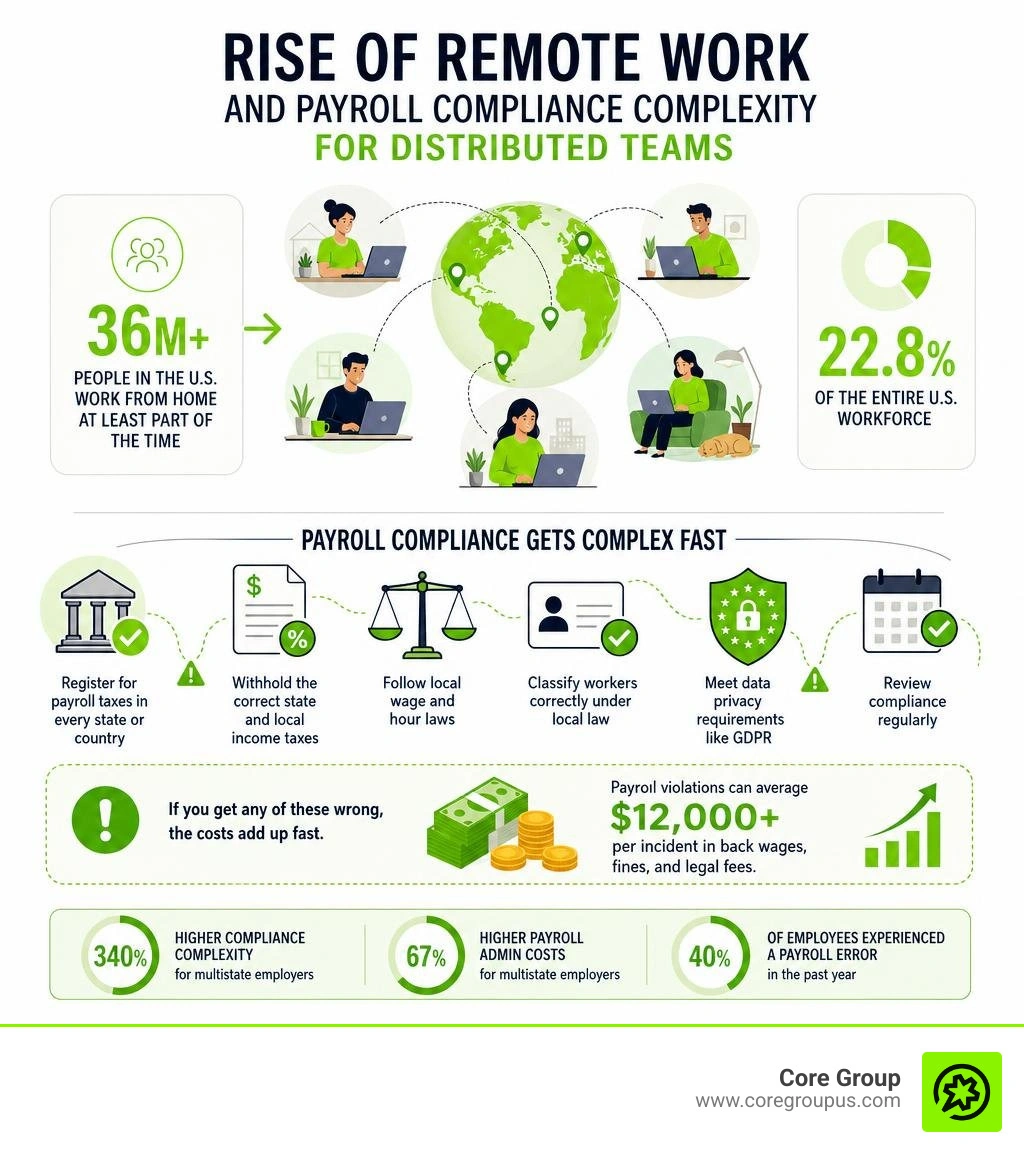
Payroll compliance for remote teams is the practice of meeting all wage, tax, and labor law obligations based on where your employees actually work, not where your business is located.
Here is what that means in practice.
- Register for payroll taxes in every state or country where a remote employee works
- Withhold the correct state and local income taxes based on the employee's work location
- Follow local wage and hour laws, including minimum wage, overtime, and paid leave rules
- Classify workers correctly as employees or independent contractors under local law
- Meet data privacy requirements like GDPR if you employ workers in the EU
- Review compliance regularly, ideally every quarter, to catch issues before they become penalties
If you get any of these wrong, the costs add up fast. Payroll violations can average $12,000 or more per incident in back wages, fines, and legal fees.
Right now, more than 36 million people in the U.S. work from home at least part of the time. That is 22.8% of the entire workforce, each potentially subject to a different set of payroll rules. For creative entrepreneurs running lean teams, this kind of complexity can sneak up on you.
The challenge is real. Multistate employers face 340% higher compliance complexity and 67% higher payroll admin costs on average compared to businesses operating in a single state. And nearly 40% of employees experienced a payroll error in the past year, which damages trust and signals deeper process problems.
This guide breaks down exactly what you need to know to stay legal, no matter where your team logs in from.
Payroll compliance for remote teams further reading
Understanding Payroll Compliance for Remote Teams and Why It Matters
When you run a traditional business with a single physical office, payroll is relatively straightforward. You set up tax withholding for your home state, follow the local minimum wage, and file your quarterly reports.
Once your team goes remote, the entire compliance landscape shifts. The legal and financial rules governing employment are almost always determined by where the employee physically sits when they perform the work. This is the core concept of remote payroll compliance.
Many business owners assume that if their company is registered in California or Delaware, they only need to follow the laws of that specific state. This is a dangerous misconception. If your software developer moves to Oregon, or your graphic designer works from their home in Ohio, your business suddenly becomes subject to the tax and employment laws of those states.
Failing to understand this distinction can result in severe consequences. You might fail to register with the correct state tax authority, withhold the wrong amount of income tax, or ignore local paid leave mandates. Beyond the immediate financial penalties, which can easily exceed $12,000 per violation, payroll errors damage the trust you have built with your team. Employees rely on accurate, timely payments. When errors occur due to compliance oversight, it hurts morale and increases turnover.
To protect your business and keep your team happy, you must build a robust system for tracking where your workers are located and understanding the specific rules that apply to them. You can learn more about managing these risks in our detailed guide on Payroll Tax Compliance.
Multi State Tax Obligations and Employment Law Challenges
Operating a distributed workforce across state lines means you are no longer a single-state employer. You are now a multistate enterprise, even if you only have a handful of employees. This transition introduces a massive amount of administrative overhead.
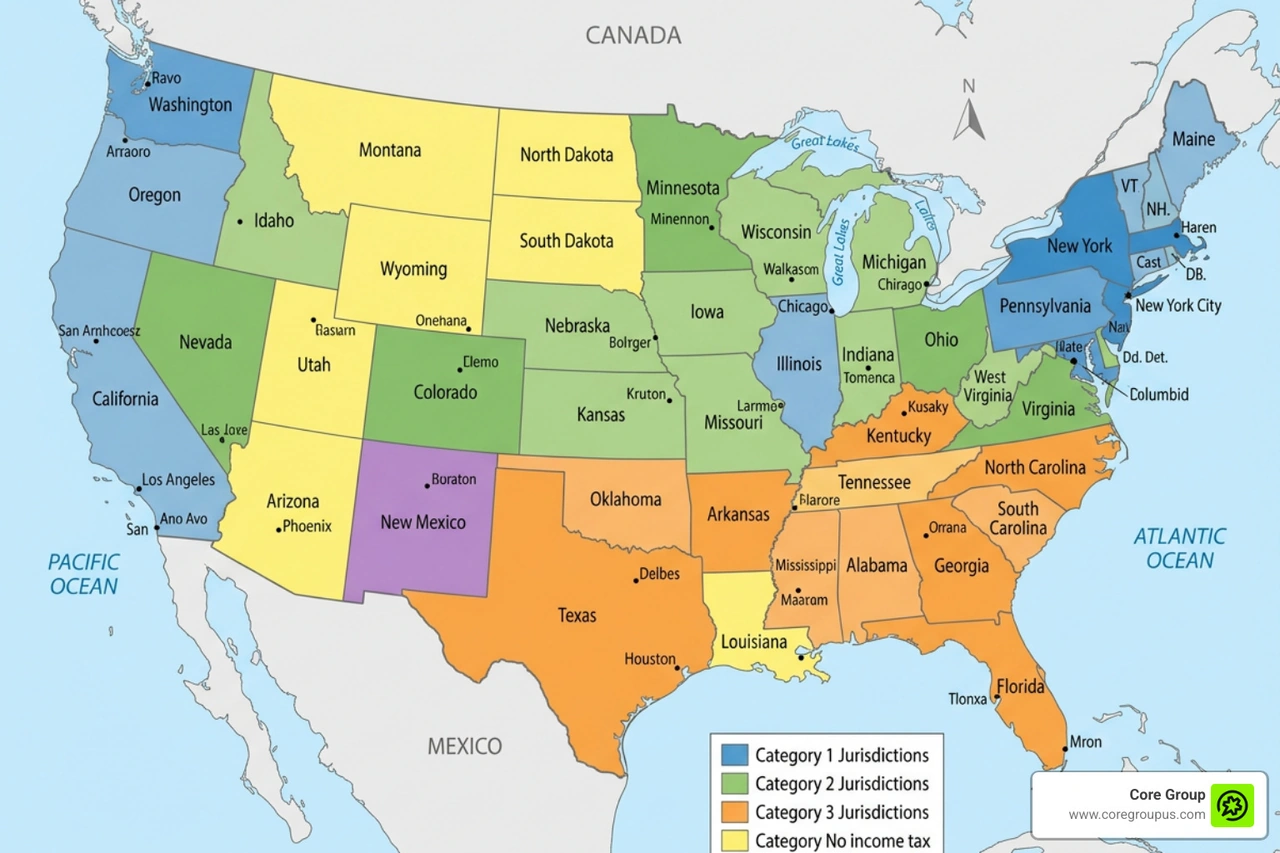
Every state has its own Department of Revenue, its own Department of Labor, and its own unique rules for payroll processing. Managing these differences is what drives the 340% increase in compliance complexity for multistate companies. If you are hiring out of state, you must review the specific Out of state employee payroll rules to ensure you are setting up your accounts correctly from day one.
The primary trigger for these rules is a legal concept known as tax nexus.
Managing State Tax Nexus and Withholding Rules
Tax nexus is the legal connection that gives a state the authority to tax your business or require you to collect taxes. Historically, nexus was triggered by having a physical office, warehouse, or retail store in a state. Today, having a single remote employee working from their living room in a state is usually enough to establish a physical presence tax nexus.
Once you have tax nexus in a state, you are generally required to
- Register your business with the state’s tax authority
- Set up a state withholding tax account
- Withhold state income taxes from the employee’s paycheck and remit them to the state
- File regular quarterly and annual payroll tax returns with that state
Some states have reciprocal tax agreements that simplify this process. For example, if an employee lives in one state but works in another, these agreements may allow you to withhold taxes only for their resident state. However, if no reciprocal agreement exists, you must track their physical work location carefully.
You must also watch out for the convenience of the employer rule. This rule, enforced by states like New York, dictates that if an employee is associated with an office in New York but chooses to work remotely from another state for their own convenience rather than out of necessity, their wages are still subject to New York state income tax. This can lead to complex double-taxation scenarios that require careful planning.
In contrast, California has its own highly detailed set of regulations. If you employ remote workers in the Golden State, you must navigate local minimum wage variations across more than 40 jurisdictions, mandatory meal breaks, and strict expense reimbursement laws. You can find specialized support for these rules in our Payroll Services California Guide.
Unemployment Insurance and Workers Compensation Across Borders
State income tax is only one part of the puzzle. You must also manage State Unemployment Insurance, often called SUI or SUTA, and Workers’ Compensation insurance for every state where your remote employees work.
SUI rates vary wildly from state to state, ranging from under 1% to over 10% of taxable wages. When you hire your first employee in a new state, you must register with the state’s unemployment agency and pay the standard new employer rate for that state. To determine which state should receive unemployment taxes for an employee who travels or splits time, you must apply the standard localization test, which looks at where the work is primarily performed, where the base of operations is located, and where the employee resides.
Workers' Compensation is also mandatory in almost every state from the very first hire. You must update your insurance policy to include coverage for every state where your remote team operates. Be especially careful in states like Ohio, North Dakota, Washington, and Wyoming, which use monopolistic state funds. In these states, you cannot use private insurance and must purchase coverage directly from the state-operated fund.
Correctly Classifying Remote Workers as Employees or Contractors
One of the most common pitfalls in payroll compliance for remote teams is worker misclassification. To avoid the administrative burden of multistate payroll, some businesses simply label their remote workers as independent contractors. This is a high-risk strategy that can lead to devastating financial penalties.
Government agencies like the IRS and the Department of Labor are actively cracking down on misclassification. They use strict legal tests to determine whether a worker is truly an independent contractor or a legal employee.
The following table highlights the key differences between these two classifications.
| Feature | Legal Employee | Independent Contractor |
|---|---|---|
| Control over work | Employer decides how, when, and where the work is done | Contractor controls their own methods, schedule, and tools |
| Financial relationship | Paid a regular salary or hourly wage with guaranteed benefits | Paid per project or flat fee and submits invoices |
| Business integration | Performs core business activities central to the company operations | Performs specialized, temporary, or peripheral services |
| Tax treatment | Employer withholds income taxes and pays payroll taxes | Contractor pays their own self-employment taxes |
If you are unsure how to structure your team, you can review our Payroll Guide Small Business Owners 2026 for practical classification strategies.
Worker Classification Tests and Misclassification Risks
To classify your remote workers correctly, you must evaluate the relationship based on three core categories of control.
- Behavioral Control does the business have the right to direct and control how the worker does the task? If you provide detailed training, specify exact working hours, and require the use of specific software, the worker is likely an employee.
- Financial Control does the business control the business aspects of the worker’s job? True independent contractors typically have a significant investment in their own equipment, have unreimbursed business expenses, and are free to seek other business opportunities.
- Relationship Type are there written contracts? Do you provide benefits like paid time off, health insurance, or a retirement plan? If the relationship is expected to continue indefinitely, it points toward an employment relationship.
Misclassification penalties are severe. Under the Fair Labor Standards Act and state laws, you can be held liable for unpaid overtime, back wages, unpaid unemployment taxes, and unpaid workers’ compensation premiums. Fines can easily average $50,000 or more per misclassified worker, and intentional violations can even lead to criminal charges.
Implementing Payroll Compliance for Remote Teams with Modern Software
Trying to manage all of these moving parts manually is a recipe for disaster. To stay compliant without losing your mind, you need to leverage modern, cloud-based payroll software.
A high-quality remote payroll solution should offer
- Automated tax calculations that automatically apply the correct federal, state, and local taxes based on the employee's home address
- Time-tracking integration to ensure hourly remote workers are paid accurately and in compliance with local overtime laws
- Geolocation tracking or address verification to confirm exactly where work is being performed
- Self-service portals that allow employees to update their addresses, view pay stubs, and download tax forms directly
By automating these processes, you reduce the risk of human error and free up valuable time to focus on growing your business. For more information on finding the right platform for your business size, check out our guide on SME Payroll Solutions.
International Hiring and Global Payroll Compliance
As your business grows, you might look beyond U.S. borders to find top talent. Hiring internationally opens up incredible opportunities, but it also introduces an entirely new level of complexity.

When you hire globally, U.S. labor laws no longer apply. You must comply with the local tax, labor, and benefits laws of the country where your employee lives. To understand the foundational requirements of this transition, you can consult our Payroll Services Small Business Guide.
Permanent Establishment Risks and Foreign Labor Laws
The biggest tax risk when hiring internationally is establishing a Permanent Establishment in a foreign country.
Permanent Establishment is a tax concept recognized by the OECD and governments worldwide. If a foreign tax authority decides that your remote employee’s activities create a stable, ongoing business presence in their country, they can claim the right to tax your company’s global corporate revenue. This risk is especially high if the remote employee has the authority to sign contracts or generate revenue on your behalf.
Additionally, you must navigate foreign labor laws, which are often far more protective of employees than U.S. laws. For example
- Many countries do not recognize at-will employment and require long notice periods or substantial severance payments for termination
- You may be legally required to provide specific benefits, such as mandatory health insurance, pension contributions, or 13th-month salary payments
- You must comply with local working hour limits, mandatory rest breaks, and generous paid leave policies
Global Payroll Compliance for Remote Teams and EOR Solutions
To hire international employees legally without the massive expense of setting up a local business entity in every country, many companies use an Employer of Record, or EOR.
An EOR is a third-party organization that has local legal entities established all over the world. The EOR legally employs your worker in their home country, handles all local payroll processing, tax withholding, and benefits administration, and then invoices you for the total cost plus a service fee.
Using an EOR is often the fastest and safest way to hire global talent. It keeps your business fully compliant with local labor laws, protects you from Permanent Establishment risks, and ensures your international team is paid accurately in their local currency. For U.S.-based remote teams, a similar co-employment model called a Professional Employer Organization, or PEO, can help manage multi-state compliance, though it still requires you to have a basic legal presence in those states.
Data Security and Fraud Prevention in Remote Environments
Managing payroll for a distributed team is not just a tax and legal challenge. It is also a data security and operational challenge. When payroll data, social security numbers, and banking details are transmitted across home networks and personal devices, the risk of data breaches increases exponentially.
Furthermore, the lack of direct physical oversight in remote environments can create gaps that allow fraud or administrative errors to go unnoticed.
Protecting Sensitive Employee Data and GDPR Compliance
To protect your team and your business, you must implement strict data security protocols. This is especially critical if you employ workers in the European Union, where the General Data Protection Regulation, or GDPR, imposes massive fines for data privacy violations.
To build a secure remote payroll environment, you should
- Enforce multi-factor authentication on all payroll, HR, and communication platforms
- Require the use of secure virtual private networks when accessing sensitive financial data
- Use encrypted cloud storage for all employee onboarding documents, W-4 forms, and direct deposit authorizations
- Establish clear policies regarding the use of personal devices for work activities
By prioritizing data security, you protect your business from devastating cyberattacks and build a culture of trust with your remote workforce.
Preventing Remote Work Fraud and Oversight Gaps
Remote work has also introduced unique fraud risks that employers rarely had to worry about in a traditional office setting. One emerging challenge is job outsourcing, where a remote employee secretly hires a subcontractor to do their work for them, exposing your proprietary data and systems to unauthorized third parties.
To prevent these risks and maintain operational control, you should
- Implement automated time-tracking software that integrates directly with your payroll system
- Use IP logging and activity audits to verify that employees are logging in from their approved work locations
- Establish clear segregation of duties within your finance team, ensuring that the person who approves payroll is not the same person who processes payments
- Conduct regular quarterly payroll audits to verify that all active payees correspond to verified, active employees
These internal controls help you maintain high operational standards and ensure that every dollar spent on payroll is fully accounted for.
Frequently Asked Questions About Remote Payroll
What is the biggest risk when running payroll for remote employees
The single biggest risk is non-compliance with local tax and labor laws. Because compliance obligations are based on where the employee physically works, hiring across state or national borders without proper registration can lead to massive penalties for unpaid taxes, misclassified workers, and wage violations.
How do state tax laws apply when an employee works from home
In almost all cases, state tax laws apply based on the employee's physical home address where they perform the work. You must register your business in that state, withhold the correct state and local income taxes, and pay into that state's unemployment and workers' compensation funds.
When should a company use an Employer of Record
A company should consider using an Employer of Record when they want to hire full-time employees in a foreign country where they do not have a local business entity. The EOR handles all local legal, payroll, and benefits compliance, allowing you to hire globally without the time and expense of international incorporation.
Conclusion
Managing payroll compliance for remote teams can feel like a daunting task, but it is entirely manageable when you have the right strategy and support in place. By shifting your perspective from a centralized office model to a location-based compliance model, you can build a highly talented, legally compliant distributed workforce.
Proactive compliance is always more cost-effective than reactive damage control. Conducting quarterly compliance evaluations of your employee locations, tax registrations, and worker classifications will help you catch 89% of potential issues before they turn into expensive penalties.
At Core Group, we understand the unique challenges that creative entrepreneurs face when scaling remote teams. We offer a no-fluff, profit-first playbook designed to handle your financial management, bookkeeping, and tax compliance, giving you complete peace of mind. We are so confident in our ability to streamline your operations and save you time that we back our services with our signature MacBook Pro guarantee.
If you are ready to simplify your remote payroll and focus on growing your business, we are here to help.
Get started with our payroll services small business guide 2026